Catalog of British Columbiana and Pacific Northwest Americana
Encyclopedia Cascadia Catalog contains book titles of mostly non-fiction Pacific Northwest Coast of North America Titles (primarially British Columbia, Idaho, Oregon and Washington State) in an easy-to-understand title catalog. If you see a link with this badge ONLINE CIRC it means that there is an online institution that provides free access to that title. In some cases there may be more than one institution hosting the title digitally.
| Catalog Title | Published |
|---|---|
|
Native Arts of the Columbia Plateau The Doris Swayze Bounds Collection of Native American Artifacts by Susan E. Harless, Orr Staff High Desert Museum Mbend 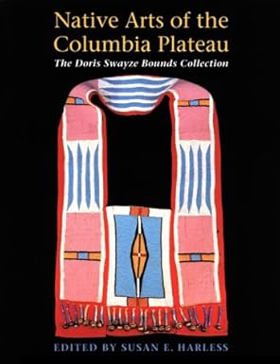
Colorfully beaded handbags, superbly tanned and decorated deerskin shirts, finely woven baskets, exquisitely beaded and fringed horse trappings -- these distinctive Native arts of the Columbia River Plateau have been overshadowed in the public eye by the arts of the Northwest Coast, Great Plains, and American Southwest. But Indians in the region where present-day Washington, Oregon, and Idaho share boundaries have for centuries combined function and beauty in the items they made for even the most mundane of uses, and their traditional arts are still vital today. This book brings overdue recognition to the artistry and craftsmanship of the Plateau Indians by focusing on the remarkable collection amassed by the late Doris Swayze Bounds, a banker in Hermiston, Oregon, who grew up with and deeply loved Native people and their culture. She was loved in return, and many of the nearly 1,000 Plateau items in her collection came to her as gifts from her Indian friends, who expressed their respect and affection through the time-honored tradition of gift-giving. Exposed to Euro-Americans relatively late, the Plateau Indians managed to retain many of their traditional lifeways of fishing, hunting, and gathering, as well as a vigorous ethic of generosity and respect for others. The pieces in the Bounds collection, which date mainly from the 1870s to the 1960s, reflect all these aspects of Plateau culture. They range from sturdy baskets made to hold roots or berries to elaborately beaded elkhide “tail dresses” worn on festive occasions. In five essays, both Native and non-Native experts describe the art styles and the uses and cultural meanings of the items; two other recount Doris Bound’s life, collecting practices, and relationships with Native Americans. The essays are handsomely illustrated with items from the Bounds collection. This book offers and introduction to this visually stunning art tradition. CIRC [ 0 ]
|
1998 |
|
Native and ornamental conifers in the Pacific Northwest identification, botany, and natural history by Elizabeth A. Price 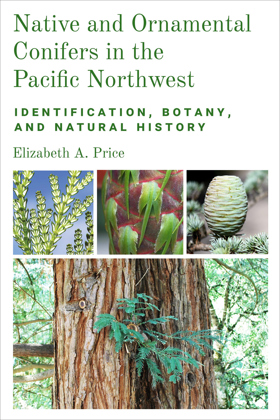
"There are a number of conifer guides available for the Pacific Northwest. Most of these guides, however, focus on native cultivars. Master gardener Elizabeth Price has put together a new guide that includes ornamentals alongside natives, arguing that most people are not necessarily concerned with distinguishing between the two, especially in a residential setting. Based on her experiences teaching workshops on conifer identification and cultivation, Price has developed identification charts that are suitable for specialists but focused on making the information as accessible as possible for amateurs. Although the book's primary goal is identification, it also weaves in natural history and a little personal narrative"-- Provided by publisher xii, 330 pages : color illustrations ; 23 cm CIRC [ 0 ]
|
2022 |
|
Native accounts of Nootka ethnography by Edward Sapir, Morris Swadesh 
This volume constitutes a continuation of Nootka Texts, Tales, and Ethnological Narratives, with Grammatical Notes and Lexical Materials, published in 1939. A third volume, Nootka Legends and Stories, is in preparation. Edward Sapir died while Nootka Texts was in press. The material for the subsequent volumes was already collected, the general plan laid out, the translation and editing begun by Sapir or by myself working under his guidance. However, a great deal remained to be carried out with- out his help. Editorial economy was a major problem. If the full body of Sapir's native Nootka collection were to be published in the manner followed in Nootka Texts, it would require eight or ten comparable volumes. Some simplification for the subsequent volumes, such as omissions of interlinear translation and linguistic commentary, were already envisaged by Sapir. However, it proved desirable to go much farther-- to adopt a terser style of translation, to limit materials given in notes, to use simple phonetic symbols which eliminate diacritics and allow more compact printing. For people familiar with Vancouver Island it has to be explained that the present materials do not come from the town of Nootka, but from the vicinity of Alberni. We say Nootka, because anthropologists are in the habit of using that term for all the west coast Indians from Alberni Canal to Kyuquot Sound. . Indiana University, 1, v. 21, no. 4, pt. 2 457 pages 26 cm CIRC [ 0 ]
|
1955 |
|
National park, city playground Mount Rainier in the twentieth century by Theodore Catton 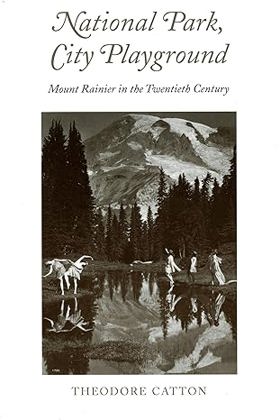
The majestic beauty of Mount Rainier, which dominates the Seattle and Tacoma skyscapes, has in many ways defined the Pacific Northwest. At the same time, those two major cities have strongly influenced the development of Rainier as a national park. From the late 1890s, when the Pacific Forest Reserve became Mount Rainier National Park, the evolving relationship between the mountain and its surrounding residents has told a history of the region itself. That story also describes the changing nature of our national park system. From the late nineteenth century to the present, park service representatives and other officials have created policies, built roads and hotels, and regulated public use of and access to Mount Rainier. Conflicting interests have shaped the decision-making process and characterized human interaction with the park. The Rainier National Park Company promoted Paradise Inn as a destination resort for East Coast tourists; Cooperative Campers of the Pacific Northwest developed backcountry camps for working-class recreationists; Asahel Curtis of the Good Roads Association wanted a road encircling the mountain; The Mountaineers promoted free public campgrounds and a roadless preserve; others focused on managing and protecting the upper mountain. The National Park Service mediated among the various parties while developing their own master plan for the park. In an engaging and accessible style, historian Theodore Catton tells the story of Mount Rainier, examining the controversies and compromises that have shaped one of America's most beautiful and beloved parks. National Park, City Playground reminds us that the way we manage our wilderness areas is a vital concern not only for the National Park Service, but for all citizens. ix, 236 pages, 16 unnumbered pages of plates : illustrations, maps ; 23 cm CIRC [ 0 ]
|
2006 |
|
Narrative of the exploring expedition to the Rocky Mountains in the year 1842 And to Oregon and North California in the years 1843-44 by John C. Fremont 
Published together in 1846 for a British readership, these reports of two westward expeditions shed light on the challenges of exploration in nineteenth-century North America. Led by the army officer and future presidential candidate John Charles Frémont (1813-90), who became known as 'the Pathfinder', the first expedition ranged west of the Missouri River, while the second pushed beyond the Rocky Mountains, north to Fort Vancouver and then south into Mexican-held California. Frémont's detailed accounts are accessible to the non-specialist: this edition omits 'only the portions which are altogether astronomical, scientific, and philosophical, and, therefore, not adapted for general utility'. When originally published separately in 1843 and 1845, the narratives enthused a great many Americans, encouraging them to migrate west by providing stirring inspiration, valuable maps and practical information. Frémont's words and deeds remain of interest in the debate surrounding the 'manifest destiny' of the United States. 186 pages ; 24 cm ONLINE CIRC [ 1 ]
|
1846 |
|
Narrative of a Voyage to the Northwest Coast of America in the Years 1811, 1812, 1813, and 1814 The First American Settlement on the Pacific by Gabriel Franchère, translated by J.V. Huntington
The author, a Canadian, was one of the party sent out by John Jacob Astor to establish his colony at Astoria and he describes the voyage up the Columbia 376 pages, 4 unnumbered leaves of plates + 8 unnumbered pages of publisher's advertisements : frontispiece, illustrations (plates) ; 19 cm ONLINE CIRC [ 1 ]
|
1854 |
|
Narrative of a journey across the Rocky Mountains to the Columbia River by John Kirk Townsend 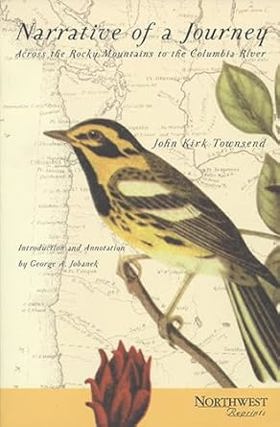
"The Narrative chronicles a journey of discovery by the first trained naturalist to cross the American continent. As a member of Nathaniel Wyeth's 1834 expedition to the Oregon country, John Kirk Townsend journeyed west through a "rich and unexplored region" that offered scientists an "almost inexhaustible field of study". Townsend's account of his travels is an engaging, personal record of the first transcontinental trek along the route that would soon become the Oregon Trail." "The Wyeth expedition was a venture that united commerce, religion, and science. Among the company's seventy men was Jason Lee, the first American missionary to the Oregon Country, and Thomas Nuttall, the renowned English botanist. It was Nuttall who invited Townsend, a young ornithologist, to join the expedition. The Narrative documents the expedition's role in the opening of the West and records the author's scientific contributions." "This Northwest Reprints edition of the Narrative restores the original full text, including Townsend's account of his two years at Fort Vancouver on the Columbia River and of his return home by way of the Hawaiian Islands and Chile. Also included is the original scientific appendix of bird and mammal life. George Jobanek's introduction provides a new appreciation of Townsend's accomplishments, and of his role as a scientific explorer in a new land."--Jacket xxix, 290 pages ; 23 cm. CIRC [ 0 ]
|
1999 |
|
Narcissa Whitman pioneer of Oregon by Jeanette Eaton , Woodi Ishmael (Illustrator), Cairns Collection of American Women Writers
Focuses on events from youth of a missionary who was the first white woman to cross the Rocky Mountains 5 unnumbered preliminary leaves of plates, pages 3-318 : illustrations, map ; 23 cm CIRC [ 1 ]
|
1941 |
|
Nanaimo retrospective the first century by E. Blanche Norcross, Nanaimo Historical Society 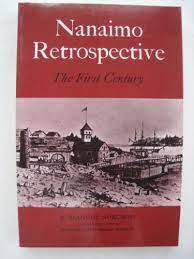
Edited by E. Blanche Norcross and published by the Nanaimo Historical Society, Nanaimo Retrospective: The First Century offers a scholarly yet accessible chronicle of the region's formative hundred years. The volume carefully examines the area's early industrial development, including coal mining and logging, alongside the intricate social dynamics between Indigenous communities and diverse waves of immigrants. Drawing upon archival materials and historical photographs, the text provides researchers and local history enthusiasts with a comprehensive foundational study of the municipality's evolution. xxi, 169 p., [28] p. of plates : ill., map, ports. ; 23 cm. CIRC [ 1 ]
|
1996 |
|
Nanaimo the harbour city by Goody Niosi, Terry Patterson 
Published in 2004, Nanaimo: The Harbour City is an engaging travel guide and visual keepsake written by Goody Niosi with photography by Terry Patterson. The book chronicles the history and cultural evolution of this Vancouver Island community, tracing its growth from an early Aboriginal settlement into a thriving, modern port city. Alongside Patterson's vibrant images of the bustling harbour and local seascape, Niosi provides readers with detailed walking tours of historic neighborhoods and insights into the area's natural beauty. It serves as both a practical resource for travelers and a colorful celebration of Nanaimo's unique coastal heritage. 112 pages : illustrations (chiefly color), 1 color map, portraits ; 28 cm CIRC [ 1 ]
|
2004 |
|
Naming, opening, and dedication of Stanley Park, Vancouver, Canada, 1888-1889 by Archives of Vancouver Society 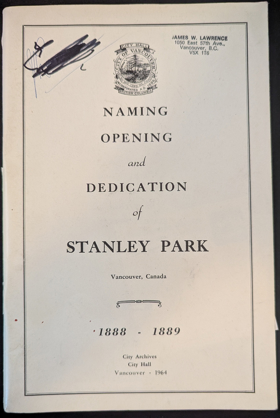
With the compliments of the Commissioners of the Park Board, past and present. On the seventy-fifth anniversary of the dedication of Stanley Park, 1889. 60 pages illustrations 23 cm CIRC [ 1 ]
|
1964 |
|
Names of Idaho Counties by Lalla Phipps Boone
Article from Names publication in 1968 where author discusses the origin of Idaho County names. pp 19-26 CIRC [ 1 ]
|
1968 |
|
Names and places studies in geographical and topographical nomenclature by J. D. Whitney
Published in 1888, Josiah Dwight Whitney’s Names and Places: Studies in Geographical and Topographical Nomenclature offers a pioneering scholarly examination of the origins, evolution, and cultural significance of place names across the expanding American landscape. Drawing on his extensive experience directing the California Geological Survey, Whitney analyzes how Indigenous appellations, Spanish colonial titles, and subsequent Anglo-American designations were layered, corrupted, or erased as the western frontier was systematically mapped. The text critiques the often arbitrary or politically motivated naming practices of early explorers, miners, and surveyors, advocating for a more rigorous and scientifically accurate approach to standardizing geographic markers. A keen insight drawn from the text is how Whitney’s linguistic study inadvertently reveals the imperial power dynamics inherent in cartography; by documenting the systematic replacement or anglicization of Indigenous toponyms, the book illustrates how the bureaucratic act of naming functioned as a definitive tool of cultural conquest, literally overwriting native geographies to assert and legitimize white territorial control. 239 pages 18 cm ONLINE CIRC [ 1 ]
|
1888 |
|
Namely Vancouver the hidden history of Vancouver place names by Tom Snyders, Jennifer O'Rourke 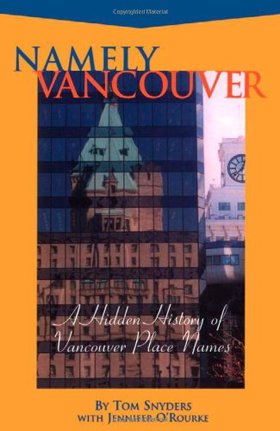
Namely Vancouver traces the fascinating origins and history of Greater Vancouver's place names--its streets, neighbourhoods, waterways, mountains, boroughs, and buildings, among others, in an illustrated historical glossary that takes you behind the ubiquitous signs and symbols, and provides a unique vantage point on the city. For instance, Commercial Drive was originally named Park Drive, as it abutted Clark Park in East Vancouver. As part of the route of the Vancouver-New Westminster interurban railway, Park Drive attracted a lot of new businesses; so much so, that in 1912 it was renamed Commercial Drive. There seems to be no truth to the rumour that Gassy Jack Deighton was so named for his frequent passing of wind. Rather, this instrumental figure in Vancouver's early history--the original site of his pub still forms the division between east and west streets in the city--was named for his windbag tendencies, and the legacy of this saloon keeper lives on in the name of historic Gastown. While many of Vancouver's early surveyors, mayors, and even saloon keepers had the honour of having streets or neighbourhoods named after them, John Morton had a slightly more dubious distinction. As one of the "three greenhorns," Morton went down in history as one of Vancouver's earliest settlers. In return, one of Vancouver's shortest streets is named after him. Lulu Island is named after Lulu Sweet, an actress with a travelling theatre company. Colonel Moody (of Port Moody fame) was smitten with Miss Lulu, and named the island, now known as Richmond, after her. An unorthodox and revealing guide, Namely Vancouver is an ideal book for tourists and Vancouverites alike. Includes numerous historical and contemporary B&W photographs. 299 pages : illustrations ; 23 cm CIRC [ 1 ]
|
2001 |
|
Naked in the woods my unexpected years in a hippie commune by Margaret Grundstein 
"In 1970, Margaret Grundstein abandoned her graduate degree at Yale and followed her husband, an Indonesian prince and community activist, to a commune in the backwoods of Oregon. Together with ten friends and an ever-changing mix of strangers, they began to build their vision of utopia. Naked in the Woods chronicles Grundstein's shift from reluctant hippie to committed utopian--sacrificing phones, electricity, and running water to live on 160 acres of remote forest with nothing but a drafty cabin and each other. Grundstein, (whose husband left, seduced by "freer love") faced tough choices. Could she make it as a single woman in man's country? Did she still want to? How committed was she to her new life? Although she reveled in the shared transcendence of communal life deep in the natural world, disillusionment slowly eroded the dream. Brotherhood frayed when food became scarce. Rifts formed over land ownership. Dogma and reality clashed. Many people, baby boomers and millennials alike, have romantic notions about the 1960s and 70s. Grundstein's vivid account offers an unflinching, authentic portrait of this iconic and often misreported time in American history. Accompanied by a collection of distinctive photographs she took at the time, Naked in the Woods draws readers into a period of convulsive social change and raises timeless questions: how far must we venture to find the meaning we seek, and is it ever far out enough to escape our ingrained human nature?"-- Provided by publisher 212 pages : illustrations ; 23 cm CIRC [ 0 ]
|
2015 |
|
Naked against the rain the people of the lower Columbia River, 1770-1830 by Rick Rubin 
Thanks in large part to the abundant salmon runs the Chinook–speakers residing along the lower Columbia River were among the wealthiest in North America. Master fisherman and expert canoeists it was not uncommon for a single canoe and crew to net two tons of succulent Chinook salmon on a single outgoing tide. A thickset people with artificially flattened heads, anarchistic politics, and a highly stratified society, they spoke a language unconnected to any known language on earth. Yet despite all their wealth and accomplishments they were all but completely wiped out in a few short decades after whites first landed on their shores. Rubin conveys information about the people's daily life, spiritual beliefs, mythologies, and how the introduction of white settlers into the region forever changed their culture. 431 pages : illustrations ; 24 cm CIRC [ 0 ]
|
1999 |
|
Myths of the Alsea Indians of northwestern Oregon by Leo Joachim Frachtenberg
Published in 1920 by anthropologist Leo Joachim Frachtenberg, Myths of the Alsea Indians of Northwestern Oregon is a vital ethnographic compilation preserving the oral traditions and linguistic structures of the heavily displaced Alsea people. Working under the auspices of the Bureau of American Ethnology during the frantic era of "salvage anthropology," Frachtenberg meticulously transcribed cosmologies, animal tales, and cultural taboos directly from some of the tribe's very last fluent speakers. The resulting volume serves as both a dense linguistic archive and a haunting cultural repository of a complex coastal civilization that had been systematically decimated by disease and forced relocation to the Siletz Reservation. A keen insight drawn from the work is how early twentieth-century ethnography often functioned as a bureaucratic autopsy of the very cultures the federal government was actively extinguishing; by transforming the sacred, living oral traditions of the Alsea into sterile, standardized data for state archives, anthropologists inadvertently completed a final act of colonial extraction, mining Indigenous intellectual wealth only after the physical communities had been thoroughly marginalized. pages 64-75 ONLINE CIRC [ 2 ]
|
1917 |
|
Mysterious San Juan Island by Joseph Reigel 
Few places could hope to rival the rich history of Washington's San Juan Island. From the famed Pig War to the secretive "kingdom" at Roche Harbor, the island has played host to countless remarkable stories. Like any other historical place, however, there are some tales that the textbooks tend to omit; tales like the terrifying "Cry Baby House," or the subterranean sasquatch said to stalk the woods around Cady Mountain. With the aid of articles, first-hand accounts, and period photographs, Mysterious San Juan Island attempts to document this strange side of San Juan history-and to ensure that the island's campfire stories remain suitably spooky for years to come. CIRC [ 0 ]
|
2025 |
|
My, how time flies by George Hunsby
|
1977 |
|
My paddle's keen and bright summer camp stories by Rika Ruebsaat 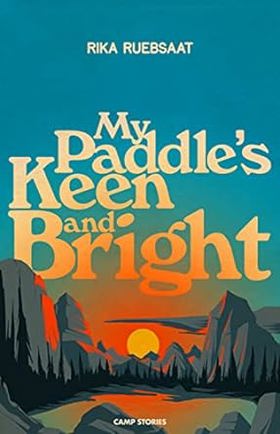
"Parents began sending their kids off to summer camp more than a century ago, a tradition that continues strong in the face of transformative changes to society, and childhood. The history of summer camping, with its roots in Boy Scouts and other Victorian-era social movements, is beginning to be written. But until now, less has been said about the experiences of the generations of young men and women whose outlook has been shaped by their summer vacations. In My Paddle's Keen and Bright, Rika Ruebsaat allows the camp veterans of all ages and backgrounds to reflect on their experiences, and the indelible lifelong impressions these have left on them. Every facet of camp experience is described, from the bus or boat that takes you away from the familiars into a new world of strangers, to the bittersweet partings and memories lasting a lifetime. Campers describe the terror, and exhilaration, of learning about new people and different lives outside of their own families; the food, strange rituals, and exciting new adventures involving boats, or horses, or hikes, chores, even practical jokes. Here are the vivid recollections of passionate friendships made in the course of a few days; of crushes on counsellors; the campfires and songs; the first fumbling sexual explorations; the skinned knees and overcome fears; the lessons learned and carried for the rest of their lives. Grown-ups from all social classes and outloooks established summer camps. The storytellers reflect on their experiences in the more traditional summer camps organized by Boy Scouts or Girl Guides; the camps organized by religious organizations or around political viewpoints. The differences - and, more often, the continuities - provide a fascinating and unique perspective into a world that continues to leave an indelible mark on society, even as the world of summer camp slips into history."-- Provided by publisher xii, 287 pages ; 22 cm CIRC [ 0 ]
|
2023 |
|
My name is LaMoosh by Linda Meanus , Oregon State University Press (Publisher), Confluence Project (Publisher) 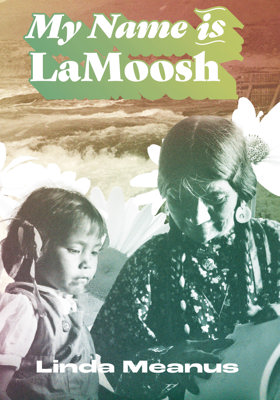
"My Name is LaMoosh is the life story of Warm Springs Tribal Elder Linda Meanus. She grew up with her grandma Flora Thompson and grandpa Chief Tommy Thompson near Celilo Falls, a mighty fishery on the Columbia that was flooded in 1957 by the construction of The Dalles Dam. Linda persevered through this historic trauma and life's challenges to teach young people about the Indigenous ways of the Columbia River. Intended for early readers to learn more about Native American history through a first-hand account, the book is also a reminder that Indigenous people continue to maintain a cultural connection to the land and river that gave them their identity. My Name is LaMoosh includes fact boxes that provide historical, cultural, and environmental context for Linda's personal story. Hundreds of books exist about Lewis and Clark and their journey of "discovery." This book balances our understanding of American history with the long-neglected voices of Indigenous people. Linda's story is not just about historic trauma but also about resilience, perseverance, and reciprocity."-- Provided by publisher 95 pages : illustrations, maps, portraits ; 26 cm CIRC [ 0 ]
|
2023 |
|
My memories by Philip A. Matson 
A collection of memories of growing up and beyond in Marshfield, Oregon during the midtwentieth century. 158 pages : illustrations, facsimiles, portraits ; 28 cm CIRC [ 1 ]
|
2012 |
|
My life reminiscences of a Grand Ronde Reservation childhood ; a text in Tualatin Northern Kalapuya by Louis Kenoyer , Jedd Schrock (Translator), Henry Benjamin Zenk (Translator) 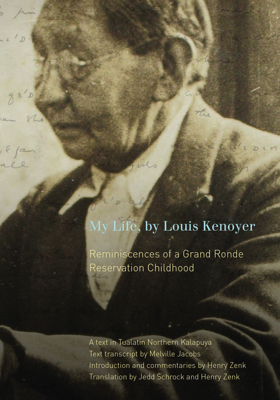
My Life, by Louis Kenoyer was dictated in Tualatin Northern Kalapuya by Louis Kenoyer, the last known speaker of that language. A rare, first-person narrative by a Native American describing life on an Oregon reservation, Kenoyer's account tells the story of his childhood on the late-nineteenth century Grand Ronde Reservation. It includes compelling descriptions of daily life in the reservation community, capturing the intermingling of new Euro-American ways with persisting indigenous beliefs and practices. The first quarter of the narrative was dictated to Jaime de Angulo and L. S. Freeland in 1928, the remainder to Melville Jacobs in 1936. Louis Kenoyer died in 1937, before Jacobs could complete a translation with him. Jacobs subsequently prepared a transcript from the translated portions of the text, but the last quarter of the complete narrative remained untranslated until now. Henry Zenk and Jedd Schrock drew on the previously translated portions of the narrative, as well as on available supporting linguistic, ethnographic, and historical documentation, to complete the work for this volume. The result is a complete bilingual English-Tualatin text, accompanied by extensive notes and commentary providing historical and ethnographic context. Louis Kenoyer (baχawádas) was born in 1868 at Grand Ronde Reservation, Oregon. He died in 1937 at Yakama Reservation, Washington. ix, 326 pages : illustrations, maps ; 26 cm CIRC [ 0 ]
|
2017 |
|
My Ain folk Denman Island 1875-1975 by Winnifred A. Isbister
|
1976 |
|
Mushrooms of Idaho and the Pacific Northwest. Vol 2, Non-gilled hymenomycetes by Edmond E. Tylutki 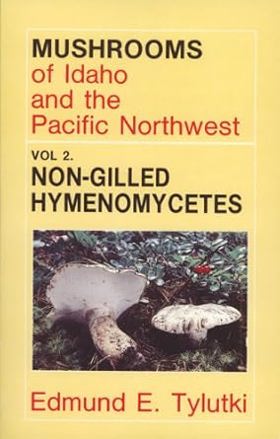
Valuable and complete information is provided for 354 species of non-gilled mushrooms in the Northwest, including 119 species of boletes, 119 coral fungi, 12 chanterelles, 121 polypores, and 50 spine fungi. Field and technical keys for the determination of species, along with descriptions and black & white photographs. CIRC [ 0 ]
|
1987 |