Catalog of British Columbiana and Pacific Northwest Americana
Encyclopedia Cascadia Catalog contains book titles of mostly non-fiction Pacific Northwest Coast of North America Titles (primarially British Columbia, Idaho, Oregon and Washington State) in an easy-to-understand title catalog. If you see a link with this badge ONLINE CIRC it means that there is an online institution that provides free access to that title. In some cases there may be more than one institution hosting the title digitally.
| Catalog Title | Published |
|---|---|
|
The Nez Perce Indians and the opening of the Northwest by Alvin M. Josephy 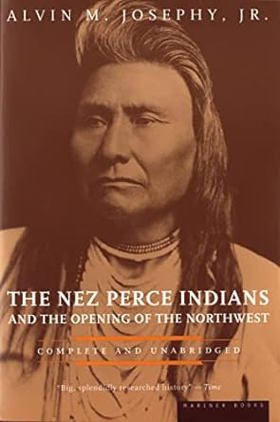
This is the story of the so-called Inland Empire of teh Northwest, that rugged and majestic region bounded east and west by the Cascades and the Rockies, from the time of the great exploration of Lewis and Clark to the tragic defeat of Chief Joseph in 1877. Explorers, fur traders, miner, settlers, missionaries, ranchers and above all a unique succession of Indian chiefs and their tribespeople bring into focus one of the permanently instructive chapters in the history of the American West xx, 705 pages : illustrations, maps ; 23 cm CIRC [ 1 ]
|
1997 |
|
Snowbound by Ladd Hamilton 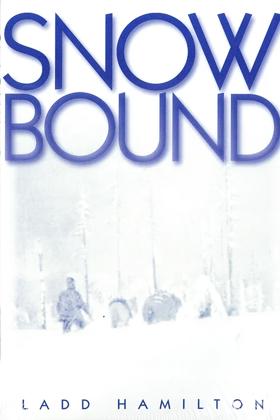
Into the untamed vastness of the Bitterroot mountains go three young New York men, their guide, and a camp cook. This is to be the adventure of a lifetime, but it is already September. Ahead of the hunters, as they make their way up the Lolo Trail, are the record snows of 1893 and a cruel, controversial decision. Snowbound is the true story of the Carlin party, whose ill luck and bad judgement drove decent men to an ethical dilemma that intrigued the nation and still can raise an argument wherever people rub shoulders with wilderness. Ladd Hamilton’s previous book for WSU Press, This Bloody Deed, detailed the story of the Magruder massacre of the 1860s in that same Idaho wilderness. The New York Times Book Review noted that “This Bloody Deed is marked by the author’s…familiarity with that rough Western terrain and his clear affection for the complex people who…roamed and tamed it.” Once again, Hamilton has brought rich narrative detail and crackling tension to an intriguing episode of Northwest history. Ladd Hamilton retired in 1987 as senior editor and columnist of the Lewiston Morning Tribune, and since then has been writing and teaching journalism at Lewis-Clark State College in Lewiston, Idaho. He and his wife Pauletta live in the Lewiston Orchards. xii, 228 pages, 8 unnumbered pages of plates : illustrations, map, portraits ; 24 cm CIRC [ 0 ]
|
1997 |
|
The Rogue River Indian War and its aftermath, 1850-1980 by E. A. Schwartz 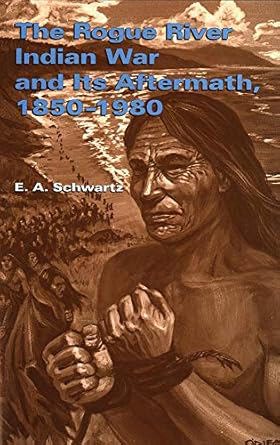
This history of the native peoples of western Oregon is a systematic study of the formation, application and effects of United States Indian policy. Historian E.A. Schwartz tells how contacts with whites early in the nineteenth century culminated in the pork-barrel Rogue River War of 1855-56, in which the Rogue River peoples demonstrated superior tactics and repeatedly drove off more-numerous opponents. Schwartz narrates how the Indian peoples known today as the Confederated Tribes of the Siletz Reservation survived American expansion and coped with each federal Indian-policy initiative, from the new western reservation policy of the 1850s through termination and restoration in the 1970s xiv, 354 pages : illustrations, maps ; 24 cm CIRC [ 0 ]
|
1997 |
|
Memories of Clear Lake by Charles R. Hyatt, Clear Lake Historical Association 
Published by the Clear Lake Historical Association and compiled by Charles R. Hyatt, Memories of Clear Lake presents a nostalgic and detailed chronicle of the historic logging, rail, and community developments around the Skagit County settlement in northwest Washington. The book compiles vintage photographs, local newspaper excerpts, and personal reminiscences to trace how a bustling timber outpost grew and shifted alongside the changing regional economy. Through these collected records, the text preserves the domestic and industrial rhythms of families who built their lives amidst towering old-growth forests and local waters. A keen insight drawn from the work is how single-industry towns experienced a unique form of community permanence even after their primary resource vanished; by documenting how residents repurposed old logging infrastructure and community spaces for long-term rural living, the narrative reveals that the true legacy of these settlements was not the timber they exported, but the stubborn social bonds forged in the shadow of the mill. vi, 105 pages : illustrations ; 22 cm CIRC [ 1 ]
|
1998 |
|
Newcastle Island a place of discovery by Bill Merilees 
Authored by naturalist and historian Bill Merilees, Newcastle Island: A Place of Discovery explores the rich natural and industrial heritage of the historic island park located off the coast of Nanaimo, British Columbia. The book traces the island's multifaceted past, from its early significance to the Snuneymuxw First Nation and its late 19th-century boom as a bustling coal-mining and sandstone-quarrying hub to its eventual transition into a beloved coastal recreation area. Through archival photographs, maps, and detailed natural history notes, the text captures how a small marine island became a microcasm of regional resource extraction and leisure. A keen insight drawn from the work is how industrial wastelands can be successfully reclaimed by nature and public memory; by documenting the physical transition from smoky coal pits to tranquil park trails, the narrative reveals that the landscape itself acts as a resilient archivist, quietly healing its extraction scars to offer new generations a sanctuary for ecological discovery. 128 pages : illustrations, facsimiles, maps, portraits ; 22 cm CIRC [ 1 ]
|
1998 |
|
José Narváez the forgotten explorer : including his narrative of a voyage on the northwest coast in 1788 by Jim McDowell
Even during his lifetime (1768-1840) was Narvaez forgotten, dying in poverty and obscurity in the Mexico he adopted as home in preference to his native Spain, but fortunately not during the high tides of his adventures in the 1780s and 1790s. Here is what is known about his voyages along the northwest coast of North America investigating the Russian movement into Alaska and searching for the Northwest Passage, and about the subsequent fate of his accounts of them. c. Book News Inc 189 pages : illustrations, maps ; 24 cm. CIRC [ 1 ]
|
1998 |
|
Handbook of North American Indians Volume 12, Plateau by William C. Sturtevant , Deward E. Walker , Smithsonian Institution 
This is part of the Smithsonian Institution’s Handbook of North American Indians series, the ultimate resource for Native American history across various regions of North America. The set is intended to give an encyclopedic summary of what is know about the prehistory, history, and cultures of the aboriginal peoples of North America north of the urban civilizations of central Mexico. Volume 12 provides a summary of what is known about the prehistory, history, and culture of the American Indians of the Plateau Culture area. This area is defined by the region in northwestern United States and southwestern Canada drained by the Columbia and Fraser rivers. The Plateau culture area includes the Interior Salishan peoples, the Sahaptian peoples, and several cultural isolates, Athapaskan outliers, and the Kootenai and Cayuse. xvi, 791 pages : illustrations, maps, portraits ; 29 cm CIRC [ 1 ]
|
1998 |
|
America's worst train disaster the 1910 Wellington tragedy by Don Moody 
Review from "True Rail Stories" "America's Worst Train Disaster may be about a terrible event back in 1910, but it makes wonderful reading for lovers of steam railroads. It tells of the business pressures driving decisions, decisions that ultimately resulted in over 96 deaths when an avalanche swept a mail and a passenger train down a deep gorge in Washington. According to the author, the trains were trapped in a snowstorm because the railroad undergoing evaluation for a mail contract. Besides that, the railroad also failed to move the trains to a siding which would have saved them from the avalanche. You will find a lot of description of railroad equipment. For example, ever hear of an articulated engine?- one that had a pivot to let it bend in the middle on sharp curves. Of course, there is considerable discussion of equipment and techniques of snow removal. Perhaps you have forgotten that not only passenger trains carried conductors, and the size of snow shoveling crews will amaze you. The book also contains news stories about the trapped trains, the disaster and even good quality photos taken during recovery operations by a newspaper photographer covering the sensational accident. The book contains a view of politics in the days when railroads had the power to mold laws to their liking. Moody obviously feels some of the animosity most people felt toward railroad tycoons. He particularly takes James J. Hill, the founder of the Great Northern Railway to task and suggests that Hill that arranged for the death count to be misstated on the low side. Moody lets no one off the hook in his discussion of the tragedy. He details wild stories newspaper reporters made up about the accident scene in an attempt to stimulate circulation. He tells of social biases against immigrants and uncomplimentary names used to describe foreign workers - not in private conversations but in newspaper columns too. The book does contain typos and errors that may distract the reader, but all in all, Moody did a good job. If railroads are your thing, this book belongs in your collection. 184 pages : illustrations, maps ; 23 cm CIRC [ 1 ]
|
1998 |
|
A maritime history of central Whidbey Island. Part 1, The sinking of the Calista by Roger M. Sherman 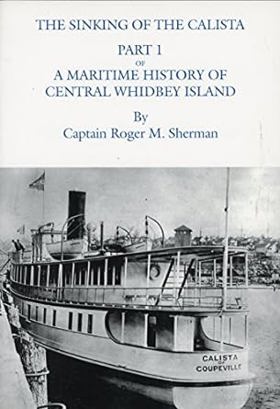
Authored by maritime historian Roger M. Sherman, A Maritime History of Central Whidbey Island, Part 1: The sinking of the Calista details the dramatic local shipping losses and aquatic commerce that shaped the marine highway of Washington's Puget Sound. The volume centers on the fateful shipwreck of the steamer Calista, exploring the intricate mechanics of early 20th-century coastal navigation, passenger travel, and the relentless dangers posed by shifting winds and hidden reefs. Through detailed archival research, contemporary newspaper accounts, and maritime logs, the text brings to light the perilous conditions faced by the small vessels that served as the primary lifeblood of island communities. A keen insight drawn from the work is how maritime disasters served as tragic catalysts for regulatory and technological reform in inland sea transport; the loss of vessels like the Calista forced an unyielding reckoning with corporate safety standards, transforming public attitudes toward the accountability of commercial navigation lines operating in dangerous Pacific Northwest waters. xii, 144 pages : illustrations, maps ; 26 cm CIRC [ 1 ]
|
1998 |
|
Legends of the Cowlitz Indian tribe by Roy I. Wilson 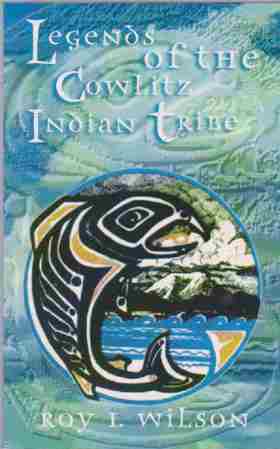
Authored by tribal elder and historian Roy I. Wilson, Legends of the Cowlitz Indian Tribe preserves the sacred oral literature, historical memory, and traditional values of the Cowlitz people of southwest Washington. The volume compiles foundational creation narratives, animal fables, and cultural teachings that explain the spiritual and physical geography of the river valleys and mountain passes sacred to the tribe. Through these transcribed stories, the text honors an ancient literary heritage that connects contemporary generations to their ancestral homelands and customary laws. A keen insight drawn from the work is how indigenous oral narratives function as enduring frameworks for tribal sovereignty; by binding specific geographical landmarks to moral and historical laws, the legends established an unwritten title to the land that colonial mapping could neither erase nor replace. 401 pages ; 21 cm CIRC [ 1 ]
|
1998 |
|
Washington's Westport by Ruth McCausland 
Authored by local historian Ruth McCausland, Washington’s Westport chronicles the dramatic transformation of the coastal Pacific Northwest town from a remote, seasonal fishing camp into a bustling commercial harbor and tourist destination. The book draws on vintage photographs, local archives, and personal interviews to detail the hazardous maritime conditions, resilient fishing families, and cannery operations that sustained the isolated community at the mouth of Grays Harbor. Through its vivid pictorial and narrative layout, the text captures the grit required to build a permanent settlement on a shifting, wave-battered spit of land. A keen insight drawn from the work is how coastal outposts maintained an uneasy economic dualism; by relying simultaneously on the volatile fortunes of commercial deep-sea fishing and the fleeting whims of summer tourists, towns like Westport were forced to constantly reinvent their identity to survive the unpredictable rhythms of the Pacific Ocean. 192 pages : illustrations, map ; 26 cm CIRC [ 1 ]
|
1998 |
|
Indians in the making ethnic relations and Indian identities around Puget Sound by Alexandra Harmon 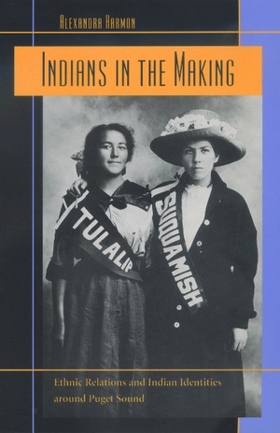
In the Puget Sound region of Washington state, indigenous peoples and their descendants have a long history of interaction with settlers and their descendants. Indians in the Making offers the first comprehensive account of these meetings, from the land-based fur trade of the 1820s to the Indian fishing rights activism of the 1970s. Thoroughly researched and theoretically sophisticated, this history shows how notions of Indian identity - both Indian and non-Indian - changed as relations changed. In the Puget Sound region of Washington state, indigenous peoples and their descendants have a long history of interaction with settlers and their descendants. Indians in the Making offers the first comprehensive account of these interactions, from contact with traders of the 1820s to the Indian fishing rights activism of the 1970s. In this thoroughly researched history, Alexandra Harmon also provides a theoretically sophisticated analysis that charts shifting notions of Indian identity, both in native and in nonnative communities. During the period under consideration, each major shift in demographic, economic, and political conditions precipitated new deliberations about how to distinguish Indians from non-Indians and from each other. By chronicling such dialogues over 150 years, this groundbreaking study reveals that Indian identity has a complex history. Examining relations in various spheres of lifelabor, public ceremony, marriage and kinship, politics and law. Harmon shows how Indians have continually redefined themselves. Her focus on the negotiations that have given rise to modern Indian identity makes a significant contribution to the discourse of contemporary multiculturalism and ethnic studies. xii, 393 pages : illustrations, maps ; 24 cm. CIRC [ 0 ]
|
1998 |
|
North Bank claiming a place on the Rogue by Robin Carey 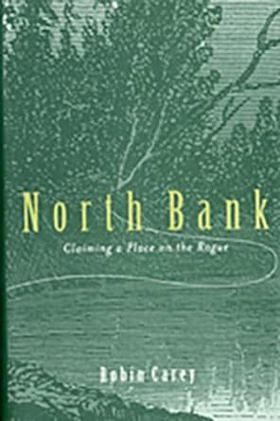
It was a fly fisher's dream - a cabin on the lower Rogue River in southern Oregon. But for Robin Carey, this new home also meant learning a new home river. In North Bank, Carey explores how new places gradually become familiar. His engaging essays describe how old memories - of family, of certain fish, of other rivers - and fresh experiences - scouting river canyons, volunteering at a fish hatchery, remodeling the cabin - have combined to shape this place on the Rogue into a place he calls home. That process, of creating home ground in a new place, is the subject of North Bank, a rich and poignant look at fly fishing, favorite rivers, and the desire for familiar landscapes 122 pages : illustrations ; 24 cm CIRC [ 1 ]
|
1998 |
|
Mainstays women who shaped BC by Cathy Converse 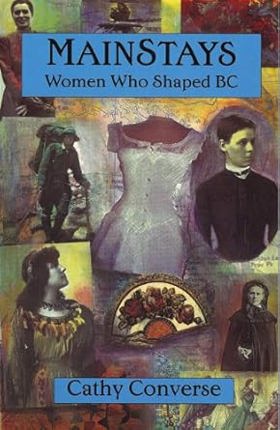
We all know that there have been women in British Columbia since the early days, and they were not just ironing shirts and baking bread. They organized unions, won elections, started schools and hospitals and became judges, scientists, artists and doctors. BC has benefited from a long tradition of energetic women who have had an impact on the province as we know it. The twenty women profiled in this book didn't all succeed in everything they attempted, but they were flexible, saw what needed to be done and just did it. xi, 212 pages : illustrations, portraits ; 22 cm CIRC [ 0 ]
|
1998 |
|
Cecil Andrus politics western style by Cecil D. Andrus, Joel Connelly 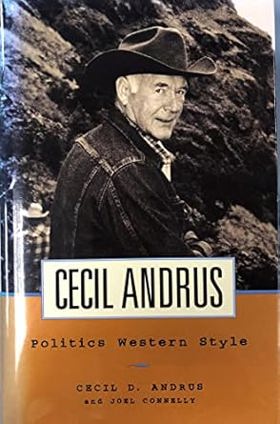
The immensely popular governor of Idaho from 1970 to 1994--and former U.S. Secretary of Interior--tells it like it is in this frank and perceptive memoir of his life as a Western politician 248 pages : illustrations ; 22 cm CIRC [ 0 ]
|
1998 |
|
Raising the roof creating the Kibbie Dome at the University of Idaho by Peter Johnson 
Construction of the University of Idaho's Kibbie Dome, which won the American Society of Civil Engineer's Outstanding Structural Achievement Award for 1976, demonstrates what can be accomplished within a framework of limited budgets and tight timelines. The proposed structure would have a 400 foot clear span, with a clearance above the field equivalent to a twelve-story building. 61 pages : illustrations (some color) ; 25 cm CIRC [ 0 ]
|
1998 |
|
Governor Smylie remembers by Robert E. Smylie 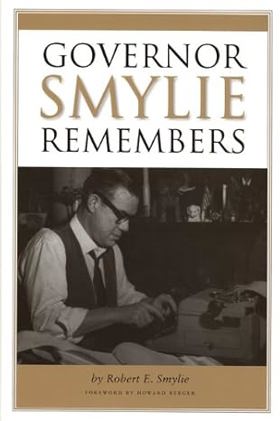
"Robert E. Smylie was born in Marcus, Iowa, in 1914 and first came to Idaho as a student at what was then the College of Idaho in Caldwell. Subsequently he worked his way through law school at George Washington University in Washington, D.C., served in the Coast Guard during World War II, married, and came back to Idaho in 1947 first as Assistant Attorney General and then Attorney General."--BOOK JACKET. "In 1954 Robert E. Smylie decided to run for governor, was elected, and served in that office until 1967. During his three terms in office, Governor Smylie could count among his many achievements an increase in the minimum wage, a five-day work week for state employees, creation of the Department of Commerce, a massive state highway construction program, promotion of the interests of business, land, and water within Idaho, serving as chair of the Western Governor's Association, the establishment of the state park system, and the introduction of a state sales tax to fund education."--BOOK JACKET xv, 234 pages : illustrations ; 24 cm CIRC [ 0 ]
|
1998 |
|
Peace at heart an Oregon country life by Barbara Drake 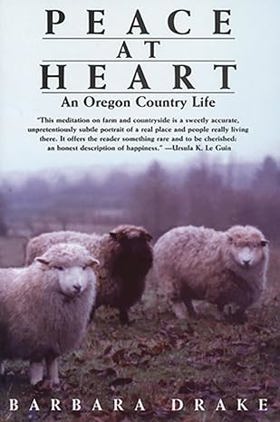
Many dream of leaving the city for a new life in the country. Few follow that dream. In 1987, Barbara Drake and her husband sold their home in Portland and moved to a farm in western Oregon's Yamhill Valley. Home was now a modest white house, an old red barn, and a small vineyard. In Peace at Heart, Barbara Drake reflects on ten years of country living and on the happiness that this rural landscape has brought her. Weather, seasons, plants, and especially animals figure prominently in these stories. The constant company of animals-domestic and wild-on the farm inspires what Drake calls "the sacramental character of country life." In essays on birthing lambs, keeping bees, raising geese, and making wine, Drake combines gentle humor, practical advice, and deep respect for the work and the land. This rich gathering of observations and meditations-on everything from border collies and Oregon mud to picking wild apples-captures the ordinary joys and everyday blessings of country life. Finalist for the Oregon Book Award, 1998 xiv, 176 pages ; 23 cm CIRC [ 0 ]
|
1998 |
|
Propagation of Pacific Northwest native plants by Robin Rose, Caryn E. C. Chachulski, Diane L. Haase 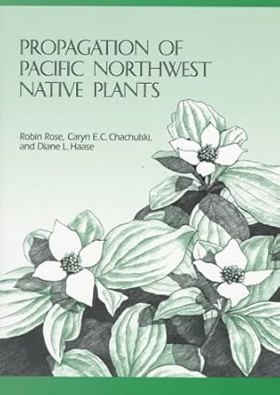
Increasing awareness of the beneficial role of native plants in promoting healthy ecosystems has generated new interest in propagation techniques. Native plants have been recognized as a crucial component of land management, especially after fires or other disturbances, and are widely used in habitat conservation efforts. In addition, native plants are increasingly desirable for landscaping and gardening. Propagation of Pacific Northwest Native Plants, the first publication of its kind, provides propagation information on nearly one hundred and forty native plants. Designed for use by both nursery professionals and home gardeners, this working manual presents the most current and comprehensive information in this emerging field. Drawn from forestry and agricultural journals, as well as gardening and horticultural handbooks and personal sources, the techniques presented here offer invaluable direction to the many who wish to grow native plants. The book is divided into four plant sections: shrubs, trees, forbs, and grasses. In addition to propagation techniques, the species accounts feature physical descriptions and information on habitat and geographic range. Abundant line drawings and an illustrated glossary help to ensure accurate use of this important new resource. viii, 248 pages : illustrations ; 26 cm CIRC [ 0 ]
|
1998 |
|
An editor for Oregon Charles A. Sprague and the politics of change by Floyd J. McKay 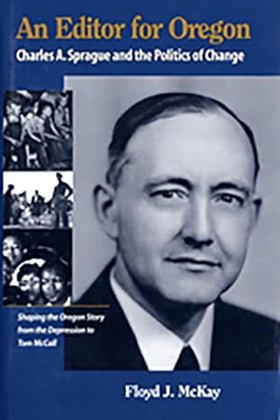
In chronicling the life of Oregon governor and newspaper editor Charles A. Sprague, Floyd McKay guides readers through the politics and journalism of twentieth-century Oregon. Sprague's remarkable career, writes McKay, "is in effect the life of a state through Depression, war and recovery, and into the era of Tom McCall and the Oregon Story." Newspaperman Charles Sprague, a progressive Republican, had lived in Oregon for only thirteen years when he became the surprise victor of the 1938 gubernatorial race. Although a capable governor, Sprague gained greater prominence during his forty-year tenure as editor and publisher of The Oregon Statesman in Salem. McKay examines the influence of Sprague's involvement in the Progressive politics of Theodore Roosevelt, his return to Republican orthodoxy, and his later emergence as a spokesman for liberal positions on race and justice, an evolution shaped by his governorship and service at the United Nations. Sprague's decisions -and later atonements- concerning ultra-patriotism in World War I and internment of Japanese Americans in World War II reveal an editor and governor torn by issues of his day. A major contribution to Oregon political history, An Editor for Oregon also offers a valuable look at one Oregon newspaper and its role in the community during the middle part of this century. x, 342 pages : illustrations ; 24 cm CIRC [ 0 ]
|
1998 |
|
The Wallowas coming of age in the wilderness by William Ashworth 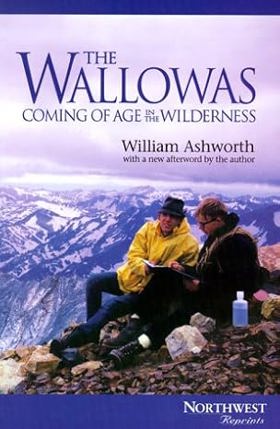
Part adventure story and part spiritual memoir, William Ashworth's The Wallowas recounts a young man's search for the challenges and the solace that the wilderness offers. It's the story of how as a student at Whitman College, Ashworth discovered the Wallowa Mountains in remote northeast Oregon. From that time on, the Wallowas were an obsession. Weekends and vacations were dedicated to exploring a rugged country roughly the size of Los Angeles and home to 126 peaks, each over 8,000 feet high. In language vivid and precise, Ashworth describes as he and a coterie of climbing buddies attempt ascents of Eagle Cap, Pete's Point, Sacajaweja, and the Matterhorn. Climbing and camping in summer rain and winter blizzards, they face the challenge of the Wallowa high country and the humility it teaches. The book tracks the author's coming of age in the wilderness from a need to conquer mountains to an awareness of the redemptive qualities found in these wild places and the need to preserve the last of them. "We need wilderness not only for what it can do for us but for what it can mean to us," writes Ashworth. "We need the wilderness — to grow up in." Twenty years after its original publication, the Oregon State University Press is pleased to introduce William Ashworth's classic memoir to a new generation of readers. 174 pages : 1 map ; 23 cm. CIRC [ 0 ]
|
1998 |
|
Kirtland Cutter architect in the land of promise by Henry Matthews, Kirtland Kelsey Cutter 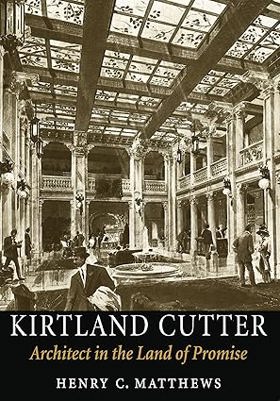
In the early years of the twentieth century, Spokane was singled out for praise in the West for the quality of its architecture and the impressive way it had rebuilt after the devastating fire of 1889. Major credit for the city's distinctive character was extended to Kirtland Kelsey Cutter for his "rare architectural force and genius for design." His remarkable career, stretching from the Gilded Age to the Great Depression, allows a fascinating study of the evolution of an eclectic form of architecture that was an inevitable response to rich regional and historical influences during a time of transition from frontier settlements to modern city. Cutter's influence was felt beyond Spokane--in Seattle, other areas of Washington, and in Oregon, Idaho, and Montana. He was also responsible for buildings in the East and even for one in England. After financial problems ended his career in the Northwest, he began anew at age sixty-three in southern California, and worked there as an architect until his death in 1939 at age seventy-nine. Henry Matthews presents a comprehensive study of the whole body of Cutter's work, with ample photographs and illustrations. The book is based on exhaustive research in both the Northwest and California, revealing the influences on Cutter and his associates, the processes at work in the design and construction of the buildings, and the relations between the architect and the many people who commissioned his work. Particularly useful to Matthews's research was a collection of 290 sets of drawings, as well as office accounts, letters, and books from Cutter's library--materials acquired by the Eastern Washington State Historical Society. He also was able to interview former assistants and clients, who provided valuable insights on the architect and the way Cutter worked. In addition, many of the architect's residences, hotels, clubs, and commercial buildings are still standing. This book adds significantly to an understanding of Western urban and regional history. But Cutter's experimentation in many styles and the imaginative nature of his work make for a study that goes beyond regional limits and sheds light on national trends. x, 438 pages : illustrations, plans, portraits ; 26 cm CIRC [ 0 ]
|
1998 |
|
From Here to There and In-Between From the Log of S.V. Stone Spirit by Donna Winter 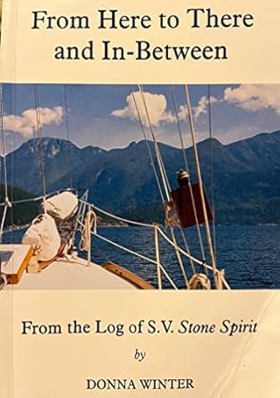
From the logbook of the 33’ ferro-cement, cutter-rigged “Stone Spirit“. Follow Donna, her husband Dave, and Montague the cat as they travel around the southern inside passage of British Columbia, Canada. 99 pages illustrations, map CIRC [ 1 ]
|
1998 |
|
The story of Sidney by Peter Grant 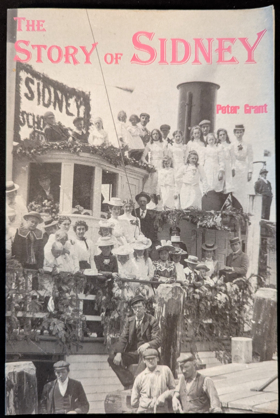
Authored by Peter Grant, The Story of Sidney chronicles the evolution of the coastal town on Vancouver Island, British Columbia, from its early Indigenous presence and 19th-century agricultural settlement into a vibrant modern community. The book details the establishment of local farms, the arrival of the railway, and the maritime connections that bridged the Saanich Peninsula to the broader Salish Sea region. Drawing on local archives, historical photographs, and personal accounts, the text highlights the community's persistent drive to balance commercial growth with small-town coastal character. A keen insight drawn from the work is how transportation revolutions dictate the very heartbeat of coastal towns; just as the transition from neighborhood steamships to the Swartz Bay ferry terminal radically reshaped Sidney's economic destiny, it proved that the survival of an island-adjacent community depends entirely on how successfully it manages its role as a regional gateway. 96 pages : illustrations ; 23 cm CIRC [ 1 ]
|
1998 |
|
Barlow Road by Wasco County Historical Society, Clackamas County Historical Society 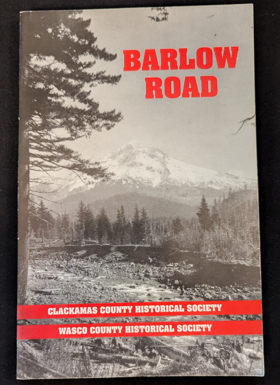
Authored collaboratively by the Wasco County Historical Society and the Clackamas County Historical Society, Barlow Road chronicles the construction and historical legacy of the final, grueling overland leg of the historic Oregon Trail. The book traces how Sam Barlow’s 1845 toll road carved a hazardous wagon route around the treacherous southern flank of Mount Hood, offering exhausted pioneers a perilous alternative to navigating the dangerous rapids of the Columbia River. Through archival maps, journals, and photographs, the text details the monumental physical labor required to hack a wagon track through dense old-growth forests and volcanic terrain. A keen insight drawn from the work is how the creation of the Barlow Road transformed a humanitarian struggle into a capitalist enterprise; by privatizing the final mountain obstacle of the migration route, the toll road proved that the westward movement was driven as much by entrepreneurial toll-gate economics as it was by Manifest Destiny. vii, 97 pages : illustrations, maps ; 21 cm CIRC [ 1 ]
|
1998 |