Catalog of British Columbiana and Pacific Northwest Americana
Encyclopedia Cascadia Catalog contains book titles of mostly non-fiction Pacific Northwest Coast of North America Titles (primarially British Columbia, Idaho, Oregon and Washington State) in an easy-to-understand title catalog. If you see a link with this badge ONLINE CIRC it means that there is an online institution that provides free access to that title. In some cases there may be more than one institution hosting the title digitally.
| Catalog Title | Published |
|---|---|
|
A tour of duty in the Pacific Northwest E.A. Porcher and H.M.S. Sparrowhawk, 1865-1868 by Edwin A. Porcher, Dwight L. Smith 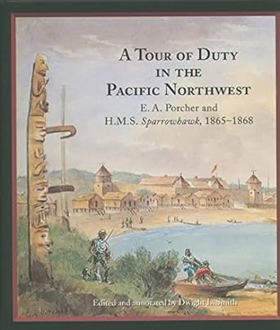
"Working with Commander Porcher's manuscript journal, now in the Beinecke Rare Book and Manuscript Collection of Yale University, as well as other documents of the time, editor Smith has conjured an era through the unique voice of one of its standard bearers. Porcher's journal reveals a man who strived to do his duty by the lights of the British Empire, then at full bloom but - caught between vulnerable Russian America to the north, and the rambunctious and expanding United States to the south, and the French virtually everywhere - in slightly precarious position on North America's Pacific coast xvii, 172 pages, approximately [52] leaves of plates : illustrations (some color), map ; 27 cm CIRC [ 1 ]
|
2000 |
|
To fish in common the ethnohistory of Lummi Indian salmon fishing by Daniel L. Boxberger , Chris Friday 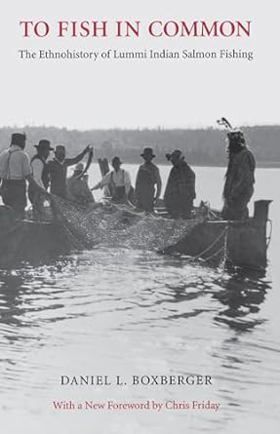
"By focusing on the history of control over productive resources (in this case salmon, methods of harvest, processing, capital investment, and markets) Boxberger shows how the Lummi slid from independence and self-sufficiency to dependency, underdevelopment, and poverty. . . . Not only is it an excellent, in-depth study of the Lummi case, it can also serve as a metaphor for the larger question of Native American treaty rights and the resource provisions of agreements." --Pacific Historical Review xviii, 212 pages : illustrations ; 22 cm. CIRC [ 1 ]
|
2000 |
|
Home mountains reflections from a Western middle age by Susan H. Swetnam 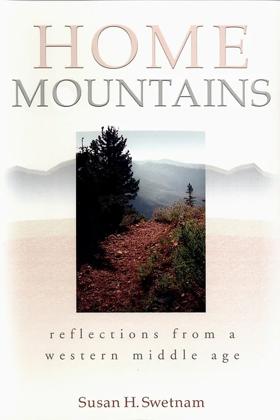
A collection of personal essays from the author's middle-age surprise of finding herself at home in the intermountain region of southeastern Idaho [6], 119, [2] pages : illustrations ; 21 cm. CIRC [ 0 ]
|
2000 |
|
Mapping women's sense of place in Stehekin, WA an oral history-based study of place by Christina Copeland 
Authored as an oral history-based study by Christina Copeland, Mapping Women's Sense of Place in Stehekin, WA investigates how women have historically experienced, shaped, and emotionally mapped the deeply isolated community nestled at the head of Lake Chelan. The dissertation draws on extensive interviews to examine the gendered dimensions of living in a remote, rugged mountain enclave accessible primarily by boat, floatplane, or trail. By centering women's narratives, the text illuminates the invisible labor, social bonds, and unique environmental attachments required to sustain family and community life in an extreme wilderness setting. A keen insight drawn from the work is how geographical isolation redefines gender roles on the frontier; rather than being sidelined by rugged topography, women in Stehekin often became the primary architects of community stability, forging a profound, place-based identity that transformed an intimidating wilderness into an enduring home. vii, 153 leaves : illustrations, maps ; 29 cm CIRC [ 1 ]
|
2001 |
|
Captain McNeill and his wife the Nishga chief, 1803-1850 from Boston fur trader to Hudson's Bay Company trader by Robin Percival Smith 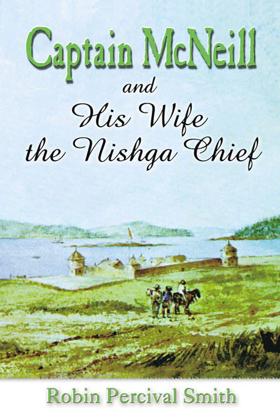
The historical recount of the life and times of Captain McNeill, a long-standing captain in the pioneering days of the fur trade. McNeill was the captain of the Honourable Hudson's Bay steam ship SS Beaver.The historical recount of the life and times of Captain McNeill, a long-standing captain in the pioneering days of the fur trade. McNeill was the captain of the Honourable Hudson's Bay steam ship SS Beaver. William McNeill was born in Boston in 1803. At eleven years old, he chose a life at sea, and began gaining his experience to rise to the rank of master of a vessel, which required skill in mathematics and an understanding of the cosmos for navigation. William was a red-head, tall and heavy set. His temper was on a short fuse and, when threatened, he was aggressive in his action, impetuous, blusterous and a little given to exaggeration. He was not fond of waiting to see how things might turn out. William was probably first mate at fifteen years of age on the brigantine Paragon and a master mariner at twenty-one. By the time he joined the Hudson's Bay Company, he was a competent and experienced master mariner and fur trader. Follow his historical immigration to Canada to become one of the most feared and serviceable trading captains of the Honorable Hudson's Bay Co. 256 pages : illustrations, maps ; 22 cm CIRC [ 1 ]
|
2001 |
|
The accidental hermit by Noël. Murchie, Nancy Spaulding 
An amusing account of a 50-something woman living alone for a year in a rural cabin on a Puget Sound island. During her adventure she finds out more than she bargained for about pesky raccoons, wacky plumbing, foot infections, capricious weather, the effects of loneliness...and knowing herself. 170 pages ; 22 cm CIRC [ 1 ]
|
2001 |
|
The world of Chief Seattle how can one sell the air? by Warren Jefferson 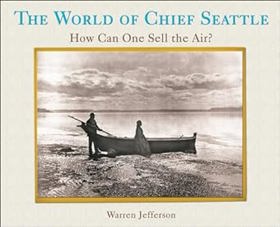
Chief Seattle gave his now famous speech in 1854 during treaty negotiations with the U.S. government, which was intent on forcing the Native people of Washington's Puget Sound onto reservations. This book puts Chief Seattle's life into the context of his time and gives a brief history of the region and its many tribes, with particular emphasis on Chief Seattle's tribe, the Suquamish 128 pages : illustrations, map ; 19 x 23 cm CIRC [ 1 ]
|
2001 |
|
Historical atlas of the North Pacific Ocean maps of discovery and scientific exploration, 1500-2000 by Derek Hayes, North Pacific Marine Science Organization 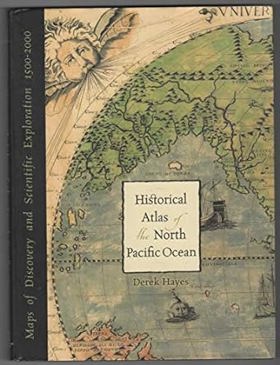
Map junkies rejoice! Derek Hayes, author of Historical Atlas of the Pacific Northwest, delivers another stunning atlas filled with stories of explorations and exquisite historical maps. Over five hundred years of maps depicting the North Pacific Ocean and the lands that border itthe United States, Canada, Alaska, Russia, Japan, Korea, and Chinahave been collected into this new atlas. From antique maps of the sixteenth century to modern satellite images, this volume covers all the major explorations, such as Magellan, Bering, Cook, and Vancouver; Perrys opening of Japan; and the U.S. North Pacific Exploring Expedition. It also includes modern maps that use the latest technology to show ocean currents, fault lines, and the seabed in astounding detail. 1 atlas (224 pages) : illustrations, color maps ; 33 cm CIRC [ 1 ]
|
2001 |
|
Bitterbrush country living on the edge of the land by Diane Josephy Peavey 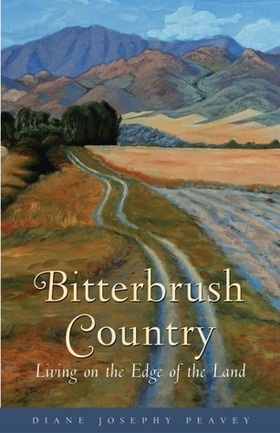
When author Diane Josephy Peavey first arrived in south-central Idaho twenty years ago, she did not know it was possible to become as connected to a place as she is now, nor, she claims, did she understand the "meaning of love, of home, of commitment. That would come to me here, 24 dirt-road miles from town." Story by story, readers will pass through the seasons of a ranching life, discovering the power of a landscape that inspires passion in so many. Book jacket xvi, 239 pages ; 23 cm CIRC [ 1 ]
|
2001 |
|
Idaho's Malad Valley a history by Thomas J. McDevitt 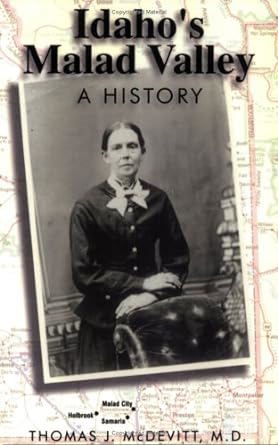
A history of the development of a section of Southeastern Idaho which was one of the main transportation routes from Salt Lake City to the gold fields as well as a rich agricultural area. A good, bad and ugly history of a small Idaho Welsh settlement. The frontier between Mormon and Gentile, Saint and sinner. A place once advertised where a woman could shoot her husband and never spend a day in jail.The Presbyterian tolled for an "innocent" young Michael Murphy, the first man legally hanged in Idaho. Charles Fremont looked from Malad towards Great Salt Lake. They almost drowned exploring from a rubber boat. x, 230 pages : illustrations, portraits ; 23 cm CIRC [ 1 ]
|
2001 |
|
A history of Whidbey's Island (Whidbey Island), State of Washington by George Albert Kellogg, Island County Historical Society 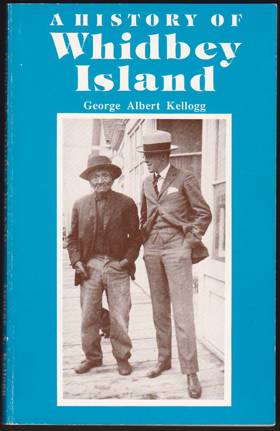
Published by the Island County Historical Society and authored by early pioneer descendant George Albert Kellogg, A History of Whidbey's Island, State of Washington chronicles the foundational decades of Puget Sound's largest island through the eyes of those who settled it. The book details the arrival of the first European-American homesteaders, maritime trading exploits, encounters with local Indigenous populations, and the arduous establishment of agriculture and civic infrastructure across the mid-to-late 19th century. Drawing on firsthand accounts, local lore, and early archival records, the text preserves the gritty, self-reliant spirit of a community forged in maritime isolation. A keen insight drawn from the work is how pioneer-authored local histories functioned as acts of cultural legitimation; by meticulously recording the trials of early settlement, authors like Kellogg sought to rapidly replace a deep, ancient indigenous geography with a heroic, permanent Anglo-American narrative of progress. 183 pages : maps, portrait ; 21 cm CIRC [ 1 ]
|
2001 |
|
A Sto:lo Coast Salish historical atlas by Keith Carlson, Albert Jules McHalsie, Stó:lō Heritage Trust 
This volume presents an in-depth natural, cultural, and spiritual history of the Fraser River region and its aboriginal and post-contact inhabitants over 15,000 years, in graphs, charts, lexicographies, historic maps, archival photographs, and original artwork. It covers such diverse subjects as: origins of the people and landscape, relationship between the Coast Salish spiritual beliefs and contemporary land management, pre-contact fortifications and warfare, expression and history of Sto:lo and Coast Salish identity, population movement in the historic era, architectural history, Sto:lo systems of justice, spatial analysis of hop yards, salmon canneries and residential schools, reinterpretation of Sto:lo historical demographics xvi, 208 p. : ill. (some col.), maps (some col.) 38 cm. CIRC [ 1 ]
|
2001 |
|
River pigs & cayuses oral histories from the Pacific Northwest by Ron Strickland 
Ron Strickland’s oral histories recover a part of the original Northwest character that is rapidly disappearing. In River Pigs and Cayuses, he gathers stories from old-timers in Washington, Idaho, and Montana. Brimming with lively accounts both humorous and poignant, the book illuminates cadences and traditions that Strickland hopes will survive long after the storytellers are gone. Here a moonshiner, a fish pirate, a timber cruiser, a branding iron maker, a smoke jumper, a frontier bride, and 25 other fascinating individuals speak vividly, revealing their personal histories in their own words. Strickland introduces each story, providing information on the teller and placing the story in context. In telling their own stories, his subjects speak to the diversity of life and labor in the Northwest. A short glossary enhances the “listening” experience, as do Strickland's own photographs of the storytellers. In a new introduction, William Kittredge notes that Strickland’s interviewees are most passionate when speaking of their survival in the work-a-day world, sustained both by their livelihoods and by the solace of companionship. “What we hear echoing over and again in these voices,” Kittredge writes, “is pride, at having managed difficult lives, and having along the way earned independence, all the individuality they could manage, and an unapologetic sense of self.” xx, 155 pages : illustrations ; 23 cm. CIRC [ 1 ]
|
2001 |
|
Eastern Oregon books and print an annotated and historical bibliography by Wayne Kee 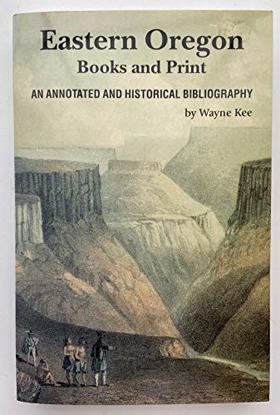
Published as an annotated historical bibliography by Wayne Kee, Eastern Oregon Books and Print catalogs the diverse literary output, regional imprints, and historical texts documenting the high desert and mountain landscapes of eastern Oregon. The work compiles comprehensive descriptions of rare books, pamphlets, and promotional literature ranging from early exploration journals and settlement guides to local histories and indigenous accounts. By structuring these bibliographic entries chronologically and topically, the text maps how print culture mirrored the region's economic and social transformation from an isolated frontier into an organized agrarian and resource-based society. A keen insight drawn from the work is how regional bibliographies function as meta-histories of ideological expansion; the catalog reveals that the printed word was not merely a passive record of eastern Oregon's development, but an active promotional tool deliberately used to tame an intimidating arid landscape into a welcoming destination for homesteaders and investors. xxi, 286 pages : illustrations ; 23 cm CIRC [ 1 ]
|
2001 |
|
Pioneer history of North Lincoln County, Oregon Volume III, January 2001 by Mildred Harmon Salazar (Composer)
Compiled and edited by Mildred Harmon Salazar, Pioneer History of North Lincoln County, Oregon, Volume III preserves the oral traditions, genealogical records, and firsthand accounts of the early homesteaders, loggers, and coastal traders who settled Oregon's rugged central coast. The volume details the immense challenges of carving out a living amid dense coastal forests, treacherous bar crossings, and geographic isolation before the arrival of modern highways. Through collected memoirs, family trees, and vintage photographs, the text captures the gritty everyday realities of building community infrastructure along a dramatic and unforgiving shoreline. A keen insight drawn from the work is how community-compiled pioneer histories serve as vital grassroots archives that rescue ordinary working lives from historical obscurity; by gathering stories directly from aging settlers, the volume reveals that the true foundation of coastal development was built not by corporate industrialists, but by the quiet, unyielding persistence of families adapting to an untamed maritime frontier. x, 212 pages : illustrations CIRC [ 1 ]
|
2001 |
|
Exploring Washington's past a road guide to history by Ruth Kirk, Carmela Alexander, David L. Nicandri, Louis Kirk 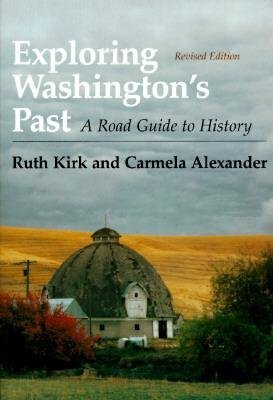
Exploring Washington’s Past tells the state’s story in terms of where to go and what to see. With words, photographs, and maps, the authors evoke the cultural landscape and portray Washington’s people and events from the days of the fur trade and pioneer settlement to the recent past. Capsule descriptions of small communities -- from Altoona to Zillah -- are interwoven with those of better known cities, and eastern and western Washington receive equal attention. More than two hundred photographs portray our historical landscape through images of today intermixed with a sampling of the past. This book will be an indispensable guide for residents, tourists, and armchair travelers. xiii, 543 pages : illustrations, maps (some color) ; 26 cm CIRC [ 1 ]
|
2001 |
|
Thumbpapers sketches of pioneer days by Leonore Gale Barette 
Published in local editions, Leonore Gale Barette’s Thumbpapers: Sketches of Pioneer Days offers a charming and intimate collection of vignettes capturing the daily struggles, simple pleasures, and quiet resilience of early settlers in the Pacific Northwest. The book weaves together personal reminiscences and local folklore to illustrate how isolated frontier communities banded together to build homes, schools, and civic life amidst vast wilderness. Through its evocative, unpretentious prose, the text preserves the texture of a bygone era before industrialization reshaped the rural landscape. A keen insight drawn from the work is how domestic and everyday details—rather than grand political milestones—serve as the true bedrock of historical memory; by focusing on the small, routine friction of pioneer housekeeping and community socializing, the narrative reveals that civilization on the frontier was sustained just as much by ordinary human connection as it was by physical survival. xi, 67 pages : illustrations ; 23 cm CIRC [ 1 ]
|
2001 |
|
Yester years by Gordon Ross 
Published locally by longtime Coos County dairy farmer, historian, and former commissioner Gordon Ross, Yester Years is a collection of humorous and homespun stories documenting the trials, eccentricities, and daily realities of early rural life in southwest Oregon. Drawing heavily on family lore, handed-down anecdotes, and personal recollections of the Ross Slough and Coos Bay regions, the book captures a vanishing landscape where neighbors survived through grit, improvisation, and close-knit community cooperation. Through lighthearted and unpretentious prose, the text preserves the rich oral history of pioneers, farmers, and loggers who shaped the rugged frontier. A keen insight drawn from the work is how regional humor functions as an essential survival mechanism; by chronicling the absurdities and hardships of frontier isolation with witty storytelling, the narrative reveals that laughter was just as vital as physical labor in subduing an unforgiving wilderness. 93 pages : illustrations ; 22 cm CIRC [ 1 ]
|
2001 |
|
A century of Coos County railroads by Steven Greif
Published by local historian Steven Greif, A Century of Coos County Railroads chronicles the ambitious, logistically treacherous, and economically volatile history of rail development along southwest Oregon’s rugged coast. The book details the immense engineering feats required to carve rail lines through dense timber, cross treacherous waterways, and connect isolated coastal timber and shipping towns to the national grid. Through detailed archival photographs, corporate records, and local lore, the text charts how steel tracks served as the primary economic lifeline that transitioned the region from maritime isolation into a heavy industrial timber economy. A keen insight drawn from the work is how railroads on the Pacific Northwest frontier acted as both liberators and tyrants; while steel lines successfully shattered geographic isolation, they simultaneously bound local communities to boom-and-bust corporate monopolies, making the region's economic survival entirely dependent on external market demands. 57 pages : illustrations, facsimiles, map ; 28 cm CIRC [ 1 ]
|
2001 |
|
Mill town footlights the theaters of Everett, Washington by David Dilgard, Everett Public Library 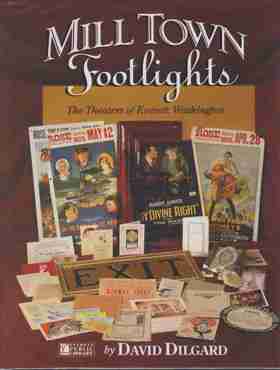
Published in local editions by historian David Dilgard and the Everett Public Library, Mill Town Footlights: The Theaters of Everett, Washington chronicles the vibrant, bustling entertainment history of a booming turn-of-the-century industrial city. The book details the rise and fall of Everett’s historic playhouses, vaudeville houses, and nickelodeons, illustrating how cultural institutions thrived amidst the grit, smoke, and labor strife of a quintessential Pacific Northwest mill town. Drawing on rich archival photographs and local ephemera, the text traces how early residents sought out sophisticated theatrical escapism as a vital counterbalance to grueling industrial labor. A keen insight drawn from the work is how the rapid emergence of high-culture entertainment in an isolated timber hub demonstrates that rough-edged frontier economies were deeply hungry for civic refinement, using the performing arts to rapidly project an image of metropolitan permanence and respectability onto a raw landscape iv, 116 pages : illustrations ; 29 cm CIRC [ 0 ]
|
2001 |
|
River of life, channel of death fish and dams on the lower Snake by Keith Petersen 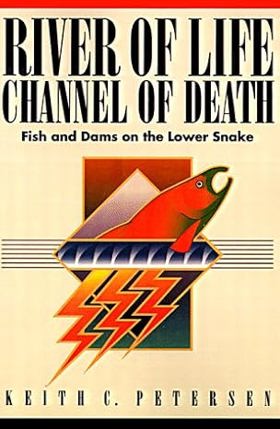
In the words of the author, "this book is the story of how people came to settle this region and demand river alterations--and how some eventually came to oppose them… It is also the chronicle, yet unfolding, of the conflict between native wildlife and dams. In microcosm it is, in many ways, the story of the American West." This history of the four Lower Snake River dams and their impact on Northwest salmon was named "Book of the Year" by the Idaho Library Association. River of Life, Channel of Death tells the story of the long struggle to bring navigation to Lewiston and hydro-power to a region; of the influence of powerful congressional representatives and booster organizations; of a clash of cultures, first between Indians and whites and later between environmentalists and developers; and of the role of the federal government in Western settlement. While the dams made Lewiston into the farthermost inland seaport in the western United States, they continue to be a subject of controversy in the continuing national debate over the fate of Northwest salmon. In a new preface written for this edition, Petersen comments on information that has become available and events that have occurred since his book was first published in 1995. xiv, 321 pages : map ; 23 cm CIRC [ 0 ]
|
2001 |
|
Tough trip through paradise, 1878-1879 by Andrew Garcia, Bennett H. Stein 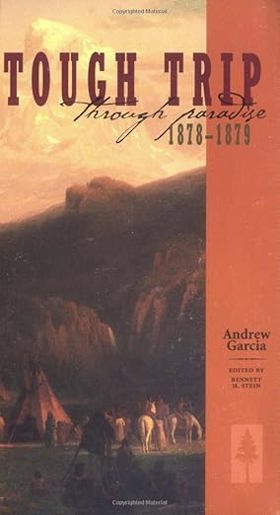
This book grew out of a manuscript left by Andrew Garcia. Bennett Stein edited the manuscript to tell Garcia's story of the 1877 Nez Perce War, the end of the buffalo herds, and other historic events in western life. Garcia, a man of Hispanic descent was born in El Paso, moved north to Montana in 1876 and became a mountain man. Garcia served as a herder and packer for the U.S. Army in Montana in the Yellowstone and Musselshell country, working for Colonel Samuel D. Sturgis' "Boys in Blue" out of Fort Ellis from 1876-1878. He was present during the Nez Perce War. The book begins in 1878, when Garcia left his job with the army to go into business with a man named Beaver Tom, trapping beaver and trading for buffalo robes. While trading with members of the Pend d'Oreilles tribe, Garcia met and married a Nez Perce woman known among the Pend d'Oreille as In-who-lise ('Broken Tooth'; her original name, Kot-kot-hy-hih, means White Feather), who had been with Chief Joseph's tribe when they ran from the U.S. Cavalry. The book includes Garcia's reproduction of her firsthand account of the final engagement with 7th Infantry at the Battle of the Big Hole xviii, 409 pages : maps ; 18 cm CIRC [ 0 ]
|
2001 |
|
Women in Pacific Northwest history by Karen J. Blair 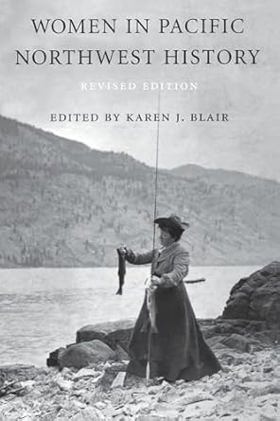
A collection of essays exploring women's experiences in Northwest history. This new edition of Karen Blair’s popular anthology originally published in 1989 includes thirteen essays, eight of which are new. Together they suggest the wide spectrum of women’s experiences that make up a vital part of Northwest history. ix, 324 pages, 4 unnumbered pages of plates : illustrations (some color), portraits ; 23 cm CIRC [ 0 ]
|
2001 |
|
Wings of power Boeing and the politics of growth in the Northwest by T. M. Sell 
Through most of its history, the Boeing Company has been one of the biggest providers of jobs and wealth in western Washington State. But in the 1990s, the company found itself a target of local activists and politicians who saw urban sprawl and “growth politics” ruining the region’s quality of life. T. M. Sell grew up in a Boeing family, near Boeing’s Renton plant, and later covered the company as a reporter for the Valley Daily News and the Seattle Post-Intelligencer. He is a first-hand observer of the drama he unfolds--one personally interested in the future of his community, well informed about the details of its history, acquainted with many of the principal players, and conversant with the theoretical and historical literature that bears on the multifaceted questions he seeks to answer. After a lively sketch of the Boeing Company’s history into the last decade of the 20th century, Sell looks at what happened when Boeing tried to expand its facilities in Renton and Everett. It was then that the “paradox of growth” first manifested itself, the point at which the benefits of economic expansion appeared to be outweighed by its costs. Sell examines political power management in Washington State, paying particular attention to Boeing’s successful efforts to be a positive influence in the state, to the strategies it used to influence growth-management legislation in Olympia, and to its negotiations with the communities most affected by its efforts to grow. In each case, Sell gives not just an overview of positions and strategies but also sharply drawn portraits of the lobbyists, analysts, and politicians involved, many of whom explain their views in direct conversation. The balanced and comprehensive approach Sell brings to bear on the story is also his recommendation for dealing with inevitable future growth-related contentions. Fostering the continuing health of our economic and political environment, he concludes, will require just such a broad, evenhanded, and sensible approach to the politics of compromise. xxx, 162 pages ; 24 cm CIRC [ 0 ]
|
2001 |
|
Chief Seattle, man of vision by Florence Westover Bond 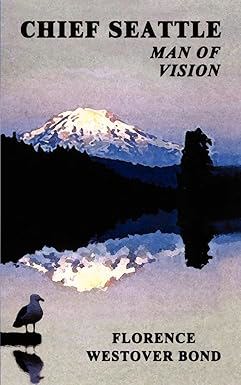
Published in regional biographical editions by Florence Westover Bond, Chief Seattle, Man of Vision explores the life, diplomacy, and complex legacy of the mid-19th-century Duwamish and Suquamish leader whose name became synonymous with the city of Seattle. The book details his strategic efforts to navigate the turbulent arrival of European-American settlers, maintain peace during the devastating conflicts of the 1850s, and protect the sovereign interests of his people amidst aggressive territorial displacement. Drawing on historical records and regional oral traditions, the text contrasts the popular, romanticized myth of the tragic vanishing Indian with the reality of a pragmatic political strategist. A keen insight drawn from the work is how Chief Seattle’s famous, oft-romanticized speech was not a surrender to inevitability, but a brilliant act of long-term rhetorical positioning; by binding the spiritual destiny of the white settlers to the sacred ancestral land of the tribes, he sought to morally obligate the colonizers to respect native memory even as their physical presence was being dismantled. xiv, 139 pages ; 21 cm CIRC [ 0 ]
|
2001 |