Catalog of British Columbiana and Pacific Northwest Americana
Encyclopedia Cascadia Catalog contains book titles of mostly non-fiction Pacific Northwest Coast of North America Titles (primarially British Columbia, Idaho, Oregon and Washington State) in an easy-to-understand title catalog. If you see a link with this badge ONLINE CIRC it means that there is an online institution that provides free access to that title. In some cases there may be more than one institution hosting the title digitally.
| Catalog Title | Published |
|---|---|
|
Birds of Oregon a general reference by David B. Marshall, Matthew G. Hunter, Alan Contreras, Oregon Breeding Bird Atlas Project 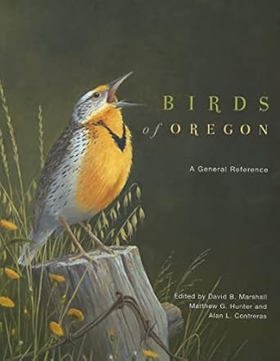
Birds of Oregon is the first complete reference work on Oregon's birds to be published since Gabrielson and Jewett's landmark book in 1940. This comprehensive volume includes individual accounts of the approximately 500 species now known to occur in Oregon (about 150 more than in 1940), including detailed accounts of the 353 species that regularly occur and briefer accounts of another 133 species that are considered vagrants. A separate chapter covers extirpated and questionable species as well as those which have been introduced but have not become established. Oregon is long overdue for a book of this kind. Although northern states generally support fewer species of birds than more southerly ones, Oregon ranks fifth behind only Florida, New Mexico, Texas, and California in terms of numbers of species. This is due to its varied climate, its wide range of habitats, and the mild winters over much of the state, which make it an important wintering area. Birds of Oregon is not a field guide for identifying birds, although it describes the appearance and any unique or special characteristics of each species, and approximately 100 species are illustrated with attractive line drawings. Instead, it compiles and presents in a single large volume what is known today about the population status and distribution of each species, as well as their habitat requirements and diet, their seasonal activities and behavior, where and how they might be found, and any conservation problems. It includes about 200 range maps that reflect the work of more than 700 volunteers who participated in the Oregon Breeding Bird Atlas project, as well as other sources. Subspecies--of which Oregon has many because of the variability of the state's avian habitats--are listed with their ranges, thus providing the first accounting of subspecies in the state since 1957. In addition to the species accounts, Birds of Oregon also includes a discussion of changes among Oregon's birds since 1940 and a description of the state's nine ecoregions and how they relate to bird species. Approximately 100 contributing authors volunteered their time and expertise to create Birds of Oregon, and numerous other individuals reviewed drafts of the species accounts to insure that they are as accurate and up-to-date as possible. Although heavily referenced with approximately 4,000 literature citations, Birds of Oregon is written in nontechnical language and will appeal to a broad audience, including birders, wildlife biologists, land managers, conservationists, naturalists, hunters, and wildlife enthusiasts in general. This new paperback edition includes an annotated list of species that have been added to the official state bird list since the book was first published in 2003. xvi, 752 pages : illustrations, maps ; 29 cm CIRC [ 0 ]
|
2006 |
|
Corvallis trails exploring the heart of the valley by Margie C. Powell 
Situated in the heart of the Willamette Valley and nestled against the rolling hills of the Coast Range, Corvallis is an outdoor enthusiast's paradise, renowned for its abundance of parks and natural areas, easily accessed within a few minutes from downtown. This informative, well-organized guide introduces nearly sixty trails, all either in Corvallis or within an hour's drive, and many suited for casual hikers and families with children. In Corvallis Trails, you'll discover close-in recreational opportunities, including walks and short hikes in Corvallis city parks and McDonald Forest. Most of these are easily accessible by foot, bicycle, or public transportation. trails outside of Corvallis but still within easy reach, including Marys Peak, four National Wildlife Refuges, two waterfall walks, and nearby Coast Range outings. The detailed trail descriptions include directions, maps, the length and difficulty of each trail, and a wealth of information on the plants, wildlife, and natural attractions to be found. Also included are accounts of area history and local conservation efforts. Walkers, hikers, runners, mountain bikers, equestrians, and outdoor enthusiasts of all kinds will find this comprehensive guidebook an essential companion as they explore the miles of well-known - and not so well-known - trails in Corvallis and environs. 161 pages : illustrations, maps ; 24 cm CIRC [ 0 ]
|
2006 |
|
The grail a year ambling & shambling through an Oregon vineyard in pursuit of the best pinot noir wine in the whole wild world by Brian Doyle 
From the red clay hills of Dundee, Oregon, come increasingly world-renowned pinot noir wines. After being startled and delighted by one winery's elixir, and the shaggy humor of the father and son who made it, Brian Doyle set out to spend a year in one Willamette Valley vineyard, chronicling the creative and chaotic labor as the winemakers chase after the perfect pinot noir. A self-described "wine doofus," Doyle follows closely at the elbow of Jesse Lange, son of Lange Winery founder Don Lange, peppering the young winemaker with questions about the growing of grapes and making of wine. With dry wit and otherworldly patience, Jesse Lange offers his interlocutor a primer on pinot, describing how acres of tiny black grapes are turned into complex and superb wines. Doyle is absorbed in the real work of winemaking, "the sheer labor of it, the creativity, the dust, the bugs, the machinery, the botany, the chemistry, the wild nuttiness of trying to make a great wine." He records the rhythms and cycles of winemaking: the fallow times, the times of wild energy, and always the worry about the precious crop. Doyle serves as a cheerful tour guide through the world of wine, alert to the colorful and riveting stories that swirl around its creation and consumption. In The Grail, he collects and shares dozens of these stories about the natural history of the vineyard, the fussiness of the pinot vine, the boom in pinot noir around the world, the surprising buying habits of tasting room visitors, and the subtle craft of winemakers who know, as Jesse Lange says, grinning, "how to get out of the way of great grapes." In short, The Grail is a spirited and entertaining chase for a truly special wine. 208 pages : illustrations ; 22 cm CIRC [ 0 ]
|
2006 |
|
Public power, private dams the Hells Canyon High Dam controversy by Karl Boyd Brooks, William Cronon 
In the years following World War II, the world’s biggest dam was almost built in Hells Canyon on the Snake River in Idaho. Karl Boyd Brooks tells the story of the dam controversy, which became a referendum not only on public-power expansion but also on the environmental implications of the New Deal’s natural resources and economic policy. Private-power critics of the Hells Canyon High Dam posed difficult questions about the implications of damming rivers to create power and to grow crops. Activists, attorneys, and scientists pioneered legal tactics and political rhetoric that would help to define the environmental movement in the 1960s. The debate, however, was less about endangered salmon or threatened wild country and more about who would control land and water and whether state enterprise or private capital would oversee the supply of electricity. By thwarting the dam’s construction, Snake Basin irrigators retained control over water as well as economic and political power in Idaho, putting the state on a postwar path that diverged markedly from that of bordering states. In the end, the opponents of the dam were responsible for preserving high deserts and mountain rivers from radical change. With Public Power, Private Dams, Karl Brooks makes an important contribution not only to the history of the Pacific Northwest and the region’s anadromous fisheries but also to the environmental history of the United States in the period after World War II. xxvii, 290 pages, 16 unnumbered pages of plates : illustrations, map ; 24 cm. CIRC [ 0 ]
|
2006 |
|
Far west the story of British Columbia by Daniel Francis 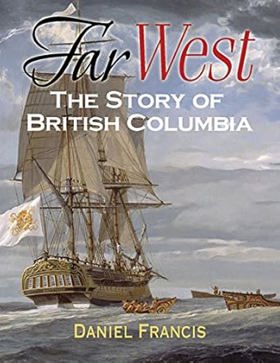
British Columbia's colourful story has been told many times, but until now no one has attempted to relate the chronicle specifically for young readers. From the gold rush to the Gumboot Navy and from "brideships" to W.A.C. Bennett, BC history comes alive in this highly illustrated and vivid account by award-winning writer and historian Daniel Francis. Starting with the story of BC's aboriginal people and their lives prior to the arrival of the Europeans, Far West recounts first contact with early explorers such as Captain James Cook and Captain George Vancouver and the changes the fur trade brought to the "New World." Francis then describes how BC was born, starting with the gold rush and Confederation eras, going through to modern times and speculating on BC's future. On the way we meet interesting characters from BC's history, people such as Frances Barkley, the first European woman to visit British Columbia in 1787; Joe Capilano, who travelled to London, England, in 1906 to explain to the British king how BC's aboriginal people were displaced by white settlers; and Rosemary Brown, a Vancouver social worker who was the first black woman elected to political office in Canada in 1972. Quotes from BC people--past and present--and anecdotal sidebars containing little-known BC facts spice up the text. Geared toward readers aged nine and up and richly illustrated with archival photographs, colourful paintings, maps and original illustrations, Far West is a must-have for every BC family. 175 p. : ill. (some col.), col. maps ; 29 cm. CIRC [ 0 ]
|
2006 |
|
The West beyond the West a history of British Columbia by Jean Barman 
"British Columbia is regularly described in superlatives both positive and negative - most spectacular scenery, strangest politics, greatest environmental sensitivity, richest Aboriginal cultures, most aggressive resource exploitation, closest ties to Asia. Jean Barman's The West beyond the West presents the history of the province in all its diversity and apparent contradictions. This critically acclaimed work is the premiere book on British Columbian history, with a narrative beginning at the point of contact between Native peoples and Europeans and continuing into the twenty-first century." "First published in 1991 and revised in 1996, this third edition of The West beyond the West, has been supplemented by statistical tables incorporating the 2001 census, two more extensive illustration sections portraying British Columbia's history in images, and other new material bringing the book up to date. Barman's deft scholarship is readily apparent and the book demands to be on the shelf of anyone with an interest in British Columbian or Canadian history."--Jacket xx, 539 pages, 48 unnumbered pages of plates : illustrations, maps, portraits ; 25 cm CIRC [ 1 ]
|
2007 |
|
Enchanted isles the southern Gulf Islands by David A. E. Spalding, Kevin Oke 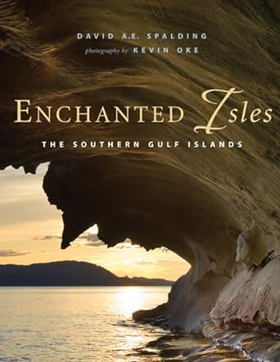
The southern Gulf Islands between Nanaimo and Victoria are among British Columbia's greatest scenic treasures, projecting an appeal so powerful as to make nesomanes (island lovers) of the most unromantic souls. Ranging in size from Saltspring (pop. 12,000) to unoccupied D'arcy, they first began to attract European settlers in 1859 and have been home to a special breed of freedom-loving denizen ever since. Author David A.E. Spalding and photographer Kevin Oke are both members of this unique tribe and in this book pay tribute to their chosen region with the sensitivity and insider knowledge only long-time residents can provide. Brimming with gorgeous colour photographs by Oke, Enchanted Isles begins with a historic overview detailing how the islands served as a favoured hideaway of some of BC's most distinguished eccentrics. Remittance men and other escapees from British stuffiness form one stream of islanders, but there have been many others. A census of Saltspring in 1895 included a Patagonian, Germans, Portuguese, Hawaiians, Americans, Shetlanders and Scandinavians. Today you may expect to find individuals from virtually anywhere in the world. Enchanted Isles showcases local wildlife, captures local character and history and offers insider tips for visitors. It is a spectacular coffee-table book that shows why the Gulf Islands rank with Whistler and the Pacific Rim as one of the most popular tourist destinations in BC. 144 p. : col. ill. ; 29 cm. CIRC [ 1 ]
|
2007 |
|
The white cascade the Great Northern Railway disaster and America's deadliest avalanche by Gary Krist 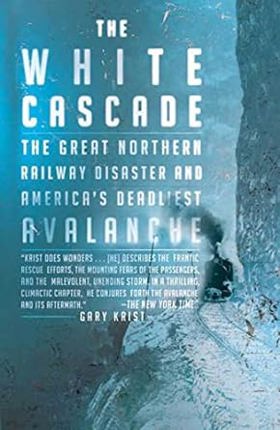
In February 1910, a monstrous blizzard hit the Northwest. High in the Cascade Mountains, near the tiny town of Wellington, two trainloads of cold, hungry passengers and their crews found their railcars marooned, buried in rising drifts on the edge of a steep ravine. Days later, with the effort to rescue the trains continuing, a colossal avalance tumbled down, sweeping the trains over the steep slope and down the mountainside xii, [6], 315, [2] pages, 16 unnumbered pages of plates : illustrations, maps, portraits ; 21 cm CIRC [ 1 ]
|
2007 |
|
Up the Strait coastal British Columbia stories by Wayne J. Lutz 
Boating, hiking, and survival off the grid in coastal British Columbia, where mountains drop into the sea and people practice self-reliance and a different sense of purpose. Destinations on the Strait of Georgia that can be reached by boat, bicycle, all-terrain vehicle, and sea kayak. Contrarian views of the people and places of coastal British Columbia. A travelogue memoir based on off-the-grid living in a floating cabin, where the sublime beauty of British Columbia's lower mainland forms the setting, and the Strait of Georgia awaits on your doorstep. 223 p. : ill., maps, ports. ; 23 cm. CIRC [ 1 ]
|
2007 |
|
Desolation Sound a history by Heather Harbord 
Beautiful Desolation Sound, 150 km north of Vancouver, has for many years been the most popular cruising destination on the BC coast, but is today almost as devoid of local occupants as it was in 1792 when the dyspeptic Captain George Vancouver gave it its misleading name. It has not always been this way. Thick clamshell middens in remote bays, rotted pilings on silent estuaries, ambitious stone terraces on vacant hillsides, overgrown fences around deserted fields, even abandoned railroads--all contribute to an impression that this is an area full of ghosts, an area with a storied past. In Desolation Sound, author Heather Harbord details that remarkable past and brings those ghosts back to unforgettable life. We meet Mike Shuttler, the Homer-quoting hermit who figured in famous books by Stuart Edward White and M. Wylie Blanchet. We meet his illiterate neighbour Phil Lavigne, who said, when Shuttler died, "All dem words, and 'e 'ad to die like all de rest of us!" We meet "the Cougar Queen of Okeover Arm," who said, "Living in the bush like I do, a gun is as much a part of my household tools as a vacuum cleaner is in the city." We visit Baloney Bay, a sprawling Depression-era logging camp where human life had so little value they piled accident victims in a heap and didn't bother moving them until the end of the working day. We meet Sliammon chief Joe Mitchell, whose ancestors had an aboriginal city with buildings 200 feet long in now-deserted Grace Harbour. Harbord assiduously tracks down all the old legends that cling to the shoreside trees like Spanish moss, debunking some, confirming many. Desolation Sound is a captivating book full of great characters, heroic deeds, humorous anecdotes and well-researched fact. It fills a crucial hole in the history of the BC coast. xi, 260 p. : ill., maps, ports. ; 23 cm. CIRC [ 1 ]
|
2007 |
|
The land called Lewis a history of Lewis County, Washington by Sandra A. Crowell 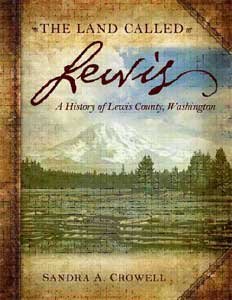
An excellent and comprehensive historical account of Lewis County history, from the first tribes to the closing of the Trans Alta coal mine in 2006. Wonderful historical photographs and fantastic research. A true Lewis County treasure. 204 pages : illustrations, maps ; 29 cm CIRC [ 1 ]
|
2007 |
|
Four travel journals the Americas, Antarctica and Africa, 1775-1874 by H. K. Beals 
The journals featured are: the 1775 journal of Juan Francisco de la Bodega y Quadra, Pringle Stokes' journal of HMS Beagle in the Straits of Magellan, 1827, the journal kept by Joseph Henry Kay during the voyage of HMS Chanticleer, 1828-1831, and Jacob Wainwright's diary telling of the transportation of Dr Livingstone's body, 1873-1874 x, 404 pages : illustrations, maps ; 26 cm. CIRC [ 1 ]
|
2007 |
|
Native Seattle histories from the crossing-over place by Coll-Peter Thrush 
In traditional scholarship, Native Americans have been conspicuously absent from urban history. Indians appear at the time of contact, are involved in fighting or treaties, and then seem to vanish, usually onto reservations. In Native Seattle, Coll Thrush explodes the commonly accepted notion that Indians and cities--and thus Indian and urban histories--are mutually exclusive, that Indians and cities cannot coexist, and that one must necessarily be eclipsed by the other. Native people and places played a vital part in the founding of Seattle and in what the city is today, just as urban changes transformed what it meant to be Native. On the urban indigenous frontier of the 1850s, 1860s, and 1870s, Indians were central to town life. Native Americans literally made Seattle possible through their labor and their participation, even as they were made scapegoats for urban disorder. As late as 1880, Seattle was still very much a Native place. Between the 1880s and the 1930s, however, Seattle's urban and Indian histories were transformed as the town turned into a metropolis. Massive changes in the urban environment dramatically affected indigenous people's abilities to survive in traditional places. The movement of Native people and their material culture to Seattle from all across the region inspired new identities both for the migrants and for the city itself. As boosters, historians, and pioneers tried to explain Seattle's historical trajectory, they told stories about Indians: as hostile enemies, as exotic Others, and as noble symbols of a vanished wilderness. But by the beginning of World War II, a new multitribal urban Native community had begun to take shape in Seattle, even as it was overshadowed by the city's appropriation of Indian images to understand and sell itself. After World War II, more changes in the city, combined with the agency of Native people, led to a new visibility and authority for Indians in Seattle. The descendants of Seattle's indigenous peoples capitalized on broader historical revisionism to claim new authority over urban places and narratives. At the beginning of the twenty-first century, Native people have returned to the center of civic life, not as contrived symbols of a whitewashed past but on their own terms. In Seattle, the strands of urban and Indian history have always been intertwined. --From publisher's description 1 online resource (xxi, 326 pages) : illustrations CIRC [ 1 ]
|
2007 |
|
The Stehekin we remember by Buckner Sisters, Irene Sargo, Harriet Morehead, Elizabeth Gans 
Published in 2007 by Irene Sargo, Harriet Morehead, and Elizabeth Gans—known as the Buckner sisters—The Stehekin We Remember offers an intimate, firsthand chronicle of pioneer life in the isolated Stehekin Valley at the head of Lake Chelan during the 1920s through the 1940s. The book blends family memoirs, historic photographs, and detailed genealogical maps to document the daily routines of self-sufficient homesteading, one-room schoolhouses, and orchard management without modern amenities. Alongside their own family history, the authors meticulously record the profiles of neighboring pioneer households, preserving a comprehensive social fabric of the valley. A keen insight drawn from the text is how it highlights the duality of isolation; while geographic remoteness imposed severe physical hardships and labor-intensive survival strategies on children growing up in the North Cascades, it simultaneously fostered a remarkably resilient, hyper-collaborative community network that deeply anchored their collective identity. 203 pages : illustrations ; 23 cm CIRC [ 1 ]
|
2007 |
|
Historical atlas of Vancouver and the Lower Fraser Valley by Derek Hayes 
Map researcher and collector Derek Hayes here presents the sixth in a series of critically acclaimed, award-winning historical atlases. Gathered together in a single volume for the first time, here are the maps that shaped Vancouver and the surrounding Lower Fraser Valley. More than 370 original maps chart the region’s development beginning with the years of discovery and exploration. They depict its days as a fledgling colonial outpost, its appearance on the world scene after the arrival of the Canadian Pacific Railway, through to its emergence as a postwar Pacific metropolis. These maps evoke such historic events and developments as the founding of Fort Langley, the first settlements on the inlet, and the filling in of False Creek, along with more recent aspects of this richly diverse area such as the real estate boom and the explosive growth of Vancouver. Included are many fascinating plans for schemes that never got off the drawing board. 192 p. : ill. ; 30 cm. CIRC [ 1 ]
|
2007 |
|
McClure of Idaho by William L. Smallwood 
Smallwood presents a biography of Senator Jim McClure, covering his career as a Congressman in Idaho to his 18 years of service in the US Senate until 1991. The biography is based on interviews with McClure and those who worked with him. It begins with how the Republican candidate for Idaho's 1st Congressional District seat died in a plane crash, leaving the possibility open for McClure, and goes back to McClure's family history and childhood, followed by his education as a law student and the period when he was a practicing lawyer, and his work as a politician during the terms of six presidents. --Publisher xvii, 485 pages : illustrations ; 24 cm CIRC [ 0 ]
|
2007 |
|
The deadliest Indian war in the West the Snake conflict, 1864-1868 by Gregory Michno 
The Snake War is one of the least known of the many clashes of culture that occurred in the American West during the 19th Century. Most Americans have heard of famous chiefs like Sitting Bull, Red Cloud, Geronimo, Cochise, and Crazy Horse. Few have heard of Paulina, Weahwewa, Howluck, or Ocheho. To most people, Winnemucca is simply the name of a lonely stop on the Nevada Interstate. These were the men who led their people in a fight for survival in the Great Basin between the Rockies and the Sierras. The author gives readers the first comprehensive look at the natives, soldiers, and settlers who clashed on the high desert of Idaho, Nevada, Utah, Oregon, and Northern California in a struggle that, over a 4-year period, claimed more lives than any other Western Indian war xviii, 380 pages : illustrations, maps ; 23 cm CIRC [ 0 ]
|
2007 |
|
With Vancouver in inland Washington waters journals of 12 crewmen, April-June 1792 by Richard W. Blumenthal 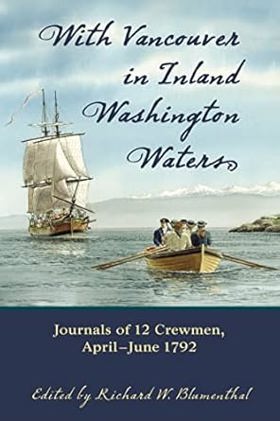
Publisher description: Picking up the narrative from his earlier volume, The Early Exploration of Inland Washington Waters: Journals and Logs from Six Expeditions, 1786-1792, Richard Blumenthal once again offers the reader a fascinating, firsthand look at the Northwest's earliest maritime history. This volume reproduces twelve individual journals, each composed by one of George Vancouver's men as they explored the Washington area in 1792. Providing additional details of exploration in inland areas not previously described, it contains a record of Peter Puget's observations and explorations of Puget Sound and a detailed description of William Broughton's passage through San Juan Islands. These journals also provide detail regarding the day-to-day onboard activities of both officers and enlisted men. A brief biographical note is provided at the beginning of each man's journal vii, 230 pages : maps ; 23 cm CIRC [ 0 ]
|
2007 |
|
Operation Orca Springer, Luna and the struggle to save West Coast killer whales by Daniel Francis, Gil Hewlett 
In 1964 when the Vancouver Aquarium obtained its first killer whale, Moby Doll, the prevalent attitudes towards killer whales was that they were fierce and vicious man-eaters. Over the years, attitudes have begun to change, and orcas are now revered as loveable, intelligent creatures and iconic symbols of the marine environment. In January 2002, a young killer whale was discovered alone in the waters of Puget Sound near Seattle. Determining that the whale would not survive alone so far from home, a team of scientists captured "Springer" and transported her by boat north to her home range where she rejoined her family. At the same time Springer was making her historic journey, another lone whale turned up in Nootka Sound on the west coast of Vancouver Island. The people of Nootka Sound adopted "Luna" as their own, but he was a large, boisterous youngster who liked to cuddle boats and the government feared he would get into trouble. Another rescue was planned to return Luna to his family but this time there was no happy ending. In Operation Orca, winner of the 2008 Foreword Magazine Nature Book of the Year award, author Daniel Francis and long-time Vancouver Aquarium staff member Gil Hewlett give breadth to the complications, contradictions, and political posturing that twice engulfed the debate of whether to interfere or let nature take its course. Through the amazing story of these two "orphan" whales, Operation Orca tells the larger story of orcas in the Pacific Northwest, the people who have studied them and the transformation of the whale's image from killer to icon. 280 p. : ill. (some col.), maps ; 24 cm. CIRC [ 0 ]
|
2007 |
|
Silviculture and ecology of western U.S. forests by John C. Tappeiner, Douglas A. Maguire, Timothy B. Harrington 
Silviculture, once regarded solely as reforestation and growing trees for timber, is understood today as also maintaining forest health, reducing fire potential, benefitting wildlife and aesthetics, and ensuring multiple options for the future against the uncertainties of a changing climate. Silviculture and Ecology of Western U.S. Forests, Second Edition, is a text for students, professional forest managers, and scientists that summarizes both early and contemporary research and principles relevant to the silviculture, ecology, and multi-purpose management of western U. S. forests. Based on its authors’ significant experiences and contributions in the field, as well as nearly 1000 additional references, Silviculture and Ecology remains the only text that focuses on silviculture in western U.S. forests—providing background and basis for current biological, ecological, and managerial practices. Detailed chapters on fire, tree growth, and management of complex stand structures, as well as shrub ecology and an ecosystem framework, are bolstered in the second edition. A new series of case studies illustrates how silvicultural practices are developed and modified as forests grow and new challenges and opportunities occur. Contemporary silvicultural practices, particularly pertaining to fire use, vegetation management, soil fertility, and fertilization have been updated, and modifications that enhance standard practices are demonstrated throughout the text. In this comprehensive reference, readers entering the field will come to understand the significance of carefully managing forests by conscious design, and experienced silviculturists will benefit from the edition’s up-to-date information, providing forest users with a greater range of ecosystem services and consumable products alike. vii, 440 pages : illustrations ; 23 cm CIRC [ 0 ]
|
2007 |
|
Empty nets Indians, dams, and the Columbia River by Roberta Ulrich 
Empty Nets is a disturbing history of broken promises and justice delayed. It chronicles the Columbia River Indians' fight to maintain their livelihood and culture in the face of an indifferent federal bureaucracy and hostile state governments. In 1939, the U.S. Government promised to provide Columbia River Indians with replacements for traditional fishing sites flooded in the backwater of the Bonneville Dam. Roberta Ulrich recounts the Indians' decades-long struggle, in the courts and on the river, to persuade the government to keep its promise. From the beginning, the battle was intertwined with the tribes’ larger effort to assert treaty-guaranteed fishing rights. Ulrich deftly examines a host of other issues—including declining salmon runs, industrial development, tribal self-government, and recreation—that became enmeshed in the tribes’ pursuit of justice. Her broad and incisive account ranges from descriptions of the dam’s disastrous effects on a salmon-dependent culture to portraits of the plights of individual Indian families. Descendants of those to whom the promise was made and activists who have spent their lives working to acquire the sites reveal the remarkable patience and resilience of the Columbia River Indians. As Ulrich notes in a new epilogue to Empty Nets, the story continues to the present. With most of the replacement fishing sites now completed, the government’s promise will finally be fulfilled in this new century. vii, 254 pages : illustrations, map ; 23 cm. CIRC [ 0 ]
|
2007 |
|
An architectural guidebook to Portland by Bart King 
Portland strikes a graceful balance between the rich traditions of its past and the creative developments of modern architecture. Written for both layperson and professional, An Architectural Guidebook to Portland is filled with history and photos that demonstrate why this city is one of the most admired in the nation. Portland's civic planning, historic preservation, and overall attractiveness are all explored in detailed profiles of structures ranging from 19th-century cast-iron front buildings to sleek modern skyscrapers. Now revised and updated to reflect Portland's explosive growth in the 21st century, this second edition includes an added focus on the development of "green buildings" and sustainable design, a chapter on downtown bridges, and expanded coverage of the city's vibrant neighborhoods. With over 250 entries that tell the stories behind Portland's celebrated cityscape, this comprehensive guide is an indispensable resource for visitors and Portlanders alike. Don't miss Bart King's Architecural Guide to Portland, a mobile site for the Web and mobile devices, which features rotating content from the book. viii, 320 pages : illustrations, maps ; 23 cm CIRC [ 0 ]
|
2007 |
|
Children of the fur trade forgotten Métis of the Pacific Northwest by John C. Jackson 
A riveting glimpse into a unique heritage, Children of the Fur Trade recovers a vital part of Northwest history. During the first half of the 19th century, a unique subculture built around hunting and mobility existed quietly in the Pacific Northwest. Descendants of European or Canadian fur trapper fathers and Native American mothers, these mixed-blood settlers--called Metis--were pivotal to the development of the Oregon Country, but have been generally neglected in its written history. Today we know them by the names they left on the land and the waters: The Dalles, Deschutes, Grand Ronde, Portneuf, Payette; and on the peoples who lived there: Pend Oreille, Coeur d'Alene, Nez Perce. John C. Jackson's Children of the Fur Trade gives readers a vivid and memorable portrait of Metis life at the western edge of North America. This informal account shows the Metis as explorers and mapmakers, as fur trappers and traders, and as boatmen and travelers in a vanishing landscape. Because of their mixed race, they were forced into the margin between cultures in collision. Often disparaged as half-breeds, they became links between the dispossessed native peoples and the new order of pioneer settlement. 326 pages : illustrations, maps ; 23 cm. CIRC [ 0 ]
|
2007 |
|
The Seattle bungalow people and houses, 1900-1940 by Janet Ore 
In the early twentieth century, the appearance of new houses across the United States shifted dramatically. Rejecting the elaborate decoration and complexity of Victorian homes, these new houses featured open, parlorless interiors and a minimalist aesthetic, radiating an aura of warmth, coziness, and naturalness. Nowhere were such residences more evident than in West Coast cities, especially Seattle, where explosive growth generated entire neighborhoods of this new house type--the bungalow. It was the nation's first modern home, and it established the essential characteristics of popular housing for the rest of the twentieth century. In The Seattle Bungalow, Janet Ore modifies the common notion that architectural change flows only from the design elite--the architects, domestic reformers, and planners who advocate for changes in domestic architecture--and argues that ordinary people played a crucial role in creating the bungalow. Through their growing power as consumers, modest-income families influenced the physical form of early twentieth-century houses and suburban landscapes. Still operating within a nineteenth-century labor and contracting system, small home builders responded to rising consumer demand for new conveniences such as electricity and central heating by simplifying their structures. Ambitious salespeople-real estate agents, plan book purveyors, and builders--created a new market for affordable small houses through astute advertising and financing. And once families acquired their homes, they used them flexibly, adapting their lives to their domestic spaces and refashioning their homes when necessary. From such efforts sprang the Seattle bungalow, an artifact of ordinary people's part in creating modern culture. xviii, 202 pages : illustrations, map ; 26 cm CIRC [ 0 ]
|
2007 |
|
On American soil how justice became a casualty of World War II by Jack Hamann 
During the night of August 14, 1944, an Italian prisoner of war was lynched on the Fort Lawton army base in Seattle--a murder that shocked the nation and the international community. It was a time of deep segregation in the army, and the War Department was quick to charge three African American soldiers with first-degree murder, although there was no evidence linking them to the crime. Forty other black soldiers faced lesser charges over the incident, launching one of the largest and longest army trials of World War II. In this harrowing story of race, privilege, and power, Jack Hamann explores the most overlooked civil rights event in American history. On American Soil raises important questions about how justice is carried out when a country is at war, offering vital lessons on the tensions between national security and individual rights. xviii, 358 pages ; 23 cm CIRC [ 0 ]
|
2007 |