Catalog of British Columbiana and Pacific Northwest Americana
Encyclopedia Cascadia Catalog contains book titles of mostly non-fiction Pacific Northwest Coast of North America Titles (primarially British Columbia, Idaho, Oregon and Washington State) in an easy-to-understand title catalog. If you see a link with this badge ONLINE CIRC it means that there is an online institution that provides free access to that title. In some cases there may be more than one institution hosting the title digitally.
| Catalog Title | Published |
|---|---|
|
Atlas of Lane County, Oregon by James E. Meacham, Lane County (Or), University of Oregon, Lane Council of Governments (Or)
|
1990 |
|
At the hearth of the crossed races a French-Indian community in nineteenth-century Oregon, 1812-1859 by Melinda Marie Jetté 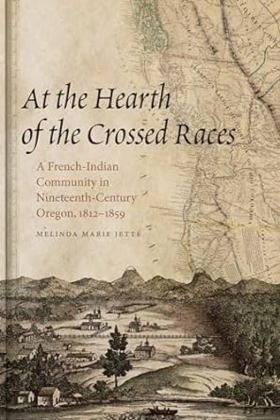
"Despite the force of Oregon's founding mythology, the Willamette Valley was not an empty Eden awaiting settlement by hardy American pioneers. Rather, it was, as Melinda Jette explores in At the Hearth of the Crossed Races, one of the earliest sites of extensive intercultural contact in the Pacific Northwest. Jette's study focuses on the 'hearth' of this contact: French Prairie, so named for the French-Indian families who resettled the homeland of the Ahantchuyuk Kalapuyans. Although these families sought a middle course in their relations with their various neighbors, their presence ultimately contributed to the Anglo-American colonization of the region. By establishing farming and husbandry operations in the valley, the French-Indian settlers enhanced the Willamette Valley's appeal as a destination of choice for the Anglo-Americans who later emigrated to the Pacific Northwest via the Oregon Trail. Upon these emigrants' arrival, the social space for the people of the 'crossed races' diminished considerably, as the Anglo-Americans instituted a system of settler colonialism based on racial exclusion. Like their Native kin, the French-Indian families pursued various strategies to navigate the changing times and Jette's study of French Prairie takes on the relationships among all three: the French-Indian families, the Indigenous peoples, and the Anglo-American settlers. With At the Hearth of the Crossed Races, Jette delivers a social history that deepens our understanding of the Oregon Country in the nineteenth century. This history of French Prairie provides a window into the multi-racial history of the Pacific Northwest and offers an alternative vision of early Oregon in the lives of the biracial French-Indian families whose community challenged notions of white supremacy, racial separation, and social exclusion"-- Provided by publisher xix, 337 pages : illustrations ; 23 cm. CIRC [ 1 ]
|
2015 |
|
At the end of the car line by Ben Hur Lampman 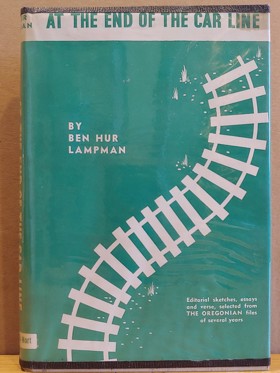
At the End of the Car Line, published in 1942 by Binfords & Mort in Portland, Oregon, is a collection of editorial sketches, essays, and verses originally written by Ben Hur Lampman for The Oregonian, where he was a longtime columnist and associate editor. Lampman, a celebrated Oregon writer and the state’s poet laureate from 1951 until his death in 1954, was known for his lyrical yet accessible style, capturing the everyday life and natural beauty of the Pacific Northwest. This book reflects his versatility as a writer—blending prose and poetry to explore themes close to his heart. 1 preliminary leaf, 191, [1] pages : frontispiece (illustration) ; 21 cm CIRC [ 0 ]
|
1942 |
|
At the bridge James Teit and an anthropology of belonging by Wendy C. Wickwire 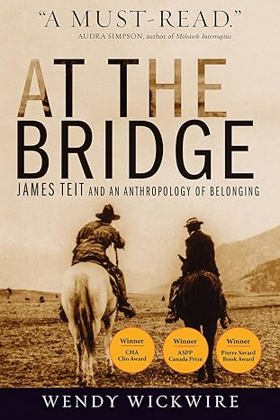
"Every once in a while, an important historical figure makes an appearance, makes a difference, and then disappears from the public record. James Teit (1864-1922) was such a figure. A prolific ethnographer and tireless Indian rights activist, Teit spent four decades helping British Columbia's Indigenous peoples in their challenge of the settler-colonial assault on their lives and territories. Yet his story is little known. At the Bridge chronicles Teit's fascinating story. From his base at Spences Bridge, British Columbia, Teit practised a participant- and place-based anthropology - an anthropology of belonging - that covered much of BC and northern Washington, Idaho, and Montana. Whereas his contemporaries, including famed anthropologist Franz Boas, studied Indigenous peoples as the last survivors of "dying cultures" in need of preservation in metropolitan museums, Teit worked with them as members of living cultures actively asserting jurisdiction over their lives and lands. Whether recording stories and songs, mapping place-names, or participating in the chiefs' fight for fair treatment, he made their objectives his own. With his allies, he produced copious, meticulous records; an army of anthropologists could not have achieved a fraction of what Teit achieved in his short life. Wendy Wickwire's beautifully crafted narrative accords Teit the status he deserves. At the Bridge serves as a long-overdue corrective, consolidating Teit's place as a leading and innovative anthropologist in his own right."-- Provided by publisher xviii, 374 pages : illustrations, maps ; 24 cm CIRC [ 1 ]
|
2019 |
|
Astorians, eccentric and extraordinary by Karen Kirtley 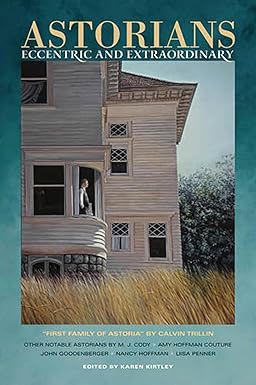
In 1993, The New Yorker published Calvin Trillin’s memorable article on the eccentric Flavel family of Astoria, the descendants of Captain George Flavel, whose ornate Queen-Anne-style mansion is a tourist draw today. With Trillin’s gracious consent, “First Family of Astoria” is reprinted in Part One of Astorians, Eccentric and Extraordinary, making its first appearance in book form. Part Two carries on the theme with portraits of fifty-five other notable Astorians. Five Oregon writers have captured the essence and the flavor of vivid personalities that include the notorious shanghaier Bridget Grant; the charming scoundrel Mayor Francis Clay Harley; the elusive English “barmaid” Jane Barnes, the first white woman in the Pacific Northwest; and Rolf Klep, who believed he could create a major maritime museum in an economically depressed town—and made it happen. In biology, it is said that the richest life forms reside at the edge of the ecosystem. Astoria epitomizes edges—the edge of the country, the edge of a great river, the edge of the Pacific Ocean, and the edge of our American culture. This book celebrates the larger-than-life quality that has appeared with regularity in the town’s two-hundred-year history. As Steve Forrester, publisher of The Daily Astorian, notes in the book’s introduction: “Extraordinary people are not necessarily eccentric. But eccentrics are driven to do extraordinary things.” 224 pages : illustrations, maps ; 23 cm CIRC [ 0 ]
|
2010 |
|
Astoria & empire by James P. Ronda 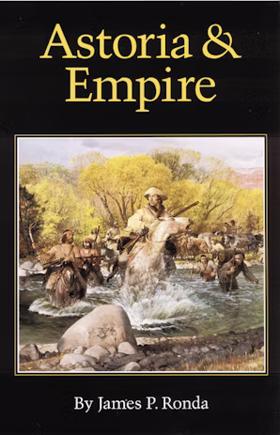
In late December 1788 a worried Spanish official in Mexico City set down his fears about a new and aggressive northern neighbor. Viceroy Manuel Antonio Florez offered a gloomy prediction about the future of Spanish-United States relations in the West. He already knew about the steady march of frontiersmen toward St. Louis and now came troubling word of Robert Gray's ship Columbia on the Northwest coast. All this seemed to fit a pattern, a design for Yankee expansion. "We ought not to be surprised," warned the viceroy, "that the English colonies of America, now being an independent Republic, should carry out the design of finding a safe port on the Pacific and of attempting to sustain it by crossing the immense country of the continent above our possessions of Texas, New Mexico, and California." Canadian fur merchants and Russian bureaucrats also viewed the young republic as a potential rival in the struggle for western dominion. The viceroy's vision of the future proved startlingly accurate. Within the next two decades an American president would authorize a federally funded expedition to find just the sort of transcontinental route Florez imagined. Equally important, a New York entrepreneur would propose and put into motion an ambitious plan to make the Northwest an American political and commercial empire. John Astor's Pacific Fur Company, with Astoria as its central post on the Columbia River, was Florez's nightmare come true. Astoria had long represented either a daring overland adventure or simply a failed trading venture. The Astorians surely had their share of adventure. And the Pacific Fur Company never brought its founder the profits he expected. But all those involved in the extensive enterprise knew it meant more. Thomas Jefferson once described Astoria as the "germ of a great, free and independent empire," believing that the entire American claim to the lands west of the Rockies rested on "Astor's settlement at the mouth of the Columbia." And John Quincy Adams, the expansionist-minded secretary of state, labeled then entire Northwest as "the empire of Astoria." This book seeks to explore Astoria as part of a large and complex struggle for national sovereignty in the Northwest. The Astorians and their rivals were always engaged in more than trading and trapping. They were advance agents of empire. -- from Preface xiv, 400 pages : illustrations, maps ; 23 cm CIRC [ 1 ]
|
1990 |
|
Astoria Enterprise beyond the Rocky mountains by Washington Irving 
Washington Irving's 'Astoria' chronicles the story of John Jacob Astor's ambitious attempt to establish a trading post on the Columbia River in Oregon in 1810. Irving narrates the adventurous spirit of the pioneers, their encounters with native tribes, and the legacy they left behind. It is a gripping tale of exploration and enterprise, ideal for readers of adventure and history. xvi, 336 pages ; 22 cm ONLINE CIRC [ 1 ]
|
1836 |
|
Astoria an Oregon history by Karen L. Leedom 
The rest of the country is just beginning to discover Astoria, Oregon, that historic gem of a town at the mouth of the Columbia River west of Portland, and the oldest European-American settlement west of the Rockies. The author provides a chronological look dating back to the 1500s, including European exploration, Native American life, logging, fishing, Chinese laborers in the salmon industry, a giant cheese in the Civil War, Oregon’s first female surgeon, Victorian architecture, and valiant Coast Guard rescues. vi, 218 pages : illustrations, maps ; 23 cm CIRC [ 1 ]
|
2010 |
|
Astoria by Washington Irving
|
1967 |
|
Astoria by Chelsea K. Vaughn 
Established in 1811, Astoria, Oregon, holds claim to being the oldest US settlement west of the Rockies. After surviving devastating fires and severe economic downturns, modern Astoria--with its well-preserved historic homes and bustling downtown--is a beacon on the scenic Columbia River. Comparing our present to our past is how we understand our history. Books in this series offer a special view of American life by placing historical images side by side with contemporary photographs.--From back cover x, 95 pages : illustrations (some color) ; 24 cm. CIRC [ 0 ]
|
2023 |
|
Asserting native resilience Pacific rim indigenous nations face the climate crisis by Zoltán. Grossman, Alan Parker 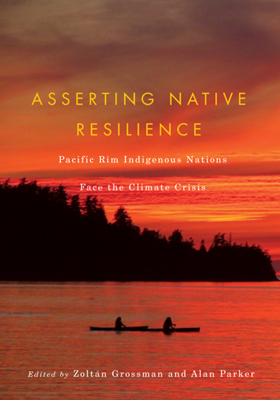
Indigenous nations are on the frontline of the current climate crisis. With cultures and economies among the most vulnerable to climate-related catastrophes, Native peoples are developing responses to climate change that serve as a model for Native and non-Native communities alike. Native American nations in the Pacific Northwest, First Nations in Canada, and Indigenous peoples around the Pacific Rim have already been deeply affected by droughts, flooding, reduced glaciers and snowmelts, seasonal shifts in winds and storms, and changes in species on the land and in the ocean. Having survived the historical and ecological wounds inflicted by colonization, industrialization, and urbanization, Indigenous peoples are using tools of resilience that have enabled them to respond to sudden environmental changes and protect the habitat of salmon and other culturally vital species. They are creating defenses to strengthen their communities, mitigate losses, and adapt where possible. Asserting Native Resilience presents a rich variety of perspectives on Indigenous responses to the climate crisis, reflecting the voices of more than twenty contributors, including Indigenous leaders and Native and non-Native scientists, scholars, and activists from the Pacific Northwest, British Columbia, Alaska, and Aotearoa/New Zealand. Also included is a resource directory of indigenous governments, non-governmental organizations, and communities that are researching and responding to climate change and a community organizing booklet for use by Northwest tribes. An invaluable addition to the literature on climate change, Asserting Native Resilience will be useful for students of environmental studies, Native studies, geography, and rural sociology, and will serve as an important reference for indigenous leaders, tribal members, rural planners, and environmental agency staff. 239 pages : illustrations, maps ; 26 cm CIRC [ 0 ]
|
2012 |
|
Ashland, an Oregon oasis an Oregon documentary by Janelle Davidson, Bert Webber 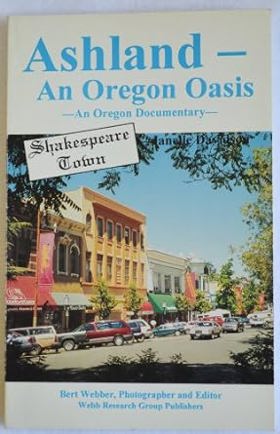
Authored by Janelle Davidson and Bert Webber, Ashland, an Oregon Oasis: An Oregon Documentary chronicles the development of the southern Oregon town from a pioneer milling settlement into a vibrant cultural haven renowned for its natural mineral springs and the Oregon Shakespeare Festival. The book weaves together historical photographs, local archives, and narrative documents to trace how the community leveraged its unique natural geography and artistic ambitions to survive economic shifts. Through these collected records, the text captures the deliberate transformation of a remote Rogue Valley stopover into a thriving destination for travelers and intellectuals alike. A keen insight drawn from the work is how intentional cultural institutions can insulate a regional economy from resource dependency; by pivoting from local timber and agriculture toward world-class theater and holistic tourism, Ashland demonstrated that remote communities can engineer their own prosperity by transforming local geographic assets into an internationally recognized cultural brand. 160 pages : illustrations, maps ; 22 cm CIRC [ 1 ]
|
1995 |
|
Ashland the first 130 years by Marjorie O'Harra
|
1981 |
|
As the condor soars conserving and restoring Oregon's birds by Susan M. Haig , Daniel D. Roby , Tashi A. Haig , Ramiel Papish (Illustrator), John A. Wiens, John D. Alexander , Oregon State University Press (Publisher) 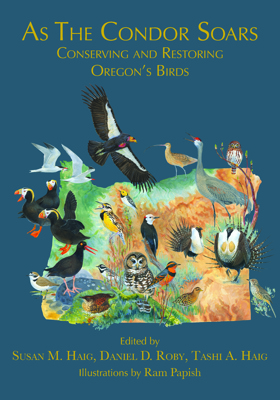
"This book is a gift to Oregon about Oregon birds by the Oregonians who care so much about saving the precious creatures and the habitats they live in. It is a series of engaging essays about the dramatic efforts these scientists have made and continue to make to reduce the decline of threatened Oregon bird species. Readers learn about the innovative approaches avian ecologists have used over the decades and the important role of citizen scientists in saving our treasured birds. Ten years ago, no one would have imagined welcoming majestic California Condors back into Oregon. Very few would have predicted record numbers of Snowy Plovers on the coast. Yet, thanks to the efforts of these authors and others, the birds are returning. These essays provide hope for species recovery, despite environmental threats, when scientists and the public work together. They also offer to other regions examples of adaptive management learned over the decades. The full color book is beautifully illustrated by noted Oregon Coast artist Ram Papish and includes over 80 stunning bird photographs donated by some of the state's finest nature photographers. An additional 50 biographies of noted Oregon avian scientists and conservationists rounds out the inspirational stories about the monumental efforts that have taken shape for decades - often with national and international attention. The book is an easy read for interested nature-lovers and can serve as the basis for conservation-related discussions from the high school level through graduate seminars."--Provided by publisher xxiii, 334 pages : color illustrations, color maps, color portraits ; 26 cm CIRC [ 0 ]
|
2022 |
|
As the anvil rings by Geneva Bair Wilson 
As the Anvil Rings by Geneva Bair Wilson is a 1986 autobiographical memoir published by the regional historical publisher Ye Galleon Press, based in Fairfield, Washington. The book chronicles Wilson's pioneer childhood and coming-of-age experiences, tracing her early life in eastern Kansas and near Cheyenne Wells, Colorado, up to her marriage to True Wilson in 1925. While its primary setting is geographically east of the Pacific Northwest, the work is part of the broader Western Americana catalog preserved by this notable Washington press, serving as a valuable firsthand account of early 20th-century frontier settlement, agricultural challenges, and rural family dynamics. 313 pages : illustrations (some color) ; 27 cm CIRC [ 1 ]
|
1986 |
|
As rugged as the terrain CCC "boys," federal convicts, and World War II alien internees wrestle with a mountain wilderness by Priscilla Wegars , Dick Hendricks 
As Rugged as the Terrain: CCC Boys, Federal Convicts, and World War II Alien Internees Wrestle with a Mountain Wilderness explores some intriguing history of Idahos wild and scenic Lochsa River. In 1893 this site, at turbulent Canyon Creek, was a footnote in the saga of the ill-fated Carlin hunting party. Next, in 1933, it held nearly 200 tent-dwelling Civilian Conservation Corps recruits, most from New York State. The antics of these city slickers provide colorful insights into CCC camps housing young men far from home. xxxviii, 393 pages : illustrations, maps ; 23 cm. CIRC [ 0 ]
|
2013 |
|
|
1953 |
|
Art of the Northwest coast by Aldona Jonaitis 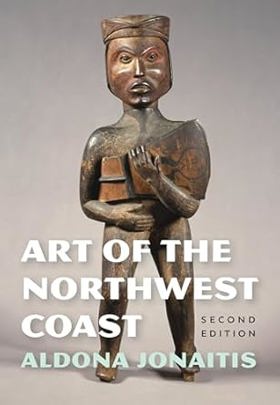
"Originally published in 2006, Art of the Northwest Coast offers an expansive history of this great tradition, from the earliest known works to those made at the beginning of the twenty-first century. Although non-Natives often claimed that First Nations cultures were disappearing, Northwest Coast Native people continued to make art during the painful era of colonization, often subtly expressing resistance to their oppressors and demonstrating the resilience of their heritage. Integrating the art's development with historical events following contact with Euro-Americans sheds light on the creativity of artists as they appropriated and transformed foreign elements into uniquely Indigenous statements. A new chapter discusses contemporary artists, including Marianne Nicholson, Nicholas Galanin, Lawrence Paul Yuxweluptun, and Sonny Assu, who address pressing issues ranging from Indigenous sovereignty and destruction of the environment to the power of Native women and efforts to work with non-Natives to heal the wounds of racism and discrimination"-- Provided by publisher xxiv, 387 pages : illustrations (some color), maps ; 25 cm CIRC [ 0 ]
|
2021 |
|
Art in Seattle's public places an illustrated guide by James M. Rupp, Mary Randlett 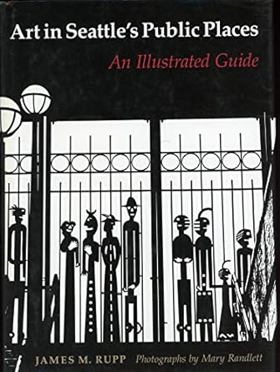
Covers art in Seattle's neighborhoods, including the downtown, Pioneer Square, the University of Washington, Green Lake and north Seattle. Includes sculpture, stained glass and murals 320 pages : illustrations, maps ; 27 cm CIRC [ 1 ]
|
1992 |
|
Archaeology of the upper Columbia region by Donald Collier , Alfred E. Hudson , Arlo Ford
176, [1] pages : including illustrations (including maps, plans) XXII plates, tables, profiles ; 26 cm CIRC [ 1 ]
|
1942 |
|
Arch Cape chronicles a bit of Oregon coast's past by David English, Alma English 
Published by local historians David and Alma English, Arch Cape Chronicles: A Bit of Oregon Coast's Past explores the intimate, isolated history of a windswept coastal community nestled between Cannon Beach and Nehalem. The book traces Arch Cape’s evolution from an untamed wilderness of dense old-growth timber and rocky headlands into a quiet haven for pioneering homesteaders, loggers, and vacationers. Drawing on historical documents, oral histories, and vintage photographs, the authors document how early travelers navigated the treacherous coastline before the construction of modern highways and tunnels carved open the rugged terrain. A keen insight drawn from the work is how the very geographic barriers that delayed Arch Cape's development—such as towering sea cliffs and impassable tides—ultimately preserved its secluded character, transforming what was once an existential travel hazard into an exclusive sanctuary for those seeking refuge from the modern world. 357 pages : illustrations ; 26 cm CIRC [ 1 ]
|
1993 |
|
Another way the river has taut true tales from the Northwest by Robin Cody , Brian Doyle, Oregon State University Press (Issuing body) 
A collection of Robin Cody's nonfiction writing, 1982-2008. Another Way the River Has collects Robin Cody’s finest nonfiction writings, many appearing for the first time in print. Cody’s prose rings with a sense of place. He is a native speaker who probes the streams and woods and salmon that run to the heart of what it means to live and love, to work and play, in Oregon. His characters—from loggers to fishers to cowboys to the kids on his school bus—are smart and curious, often off-beat, always vivid. Cody brings the ear of a novelist and the eye of a reporter to the people and places that make the Northwest, and Northwest literature, distinctive. 190 pages ; 23 cm. CIRC [ 1 ]
|
2010 |
|
Annals of Astoria the headquarters log of the Pacific Fur Company on the Columbia River, 1811-1813 by Robert F. Jones 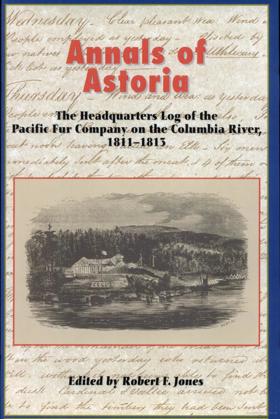
"This is the journal of Duncan McDougall, supervising partner of the Pacific Fur Company at Astoria. It records the daily operations at the post and in the Oregon country from the ship Tonquin's arrival on the Columbia until the sale of the post and the company assets to the North West Fur Company in November 1813"--Jacket xxx, 256 pages ; 24 cm CIRC [ 1 ]
|
1999 |
|
Ancient Modocs of California and Oregon by Carrol B. Howe
|
1979 |
|
Anakú Iwachá Yakama legends and stories by Virginia Beavert , Michelle M. Jacob , Joana W. Jansen 
An expanded collection of foundational Yakama stories. Central to the Yakama oral tradition, storytelling enables Tribal Elders to share lessons, values, and customs with younger generations across the Columbia River plateau and the Pacific Northwest. Drawn from a time before the coming of human beings when animals were like people, the stories present characters and motifs that paint a bigger picture of the world as Yakama ancestors knew it. The original edition of Anakú Iwachá featured stories that Yakama Tribal Elders recorded in several dialects of the Ichishkíin language that were collected and translated into English by renowned linguist and scholar Virginia Beavert. This new edition adds a preface from the Yakama Nation and essays on the history of the project and on Ichishkíin-language education. It includes four additional legends in Ichishkíin and English, annotations, an updated glossary, and more artwork by Tribal artists, helping readers, teachers, and students engage with the legends as teaching and learning tools and as a precious gift to current and future Yakama generations. xxi, 372 pages : illustrations (some color), maps (some color) ; 23 cm CIRC [ 1 ]
|
2021 |