Catalog of British Columbiana and Pacific Northwest Americana
Encyclopedia Cascadia Catalog contains book titles of mostly non-fiction Pacific Northwest Coast of North America Titles (primarially British Columbia, Idaho, Oregon and Washington State) in an easy-to-understand title catalog. If you see a link with this badge ONLINE CIRC it means that there is an online institution that provides free access to that title. In some cases there may be more than one institution hosting the title digitally.
| Catalog Title | Published |
|---|---|
|
Oregon literature by John B. Horner 
Oregon has produced more genuine literature during the short period of her history, extending back only fifty years, than all the thirteen American colonies wrote in a century and half. Notwithstanding this fact, she is the oldest state in the Union that has not collated the best things written by her sons and daughters. This task has been delayed merely for want of time and inclination. No one did it, so I undertook it 253, [2] pages, 36 unnumbered leaves of plates : illustrations, portraits ; 21 cm ONLINE CIRC [ 1 ]
|
1902 |
|
The Formation and Administration of the Provisional Government of Oregon by H. W. Scott
Harvey W. Scott's historical account details the 1843 establishment of Oregon's Provisional Government, chronicling how American pioneers in the Willamette Valley organically created their own civil authority prior to formal United States jurisdiction. A keen insight drawn from the text is that this localized governance was not born of political rebellion against the British Hudson's Bay Company, but rather out of the pragmatic necessity to manage land disputes, probate laws, and frontier security in a stateless vacuum. The narrative meticulously outlines the legislative and administrative milestones of this temporary state, highlighting the early settlers' inherent capacity for democratic organization. Ultimately, Scott demonstrates how this impromptu legal framework effectively secured American civilian control over the disputed Pacific Northwest, seamlessly paving the way for eventual territorial status without descending into frontier anarchy. 25 pages ONLINE CIRC [ 1 ]
|
1901 |
|
Life of General Isaac I. Stevens by Hazard Stevens
Written by his son Hazard Stevens, this extensive biography chronicles the life of General Isaac I. Stevens, focusing on his tenure as the first governor of Washington Territory and his subsequent military service during the Civil War. The narrative details his ambitious efforts to survey the northern transcontinental railroad route, his aggressive treaty negotiations with Pacific Northwest Native American tribes, and his eventual death at the Battle of Chantilly. A keen insight drawn from the text is how its deeply defensive, hagiographic tone—particularly regarding Stevens's highly controversial use of martial law during the Puget Sound War—demonstrates how 19th-century biographers actively sanitized the harsh realities of Manifest Destiny to cement a heroic family legacy. Ultimately, the work remains a vital, albeit heavily biased, historical record of the political and military foundations of the Pacific Northwest. Isaac Ingalls Stevens (March 25, 1818 - September 1, 1862) was the first governor of Washington Territory, a United States Congressman, and a major general in the Union Army during the American Civil War until his death at the Battle of Chantilly. 2 volumes (xix., 480, [13] leaves of plates; xx, 530 pages, [44] leaves of plates) : illustrations, maps, plans, portraits ; 24 cm ONLINE CIRC [ 2 ] CIRC [ 2 ]
|
1901 |
|
An illustrated history of Walla Walla County, state of Washington by W. D. Lyman
Published in 1901, W. D. Lyman’s comprehensive volume chronicles the pioneer settlement, agricultural expansion, and civic maturation of Walla Walla County in southeastern Washington. A keen insight drawn from the text is how Walla Walla's strategic evolution from a chaotic gold-rush supply post into a highly stable, wheat-producing powerhouse allowed it to economically and politically dominate the early Washington Territory long before the rise of the Puget Sound cities. The narrative meticulously details this transformation alongside the complex pioneer interactions with Native American tribes, including the profound regional impact of the Whitman Massacre. Like similar historical works of its era, the book ultimately serves as a vital genealogical archive by preserving hundreds of detailed biographical sketches of the resilient farmers, merchants, and civic leaders who built the region. ONLINE CIRC [ 1 ]
|
1901 |
|
Kathlamet texts by Franz Boas
Published in 1901 by pioneering anthropologist Franz Boas, Kathlamet Texts is a foundational ethnographic compilation of the myths, legends, and cultural narratives of the Kathlamet Chinookan people of the lower Columbia River. Working closely with Charles Cultee, one of the final fluent speakers of the nearly extinct language, Boas meticulously recorded these oral traditions using rigorous phonetic transcriptions alongside literal English translations. A keen insight drawn from the work is how the complex syntax and untranslatable idioms preserved in these bilingual texts vividly demonstrate Boas's foundational theory of linguistic relativity, proving that the nuanced Kathlamet worldview was inextricably bound to the specific structure of their language. Consequently, the book stands not merely as a collection of folklore, but as a critical act of linguistic salvage that permanently secured the grammatical and cultural heritage of a vanishing Pacific Northwest civilization. 261 pages : portraits ; 30 cm ONLINE CIRC [ 1 ]
|
1901 |
|
History and folklore of the Cowichan Indians by Martha Douglas Harris, Margaret C. Maclure (Illustrator) 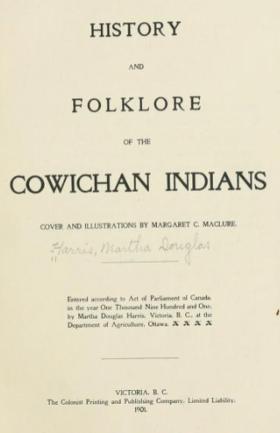
In the late 1800s, Martha Douglas Harris, the daughter of the former governor of British Columbia, observed that "civilization" was destroying the "native dignity and wholesome life" of the Cowichan tribe of Vancouver, "substituting much evil for the real good found in their former customs and character." She herself was part Cree Indian-a fact that her father was none too eager to make public. But he and her mother had long since passed away, and so she wrote this book of 20 folktales in 1901, partly to honor her Native American heritage 89, [1] pages frontispiece, illustrations 21 cm ONLINE CIRC [ 1 ]
|
1901 |
|
A history of the state of Washington by Lancaster Pollard
Published in 1937, Lancaster Pollard's A History of the State of Washington is a comprehensive, multi-volume chronicle that documents the Pacific Northwest's rapid transformation from an isolated frontier territory into an established, industrialized state. The text meticulously details the economic and political forces that shaped the region, covering the early fur trade, pioneer settlements, complex Native American relations, and explosive urban growth. A keen insight drawn from the work is how the state's extreme geographic isolation from the eastern United States forged a distinct, self-reliant "area-kinship" among early settlers, driving them to rapidly develop robust, localized economies centered on timber and agriculture. Additionally, the latter half of the work serves as an invaluable genealogical archive by preserving hundreds of detailed biographical sketches of the prominent pioneers and civic leaders who built Washington's foundational communities. ONLINE CIRC [ 1 ]
|
1900 |
|
History of Custer County, Idaho .. by Jesse R. Black
Published in 1900, Jesse R. Black's History of Custer County, Idaho provides a concise chronicle of the region's establishment in 1880 and its rapid transition from untamed wilderness to a bustling frontier hub. The narrative details the volatile boom-and-bust cycles of the gold and silver rushes that birthed high-altitude mining towns like Bonanza and Custer, while also documenting the severe challenges faced by early settlers. A keen insight drawn from the text is how the area's violent early history—marked by profound geographic isolation, harsh mountain elements, and bloody conflicts with Native American tribes—forged a fiercely resilient pioneer culture built entirely around rapid resource extraction. Ultimately, this brief volume serves as a vital historical snapshot of the fleeting but transformative mining boom that defined central Idaho's rugged pioneer era. 1 preliminary leaf, 21 pages, 1 leaf 20 cm ONLINE CIRC [ 1 ]
|
1900 |
|
The Thompson Indians of British Columbia by James Alexander Teit, Franz Boas 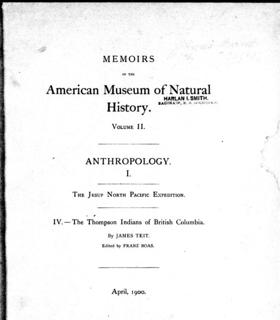
The following description of the Thompson Indians is based on two manuscripts prepared by Mr. James Teit, - the one a description of the Upper Thompson Indians, written in 1895; the other a description of the Lower Thompson Indians, written in 1897 as a result of work done by Mr. Teit for the Jesup North Pacific Expedition. pages 163-392. illustrations (including map) plates XIV-XX. 36 cm ONLINE CIRC [ 1 ]
|
1900 |
|
The correspondence and journals of Captain Nathaniel J. Wyeth, 1831-6 a record of two expeditions for the occupation of the Oregon Country, with maps, introduction and index by F.G. Young, Nathaniel J. Wyeth
Describes the famous Battle of Pierre's Hole of that year between the Blackfeet and the trappers and their Indian allies (including the Flatheads). The second section covers Wyeth's observations camping with a Flathead camp during April and May 1833 xix, 262 pages, 3 unnumbered leaves of plates (2 folded) : maps ; 25 cm ONLINE CIRC [ 1 ]
|
1899 |
|
An illustrated history of the state of Idaho containing a history of the state of Idaho from the earliest period of its discovery to the present time, together with glimpses of its auspicious future ; illustrations ... and biographical mention of many pioneers and prominent citizens of to-day .. by Lewis Publishing Company (Publisher)
Published in 1899 by the Lewis Publishing Company, this expansive volume offers a comprehensive chronicle of Idaho’s evolution from its earliest European exploration and volatile territorial days through its first crucial decade of statehood. A keen insight drawn from the text is how its enthusiastic, progress-driven narrative actively attempts to rebrand Idaho—deliberately transitioning its public reputation from a transient, lawless mining frontier into a stable, unified agricultural and civic powerhouse ready for outside investment. To reinforce this vision of civilized permanence, the text devotes substantial space to extensive biographical sketches of the prominent pioneers, merchants, and ranchers who built the state's foundational institutions. Ultimately, the work stands as both a vital genealogical archive and a fascinating artifact of Gilded Age boosterism designed to cement a cohesive identity for the newly formed state. xv, 726 pages, 105 unnumbered leaves of plates : frontispiece (portrait) illustrations, portraits ; 30 cm ONLINE CIRC [ 1 ]
|
1899 |
|
Traditions of the Thompson River Indians of British Columbia by James Alexander Teit (Compiler, Annotator), Franz Boas (Writer of introduction) 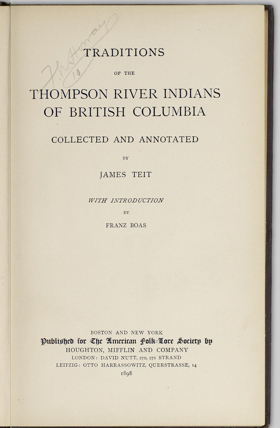
The following collection of traditions is the result of the long-continued studies of Mr. James Teit on the Thompson River Indians of British Columbia. The tales have been recorded with great care. The present collection contains the prevalent versions, while variants are given in notes accompanying the tales. I have added to the notes a number of references to similar tales found among other tribes of North America. These references do not claim to be exhaustive, but an attempt has been made to bring forward the more important points of similarity between the traditions of the Thompson River Indians and those of other tribes. I have also added brief abstracts of the tales, in order to facilitate the use of the collection by the student of comparative mythology. -Franz Boas viii pages, 1 leaf, 137 pages 25 cm. ONLINE CIRC [ 1 ]
|
1898 |
|
A historical, descriptive and commercial directory of Owyhee County, Idaho, January 1898 Silver City, De Lamar, and Guffey by Press of The Owyhee Avalanche 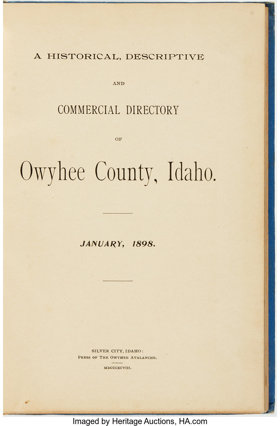
Published in 1898 by the Press of The Owyhee Avalanche, this volume serves as both a foundational historical record and a practical commercial guide to Owyhee County, Idaho, during its late 19th-century resource boom. The text provides detailed accounts of the region's geography, emerging rail infrastructure, and lucrative mining operations, while also cataloging the local businesses, civic leaders, and pioneer residents who populated towns like Silver City, De Lamar, and Guffey. A keen insight drawn from the publication is how frontier newspapers actively functioned as regional boosters, utilizing these exhaustively detailed directories to legitimize rugged, isolated mining camps into permanent, investment-worthy municipalities by projecting a highly organized image of commerce and rapid modernization. 154 pages : illustrations, portraits ; 24 cm ONLINE CIRC [ 1 ]
|
1898 |
|
Pioneer history of Coos and Curry Counties, Or. heroic deeds and thrilling adventures of the early settlers by Orvil Ovando Dodge, Pioneer and Historical Association of Coos County, Or (Issuing body) 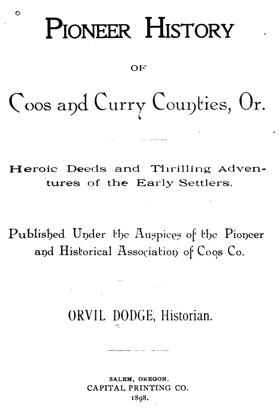
Published in 1898 by Orvil Ovando Dodge, this historical volume chronicles the early white settlement, resource extraction, and violent conflicts that defined the foundational pioneer era of Oregon's rugged southern coast. A keen insight drawn from the text is how its highly romanticized framing of the brutal Rogue River Wars as "heroic deeds" demonstrates the active mythmaking required by early settlers to morally justify the violent displacement of indigenous populations in pursuit of timber and coastal gold. The narrative details the region's extreme geographic isolation, explaining how the impenetrable Coast Range forced these early communities to develop fiercely independent maritime and logging economies rather than relying on overland trails. Furthermore, the book serves as a vital genealogical archive by preserving extensive biographical sketches and firsthand accounts of the resilient prospectors, sailors, and civic leaders who built Coos and Curry counties. 4 preliminary leaves, 5-468, 103 pages, 27 unnumbered leaves of plates : frontispiece, illustrations, portraits ; 22 cm CIRC [ 0 ]
|
1898 |
|
New light on the early history of the greater North-west. The manuscript journals of Alexander Henry ... and of David Thompson ... 1799-1814. Exploration and adventure among the Indians on the Red, Saskatchewan, Missouri, and Columbia rivers by Alexander Henry, David Thompson, Elliott Coues
Published in 1897 and meticulously annotated by historian Elliott Coues, this foundational three-volume work compiles the raw manuscript journals of North West Company fur trader Alexander Henry and master topographer David Thompson from 1799 to 1814. A keen insight drawn from the text is how Henry’s brutally candid daily entries shatter the romanticized myth of the heroic frontiersman, exposing the early North American fur trade as a ruthlessly pragmatic enterprise heavily reliant on the deliberate weaponization of alcohol to control and exploit Indigenous populations. The narrative tracks their extensive expeditions across the Red, Saskatchewan, Missouri, and Columbia river basins, providing granular details on frontier survival, commercial logistics, and complex tribal negotiations. Ultimately, by fusing Thompson’s unparalleled geographical surveys with Henry’s gritty cultural observations, the compilation stands as an indispensable primary source for understanding the harsh geopolitical realities of the early Pacific Northwest. 3 volumes frontispiece (portrait) maps (in pocket) 25 cm ONLINE CIRC [ 3 ]
|
1897 |
|
Notes on the cosmogony and history of the Squamish Indians of British Columbia by Charles Hill-Tout, Royal Society of Canada 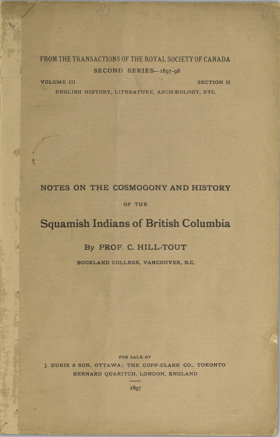
Published in 1897 within the Transactions of the Royal Society of Canada, Charles Hill-Tout’s ethnographic monograph provides an early, detailed record of the oral traditions, creation myths, and social structures of the Squamish (Sḵwx̱wú7mesh) people of British Columbia. A keen insight drawn from the text is how Hill-Tout’s underlying framework of "salvage anthropology"—the assumption that he was documenting a doomed, vanishing race—inadvertently highlights the immense, destructive pressure that colonial assimilation policies were already exerting upon Indigenous communities at the turn of the century. The work meticulously catalogs their ancestral stories, complex cosmology, and historical origins in a dedicated effort to preserve their cultural heritage. Despite being heavily filtered through the paternalistic academic lens of its era, the publication remains a crucial archival resource for understanding the early linguistic and cultural history of the Coast Salish peoples. 85-90 pages 25 cm ONLINE CIRC [ 1 ]
|
1897 |
|
San Juan and secession possible relation to the War of the Rebellion by Granville O. Haller 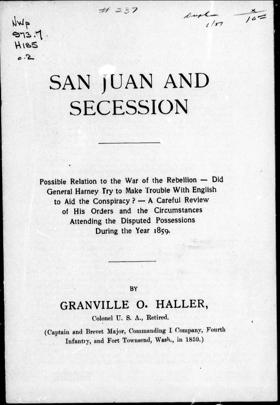
Published in 1896 by Major Granville O. Haller, this historical pamphlet re-examines the 1859 "Pig War" boundary dispute over San Juan Island between the United States and Great Britain. A keen insight drawn from the text is Haller's controversial thesis that the aggressive military escalations by Captain George Pickett and General William S. Harney were not merely localized bravado, but rather a deliberate conspiracy by Southern sympathizers to provoke a unifying national war with Britain to distract from the impending American Civil War. The author leverages his firsthand military experience during the crisis to reframe this bizarre frontier standoff as a high-stakes geopolitical gambit tied directly to the secessionist movement. Ultimately, the work transforms a seemingly comical regional squabble into a fascinating exploration of pre-Civil War political machinations in the Pacific Northwest. 15 pages ; 23 cm ONLINE CIRC [ 1 ]
|
1896 |
|
The Siwash their life, legends and tales; Puget Sound and Pacific Northwest by Joseph A. Costello
Published in 1895, Joseph A. Costello’s The Siwash: Their Life, Legends and Tales is an early ethnographic compilation documenting the oral traditions, daily customs, and folklore of the Coast Salish peoples across the Puget Sound region. A keen insight drawn from the text is how the author's reliance on the Chinook Jargon term "Siwash"—derived from the French word for "savage"—exposes the inherent paradox of late 19th-century settler literature, which eagerly commodified and preserved Indigenous heritage while viewing the people themselves through a deeply paternalistic, colonial lens. The narrative compiles regional creation myths, spiritual practices, and historical anecdotes, filtering complex indigenous histories through the perspective of the incoming white pioneers. Ultimately, the volume stands as both a foundational, albeit flawed, archive of Pacific Northwest Native American legends and a revealing historical artifact of the era's complex attitudes toward indigenous displacement. vii, [3], 169 pages : frontispiece, plates, portraits ; 24 cm ONLINE CIRC [ 1 ]
|
1895 |
|
Salt Spring Island, British Columbia by Edward F. Wilson 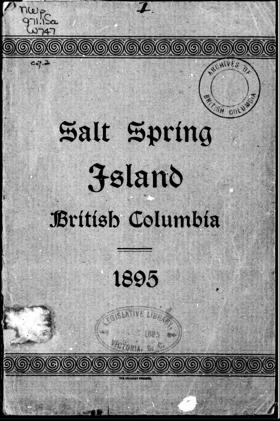
Originally marked on the naval charts of 1858 as "Admiral Island," it has of late years altogether dropped that name, and is now known both popularly, and also in the more recently published maps, as Salt Spring Island^ — the saline springs, of which there are some 14 or 15 on the island, being sufficient reason for its present name 30 pages : illustrations, map ONLINE CIRC [ 1 ]
|
1895 |
|
Indianische sagen von der nord-pacifischen küste Amerikas by Franz Boas
Published in 1895, Franz Boas's Indianische Sagen von der Nord-Pacifischen Küste Amerikas is a foundational German-language compilation of indigenous myths, legends, and oral traditions gathered from numerous tribes along the Pacific Northwest coast. The text meticulously documents the folklore of groups such as the Tlingit, Haida, and Coast Salish, focusing heavily on widespread cultural narratives like the Raven cycle and various regional creation myths. A keen insight drawn from the work is Boas's pioneering use of these folktales to prove the theory of cultural diffusion, demonstrating how specific narrative motifs spread across distinct linguistic barriers through extensive trade and intermarriage rather than developing independently. By mapping these shared story elements across vast geographic areas, Boas fundamentally challenged the era's prevailing theories of unilineal cultural evolution and established a new standard for rigorous comparative anthropology. vi, 363, [1] pages map 26 cm ONLINE CIRC [ 1 ]
|
1895 |
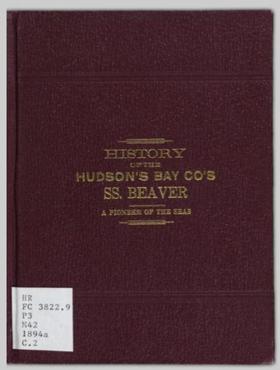
Also containing a description of the Hudson's Bay Company from its formation in 1670, down to the present time; biography of Captain McNeill; the narrative of a Fraser River prospector of 1859; historical momentoes of the Beaver's copper remains; the sad ending of the author's last trip in search of old-time naval relics; important developments in steam since its introduction in 1769, etc." -- Lowther, B. J., & Laing, M. (1968). A bibliography of British Columbia: Laying the foundations, 1849-1899. Victoria, BC: University of Victoria, p. 124. 99 pages : photographs, illustration ; 17 cm ONLINE CIRC [ 2 ]
|
1894 |
|
Chinook texts by Franz Boas, Charles Cultee 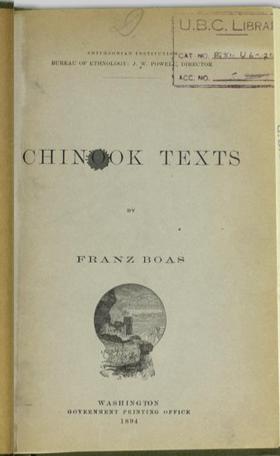
Published in 1894, Chinook Texts is a foundational ethnolinguistic work compiled by anthropologist Franz Boas, who meticulously transcribed the myths, historical narratives, and cultural traditions of the Lower Chinook people directly from Charles Cultee, one of the last living fluent speakers. A keen insight drawn from the text is how the urgency of Boas's "salvage anthropology" highlights the devastating impact of colonization, demonstrating how the preservation of an entire linguistic system ultimately relied on the extraordinary memory of a single indigenous informant. By presenting the original phonetically transcribed Chinookan dialect alongside literal English translations, the volume rigorously documents the complex grammatical syntax and nuanced worldview of the lower Columbia River tribes. Consequently, the book stands not merely as a collection of regional folklore, but as an indispensable archival record that permanently secured the heritage of a vanishing Pacific Northwest civilization. 1 preliminary leaf, 278 pages, 2 leaves of plates : portraits ; 24 cm ONLINE CIRC [ 1 ]
|
1894 |
|
The Chinook jargon by Myron Eells
Published in the late 19th century, Myron Eells's work on the Chinook Jargon serves as both a linguistic record and a practical guide to the widely used trade pidgin of the Pacific Northwest. The text documents the vocabulary and pronunciation of a language born from the blending of Indigenous dialects, French, and English, which originally facilitated commerce between diverse tribes and incoming white settlers,. A keen insight drawn from Eells's scholarship is how his rigorous documentation of the language was inextricably bound to his religious mission; because the Jargon was already broadly understood, he utilized it as the most efficient medium for rapidly spreading Christian hymns and teachings across multiple distinct linguistic groups,. Consequently, the work exists as both a valuable ethnographic artifact of a unique contact language and a practical tool designed to aid in the cultural assimilation of Indigenous populations. pages 300-312 CIRC [ 0 ]
|
1894 |
|
History of British Columbia from its earliest discovery to the present time by Alexander Begg 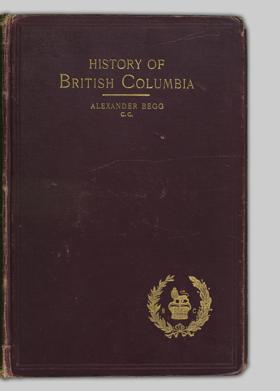
Published in 1894, Alexander Begg's comprehensive volume chronicles the political and economic evolution of British Columbia, tracing its trajectory from early maritime exploration and the fur trade era to its eventual confederation with Canada. A keen insight drawn from the text is how Begg’s narrative functions simultaneously as a historical record and a piece of deliberate economic boosterism, actively framing the region's transition from a guarded Hudson's Bay Company monopoly into a civilized province as a triumph of British imperial progress designed to attract settlers and investment. The author meticulously details the transformative impacts of the Fraser River and Cariboo gold rushes, the administrative leadership of James Douglas, and the critical unifying role of the Canadian Pacific Railway. Ultimately, the book stands as an exhaustive, albeit heavily pro-colonial, late 19th-century archive documenting the foundational events that integrated a rugged frontier into the Canadian dominion. xvii, [7]-568 pages : illustrations, folded map, portraits ; 23 cm ONLINE CIRC [ 1 ]
|
1894 |
|
Bibliography of the Chinookan languages (including the Chinook jargon) by James Constantine Pilling
Published in 1893 by the Bureau of American Ethnology, James Constantine Pilling’s Bibliography of the Chinookan Languages (Including the Chinook Jargon) provides an exhaustive catalog of early linguistic materials from the Pacific Northwest. The reference volume systematically documents books, articles, and unpublished manuscripts that captured the vocabulary and syntax of these complex regional dialects and their associated trade pidgin. A keen insight drawn from the work is how Pilling's meticulous inclusion of biographical details about the various authors transforms the book from a simple index into a vital historical record of the early missionaries, traders, and anthropologists who first interacted with the region's tribes. Ultimately, this comprehensive bibliography laid the essential academic foundation for all subsequent modern scholarship and dictionary compilation regarding the Chinookan language family. xiii, 81 pages : facsimiles ; 23 cm ONLINE CIRC [ 1 ]
|
1893 |