Catalog of British Columbiana and Pacific Northwest Americana
Encyclopedia Cascadia Catalog contains book titles of mostly non-fiction Pacific Northwest Coast of North America Titles (primarially British Columbia, Idaho, Oregon and Washington State) in an easy-to-understand title catalog. If you see a link with this badge ONLINE CIRC it means that there is an online institution that provides free access to that title. In some cases there may be more than one institution hosting the title digitally.
| Catalog Title | Published |
|---|---|
|
The Chinook Indians traders of the Lower Columbia River by Robert H. Ruby, John A. Brown
|
1976 |
|
The Chinese in Washington State by Art Chin, Doug Chin 
Published in 2013 by Art Chin and Doug Chin, The Chinese in Washington State chronicles over a century of Chinese American history, detailing the trials, contributions, and enduring resilience of pioneers who helped shape the Pacific Northwest. Drawing on rich archival photographs and community narratives, the book documents early immigration waves, the harsh realities of labor discrimination and anti-Chinese expulsion movements, and the eventual establishment of vibrant cultural enclaves like Seattle's Chinatown-International District. A keen insight drawn from the text is how it deliberately shifts the historical lens away from passive victimhood, emphasizing instead how early Chinese communities actively built robust mutual-aid networks, economic institutions, and political coalitions that transformed them into foundational architects of modern Washington society. 144 pages : illustrations ; 23 cm CIRC [ 1 ]
|
2013 |
|
The Chilliwacks and their neighbors by Oliver Wells, Ralph Maud, Brent Douglas Galloway, Marie Weeden 
Oliver Wells, naturalist, writer, ethnographer, farmer, and stock breeder, was born in 1907 at the pioneer farm established by his family three generations before in the valley of the Chilliwack River. The name of this farm, Edenbank, echoes the rich heritage and idealist aspirations of the pioneer family who came to the valley to establish a new way of life in this new land. Their neighbors were the Chilliwacks, the native Canadians who live in the area. In the 1950s, sensing that the people with whom his family had shared the land for generations were on the threshold of losing their culture and traditions in the face of ever-growing pressure of settlement in the area, he began work on preserving, with the Native community, their way of life and their history. While Wells was not a trained ethnographer, he brought to his work a vitality possible only for a man who can draw on generations of intimacy and wide-ranging friendships within the community. With tape recorder, notebook, and sketch pad, he began recording the lives and memories of his friends in exhaustive detail. He did not record this information as an outsider―he took an active part in an attempt to actually revitalize the culture and traditions of his friends. He is credited, for example, with reviving the Salish weaving techniques of the community which are now famous throughout the world. 226 pages : illustrations ; 26 cm CIRC [ 1 ]
|
1987 |
|
The changing Pacific Northwest interpreting its past by David H. Stratton , George A. Frykman , National Endowment for the Humanities, Washington State University Department of History 
In order to explore the unique history of the Pacific Northwest, Washington State University established the Sherman and Mabel Smith Pettyjohn Distinguished Lecture Series in 1980. Since that time a series of nationally prominent guest speakers presented numerous, original contributions to the body of information available on the region. In this volume, nine schools explore Pacific Northwest hisorty from their unique perspectives. Pacific Northwest economic, social, and political trends are examined as important parts of a rapidly emerging, regional culture. Challenges posed by women's history, Alaska's place in the Pacific Northwest, the role cultural elites have played in Pacific Northwest development, the labor movement, and other issues are discussed in detail. The Changing Pacific Northwest presents nine articles by Pettyjohn lecturers, confronting these and other important questions. In doing so, they give us much insights in the history of this region xi, 187 pages : illustrations, map ; 23 cm. CIRC [ 1 ]
|
1988 |
|
The ceremonial societies of the Quileute Indians by Leo Joachim Frachtenberg 
Published in 1921 in the American Anthropologist by ethnologist Leo Joachim Frachtenberg, The Ceremonial Societies of the Quileute Indians offers a detailed taxonomy of the ritualistic organizations governing the spiritual and social life of the Quileute people on Washington's Olympic Peninsula. Drawing from extensive fieldwork conducted on the reservation in 1915 and 1916, Frachtenberg meticulously catalogs the initiation rites, esoteric dances, and specialized spiritual powers associated with distinct tribal guilds, such as the prominent Wolf (Tlokwala), Elk Hunter, and Whaler societies. The resulting text serves as a dense ethnographic record of the complex, formalized frameworks that traditionally dictated status, professional obligation, and spiritual authority within the community prior to the aggressive enforcement of federal assimilation policies. A keen insight drawn from the work is how the anthropological taxonomy of Indigenous spiritual practices often functioned as a subtle form of cultural vivisection; by categorizing deeply integrated socio-political systems into isolated, easily digestible "secret societies" implicitly modeled after Western fraternal orders, Frachtenberg’s analysis inadvertently stripped these ceremonies of their holistic governing authority, reducing active Indigenous legal and spiritual structures to mere ethnographic curiosities prepared for academic consumption. 33 unnumbered pages 30 cm ONLINE CIRC [ 1 ]
|
1921 |
|
The ceremonial societies of the Quileute Indians by Leo Joachim Frachtenberg
Published in 1921 in the American Anthropologist, Leo Joachim Frachtenberg’s The Ceremonial Societies of the Quileute Indians provides a highly structured taxonomy of the esoteric ritual organizations that ordered social and spiritual life for the Quileute people on Washington's Olympic Peninsula. Based on fieldwork conducted in 1915 and 1916, the monograph meticulously documents the tribe's complex guild systems—including the prestigious Wolf (Tlokwala), Elk Hunter, and Whaler societies—detailing their exclusive initiation rites, ceremonial dances, and the specialized powers they conferred. Conceived during the height of salvage anthropology, the text operates as a dense scholarly archive attempting to preserve the mechanics of Quileute ceremonial life during a period of intense federal assimilation efforts. A keen insight drawn from the work is how the academic categorization of Indigenous practices often served to depoliticize active systems of Native governance; by analyzing these highly integrated bodies purely as esoteric "secret societies" akin to Western fraternal orders, Frachtenberg's ethnographic framework conceptually stripped them of their inherent legal, economic, and political authority. This scholarly approach subtly reinforced colonial objectives by redefining complex Indigenous systems of resource management and social control as mere religious curiosities, cataloging them for scientific posterity just as the state was actively dismantling their real-world power on the reservation. 33 unnumbered pages 30 cm ONLINE CIRC [ 1 ]
|
1921 |
|
The Centralia tragedy of 1919 Elmer Smith and the Wobblies by Tom Copeland 
On November 11, 1919, the citizens of Centralia, Washington, gathered to watch former servicemen, local Boy Scouts, and other community groups march in the Armistice Day parade. When the marchers swung past the meeting hall of the Industrial Workers of the World, a group of veterans broke ranks, charged the hall, and were met by gunshots. Before the day was over, four of the marchers were dead and one of the Wobblies had been lynched by the mob. Through a wealth of newly available primary source material including previously sealed court documents, FBI records released under the Freedom of Information Act, and interviews with surviving witnesses, Tom Copeland has pieced together the events of that day and has traced the fate of the men who were accused and convicted of murdering the marchers. Copeland focuses on Elmer Smith, the local attorney who advised the Wobblies that they had the right to defend their hall against an anticipated attack. Although he never belonged to the I.W.W., Smith sympathized with their interests, championing the rights of working people and speaking on their behalf. He was originally arrested with the Wobblies and then took up their cause in the courts, beginning a life-long struggle to free the men who were charged with murdering the Centralia marchers. The fight lasted for fourteen years, during which Smith endured insults, threats, arrest, disbarment, and reinstatement. Copeland recounts Smith's run for political office, his speeches throughout the Northwest, and his unyielding support for the workers' cause. In 1932 he died at the age of forty-four. The book is a balanced treatment of the Centralia tragedy and its legal repercussions written by a practicing lawyer. It is also a compelling human drama, centering on the marginal life of an industrial frontier labor lawyer; a study of radical politics of the 1920s; and a depiction of conditions of life in the lumber camps and towns. It is thus biography as well as legal, political, and social history xv, 233 pages, 8 unnumbered pages of plates : illustrations ; 25 cm CIRC [ 1 ]
|
1993 |
|
The centennial history of Oregon, 1811-1912 by Joseph Gaston
Authored by railroad promoter and pioneer historian Joseph Gaston, The Centennial History of Oregon, 1811-1912 is a massive, multi-volume retrospective chronicling the state’s evolution from the early fur-trading expeditions to a modernized, twentieth-century society. The exhaustive work details a century of territorial expansion, pioneer struggles, and agricultural growth, dedicating significant focus to the fierce transportation rivalries and infrastructure developments that connected the Pacific Northwest to the national economy. Packed with extensive biographical sketches of prominent local patriarchs, the text serves as a sweeping celebration of the pioneer generation's triumph over the wilderness and their establishment of robust civic institutions. A keen insight drawn from the work is how the author's own background as a corporate developer fundamentally shaped the state's historical memory; by centering railroad battles and commercial industrialization as the defining milestones of Oregon's progress, Gaston's narrative illustrates how the early architects of regional capitalism literally wrote the history books to ensure their economic ambitions were immortalized as heroic statecraft. 4 volumes : frontispiece, illustrations (plates), facsimiles, maps, portraits ; 27 cm ONLINE CIRC [ 4 ]
|
1912 |
|
The Cariboo trail a chronicle of the gold-fields of British Columbia by Agnes C. Laut 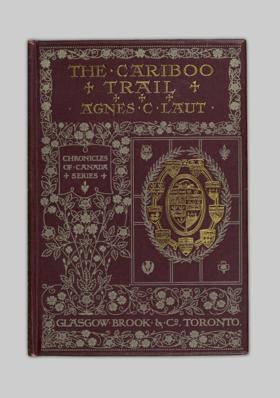
Authored by prominent Canadian journalist and historian Agnes C. Laut in 1916, The Cariboo Trail: A Chronicle of the Gold-Fields of British Columbia offers a dramatized, fast-paced narrative of the 1860s gold rush that violently transformed the province's remote interior. The text recounts the perilous journeys of the "Overlanders," the grueling construction of the Cariboo Wagon Road, and the frantic transition of the region from a quiet Hudson’s Bay Company fur monopoly into a booming British colony under Governor James Douglas. Driven by the era's taste for frontier romance, Laut emphasizes the grit, eccentricities, and triumphant endurance of white prospectors battling a rugged, unforgiving wilderness. A keen insight drawn from the work is how early popular histories weaponized the romanticism of the gold rush to legitimize colonial occupation; by framing the chaotic, ecologically destructive extraction of mineral wealth as an epic saga of Anglo-Saxon perseverance and British legal triumph, Laut effectively obscured the catastrophic impact this sudden influx of miners had on the sovereignty and survival of the region's First Nations. viii, 115 pages, 13 unnumbered leaves of plates (1 color) : illustrations, folded map ; 19 cm ONLINE CIRC [ 1 ]
|
1916 |
|
The Canadian Fur Trade in the Industrial Age by Arthur Ray 
Throughout much of the nineteenth century the Hudson's Bay Company had a virtual monopoly on the core area of the fur trade in Canada. Its products were the object of intense competition among merchants on two continents – in Leipzig, New York, London, Winnipeg, St Louis, and Montreal. But in 1870 things began to change, and by the end of the Second World War the company's share had dropped to about a quarter of the trade. Arthur Ray explores the decades of transition, the economic and technological changes that shaped them, and their impact on the Canadian north and its people. Among the developments that affected the fur trade during this period were innovations in transportation and communication; increased government involvement in business, conservation, and native economic welfare; and the effects of two severe depressions (1873-95 and 1929-38) and two world wars. The Hudson's Bay Company, confronting the first of these changes as early as 1871, embarked on a diversification program that was intended to capitalize on new economic opportunities in land development, retailing, and resource ventures. Meanwhile it continued to participate in its traditional sphere of operations. But the company's directors had difficulty keeping pace with the rapid changes that were taking place in the fur trade, and the company began to lose ground. Ray's study is the first to make extensive use of the Hudson's Bay Company archives dealing with the period between 1870 and 1945. These and other documents reveal a great deal about the decline of the company, and thus about a key element in the history of the modern Canadian fur trade. xviii, 283 pages : illustrations ; 24 cm CIRC [ 0 ]
|
1990 |
|
The boys of Boise furor, vice & folly in an American city by John Gerassi, Peter Boag 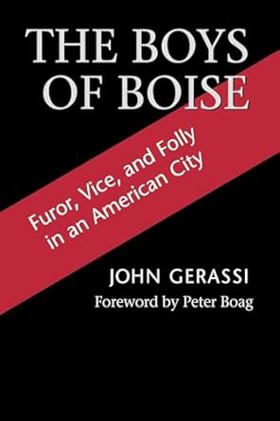
A classic account of a 1950s sex scandal that depicts middle America's traditional response to homosexuality. Written in 1965 about a same-sex sexual scandal that occurred in 1955 in Boise, Idaho, John Gerassi’s classic study depicts both middle America’s traditional response to homosexuality and an era in the country’s history before the modern gay rights movement really got underway. Because much of what Gerassi wrote about persists in today’s struggles over gay and lesbian issues, his book still has much to tell us about how contemporary society reacts to, and misunderstands, homosexuality. On the morning of November 2, 1955, the people of Boise, Idaho, were stunned by a screaming headline in the Idaho Daily Statesman, THREE BOISE MEN ADMIT SEX CHARGES. Time magazine picked up the story, reporting that a "homosexual underworld" had long operated in Idaho’s staid capital city. The Statesman led the hysteria that resulted in dozens of arrests—including some highly placed members of the community—and sentences ranging from probation to life imprisonment. Peter Boag’s Foreword places the book in historical perspective, summarizing the popular psychological theories and legal conceptions that helped to shape Gerassi’s research. He discusses advances in Idaho’s public approach to homosexuality and ways in which the provincialism chronicled by Gerassi persists to this day. xxxii, 328 pages ; 22 cm. CIRC [ 0 ]
|
2001 |
|
The boys in the boat nine Americans and their epic quest for gold at the 1936 Berlin Olympics by Daniel James Brown 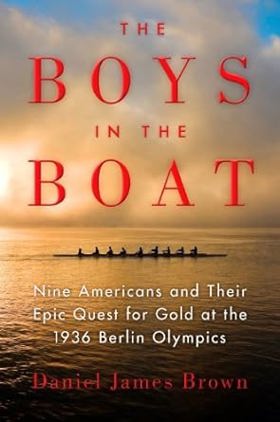
"For readers of Unbroken, out of the depths of the Depression comes an irresistible story about beating the odds and finding hope in the most desperate of times--the improbable, intimate account of how nine working-class boys from the American West showed the world at the 1936 Olympics in Berlin what true grit really meant. It was an unlikely quest from the start. With a team composed of the sons of loggers, shipyard workers, and farmers, the University of Washington's eight-oar crew team was never expected to defeat the elite teams of the East Coast and Great Britain, yet they did, going on to shock the world by defeating the German team rowing for Adolf Hitler. The emotional heart of the tale lies with Joe Rantz, a teenager without family or prospects, who rows not only to regain his shattered self-regard but also to find a real place for himself in the world. Drawing on the boys' own journals and vivid memories of a once-in-a-lifetime shared dream, Brown has created an unforgettable portrait of an era, a celebration of a remarkable achievement, and a chronicle of one extraordinary young man's personal quest." -- Publisher's description 403, 13 pages : illustrations, portraits ; 22 cm CIRC [ 1 ]
|
2014 |
|
The boy who shot the sheriff the redemption of Herbert Niccolls Jr. by Nancy Bartley 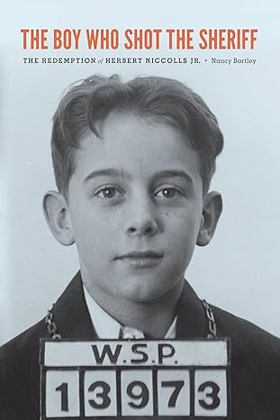
In 1931, a 12-year-old boy shot and killed the sheriff of Asotin, Washington. The incident stunned the small town and a mob threatened to hang him. Both the crime and Herbert Niccolls's eventual sentence of life imprisonment at the Washington State Penitentiary in Walla Walla drew national attention, only to be buried later in local archives. Journalist Nancy Bartley has conducted extensive research to construct a compelling narrative of the events and characters that make this a unique episode in the history of criminal justice in the United States. Niccolls became a cause for Father Flanagan of Boys Town,who took to the airwaves, imploring listeners to write Governor Hartley on the boy's behalf. The bitter campaign put Hartley in such a negative light that he lost his bid for reelection. Under a new and progressive warden, Niccolls thrived in prison. Inmates like physician Peter Miller and literary agent James Ashe became his tutors, finding that Niccolls had an insatiable appetite for knowledge. During the deadly 1934 prison riot at Walla Walla, several prisoners kept him from harm. Niccolls was finally released from prison in his early twenties. He went to work at 20th Century Fox in Hollywood, where he kept his secret for the rest of his long life. The Boy Who Shot the Sheriff explores this little-known story of a young boy's fate in the juvenile justice system during the bloodiest years in the nation's penitentiaries. xii, 284 pages : illustrations ; 23 cm CIRC [ 0 ]
|
2013 |
|
The Boiseans at home by Arthur A. Hart 
To own a fine house is a mark of success, and Boiseans of earlier times were no different from those of today in recognizing this. This volume is a collection of short essays that aim to capture the flavor of the life and times of some of the families that played a significant part in Boise s history. 86 pages : illustrations, portraits ; 20 cm CIRC [ 0 ]
|
1992 |
|
The Boise Massacre on the Oregon Trail attack on the Ward party in 1854 and massacres of 1859 by Donald H. Shannon 
Only some half-dozen of the adverse encounters between Indians and emigrants on the Oregon and California Trails can be termed "massacre". The Ward Party Massacre that occurred on the Boise river is one of those unfortunate, and often overlooked events. Author Donald H. Shannon explores the relations between the peoples of the "Snake Country" of Southern Idaho, Shoshoni, Northern Paiutes, Bannocks and Emigrants, in a attempt to describe the environment that led to several of the most violent conflicts that occurred along the Oregon and California trails. xi, 287 pages : illustrations, maps ; 23 cm. CIRC [ 1 ]
|
2004 |
|
The Bohemia story by Wally Hunter
|
1969 |
|
The Blues natural history of the Blue Mountains of northeastern Oregon and southeastern Washington by Robert J. Carson (Author, Photographer), Duane Scroggins (Photographer), Bill Rodgers (Photographer), David Frame (Photographer), Kevin R. Pogue (Photographer), Dave Powell (Photographer), Michael E. Denny (Photographer), Merrylynn Denny (Photographer), Clare Carson (Photographer), Donald Snow, Scot 
The Blue Mountains, stretching south of Walla Walla into central Oregon, are one of the Pacific Northwest's iconic mountain ranges. Formed by successive periods of volcanic activity, home to diverse forest and grassland ecosystems, and rich in wildlife, the Blues have long held a special fascination for all who live in and recreate in the range's embrace. Now the Blues' unique natural history is the subject of this new book – the first volume ever to take its readers deep into the story of the range’s creation and history. In geological parlance, the Blue Mountains are a long anticlinal ridge composed mostly of basalt flows, stretching from Clarno, Oregon to Clarkston, Washington. Here, Carson has combined scholarly and elegant writings with the outstanding photography from more than a dozen contributors. The book includes a foreword by Don Snow, an afterword by Scott Elliott, and poems by Katrina Roberts and Janice King. Duane Scroggins, Bill Rodgers, and many others have contributed hundreds of magnificent photographs that draw readers into this incredible region. vii, 208 pages : illustrations (chiefly color), maps (chiefly color) ; 23 x 29 cm CIRC [ 0 ]
|
2018 |
|
The birth, death, and resurrection of Fairhaven by George Hunsby
|
1975 |
|
The Birdcages British Columbia's First Legislative Buildings, 1859-1957 by Robert Ratcliffe Taylor 
Revealing a little-known chapter in the history of Victoria, British Columbia, The Birdcages, the province's first legislative buildings, were built 1859-1864, the formative, tumultuous time of the Gold Rushes. Constructed on the site of the present Legislature, they were built amid controversy and derided for their style. The brainchild of Governor James Douglas, they resembled, according to journalist/politician Amor de Cosmos, "something between a Dutch toy and a Chinese pagoda." Readers will discover how civil servants and politicians felt about them as a workplace and what the general public thought about them as civic architecture. The career of their designer, the mysterious Hermann Otto Tiedemann, one of Victoria's vivid early "characters," is recounted as are the contributions of local contractors and tradesmen. The site of events of national importance until their demise in 1898, the Birdcages reflected the history, character, and heritage of Victoria and played an important role in the developing political traditions of the province and the young Dominion of Canada. A place for political demonstrations and community celebrations, the House of Assembly was where the MLAs debated joining Confederation, granting the vote to women, and excluding Asian immigrants. Based on personal memoirs and letters, government documents, photographs and plans, this book will interest both students and adults, history buffs and professional historians CIRC [ 0 ]
|
2020 |
|
The Biology and management of red alder by David E. Hibbs, Dean S. DeBell, Robert F. Tarrant 
Only a few years ago, red alder, the major hardwood species in the Northwest, was regarded as a weed to be eradicated with herbicides. Today, red alder provides the raw material for a thriving industry, producing fine furniture, specialized veneers and plywoods, and paper products. In addition to its economic values, red alder has unique biological values that are proving vital in efforts to improve forest management. This timely study presents a synthesis of current knowledge about the biology and management of red alder. The first section covers topics in the basic biology of alder, while the second section offers principles and practices of alder management. The book's 34 contributors provide current and comprehensive information that will allow forest managers to weave red alder into the improved forest management systems demanded by an increasingly well-informed public. xi, 256 pages : illustrations ; 29 cm CIRC [ 0 ]
|
1994 |
|
|
1975 |
|
The big run life aboard a salmon seiner by Ray Fadich 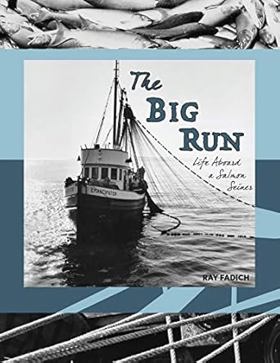
"The mighty salmon runs that worked their way through Puget Sound each season on their way to British Columbia's Fraser River provided a way of life for fishermen in the Pacific Northwest for more than a century. Commercial gillnetters and purse seiners pursued millions of Sockeye salmon each season hoping to harvest a portion of the massive schools of fish that migrated through the region each season. It was demanding, and often dangerous work, but the knowledgeable captain and crew could hit it big by being in the right place at the right time to capitalize on this natural bonanza. In 1958, when captain Nick Foreigner Barhanovich hired greenhorn Ray Fadich to work as a skiffman on Barhanovich's purse seiner, The Emancipator, Fadich had little clue of what that fishing season would hold for him. As the newest member of the Emancipator's crew Fadich had to deal with a steep learning curve, days of backbreaking physical labor, and the practical jokes and daily initiation into the brotherhood of the commercial fisherman that came with the territory."--Amazon iii, 89 pages : illustrations, map ; 28 cm CIRC [ 0 ]
|
2020 |
|
|
1967 |
|
The best of Chief Dan George by Dan George, Helmut Hirnschall 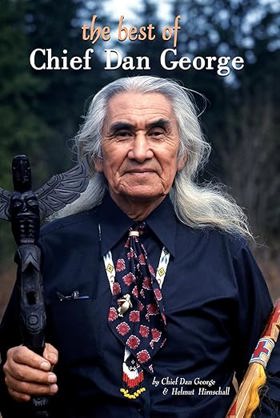
This book combines the two best sellers My Heart Soars & My Spirit Soars in one volume, 63 poems fully illustrated, eloquently illustrated throughout by Helmut Hirnschall. Included in this edition is the Lament for Confederation by Chief Dan George. Poetic and spiritual, this book has a universal message to all people. Chief Dan George was an accomplished performer, poet, philosopher, champion of Native peoples and loving patriarch of a large family. Chief Dan George was an accomplished performer, poet, philosopher, champion of first Nations peoples, loving patriarch of a large family, was born in 1899 on a Salish Band reserve on Burrard Inlet, in North Vancouver, one of twelve children of the chief. His given name was Teswahno, meaning thunder coming up over the land from the water. Like most native children at that time, under the influence of the Catholic Church, and in need of white culture's education, he went to a residential school at the age of five, so as not to be separated from his cherished older brother Harry. The next eleven years were difficult ones, being distanced from family, culture, language and customs. Schooling ended at sixteen, and he went immediately into the forest to harvest trees. At nineteen, in an arranged marriage, he and sixteen year old Squamish girl, Amy, entered into a devoted union of fifty-two years duration. They had eight children, six of whom survived into adulthood. Dan worked as a long-shoreman off and on for the next twenty-seven years, during frequent strikes supplementing his income with hunting and lumbering, until he had a serious accident on the docks in 1947, which damaged a hip and leg. In the forties, with his children and a cousin, who billed themselves as Dan George and His Indian Entertainers, he played for dances three or four nights a week throughout British Columbia. Traveling and sleeping in a covered truck, they would spend the summers picking hops and performing country and western music, with the kids doing special requests for extra money. Dan's instrument was the bass fiddle. He always remembered those years as the happiest times in his life. During the fifties, he was occupied with the duties of chief for his band. In the early 1960s, CBC TV was producing a series called Caribou Country. When an actor fell ill, the search was on to find a replacement for a character called Ol' Antoine. Through a fateful series of connections, Chief Dan tested for, and won, the part. With no formal training, he slipped into an instinctive way of acting that won him much acclaim, though initially he had to overcome a measure of hesitation and doubt. Having his two sons in the acting world was a major support, as was Amy's whole-hearted encouragement. Chief Dan gained further national recognition in 1967 with his now famous speech, The Lament for Confederation, which he read at the Centennial celebration in Vancouver. That same year, he came to the attention of the playwright, George Ryga, who was working on his powerful drama, The Ecstasy of Rita Joe. Their meeting resulted in the full development of the character of Rita Joe's father, which Chief Dan played, first at the Playhouse in Vancouver, and then two years later at the National Arts Centre in Ottawa, to glowing reviews. He also appeared in the Royal Winnipeg Ballet production based on the play. In 1973, he would recreate the part in Washington, D.C. for overflow audiences. When an episode of Paul St. Pierre's Caribou Country was brought by a Hollywood studio, Chief Dan got a call to test for the character Ol' Antoine in the Walt Disney movie, Smith. He easily got the part, and so began a film career that reached its peak with his legendary performance of the role of Old Lodgeskins, in Arthur Penn's film Little Big Man, with Dustin Hoffman, in 1970. For the first time, natives were seen without the stereotypical bias that the film industry had reflected for the first seventy years of its history. Chief Dan received the New York Film Critic's Award and the National Society of Film Critic's Award, as well as an Oscar nomination for the depth and sincerity of that characterization. For the last ten years of his life, he was in demand as a spokesperson for native people, and as an actor, musician, writer, speechmaker. He even toured for a year with the rock bank, Fireweed. Many awards came to him, including an honorary Doctor of Laws from Simon Fraser University. His highest aim was always for better understanding by white people of his culture and his people, and he pursued this with determination, wisdom and courage. He died in Vancouver in 1981. 126 pages : illustrations ; 22 cm CIRC [ 0 ]
|
2004 |
|
The best loved boat The Princess Maquinna by Ian Kennedy 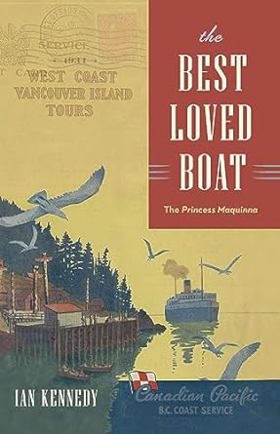
"Built in 1913, the Canadian Pacific Railway's ship Princess Maquinna steamed up and down the rugged west coast of Vancouver Island in summer and winter, calm weather and storms, for over forty years, and has become one of the most beloved boats in BC's maritime history. Princess Maquinna, sometimes referred to as the "Ugly Princess" but most often "Old Faithful," transported Indigenous people, settlers, missionaries, loggers, cannery workers, prospectors and travellers of all kinds up and down Vancouver Island's rugged and dangerous west coast, stopping at up to forty ports of call on her seven-day run. The Princess Maquinna faithfully served as the lifeline for all those who lived on the west coast of Vancouver Island before it became accessible by roads. Because of this strong connection she became the "Best Loved Boat" in BC's maritime history. Kennedy recounts battles through eighty-knot gales along the exposed coastline sailors called "The Graveyard of the Pacific," and reveals the bigotry that forced Indigenous and Chinese passengers to remain on the foredeck of the ship while other passengers sheltered from the elements inside. He brings the history of this beloved ship to life with rich detail, recalling a time when this remote part of British Columbia was alive with mines, canneries and now-forgotten settlements."-- Provided by publisher viii, 239 pages : illustrations, map ; 24 cm CIRC [ 0 ]
|
2023 |