Catalog of British Columbiana and Pacific Northwest Americana
Encyclopedia Cascadia Catalog contains book titles of mostly non-fiction Pacific Northwest Coast of North America Titles (primarially British Columbia, Idaho, Oregon and Washington State) in an easy-to-understand title catalog. If you see a link with this badge ONLINE CIRC it means that there is an online institution that provides free access to that title. In some cases there may be more than one institution hosting the title digitally.
| Catalog Title | Published |
|---|---|
|
Steamboats in the timber by Ruby El Hult 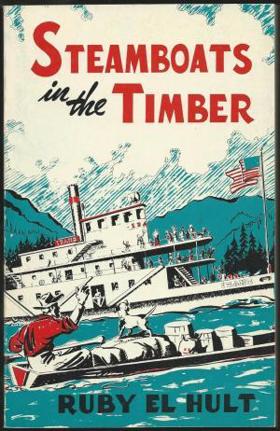
In the heyday of its water commerce, Lake Coeur d'Alene in northern Idaho was the scene of more steamboating than any other lake, salt or fresh, west of the Great Lakes. The old steamers brought gold, silver, and lead from the mines; lumber from the forests; mail to lonely homesteaders; and romance down the shadowy St. Joe River, whose silken waters flow into the Coeur d'Alene. The old steamboats are gone now from the lake-but here is their story, exciting, nostalgic and complete. Across Lake Coeur d'Alene, in the early days, the big mining boom in the Coeur d'Alene Mountains was carried out, and the ore-hauling steamers came and went. Across the lake later went the timber seekers in their rush to grab the white pine riches of the St. Joe country; and a new fleet of steamers carried timber barons, homesteaders and lumberjacks up the twisting, cottonwood-shaded St. Joe. Here you will visit the bustling waterfront boom towns of Coeur d'Alene, Harrison, St. Maries, Ferrell, and St. Joe, just as they were in the glory days of steamboating, and as they are today. Romantic and factual history skill-fully merge as the old towns, the rivermen, and the boats glide by in easy, informed narrative. 209 pages, [7] leaves of plates : illustrations, map (on lining paper) ; 23 cm CIRC [ 0 ]
|
1968 |
|
Steamboat days on the rivers by Frederick Wallace Wilson, Earle K. Stewart, Oregon Historical Society
|
1969 |
|
Stanley-Sawtooth country the colorful story of a rugged, scenic part of Idaho now included in the Sawtooth National Recreation Area, its people, and a way of life dictated by their surroundings by Esther Yarber (Composer), Edna McGown 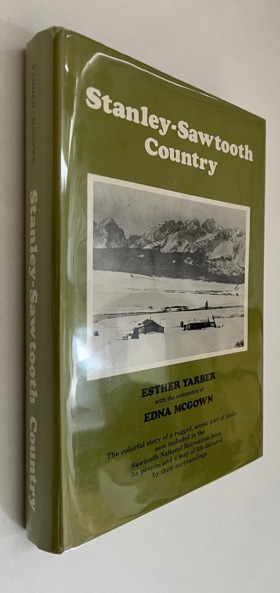
Snug within the realms of Central Idaho, the Stanley Sawtooth country comprises one of the most scenic regions in the West. This is the story of the people who settled this land and their struggle to survive its hostile winters, and about an unhurried way of life. Subjects included mining, first settlements, schools, homesteading, cattle and sheep ranching, forest service. viii, 404 pages : illustrations, maps, portraits CIRC [ 1 ]
|
1976 |
|
Standing at the water's edge Bob Straub's battle for the soul of Oregon by Charles K. Johnson 
A man of intelligence, drive, creativity, and fascinating contradictions, Straub overcame personal challenges and inevitable comparisons to his charismatic predecessor and friendly Republican rival, Tom McCall, to have a lasting impact on Oregon and the nation. Charles Johnson shares insights into Straub’s significant legacy, focusing on his leading role in the state’s financial and environmental issues and his influence on McCall. Johnson also reveals much of Straub’s warm personal story, along with his secret struggles, including his battle with depression while Governor. Standing at the Water’s Edge offers rich descriptions of other intriguing political figures of the time as well, capturing the flavor of what has been called Oregon’s political “golden age” of the sixties and seventies—created in part by the symbiotic relationship between Straub and McCall—and describing how and why it ended. Standing at the Water’s Edge is an essential addition to the literature about Oregon’s political leaders for historians, political scientists, and general readers interested in Oregon history. xiv, 338 pages : illustrations ; 23 cm CIRC [ 0 ]
|
2012 |
|
Squamish the shining valley by Kevin McLane 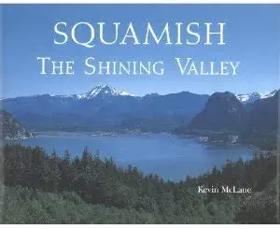
Published by mountaineer and author Kevin McLane, Squamish: The Shining Valley chronicles the dramatic geographic, cultural, and recreational evolution of British Columbia's famous fjord-side corridor. The book traces the region's transformation from an ancestral indigenous territory and a rugged 19th-century logging outpost into a world-renowned mecca for rock climbing, mountaineering, and outdoor recreation. Through striking photography and detailed historical accounts, the text captures the tenacity of the working-class communities who first carved railways and mills out of the imposing granite wilderness. A keen insight drawn from the work is how modern outdoor recreation alters the meaning of peripheral landscapes; the transition of Squamish from an extractive mill town into an elite adventure capital demonstrates that post-industrial mountain valleys are increasingly valued not for the timber they yield, but for the untamed verticality that allows modern seekers to escape urban containment. 96 pages : illustrations (some color), portraits ; 23 x 28 cm CIRC [ 1 ]
|
1994 |
|
Sporting Oregon a pictorial history of early Oregon sports by Brian S Campf 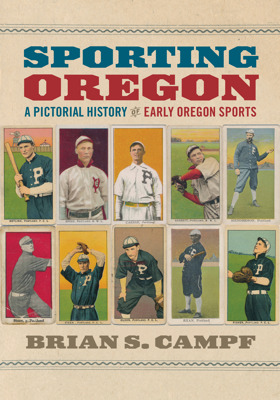
"For more than twenty-five years, Brian Campf collected vintage photographs and ephemera related to Oregon sports. Sporting Oregon includes approximately 350 images from Campf's extensive collection that offer an overview of the first fifty years of organized sports in Oregon, primarily baseball, football, and basketball, but also such pastimes as horse racing, track, hockey, tennis, and cricket. In his introduction, Campf traces the origins of team sports in Oregon, using period newspaper accounts to chronicle the increasing participation in and popularity of organized sports in the state. Detailed captions provide additional information on how and where the sports developed, on team histories, and on records of games and seasons. The book features a number of images from early Oregon Agricultural College (now OSU) and University of Oregon teams. The book's images range from historically significant (the earliest original photo of Oregon sports) and diverse (women's basketball, African American baseball) to athletes representing towns, schools, and organizations across Oregon. It is a book about sports but the images also reflect the people, places, and society of their time. Whites did not play on the same teams as blacks. Women wore modest attire. Sports were played in even the smallest communities, a welcome diversion from a hardscrabble life. Using horses, wagons, trains, and even boats, teams and their fans ventured to neighboring towns, bringing people together. Sporting Oregon is intended for readers interested in sports history, Oregon history, vintage photography, Americana, and local history. A foreword by historian Carl Abbott and an afterword by special collections librarian John Hawk provide additional context for the visual treasure trove. Packed with images from the past that provide a fascinating lens through which to view Oregon history, Sporting Oregon's pages will be savored and lingered over by people of all ages, by scholars and casual readers alike"-- Provided by publisher xiii, 226 pages : illustrations (some color), portraits ; 26 cm CIRC [ 0 ]
|
2019 |
|
Spokane story by Lucile Foster Fargo
|
1957 |
|
Spokane corona eras & empires by Edmund T. Becher 
The historical corona of the "Spokane Country," rife with romance and intrigue, truly shines brightly. It outshines most areas of the world because the Inland Empire was the last section of the North American continent to come under the control and development of a single modern imperialistic nation. This tardy development came about because the Inland Empire was ringed by formidable mountain ranges, difficult to penetrate-The Rocky Mountains to the eat, to the north the Selkirks, the Cascades on the west the the Blue Mountains on the southern rim.Geographical remoteness set the stage for the most interesting historical dramas possible. The isolation retarded the rapid influx of agricultural settlers, elsewhere often a rather prosaic over-night affair, and instead, forced an unusually long and exciting period of human-interest events involving fiercely resisting Indians, rugged explorers, freedom loving fur traders, missionaries, prospectors, miners, soldiers, cattle and sheep raisers, adventurers, surveyors and railroad builders, all of whom, for six or seven decades, were permitted to operate in a wild romantic land, uncluttered with white populations vii, 319 pages : illustrations, maps, portraits ; 24 cm CIRC [ 1 ]
|
1974 |
|
Spokane & the Inland Empire an interior Pacific Northwest anthology by David H. Stratton 
Essential aspects about the prehistory, history, geography, and architecture of the Inland Pacific Northwest are presented here in one succinct volume. This landmark collection features essays by noted national and regional scholars, such as Donald W. Meinig, Carlos A. Schwantes, Henry Matthews, Clifford E. Trafzer, and Harvey S. Rice. Spokane and the Inland Empire outlines the region's historical geographic systems, Palouse tribal history, characteristics of prehistoric Plateau Indian dwellings, a century of Columbia Plateau agriculture, Spokane's bitter labor disputes that occurred prior to America's entry into World War I, the exceptional architecture of Spokane's Kirtland Cutter, and more. This updated edition includes some new material and has been revised from the original volume published in 1991. Extensive illustrations supplement the text. xvii, 194 pages : illustrations, maps ; 24 cm CIRC [ 1 ]
|
1991 |
|
Spirit whales & sloth tales fossils of Washington state by Elizabeth A. Nesbitt , David B. Williams 
"From trilobites near the Idaho border and primitive horses on the Columbia Plateau to giant bird tracks near Bellingham and curious bear-like beasts on the Olympic Peninsula, fossils across Washington State are filled with clues of past life on Earth. With abundant and well-exposed rock layers, the state has fossils dating from Ice Age mammals only 12,000 years old back to marine invertebrates more than 500 million years old. In Spirit Whales and Sloth Tales, paleontologist Elizabeth A. Nesbitt teams up with popular science writer David B. Williams to offer a tour through more than a half billion years of natural history. Following an introduction to key concepts, twenty-four profiles-each featuring a unique plant, animal, or environment-tell stories of individual fossils, many of which are on display in Washington museums. The paleontology of Washington is brought to life with details of the fossils' discovery and extraction, their place in geological time, and the insights they provide into contemporary issues like climate change and species extinction"-- Provided by publisher x, 214 pages : color illustrations, color maps ; 24 cm CIRC [ 0 ]
|
2023 |
|
Spirit of the Siskiyous the journals of a mountain naturalist by Mary Paetzel, Jacqueline Elliott, Lee Webb 
For 25 years, Mary Paetzel roamed the Siskiyou Mountains of southwest Oregon, tracking rare plants and insects. A rugged land of peaks, canyons, and rushing rivers, the Siskiyous are renowned for their unusual plant life. A self-taught naturalist, Paetzel first came to these mountains as a pollen contractor for a pharmaceutical company. Traversing logging roads in an old Volkswagen bus and hiking the high country with her beloved dog Sal, Paetzel came to know the Siskiyous — their wildflowers, butterflies, bees and wasps, lichens, and birds — as few ever have. Mary Paetzel recorded her wilderness experiences in a series of illustrated journals. Spirit of the Siskiyous gathers the best of these writings along with selections of Paetzel's paintings and drawings into a single volume. An important natural history of the Siskiyou Mountains, the book also documents a unique personal journey through a little-known, but fascinating, landscape. Although at times outspoken in her criticism of the Forest Service, Paetzel later worked for the agency conducting species surveys in the Siskiyou National Forest. During this time, she discovered a rare colony of Mariposa copper butterflies and was instrumental in establishing several protected botanical sites. It's to make readers aware of the fragile beauty of the Siskiyous and the urgent need to protect these wild places that Mary Paetzel has made her private journals — with their keen observations, fine wit, and demonstrated love of the land — available in this remarkable book. xxviii, 164 pages : illustrations (some color) ; 26 cm CIRC [ 0 ]
|
1998 |
|
Spirit Lake people memories of Mount St. Helens by Alan Guggenheim, James Mortland
|
1986 |
|
Spirit and ancestor a century of Northwest Coast Indian art at the Burke Museum by Thomas Burke Memorial Washington State Museum, Bill Holm, Eduardo Calderón
|
1987 |
|
Spilsbury's coast pioneer years in the wet West by Howard White, Jim Spilsbury 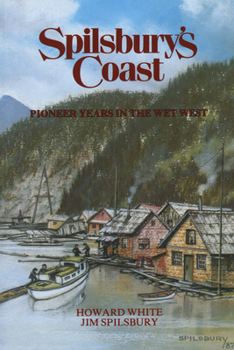
Spilsbury's Coast is that part of the Inside Passage between the Fraser River and the top end of Vancouver Island -- a place of small boats, countless islands and whole towns on floats. When Jim Spilsbury, B.C's most famous pioneer entrepreneur, teams up with master storyteller and literary craftsman Howard White, the result is a spell-binding romp up and down British Columbia's rugged coast; eighty years of fascinating anecdotes and memories distilled into 190 pages. Jim Spilsbury grew up in a tent on Savary Island, squatting on crown land. His story is one of the classic "rags-to-riches" stories in Canadian history. As well as being as brilliant inventor and an ambitious, astute businessman, he had the intangible gift of being in the right place at the right time. In 1923, at the age of 18, primed with a correspondence course in electrical engineering, Jim Spilsbury began building sophisticated radio telephones. Fishermen bought them, loggers bought them, and eventually homesteaders, explorers and even governments bought them. "Radio boomed," Spilsbury recalls, "and it carried me with it." As we follow Spilsbury in his adventures, we meet Frank Osborne, the genius engine-builder; Emil Gordon, the obsessive flamboyant Powell River salesman who sold everything from refrigerators to cows; Red Mahone, the obstreperous Boathouse cook and Spilsbury's own bizarre family, including his rifle-toting mother who cut her hair like a man's and golfed on the beaches at low tide. Howard White, himself a child of BC's backwaters, brings the voice of authority to Spilsbury's amazing tale. A rare gem of authentic storytelling - it flows fast and bright, like a mountain stream. iii, 190 pages, 64 unnumbered pages of plates : illustrations, maps, portraits ; 24 cm CIRC [ 1 ]
|
1987 |
|
Speaking for the river confronting pollution on the Willamette, 1920s-1970s by James V. Hillegas-Elting 
Since the Late 1960s, Oregon has been at the forefront of environmental protection in the United States. The state generally, and Portland in particular, continue to have strong "green" credentials well into the twenty-first century. Within this forty year period of progress, however, the health of the Willamette River has been a consistent blot on the record. Willamette River water pollution has not gone away - the problem has, in fact, gotten much more complex. James Hillegas-Elting's book, Speaking for the River, provides a historical look at this dilemma. Willamette River cleanup efforts between 1926 and 1975 centered on a struggle between abatement advocates and the two primary polluters in the watershed, the City of Portland and the pulp and paper industry. Beginning in 1926, clean streams advocates created ad hoc groups of public health experts, sanitary engineers, conservationists, sportsmen, and others to pressure Portland officials and industry representatives to cease polluting the river. By the late 1960s, these grassroots initiatives found political footholds at the state level. Governor Tom McCall took the issue of environmental protection personally, providing the charisma and leadership that was needed to finally make substantive progress toward cleaning the Willamette. Speaking for the River is the first book to describe the historical roots of Willamette River pollution, providing important context for understanding the political, fiscal, and technological antecedents to the present-day conundrum. Hillegas-Elting's contribution to the academic literature on environmental and urban history in Oregon will be welcomed by policy makers, environmentalists, and concerned citizens alike. Book jacket xiii, 334 pages : illustrations, maps ; 23 cm CIRC [ 0 ]
|
2018 |
|
Spanish explorations in the Strait of Juan de Fuca by Henry R. Wagner, Fine Arts Press (Santa Ana, Calif) (Publisher)
Thorough, scholarly study of this important aspect of the exploration of the Pacific Coast of North America. The Quimper Expedition, the Eliza Expedition, and the Galiano-Valdes Expedition are among the Spanish Expeditions presented here v, 323, [1] pages : maps (some folded) ; 28 cm CIRC [ 1 ]
|
1933 |
|
Southern Idaho ghost towns by Wayne C. Sparling 
When mineral riches were found in Idaho an explosion of development erupted and quickly died away. Here is a guide to eighty-four of Idaho s most interesting ghost towns, describing the history of Idaho s mining boomtowns and their eventual demise. Descriptions are organized by region and provide the current state of preservation. Both wilderness explorers and armchair travelers will be delighted with the treasures to be found. 135 pages : illustrations ; 23 cm CIRC [ 1 ]
|
1981 |
|
South Whidbey and its people Volume 1 by Lorna Cherry, South Whidbey Historical Society 
How it was formed. Indians - the first inhabitants. Early explorers and the arrival of settlers. The giant mammoths that once roamed here. And much, much, more. volumes : illustrations ; 26 cm CIRC [ 1 ]
|
1982 |
|
South Whidbey and its people Volume 2 by Lorna Cherry, South Whidbey Historical Society 
Towns are begun. Immigrants and pioneers gouge a living from pristine Whidbey forests. Roads are built, and civilization creates a unified society volumes : illustrations ; 26 cm CIRC [ 1 ]
|
1985 |
|
South Whidbey and its people Volume 3: Langley, The Village by the Sea by Lorna Cherry, South Whidbey Historical Society 
Langley, The Village by the Sea: A gleam in the eye of a teen-age German boy becomes a South Whidbey village. The village becomes a town and the town becomes a city volumes : illustrations ; 26 cm CIRC [ 1 ]
|
1986 |
|
South on the Sound an illustrated history of Tacoma and Pierce County by Murray Morgan, Rosa Morgan , Rita Happy 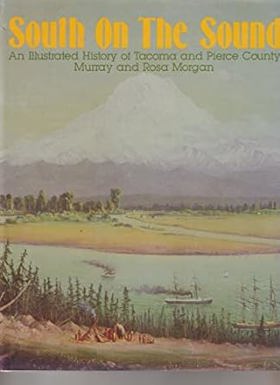
South on the Sound: An Illustrated History of Tacoma and Pierce County chronicles the evolution of Washington’s "City of Destiny" and its surrounding region from Indigenous roots and early European settlement through its late-twentieth-century industrial growth. Written by celebrated Pacific Northwest historian Murray Morgan alongside Rosa Morgan and Rita Happy, the book combines engaging narrative with a rich archive of historical photographs, maps, and archival imagery. It highlights major regional milestones, including Tacoma's pivotal selection as the Northern Pacific Railroad’s western terminus, the rise of timber and maritime shipping, and local community life. The volume stands as an accessible, visually driven portrait of the South Sound's cultural and economic heritage. 199 pages : illustrations (some color) ; 29 cm CIRC [ 1 ]
|
1984 |
|
South of Seattle notes on life in the Northwest woods by James LeMonds 
These fifteen essays invite readers in and make them feel at home in a small town in the Pacific Northwest. The straightforward and unpretentious writing carries the imagery and emotion of people and place in a way that defines a region xiv, 122 pages : illustrations ; 23 cm CIRC [ 1 ]
|
1997 |
|
Sounding for Harry Smith early Pacific Northwest influences by Bret Lunsford , John F. Szwed, Phil Elverum (Writer of preface) 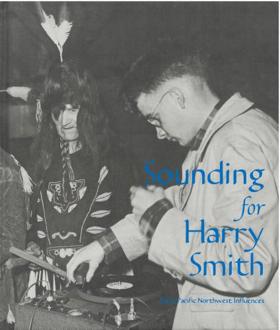
Pacific Northwest musician-historian Bret Lunsford (Beat Happening/D+) unravels a string of mysteries to reveal the avant-garde shards of a 20th century alchemist in his hometown. Harry Everett Smith (1923-1991) was a boyhood resident of Anacortes, Washington for ten years of the Great Depression. Sounding for Harry Smith: Early Pacific Northwest Influences is a visually compelling oral history-based biography that immerses the reader in Salish Sea traditions and discord to explore the myths of a countercultural shaman whose strange impacts on art, music and film resound from studies of place to beat improvisation, through brain paintings to a Grammy Award for his folk music bible. -from back cover 231 pages : illustrations (some color), maps, portraits (some color) ; 26 cm. CIRC [ 0 ]
|
2021 |
|
Sound heritage voices from British Columbia by Saeko Usukawa 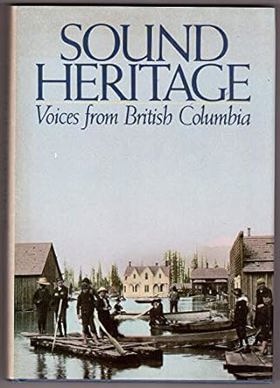
Voices of British Columbia presents the firsthand stories of the people with the courage, the dreams – and the plain stubbornness – to settle the Canadian frontier when it was still wild. These people talk candidly about the tragedy and the comedy, the good times and the rough times. Their authentic voices reveal what it was really like in those early days. Beginning with the legends and true stories of the native peoples, as well as the sagas of the early missionaries, this book tells tales all the way up to the lives and times of modern settlers on the frontier. This book is a collection of stories that appeared in BC’s oral history quarterly, Sound Heritage. 276 pages : illustrations, portraits ; 26 cm CIRC [ 1 ]
|
1984 |
|
Soul of the city the Pike Place Public Market by Alice Shorett, Murray Morgan 
Pike Place Market is a space that annually draws more people than any of the city's major sporting and cultural events. It has a reputation among American markets that is comparable to Les Halles in Paris and Convent Garden in London - the difference being that it has survived. This book illustrates the many people who have fought to sustain it. 175, [1] pages : illustrations, map ; 26 cm CIRC [ 1 ]
|
2007 |