Catalog of British Columbiana and Pacific Northwest Americana
Encyclopedia Cascadia Catalog contains book titles of mostly non-fiction Pacific Northwest Coast of North America Titles (primarially British Columbia, Idaho, Oregon and Washington State) in an easy-to-understand title catalog. If you see a link with this badge ONLINE CIRC it means that there is an online institution that provides free access to that title. In some cases there may be more than one institution hosting the title digitally.
| Catalog Title | Published |
|---|---|
|
Owyhee trails the West's forgotten corner by Mike Hanley, Ellis Lucia 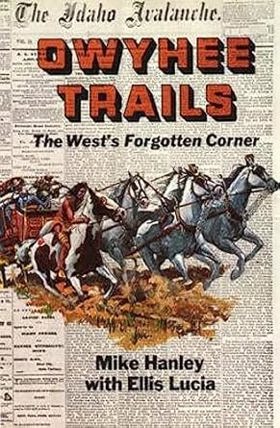
History and folklore of the little known and sparsely populated high desert region of the Owyhee Mountains. The Owyhees are sharp and ragged peaks rising from the high desert of Oregon and Idaho. Mike Hanley and Ellis Lucia recount the boisterous past and present of this wild and rugged corner of the West. xxii, 314 pages : illustrations ; 24 cm CIRC [ 1 ]
|
1973 |
|
Owyhee canyonlands by Mark Lisk, William L. Fox 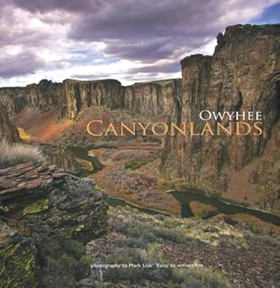
A beautifully designed book of photos celebrating the rugged Owyhee Mountain Canyonlands. The high desert of Owyhee Country contains some of the most spectacular, pristine canyonlands in the United States. A nationally recognized outdoor photographer, Mark Lisk s photographs of the Owyhees along with an essay by William Fox bring the rugged beauty of this Idaho and Oregon region to life. 120 pages : color illustrations ; 26 cm CIRC [ 0 ]
|
2008 |
|
Owning it all essays by William Kittredge 
14 autobiographical essays on the "myths of land, manhood, and manifest destiny on which ... American culture was founded. This is a deeply felt and highly informed essay collection about life in the American west by one of the finest writers ever to emerge from that region. As the Seattle Times has said of Owning It All: "You may never again see the American west in quite the same way if you take the time to view it through the eyes of William Kittredge. [This is a] stunning book." Having grown up on his family's cattle ranch in eastern Oregon, Kittredge directly confronts the contradictions and myths that lie at the heart of the Western experience: male freedom and female domesticity, the wild and the tame, self-interest and love of the land. 182 pages ; 22 cm CIRC [ 1 ]
|
1987 |
|
Overland from Canada to British Columbia by Thomas McMicking, Joanne Leduc 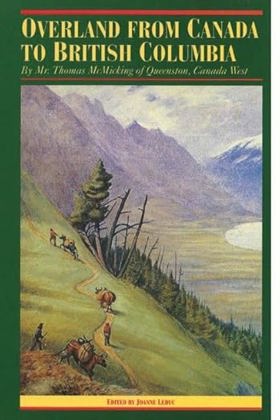
Spurred on by reports of gold in the Cariboo, adventurers from all over the world descended on British Columbia in the mid-1800s. Among them were ambitious easterners who accepted the challenge of the shorter but more arduous overland route across the prairies and the Rockies. One such man determined to find his fortune in the West was Thomas McMicking – destined to lead the largest and best organized group of “Overlanders” into British Columbia. His record of their epic journey is a valuable historical document that possesses the universal appeal of an adventure story. McMicking presents a vivid image of the hardships of the overland route, the dangers, both real and imagined -- like the apparently threatening Plains Indians who turned out to be “our best friends” – facts about important officials and settlements, and scientific observations of the physical environment. But this is also a very human document that describes a journey of self-discovery revealing a sensitive man’s encounter with a bountiful and beautiful yet hostile and alien land. The journal is augmented by a valuable introduction, appendices on the Overlanders’ trail and the McMicking family, and biographical sketches of many of the men who later played prominent roles in British Columbia’s development and whose descendants became some of the province’s best-known leaders and families. It is also enriched by the pictorial records of William Hind, a major Canadian painter who became known as the “expedition artist.” Drawing on much previously unavailable material as well as on traditional sources, the editor has created a comprehensive historical framework for this unique document. xl, 121 pages : illustrations, maps ; 23 cm. CIRC [ 0 ]
|
1981 |
|
Outsiders in a promised land religious activists in Pacific Northwest history by Dale Edward Soden 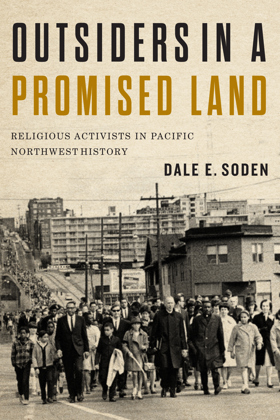
"Outsiders in a Promised Land explores the role that religious activists have played in shaping the culture of the Pacific Northwest, particularly in Washington and Oregon, from the middle of the 19th century onward. The region's earliest settlers came to work in the mines and forests, and a culture of saloons, gambling halls, and brothels grew up to serve them. When migration to the region intensified, newcomers with families and religious traditions often saw themselves as outsiders in opposition to the prevailing frontier culture. As communities grew in population, early activists found common ground in a desire to protect women and children, and make their towns more hospitable to religious values. Protestants, Catholics, and Jews worked together to transform communities. Together they introduced public and private schools, health care institutions, libraries and orphanages, and lobbied for the prohibition of alcohol. Beginning in the 1930s, religious activism played a crucial role in the emerging culture wars between liberals and conservatives. Liberals rallied around the protection of civil rights and the building of social safety nets, while conservatives decried the rise of secularism, liberalism, and communism. Today, religious activists of many faiths are deeply engaged in matters related to women's and gay rights, foreign policy, and environmental protection. Outsiders in a Promised Land is a meticulously researched, comprehensive treatment of religion in Pacific Northwest public life from the middle of the nineteenth century to the present. The first book of its kind, it is destined to be an essential reference for scholars, activists, and religious leaders of all faiths."-- Provided by publisher xiii, 306 pages : illustrations, portraits ; 23 cm CIRC [ 0 ]
|
2015 |
|
Outpost of empire the Royal Marines and the joint occupation of San Juan Island by Mike Vouri 
A history of the British Royal Marines twelve-year occupation of San Juan Island. 105 pages : illustrations, maps ; 18 x 23 cm CIRC [ 1 ]
|
2004 |
|
Outlaws of the Pacific Northwest by Bill Gulick 
The lawlessness of the frontier towns of the plains states is well documented. However, as silver and gold deposits were found in the Pacific Northwest, the rush of miners and speculators that brought to the region brought with it its own share of crime and criminals. Author Bill Gulick sticks to the facts in telling the stories of this region but does so in swift conversational prose that entertains and educates. xiv, 199 pages : illustrations, map ; 23 cm CIRC [ 0 ]
|
2000 |
|
Outlaw tales of Idaho true stories of the Gem State's most infamous crooks, culprits and cutthroats by Randy Stapilus 
In the frontier towns of Idaho, the combination of gold diggers, corrupt officials, and hot-headed vigilantes created an easily combustible mixture. Serial killer Lyda Lewis made a comfortable living for a while by poisoning her unsuspecting husbands and cashing in on their life insurance policies. When federal investigators were unable to uncover the Eddy and Splawn families’ gold coin counterfeiting scheme, a teenaged store clerk finally infiltrated the operation and gave the authorities enough evidence to send the ringleaders to prison. And “Diamondfield” Jack Davis, who nearly hung for his unfortunate combination of an itchy trigger finger and a big mouth, escaped the noose thanks to his association with the powerful cattlemen. xv, 175 pages : illustrations, map ; 23 cm CIRC [ 0 ]
|
2014 |
|
Out our back door Oregon south coast driving tours and day-hikes by Tom Baake 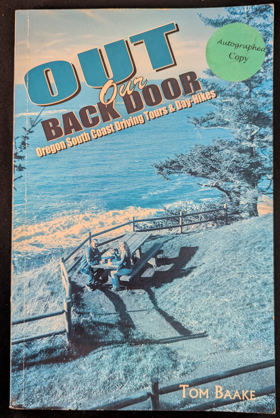
Discover the wonders of Oregon's beautiful South Coast, from unspoiled beaches and the vast Oregon Dunes, to lush river valleys and soaring forest mountaintops. Let this guidebook lead you to the region's world-famous scenery, and to some of its overlooked treasures. Coos Bay outdoor writer Tom Baake explores the region's popular scenic spots and visits the "back road" places, with an emphasis on easy day-hikes and driving loop tours. Destinations include Shore Acres State Park --spectacular seaside setting and gardens of a former lumber baron as well as Golden and Silver Falls State Park, twin cascades in a protected stand of old growth forest. Another tour takes you to South Slough, the nation's first protected estuary. With plenty of places to stop for a picnic and fun, you'll visit forest groves, see unusual geology, get inspired by waterfalls, wander the beaches and ridges, and experience life in this fascinating region. Wildflowers and wild rhododendrons line the way on many of the roads, while autumn colors are a delight. There's added information on camping, biking, paddling, boating, fishing, even a chapter on "what to do on a rainy day." Most of all, it's a book about picnics - so let's go! 183 pages : illustrations, maps ; 22 cm CIRC [ 1 ]
|
2008 |
|
Out of the fire metalworkers along the Salish Sea by Pirjo Raits 
"A stunning art book featuring twenty-three west coast artists and craftspeople who work in metal as their primary medium. Out of the Fire: Metalworkers along the Salish Sea is a breathtaking celebration of a diverse group of contemporary artists and artisans, who explore the creative possibilities of an ancient medium. From sculptors to farriers, forgers to blacksmiths, jewellers to metalsmiths, and weapons makers to welders, the twenty-three people featured in this book reflect the wide range of talent, skill, and ingenuity that exists on Canada's southwest coast. Miran Elbakyan captures movement and whimsicality in his Surrealist-inspired sculptures. Nycki Samuels earned the moniker "Tough Tiny Welder" on the road to artistic freedom, as she fought her way through the male-dominated world of industrial metalwork. Ts'uts'umutl Luke Marston began making jewellery when he was still a teenager, honing the skills of his craft at the same time as he was learning about the imagery and oral narratives of the Coast Salish Peoples. Combining a love of technology, fashion, and the industrial arts, Bev Petow has the remarkable ability to transform cold, hard steel into delicate-looking dresses. With over one hundred spectacular colour and black-and-white photographs of the artists and their works, this book is a stunning behind-the-scenes look at those who choose fire as their tool and metal as their raw material."-- Provided by publisher xiv, 206 pages : illustrations (some color), map ; 22 x 28 cm CIRC [ 0 ]
|
2022 |
|
Our Washington by Priscilla Mary Kinsman, Emlyn D. Jones, Rolland H. Upton, Virginia Bruce Goldsmith, Bearnice Skeen, Alice Hazel Hayden
|
1953 |
|
Our Pacific County by Lewis R. Williams 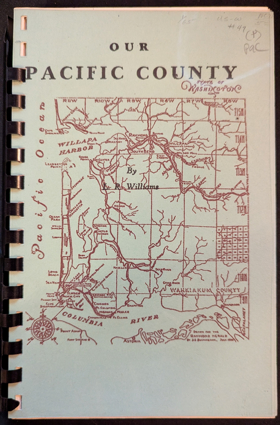
Published in 1930 by local historian Lewis R. Williams, Our Pacific County is a localized civic history detailing the American settlement and economic development of Washington State’s southwestern coast, centered primarily around the resource-rich waters of Willapa Bay (formerly Shoalwater Bay) and the Columbia River estuary. The text chronicles the region's rapid transformation from the domain of early maritime explorers to a bustling hub of pioneer commerce, focusing heavily on the highly lucrative early oyster trade that supplied Gold Rush-era San Francisco, as well as the subsequent rise of massive industrial logging and commercial salmon canning. Compiling local lore, civic milestones, and nostalgic pioneer reminiscences, the book operates as a celebratory tribute to the establishment of frontier towns like Oysterville, South Bend, and Raymond. A keen insight drawn from the work is how the narrative utilizes the romance of frontier resource extraction to morally launder the dispossession of the region's Indigenous maritime societies. By framing the aggressive, often ecologically devastating harvesting of Willapa Bay's native oysters and old-growth timber purely as a heroic tale of pioneer grit and capitalist enterprise, Williams conceptually redefines a complex, sustainably managed Indigenous homeland—historically governed by the Chinook and Chehalis peoples—into a wild, unclaimed repository of raw capital. This historiographical maneuver structurally sanitizes the colonial project, demanding that the systemic displacement of Native populations and the outright monopolization of their traditional marine resources be remembered not as an act of territorial and economic conquest, but as the spirited, inevitable triumph of American industrial progress. 104 pages : illustrations, map ; 22 cm CIRC [ 1 ]
|
1930 |
|
Our foundering fathers the story of Kirkland by Arline Ely, Kirkland Public Library 
A short history of Kirkland, Washington written by an editor of a Puget Sound magazine. 128 pages, including index. Includes many historic pictures and local stories 128 pages, 28 unnumbered leaves of plates : illustrations ; 23 cm CIRC [ 1 ]
|
1975 |
|
Otter skins, Boston ships, and China goods the maritime fur trade of the Northwest coast, 1785-1841 by James R. Gibson 
The first comprehensive account of the maritime fur trade on the Northwest Coast of North America. James Gibson's thoroughly researched and highly detailed study is the first comprehensive account of the maritime fur trade on the Northwest Coast of North America. Before Euro-American contact, the native peoples of the Northwest Coast had traded amongst themselves and with other indigenous people farther inland, but by the end of the 1780s, when Russian coasters had penetrated the Gulf of Alaska and British merchant ships were frequenting Nootka Sound, trade had become the dominant economic activity in the area.The Tlingit, Haida, Tsimshian, Nootka, Salish, and Chinook spent much of their time hunting fur-bearing animals and trading their pelts - especially the highly prized "black skins" of sea otters - to Russian, British, Spanish, and American traders for metals, firearms, textiles, and food. The Northwest Coast Indians used their newly acquired goods in intertribal trade, while the Euro-Americans traded their skins at Canton for tea, silk, and porcelain which they then sold in Europe and America. This traffic continued for more than half a century until, in the early 1840s, the Northwest trade declined significantly with depletion of the fur-bearing animals due to overhunting, depopulatlon of the Natives by disease and warfare, and depression of the market for furs.While previous studies have concentrated on the boom years of the fur trade, before the War of 1812, Gibson reveals that the maritime fur trade persisted into the 1840s and shows that the trade was not solely or even principally the domain of American traders. He gives an account of Russian, British, Spanish, and American participation, describes the market in South China, and outlines the evolution of the coast trade. He also assesses the physical and cultural effects of this trade on the Northwest Coast and Hawaiian Islands and on the industrialization of the New England states. Gibson's new interpretations derive from his use of Western primary sources that have been largely ignored by previous investigators; Russian-language sources not consulted by others; the records of the Russian-American, East India, and Hudson's Bay companies; the unpublished logs and journals of a number of American ships; and the business correspondence of several New England shipowners 1 online resource (xiii, 422 pages) : illustrations CIRC [ 1 ]
|
1991 |
|
Origins of Pierce County place names by Gary Fuller Reese
|
1989 |
|
Origin of Washington geographic names by Edmond S. Meany 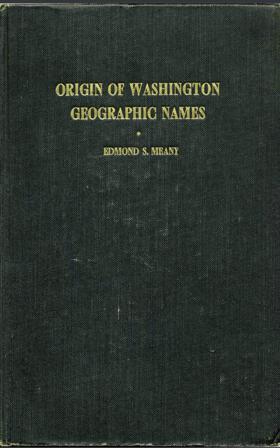
Published in 1923 by the University of Washington Press, Origin of Washington Geographic Names is a comprehensive reference work compiled by noted regional historian and professor Edmond S. Meany. The book catalogs the etymology and historical background of place names across Washington State, serving as a foundational text for Pacific Northwest history. Originally serialized as a collection of articles in the Washington Historical Quarterly, the 357-page volume documents how various towns, waterways, and landforms received their designations. Today, it remains a valuable resource for understanding the geographic, indigenous, and pioneer heritage of the region ix, 357 pages ; 21 cm ONLINE CIRC [ 2 ] CIRC [ 1 ]
|
1923 |
|
Origin of geographic names of Tacoma/Pierce County, Washington by Gary Fuller Reese
|
1974 |
|
Oregon—Its Meaning, Origin and Application by John E. Rees 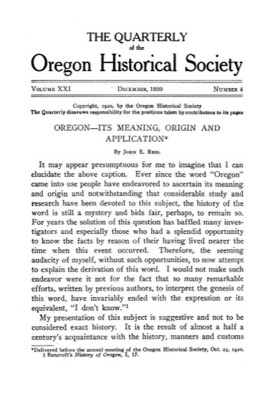
Published in 1920 by pioneer historian John E. Rees, Oregon—Its Meaning, Origin and Application is a brief etymological tract dedicated to deciphering the heavily contested linguistic roots of the state's name. Expanding upon the speculative methodologies he applied to neighboring Idaho, Rees argues that "Oregon" derives from specific Native American phonetic roots, attempting to definitively anchor the title in regional Indigenous dialects rather than European cartographic errors. By weaving together regional folklore, early exploration accounts, and localized vocabulary, the monograph attempts to construct a seamless narrative of authentic native pedigree for the broader Oregon Territory. A keen insight drawn from the work is how early regional scholars felt compelled to anchor new geopolitical entities to an imagined, romanticized Indigenous past; by fiercely claiming a "pure" Native origin for the state's name, historians like Rees actively commodified Indigenous heritage to lend an air of ancient, natural legitimacy to a recently manufactured colonial government. 1 volume (unpaged) ; 24 cm ONLINE CIRC [ 1 ]
|
1920 |
|
Oregon, end of the trail by Writers' program. Oregon
|
1940 |
|
Oregon's salty coast from explorers to the present time by Jim Gibbs, Bert Webber 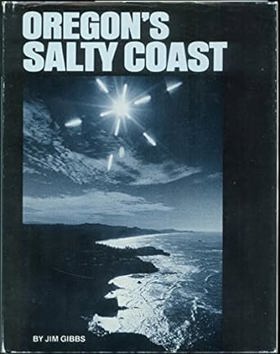
Published by maritime historians Jim Gibbs and Bert Webber, Oregon's Salty Coast: From Explorers to the Present Time chronicles the dramatic, hazard-strewn maritime history of the Pacific Northwest’s rugged shoreline. The book details the harrowing accounts of early Spanish and British explorers, the perilous era of commercial sailing ships, and the vital engineering feats required to construct and maintain iconic coastal lighthouses against relentless winter gales. Through archival photographs and vivid historical narratives, the authors capture the enduring tension between human seafaring ambition and the unforgiving power of the Pacific Ocean. A keen insight drawn from the work is how regional maritime architecture serves as a monument to human vulnerability; the isolated lighthouses clinging to treacherous sea stacks reveal that civilization's reach along the coast was achieved not by conquering the sea, but by erecting desperate beacons of survival at its absolute edge. 173 pages : illustrations, maps ; 22 cm CIRC [ 1 ]
|
1994 |
|
Oregon's promise an interpretive history by David Peterson del Mar 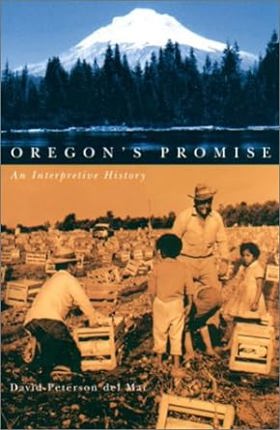
A concise and compelling general history, Oregon's Promise explores familiar and neglected people and movements in the state's history, while challenging readers to view Oregon's past, present, and future in a new way. The words "Oregon history" conjure up images of Lewis and Clark and rugged pioneers. In Oregon's Promise, David Peterson del Mar shows that the explorers' impact was both different from and less significant than commonly assumed, and that the state's settlers were much more varied, contentious, complicated, and interesting than conventional heroic stereotypes would suggest. The book's many themes revolve around Peterson del Mar's consideration of how Oregonians have attempted to build a prosperous and just society. He examines both the traditional center of Oregon history and its often overlooked margins-the people who have struggled to be included in Oregon's promise. The author is both a respected historian and an engaging writer, with a talent for explaining Oregon's past in a way that will appeal to all readers, from natives to newcomers, from students to scholars. 314 pages : illustrations, maps ; 23 cm CIRC [ 1 ]
|
2003 |
|
Oregon's others gender, civil liberties, and the surveillance state in the early twentieth century by Kimberly Jensen 
"In the era of the First World War and its aftermath, the quest to identify, restrict, and punish internal enemy "others," combined with eugenic thinking, severely curtailed civil liberties for many people in Oregon and the nation. In Oregon's Others, Kimberly Jensen analyzes the processes that shaped the growing surveillance state of the era and the compelling personal stories that tell its history. The exclusionary and invasive practices ranged from multiple wartime registrations for women and the registration of "enemy aliens" to the incarceration of women with sexually transmitted diseases, the use of deportations, and forced sterilization at the Oregon State Hospital and other institutions. But some Oregonians resisted the restrictions and challenges to their civil liberties. Their fierce determination to maintain their rights and freedoms fueled movements for human rights, social justice, and dissent that still reverberate today. Oregon's Others examines the collision of civil liberties and persecution through the lens of gender, gender identity and presentation, ability, race, ethnicity, and class"-- Provided by publisher pages cm CIRC [ 0 ]
|
2024 |
|
Oregon's names, how to say them and where are they located? an illustrated pronunciation guide by Bert Webber 
Authored by regional writer Bert Webber, Oregon's Names, How to Say Them and Where Are They Located? serves as a practical, illustrated guide designed to help travelers and newcomers correctly pronounce and locate the state's diverse geographic and town names. The book tackles the tricky indigenous, French, and pioneer phonetic quirks embedded across Oregon's map, stripping away common mispronunciations that easily betray an outsider. Through clear entries and local historical context, the text acts as an accessible linguistic bridge across the state's varied cultural landscapes. A keen insight drawn from the work is how regional place-name pronunciations function as an unwritten local citizenship test; by preserving the idiosyncratic local dialects of names like Willamette or Umatilla, the guide highlights how mastering native and pioneer linguistics is the ultimate tool for claiming authentic belonging in an adopted home. 109 pages : illustrations, maps ; 22 cm CIRC [ 1 ]
|
1995 |
|
Oregon's historical markers by W. M. Scofield, Oregon State Highway Commission, Oregon Historical Society, Souvenir Publishing Co
|
1966 |
|
Oregon's famous Columbia River Highway a descriptive view book in colors, reproducing from actual photographs the most prominent views of America's now most famous and featured highway by Lipschuetz and Katz (Publisher) 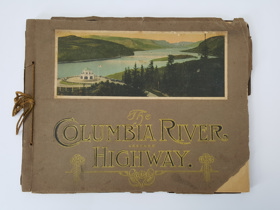
Oregon's Famous Columbia River Highway: A Descriptive View Book in Colors reproducing from Actual Photographs the most Prominent Views of America's now most Famous and Featured Highway 61 unnumbered pages : color illustrations ; 21 x 27 cm ONLINE CIRC [ 1 ] CIRC [ 1 ]
|
1920 |