Catalog of British Columbiana and Pacific Northwest Americana
Encyclopedia Cascadia Catalog contains book titles of mostly non-fiction Pacific Northwest Coast of North America Titles (primarially British Columbia, Idaho, Oregon and Washington State) in an easy-to-understand title catalog. If you see a link with this badge ONLINE CIRC it means that there is an online institution that provides free access to that title. In some cases there may be more than one institution hosting the title digitally.
| Catalog Title | Published |
|---|---|
|
The Pig War and other experiences of William Peck soldier 1858-1862, U.S. Army Corps of Engineers : the journal of William A. Peck, Jr. by William A. Peck, C. Brewster Coulter, Bert Webber 
Edited by C. Brewster Coulter and Bert Webber, The Pig War and Other Experiences of William Peck, Soldier 1858-1862 presents the remarkable personal journal of a U.S. Army engineer stationed in the Pacific Northwest during a tense geopolitical standoff. The book chronicles Private William A. Peck's daily life, military duties, and keen observations surrounding the infamous 1859 San Juan Island boundary dispute between the United States and Great Britain. Through these rare primary documents, the text captures the stark isolation, raw camp conditions, and quiet diplomacy that characterized an uneasy international borderlands garrison. A keen insight drawn from the work is how military journals humanize imperial brinkmanship; by filtering an international crisis through the mundane daily chores and reflective musings of an ordinary soldier, the narrative reveals that historical flashpoints are often lived not as grand historical dramas, but as tedious, freezing waits in remote wilderness outposts. x, 236 pages : illustrations, maps ; 21 cm CIRC [ 1 ]
|
1993 |
|
The white tide by Ruth Dunbar 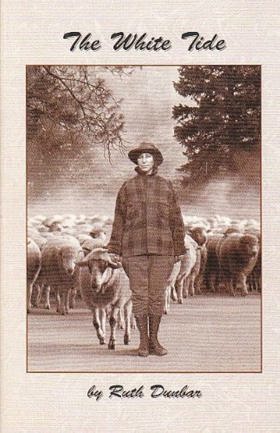
Published by regional presses, The White Tide by Ruth Dunbar explores the dramatic social and environmental transformations accompanying early settlement and resource exploitation in the Pacific Northwest. The book traces the rapid influx of pioneers, industrial loggers, and speculators whose arrival fundamentally altered indigenous landscapes and traditional ways of life across the region's river valleys and coastal frontiers. Through narrative character studies and historical context, the text highlights the heavy human and ecological costs borne by a rapidly commercialized wilderness. A keen insight drawn from the work is how the metaphor of a "white tide" captures the overwhelming, impersonal force of frontier expansion; settlement was experienced not merely as a gradual migration, but as an encroaching, high-tide wave that permanently submerged native ecosystems and historical land-use patterns under an unyielding tide of industrial modernity. v, 248 pages : illustrations ; 22 cm CIRC [ 1 ]
|
1993 |
|
Pacific graveyard a narrative of shipwrecks where the Columbia River meets the Pacific Ocean by Jim Gibbs 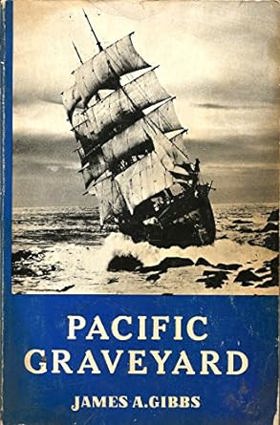
Man's age-old struggle with the sea comes historically alive in these true stories of shipwrecks off the Oregon and Washington coasts -- all near the mouth of the Columbia River. Dramatic photos of disaster and rescue at sea are placed with the stories they illustrate. Narrative appendix lists all wrecks; pictorial map gives locations. Fourth edition. 5 1/2 x 8 1/2. Highlighted by over 100 superb photos. Index. 304 pages. Companion to "Pacific Graveyard Shipwrecks Chart." 302 pages : illustrations, maps ; 22 cm CIRC [ 1 ]
|
1993 |
|
Railroad signatures across the Pacific Northwest by Carlos A. Schwantes 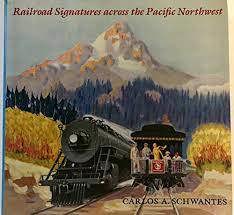
Demonstrates that the railroads profoundly affected the way people lived, how they adjusted to the new opportunities or threats that swift and cheap transportation provided. In short, how they viewed the world.This book is for everyone fascinated by trains and their nineteenth-century opening of the great Northwest. With cases of pictures never before published this book tracks the stories of families lured to settle in the west, revelations about railroad buccaneers, and breathtaking engineering feats of bridges over daunting gorges - Gene Shalit, The Today Show, NBC 359 pages : illustrations (some color) ; 26 x 27 cm CIRC [ 1 ]
|
1993 |
|
Lakelure a tale of Medina, Washington by Junius Rochester 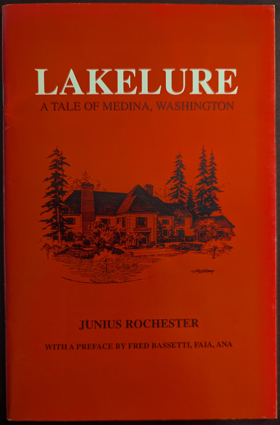
Published by local historian Junius Rochester, Lakelure: A Tale of Medina, Washington chronicles the colorful transformation of an exclusive eastern shore community along Lake Washington. The book traces Medina's evolution from a dense, stump-strewn wilderness and early 20th-century strawberry-farming enclave into one of the most affluent residential suburbs in the Pacific Northwest. Through historical photographs and engaging local archives, the text captures the summer-resort origins of families who fled the urban clamor of Seattle via the historic mosquito fleet ferries long before the floating bridges spanned the lake. A keen insight drawn from the work is how suburban wealth in the Seattle region repurposed geographical sanctuary into exclusivity; the transition of Medina from a quiet agrarian refuge into a fortress of tech barons and elites illustrates how pristine lakeside isolation is ultimately commodified and walled off from the very metropolitan core it once sought to escape. ii, 42 pages : illustrations ; 23 cm CIRC [ 1 ]
|
1993 |
|
The Lone Ranger and Tonto fistfight in heaven by Sherman Alexie 
In this darkly comic short story collection, Sherman Alexie, a Spokane/Coeur d'Alene Indian, brilliantly weaves memory, fantasy, and stark realism to paint a complex, grimly ironic portrait of life in and around the Spokane Indian Reservation. These twenty-two interlinked tales are narrated by characters raised on humiliation and government-issue cheese, and yet are filled with passion and affection, myth and dream. There is Victor, who as a nine-year-old crawled between his unconscious parents hoping that the alcohol seeping through their skins might help him sleep, Thomas Builds-the-Fire, who tells his stories long after people stop listening, and Jimmy Many Horses, dying of cancer, who writes letters on stationary that reads "From the Death Bed of Jimmy Many Horses III," even though he actually writes then on his kitchen table. Against a backdrop of alcohol, car accidents, laughter, and basketball, Alexie depicts the distances between Indians and whites, reservation Indians and urban Indians, men and women, and mostly poetically between modern Indians and the traditions of the past x, [2], 223 pages ; 24 cm CIRC [ 0 ]
|
1993 |
|
History of Idaho by Leonard J. Arrington 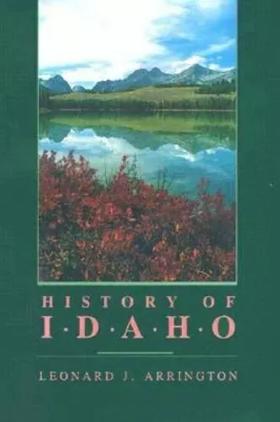
Authored by renowned regional historian Leonard J. Arrington, History of Idaho provides a comprehensive two-volume chronicle of the Gem State, tracing its evolution from an arid indigenous homeland and fur-trapping frontier into a modern agricultural and industrial powerhouse. The book meticulously examines the sweeping economic forces that shaped the state, from the 1860s gold rushes and the grueling labor struggles of the Coeur d'Alene mining district to the vast reclamation projects that turned the Snake River Plain into fertile farmland. Through exhaustive archival research and a deep appreciation for the state's diverse topography, Arrington captures the rugged independence of a population shaped by immense geographical isolation. A keen insight drawn from the work is how Idaho's unique historical trajectory was forged by a perpetual tension between radical extraction capitalism and fierce pioneer individualism; by highlighting how outside corporate mining and logging syndicates clashed with self-reliant local homesteaders, the history reveals that the state's legendary political conservatism was born out of a deep-seated defensive reaction against distant corporate and federal exploitation. 2 volumes : illustrations (some color) ; 24 cm CIRC [ 1 ]
|
1994 |
|
Reflections mostly true stories and occasional poems by Shaw Island Writers Group (Wash) , Judith Laurel Harkness (Illustrator) 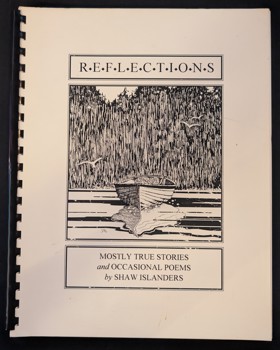
Authored by the Shaw Island Writers Group with illustrations by Judith Laurel Harkness, Reflections: Mostly True Stories and Occasional Poems captures the intimate, quirky rhythms of life on one of San Juan County's smallest and most isolated inhabited islands. The collection weaves together personal essays, local folklore, and evocative poetry penned by residents who navigate ferry schedules, one-lane dirt roads, and a profound sense of insular community. Through these unvarnished community chronicles, the text preserves the quiet humor and daily resilience required to thrive away from mainland conveniences. A keen insight drawn from the work is how collective island storytelling acts as an essential psychological buffer against isolation; by transforming everyday domestic mishaps and environmental encounters into shared literature, small island communities forge a resilient internal culture that celebrates their deliberate detachment from the fast-paced modern world. 115 pages : illustrations ; 28 cm CIRC [ 1 ]
|
1994 |
|
Strathcona Vancouver's first neighbourhood by John Atkin 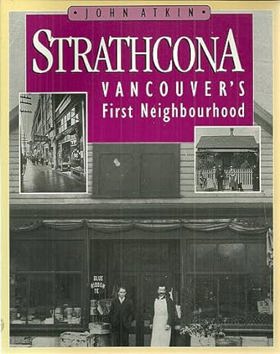
Authored by local historian John Atkin, Strathcona: Vancouver's First Neighbourhood chronicles the vibrant history, architectural evolution, and immigrant roots of Vancouver's oldest residential district. The book traces how the working-class enclave—sandwiched between industrial waterfronts and the city's commercial core—became a diverse melting pot of European, Asian, and Indigenous residents who built tight-knit community networks in the shadow of urban expansion. Through archival photographs and detailed municipal records, the text highlights the fierce neighborhood activism that repeatedly saved the area from twentieth-century freeway demolition and industrial rezoning. A keen insight drawn from the work is how grassroots architectural preservation serves as a radical form of working-class self-defense; by fighting to protect their modest wooden homes and walkable streets from municipal "renewal" projects, Strathcona residents proved that neighborhood history and vernacular architecture are vital bulwarks against the erasure of marginalized communities by corporate and bureaucratic urban planning. 93 pages : illustrations ; 24 cm CIRC [ 1 ]
|
1994 |
|
Encounters with a distant land exploration and the great Northwest by Carlos A. Schwantes, Evelyne Pickett 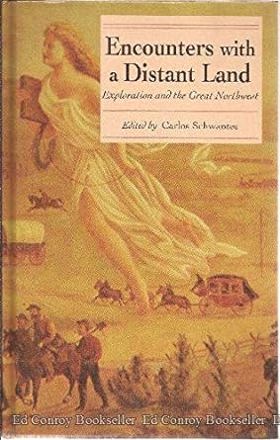
Authored by historians Carlos A. Schwantes and Evelyne Pickett, Encounters with a Distant Land: Exploration and the Great Northwest examines the centuries-long process by which fur traders, maritime explorers, and overland expeditions mapped and integrated the Pacific Northwest into the global consciousness. The book weaves together historical journals, rare maps, and firsthand exploration accounts to trace how distant empires and ambitious individuals conceptualized and claimed a rugged, uncharted wilderness. Through these documented journeys, the text illustrates the profound friction between the romanticized fantasies of early explorers and the harsh geographic realities they encountered on the ground. A keen insight drawn from the work is how the act of cartographic exploration was fundamentally an exercise in imperial imagination before it was an administrative reality; by projecting European political boundaries and commercial grids onto vast native landscapes long before permanent settlement, mapmakers and explorers successfully colonized the region's geography in the abstract years before governments ever established physical control. xii, 220 pages : illustrations ; 25 cm CIRC [ 1 ]
|
1994 |
|
Umpqua the lost county of Oregon by Jerry Winterbotham 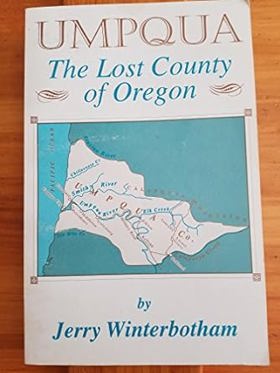
Authored by local historian Jerry Winterbotham, Umpqua: The Lost County of Oregon chronicles the short-lived history of a vast territorial district established in 1851 that eventually vanished from the map through political reorganization and county consolidation. The book details the struggles of early homesteaders, miners, and river merchants who attempted to build permanent communities along the rugged Umpqua River basin before the shifting political tides of the Oregon Territory absorbed their jurisdiction. Through legislative records and pioneer accounts, the text resurrects the forgotten administrative history of a frontier region swallowed by bureaucratic evolution. A keen insight drawn from the work is how county boundaries in the American West were ephemeral political constructs that often bore little relation to actual human geography; by tracing how a once-proud political entity was erased by administrative decree, the book reveals how early state-building frequently treated historic communities as mere ink on a map to be redrawn at the whim of distant territorial lawmakers. iv, 156 pages : illustrations, maps ; 22 cm CIRC [ 1 ]
|
1994 |
|
The Spokane Valley by Florence Boutwell (Compiler) 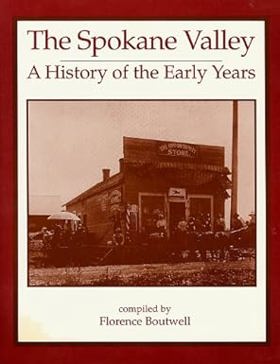
Compiled by local historian Florence Boutwell, The Spokane Valley chronicles the rapid transformation of Washington's inland plateau from an arid, pine-studded expanse into a flourishing agricultural and suburban community. Drawing on historical photographs, diaries, and local records, the book details the arrival of early homesteaders, the expansion of the Northern Pacific Railway, and the monumental irrigation efforts that turned the valley into a patchwork of prolific apple orchards and dairy farms. The text captures the close-knit social fabric of small pioneer settlements like Dishman, Millwood, and Opportunity as they gradually yielded to suburban expansion. A keen insight drawn from the work is how suburbanization in the Inland Empire inverted traditional migration patterns; unlike coastal regions where cities pushed outward, the Spokane Valley's agricultural hubs were explicitly established along irrigation canals first, forming rural clusters that later coalesced into a modern bedroom community. 3 volumes : illustrations, maps (1 folded) ; 29 cm CIRC [ 1 ]
|
1994 |
|
From homestead to lakebed Kosmos, The Town That Drowned by LaVonne M. Sparkman 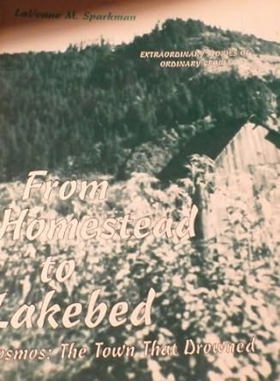
Authored by LaVonne M. Sparkman, From Homestead to Lakebed: Kosmos—The Town that Drowned chronicles the rise and deliberate inundation of Kosmos, a small logging and milling community in Washington State that was wiped off the map to make way for the Mayfield Dam. The book utilizes historical records, photographs, and accounts from former residents to trace how a thriving early-twentieth-century industrial settlement was systematically dismantled, evacuated, and submerged beneath the Cowlitz River. Through these local archives, the text preserves the poignant human cost of hydroelectric progress on rural Pacific Northwest ecosystems and neighborhoods. A keen insight drawn from the work is how corporate and state infrastructure projects treat localized working-class history as entirely disposable collateral; by documenting how a self-sustaining town was erased by utility planning, the narrative underscores how modern energy demands have repeatedly required the literal burial of regional heritage. viii, 242 pages : illustrations, maps, portraits ; 28 cm CIRC [ 1 ]
|
1994 |
|
Voices from Everett's first century by Snohomish County Museum and Historical Association 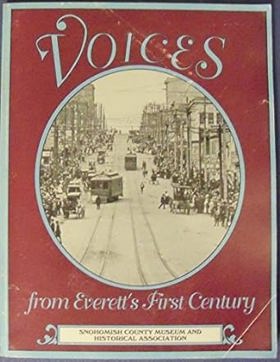
Oversize softbound social history of Everett, WA 1892-1994. 217 pages; illustrated with b/w historical photos of Everett and Snohomish County vii, 217 pages : illustrations ; 28 cm CIRC [ 1 ]
|
1994 |
|
Oregon's salty coast from explorers to the present time by Jim Gibbs, Bert Webber 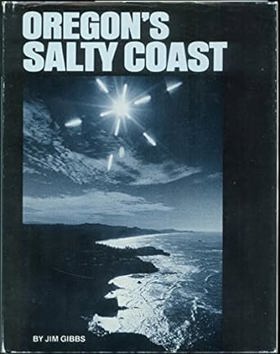
Published by maritime historians Jim Gibbs and Bert Webber, Oregon's Salty Coast: From Explorers to the Present Time chronicles the dramatic, hazard-strewn maritime history of the Pacific Northwest’s rugged shoreline. The book details the harrowing accounts of early Spanish and British explorers, the perilous era of commercial sailing ships, and the vital engineering feats required to construct and maintain iconic coastal lighthouses against relentless winter gales. Through archival photographs and vivid historical narratives, the authors capture the enduring tension between human seafaring ambition and the unforgiving power of the Pacific Ocean. A keen insight drawn from the work is how regional maritime architecture serves as a monument to human vulnerability; the isolated lighthouses clinging to treacherous sea stacks reveal that civilization's reach along the coast was achieved not by conquering the sea, but by erecting desperate beacons of survival at its absolute edge. 173 pages : illustrations, maps ; 22 cm CIRC [ 1 ]
|
1994 |
|
Port Orford, a history by Patrick Masterson 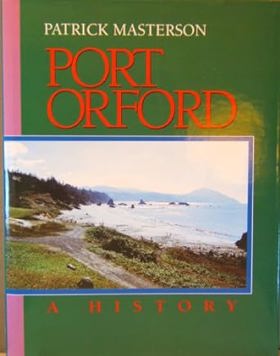
Published by local historian Patrick Masterson, Port Orford, A History chronicles the dramatic evolution of Oregon's oldest continuously settled town, perched precariously on a storm-lashed headland above the Pacific. The book traces the area's rich timeline from its 1851 founding amidst a brief gold rush and subsequent conflicts with local Native tribes, through its decades as a rugged timber and commercial fishing hub. Drawing on historical documents and archival photographs, the text captures the fierce independence required to inhabit a remote coastal enclave characterized by treacherous waters and geographic isolation. A keen insight drawn from the work is how Port Orford's unusual open-water port—where boats must be hoisted in and out of the sea by giant land-based cranes—serves as a physical metaphor for the town's entire existence; it illustrates that surviving on the edge of the wilderness demands a permanent, ingenious defiance against standard modern infrastructure. ii, 203 pages : illustrations ; 29 cm CIRC [ 1 ]
|
1994 |
|
Among my souvenirs by Bernice C. Molthu 
Collected anecdotes, poems, adages and puns, including The bricklayer's tale 62 pages : illustrations ; 22 cm CIRC [ 1 ]
|
1994 |
|
Reflections Thompson Valley histories by Wayne R. Norton, Wilf Schmidt 
Covers Kamloops and the following localities and areas in Thompson- Nicola Regional District: Lytton, Spences Bridge, Ashcroft, Cache Creek, Walhachin, Savona, Monte Creek, Pritchard, Chase, Heffley Creek, Barriere, Clearwater, Birch Island, and North Thompson. From Chase to Lytton and from Blue River to Kamloops, the communities of the Thomson Valley are linked by a magnificent river. But they are also linked by a common past that is largely overlooked in the general histories of British Columbia. This collection of new writing explores the neglected post-settlement history shared by the communities of the Thompson Valley. Supporting the text are seventy-two photographs - many published for the first time. x, 198 pages : illustrations ; 23 cm CIRC [ 0 ]
|
1994 |
|
Legacy history of nursing education at the University of British Columbia, 1919-1994 by Glennis Zilm, Ethel Warbinek, University of British Columbia School of Nursing 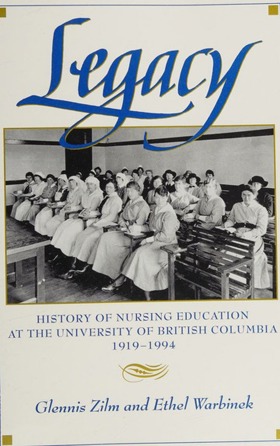
In February 1919 Dr. M.T. McEachern, VGH administrator, and Dr. McKechnie, UBC Chancellor, wrote the UBC Senate to request the establishment of a nursing department at UBC. In October a Department of Nursing was established within the Faculty of Applied Science, making UBC the first university in the British Empire to offer a degree course in nursing. Ethel Johns received a joint appointment as Superintendent of Nurses at VGH and the first Director of the Department of Nursing at UBC, where she implemented a strong, science-based liberal education. xx, 314 p. : ill. ; 23 cm. CIRC [ 0 ]
|
1994 |
|
Fire at Eden's gate Tom McCall & the Oregon story by Brent Walth
|
1994 |
|
Brains for breakfast growing up German in America by Susan Baumgartner, Claudia McGehee 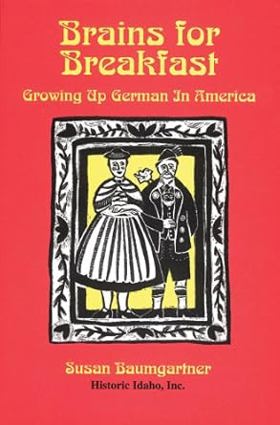
This book offers information for German Americans who know little about their own heritage and a vivid picture of northern Idaho farm life from the 1880s through the 1990s. Trace the progression of history through generations of Baumgartners, sharing family tragedies and joys. 159 pages : illustrations ; 22 cm CIRC [ 0 ]
|
1994 |
|
Boise baseball the first 125 years by Arthur A. Hart 
Here are stories about some of the great players and fascinating characters, as well as many yarns that Arthur A. Hart has collected through years of research and interviews with former players and those closely connected with the game. 109 pages : illustrations ; 21 cm CIRC [ 0 ]
|
1994 |
|
A shadow in the forest Idaho's black bear by John Beecham, Jeff Rohlman, Idaho Department of Fish and Game 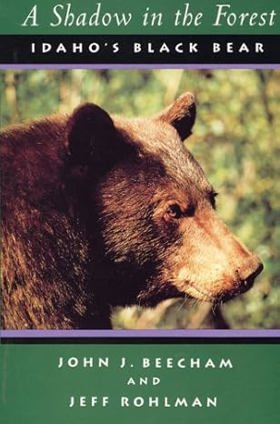
Did you know that Idaho's black bear are more active during the day than at night, that the bears diet is less than 2 percent meat and that the number of cubs born in the spring is related to the size of the fall berry crop? These are just a few of the facts the authors present about the black bear, a shy adaptable species whose secretive habits and preference for forested habitats has made it a difficult animal to observe. The authors have been collecting biological data since 1972 in order to develop a comprehensive management program for the state's black bear population, and this volume summarizes much of their research. As the black bear's range shrinks with man's encroachment into isolated areas, studies such as this one offer scientists and naturalists the necessary data to make informed decisions about successfully managing this unique and irreplaceable species of American wildlife. This volume will provide naturalists and general readers with information on and a greater understanding of the rare and elusive Idaho black bear xviii, 245 pages, [8] folded pages of plates : illustrations (some color), maps ; 13 cm. CIRC [ 0 ]
|
1994 |
|
Seeing Seattle by Roger Sale, Mary Randlett 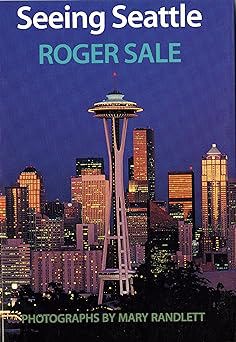
From the time that Roger Sale's interpretive history Seattle Past to Present was published in 1976 he has often served as an unofficial guide for friends and visitors to Seattle, and has also been asked by those who run professional tours for advice on how to view Seattle with fresh eyes. In Seeing Seattle he invites the reader to join him in walking tours of the city in a collaborative process of looking, asking, and forming opinions and judgments. The book starts near where Seattle itself started and works out to the city limits in layers. In the first walk, the Pioneer Square area reveals through its buildings - many of them handsomely rehabilitated - how the city re-established itself after the great fire of 1889. We are asked to observe and evaluate how new buildings and new uses have been combined with old ones, and how architects, builders, and planners have served this historical area. The same points are considered for the downtown business district, Pike Place Market, and other areas near the historic core of the city. We face the breathtaking downtown skyline from viewpoints on Seattle's many hills, from points across the bay at Duwamish Head, and from Seward Park, which has Seattle's largest stand of old-growth forest. What makes Seattle distinctively Seattle? Sale muses over this question as he walks through the older residential sections of Queen Anne Hill and Capitol Hill, with their mansions and near mansions. He traces the routes along Lake Washington Boulevard and the influence of the Olmsted brothers in shaping the social as well as the visual landscape of the city. He tours upscale neighborhoods with lake and sound views as well as working-class neighborhoods thatowe their history and early growth to nearby mills and streetcar transportation. He visits the Chinatown/International District and the University of Washington, and learns to identify trees in Washington Park Arboretum and to recognize those trees elsewhere. He finds the "enchanted house" where Mary McCarthy lived as a girl and the garden in which Theodore Roethke sought solitude among trees that "came closer with a denser shade". Sale and photographer Mary Randlett have worked together to integrate photographs closely with text and promote a view of Seattle in a context of new and old, landscapes and skyscrapers, neighborhood streets and remarkable vistas. Estimated times for each walk (or drive, in outlying areas) and bus route information are provided 255 pages : illustrations, map ; 19 cm CIRC [ 0 ]
|
1994 |
|
Lushootseed dictionary by Dawn E. Bates, Thom Hess, Vi Hilbert 
A celebration of western Washington Native language and culture, this book is a completely reformatted and greatly revised and expanded update of Thom Hess’s Dictionary of Puget Salish (1976). Editor Dawn Bates integrates the field notes of Vi Hilbert, UpperSkagit elder and native speaker of Lushootseed, with Hess’s analyses, mining information gathered by Hilbert and Hess from Skagit, Tulalip, Muckleshoot, Swinomish, Puyallup, and other Native consultants over a period of thirty years. The dictionary includes numerous example sentences taken from Lushootseed’s rich tradition of storytelling. The introduction to the Lushootseed-English section catalogs Lushootseed word-building structures, and entries exemplify each prefix, suffix, and root. The English-Lushootseed section features encyclopedic entries on many culturally significant topics, such as Native canoe classifications and animal names. Scientific classifications are included for botanical terms, and cultural information makes the volume interesting for the nonlinguist. An extensive introduction explains the structure of entries and provides clear definitions of grammatical terms. A detailed description of the sounds of Lushootseed will be invaluable for learners of the language. The traditional dictionary format is readable and economical, resulting in a volume of manageable size. This book is intended for use by a divers readership which includes Lushootseed speakers and their families, people of Lushootseed heritage unfamiliar with the languages, linguists, folklorists, and those interested in oral literature and the native culture of Washington state. xxi, 381 pages : map ; 26 cm CIRC [ 1 ]
|
1994 |