Catalog of British Columbiana and Pacific Northwest Americana
The Encyclopedia Cascadia Catalog indexes mostly non-fiction literature covering the Pacific Northwest coast of North America, with an emphasis on British Columbia, Idaho, Oregon, and Washington State.
| Catalog Title | Published |
|---|---|
|
Peaceful valley the story of Kamiah's early years by Virginia Woods Meyer 
Although this book tells the story of one little Idaho town, Kamiah, located on the Nez Perce Indian reservation and visited by the Lewis and Clark expedition, in many ways it is the story of a multitude of small Pacific Northwestern towns whose origins date back to the turn of the last century--a time when individualism, initiative, and enterprise abounded. Accounts of events as they appeared in the small, weekly newspaper of that day, along with family anecdotes bring Kamiah's history to life. This is a well-researched and entertaining account by a founding father's granddaughter who collected archival pictures from state and private historical societies and museums, and who shared personal family photos never seen before. Over 75 photos and maps. v, 294 pages : illustrations, maps ; 23 cm Non-circulating [ 1 ]
|
1999 |
|
This far-off sunset land a pictorial history of Washington County, Oregon by Carolyn M. Buan 
Authored by regional historian Carolyn M. Buan, This Far-Off Sunset Land: A Pictorial History of Washington County, Oregon offers a richly illustrated chronicle of one of the Pacific Northwest’s oldest agricultural and settlement regions west of Portland. The book compiles rare historic photographs, maps, and archival documents to trace the area's evolution from Donation Land Claim homesteads and early pioneer trails into a bustling network of farming communities and suburban outposts. Through its curated visual narrative, the text highlights the enduring legacy of the Tualatin Valley’s farming families, immigrant laborers, and small-town merchants. A keen insight drawn from the work is how pictorial histories of the Willamette Valley reveal the rapid spatial erasure of agrarian landscapes; the stark transition captured across the photo spreads from open orchards and wooden barns to sprawling paved infrastructure underscores how swiftly post-war modernization consumed the physical markers of pioneer settlement. 192 pages : illustrations ; 29 cm Non-circulating [ 1 ]
|
1999 |
|
"We left because the creek went dry" the people of the First Creek District, Lake Chelan, Washington, 1888-1932 by Elizabeth Watson Perry 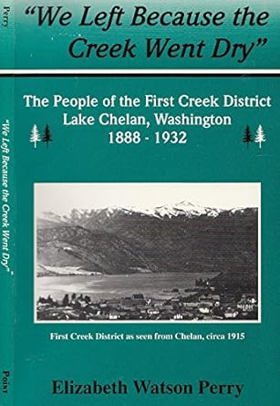
Authored by Elizabeth Watson Perry, "We Left Because the Creek Went Dry": The People of the First Creek District, Lake Chelan, Washington, 1888-1932 chronicles the rise and abandonment of an isolated homesteading community on the arid shores of north-central Washington. The book draws on diaries, family photographs, and oral histories to detail the immense physical and economic toll placed on pioneers attempting to farm steep, water-scarce canyon benches. Through intimate accounts of daily struggle, the text exposes the severe environmental limits that ultimately forced settlers to abandon their hard-won acreage. A keen insight drawn from the work is how agricultural boosterism recklessly ignored ecological realities; by romanticizing the arid Pacific Northwest as an endless land of agrarian promise, promotional literature lured families into fragile microclimates where a single vanishing water source could entirely erase a generation of backbreaking labor. 143 pages : illustrations, map ; 23 cm Non-circulating [ 1 ]
|
1999 |
|
Plants of the Oregon coastal dunes by Alfred M. Wiedemann, L. D. Johnston, Frank H. Smith 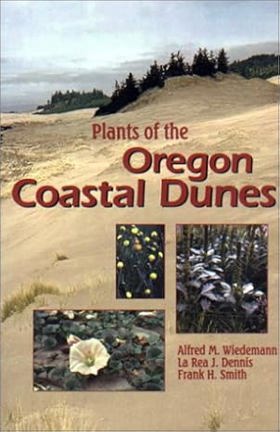
Plants of the Oregon Coastal Dunes offers a useful, informative guide for visitors to the Oregon Dunes National Recreation Area or anyone spending time on the state's remarkable beaches. The standard reference on the Oregon dunes for thirty years, this handy guide identifies those plants most likely encountered and serves as a general introduction to the ecology of dune areas. The first two sections explain the natural history of dunes and describe plant communities associated with dunes and how they change over time. The final section provides an easy-to-use key to 90 common dune plants. Each species profile includes a photograph, a detailed description, and information on habitat and range. This new edition considers changes in dune areas in recent decades, notes conservation efforts, and updates scientific names. 120 pages : illustrations ; 23 cm Desiderata
|
1999 |
|
Narrative of a journey across the Rocky Mountains to the Columbia River by John Kirk Townsend 
"The Narrative chronicles a journey of discovery by the first trained naturalist to cross the American continent. As a member of Nathaniel Wyeth's 1834 expedition to the Oregon country, John Kirk Townsend journeyed west through a "rich and unexplored region" that offered scientists an "almost inexhaustible field of study". Townsend's account of his travels is an engaging, personal record of the first transcontinental trek along the route that would soon become the Oregon Trail." "The Wyeth expedition was a venture that united commerce, religion, and science. Among the company's seventy men was Jason Lee, the first American missionary to the Oregon Country, and Thomas Nuttall, the renowned English botanist. It was Nuttall who invited Townsend, a young ornithologist, to join the expedition. The Narrative documents the expedition's role in the opening of the West and records the author's scientific contributions." "This Northwest Reprints edition of the Narrative restores the original full text, including Townsend's account of his two years at Fort Vancouver on the Columbia River and of his return home by way of the Hawaiian Islands and Chile. Also included is the original scientific appendix of bird and mammal life. George Jobanek's introduction provides a new appreciation of Townsend's accomplishments, and of his role as a scientific explorer in a new land."--Jacket xxix, 290 pages ; 23 cm. Desiderata
|
1999 |
|
A richer harvest an anthology of work in the Pacific Northwest by Craig Wollner, W. Tracy Dillon 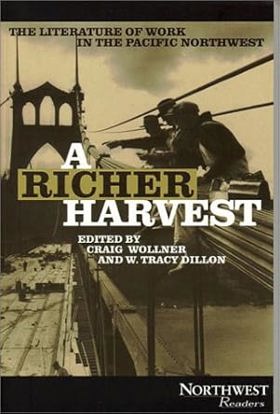
The voices of workers, from logging camps to the Microsoft campus. This fascinating collection of writings taps a rich vein of Northwest literature. From pioneer journals to union tracts and cyberpunk fiction, the selections gathered here reveal the lives of the Northwest's working people and insights into the nature of work in the region. With its strong and varied mix of fiction, poems, manifestos, songs, memoirs, and oral histories, A Richer Harvest creates a powerful, sometimes gritty portrait of work life. Selections depict the natural beauty of the land, the rough and perilous employments, the often bloody tradition of labor radicalism, and the reverence for honest, hard work. The writings detail workers' triumphs and frustrations on farms, in forests, on waterways, and in offices, stores, and factories. Many are the observations of laborers themselves; others are the product of writers who gave voice to the concerns of the working class. The selections are arranged according to three broad themes that trace the evolution of the Northwest's laboring classes. Headnotes introduce each selection, providing historical and literary context. Contributors include Sherman Alexie, Kim Barnes, Ernest Callenbach, Douglas Coupland, H. L. Davis, Tess Gallagher, Woody Guthrie, Hazel Hall, Joe Hill, Ken Kesey, Ursula K. Le Guin, Craig Lesley, Clyde Rice, and Gary Snyder. xi, 276 pages : illustrations ; 23 cm. Desiderata
|
1999 |
|
The Oregon weather book a state of extremes by George H. Taylor, Raymond R. Hatton 
Oregonians are nuts for weather. They're hungry for weather news, anecdotes, statistics, trivia, and, of course, forecasts. The Oregon Weather Book will whet Oregonians' insatiable appetite. A comprehensive and fact-filled resource for anyone who watches, studies, enjoys, or simply endures Oregon weather, this book offers a history of significant weather events and a guide to the forces that create and govern our weather. The authors consider perceptions (and misperceptions) about Oregon weather by residents and outsiders, including the origins of the term, "webfoot." An invaluable reference, The Oregon Weather Book is intended for all Oregonians, from die-hard weather watchers and professionals to those who look to the skies to make recreation, travel or business plans. Tips on interpreting atmospheric conditions will allow amateur forecasters to analyze and predict weather with greater accuracy. xiv, 242 pages : illustrations ; 26 cm Desiderata
|
1999 |
|
The climate of Oregon from rain forest to desert by George H. Taylor, Chris Hannan 
Weather is best understood as the state of the atmosphere on a given day or at a given time. Climate, on the other hand, looks at long-term averages of weather conditions. Or, as one 7-year-old explained to State Climatologist George Taylor, "weather is what you get and climate is what you're supposed to get." The Climate of Oregon gathers into a single volume a range of fascinating and useful climate information. Using state-of-the-art two-color maps and detailed tables, the authors describe various climate elements, including precipitation, temperature, winds, humidity, snow, clouds, and the growing season. Monthly maps for precipitation, snow, and temperature reveal how Oregon's climate changes throughout the year. The book defines the 9 distinct Oregon Climate Zones, examines the role of climate stations in reporting weather, and provides rich data from the state's most representative stations. Several years of unusual weather in the Pacific Northwest have generated great interest in large-scale climate change. Chapters on global warming and its impact on Oregon, El Niño and La Niña, climate changes and salmon populations, and long-term wet and dry cycles offer the latest findings on these topics. xi, 211 pages : illustrations, maps (some color) ; 26 cm Desiderata
|
1999 |
|
The Tillamook a created forest comes of age by Gail Wells 
Debates over the fate of ancient forests have been commonplace in the Pacific West for decades. The Tillamook takes up the question of younger forests, exploring the creation of a managed forest and what its story reveals about the historic and future role of second-growth forests. It was Oregon's most notorious conflagration-a series of four major fires that struck the Tillamook forest beginning in 1933 and recurred with bizarre regularity through 1951. The fires burned 355,000 acres of virgin forest and became collectively known as the Tillamook Burn. In this engaging history, Gail Wells recounts the story of these famous fires and the cooperative efforts of foresters and ordinary citizens-including thousands of schoolchildren-to get young trees growing again on the burned landscape. It became one of the largest forest rehabilitation efforts ever, resulting in a created forest that promised "timber forever." Now a state forest, the Tillamook is coming of age at a time when attitudes toward forests have changed and "timber forever" is no longer the guiding principle. In contemplating the Tillamook's fate, Wells traces the historic roots of competing perspectives on forest use and examines the contemporary debate over forest issues. She sees the future of second-growth forests as holding the possibility of a workable synthesis, "a truly stable, sustainable, and humane relationship with our forests." In a new epilogue, Wells updates the story of the Tillamook five years after her book was first published, and explains why the fate of the forest remains uncertain. viii, 184 pages : illustrations, maps ; 23 cm. Desiderata
|
1999 |
|
The hidden forest the biography of an ecosystem by Jon R. Luoma 
The tallest species of spruce, hemlock, fir, cedar, and pine trees on earth coexist in the old growth of the H. J. Andrews Experimental Forest in Oregon’s Cascade Range. Set aside as a living laboratory by the U.S. Forest Service in 1948, the 16,000 acres represent a vital scientific endeavor: the long-term study of a single contained ecosystem. Here, for the first time, researchers from an enormous range of disciplines—forest scientists, botanists, entomologists, wildlife ecologists, soil biologists, and others—have assembled to examine the role of every working element in the life of a forest. In The Hidden Forest, veteran science writer Jon Luoma offers an absorbing account of how these scientists came to recognize the importance of natural forest ecosystems and how their research is revolutionizing forest management. Luoma takes readers into the hidden forest where researchers have discovered a host of species previously unknown to science, and interactions in the forest ecosystem that no one previously imagined. He describes projects dealing with the forest canopy, rotting logs, insects, fungi, wildlife, streams, and the effects of flood, fire, clear cutting, and volcanic eruption. And he tells the human story behind the research, capturing the shared excitement and wonder of scientific discovery. Along the way, Luoma provides a short course in such complex issues as forest succession, biodiversity, and the politics of forestry. In a new foreword, Jerry Franklin discusses the importance of dedicated, long-term research sites and comments on new discoveries that have emerged from forest ecosystem research since The Hidden Forest was first published. x, 228 pages : illustrations ; 25 cm Desiderata
|
1999 |
|
Long day's journey the steamboat & stagecoach era in the northern West by Carlos A. Schwantes 
In Long Day’s Journey Carlos Schwantes gathers historical photographs, advertisements, posters, and contemporary accounts to recreate one of the most colorful periods in the American West. He traces the rapidly evolving saga of miners and settlers struggling to get from here to there in the days before railroads reached the West, trying to establish methods of transportation and communication between the eastern United States and the new territories that became Oregon, Washington, Idaho, Montana, and Wyoming—first by sea, around continents, then by land and water routes across America. Many of the enduring images and myths of the West derive from this era: the Pony Express, mule trains and plodding ox-team freighters, the picturesque side-wheelers and stern-wheelers that churned along the rivers, the colorful Concord stagecoaches drawn by four or six jingling, fleet horses. Schwantes describes in detail the technology of preindustrial modes of transportation. He explains the economics that linked the birth and death of western towns and cities, the business history of entrepreneurs and stagecoach and steamboat companies, and the challenges facing passengers and employees on the stages and steamers of the northern West. Integrating more than 200 historical photographs and other illustrations with vivid contemporary accounts, Schwantes presents a fascinating history of Americans forging the first working connections between the West and the rest of America—connections that the railroads would soon smooth and strengthen. His book Railroad Signatures across the Pacific Northwest detailed that story; here he tells of the people and animals and equipment supplanted by the twin ribbons of steel. 408 pages : illustrations (some color), maps ; 26 x 27 cm Desiderata
|
1999 |
|
Irrigated Eden the making of an agricultural landscape in the American West by Mark Fiege 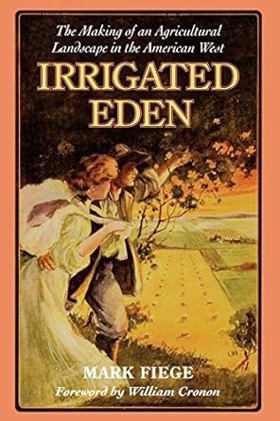
Irrigation came to the arid West in a wave of optimism about the power of water to make the desert bloom. Mark Fiege’s fascinating and innovative study of irrigation in southern Idaho’s Snake River valley describes a complex interplay of human and natural systems. Using vast quantities of labor, irrigators built dams, excavated canals, laid out farms, and brought millions of acres into cultivation. But at each step, nature rebounded and compromised the intended agricultural order. The result was a new and richly textured landscape made of layer upon layer of technology and intractable natural forces—one that engineers and farmers did not control with the precision they had anticipated. Irrigated Eden vividly portrays how human actions inadvertently helped to create a strange and sometimes baffling ecology. xv, 323 pages : illustrations, maps ; 25 cm. Desiderata
|
1999 |
|
Fleeting images of old Salmon Arm by Denis Marshall 
Denis Marshall’s Fleeting Images of Old Salmon Arm compiles visual documentation and narrative vignettes capturing early twentieth-century streetscapes, civic infrastructure, and rural outposts surrounding the Shuswap Lake basin. The chronicle examines the physical transformation of the waterfront and river valley, illustrating how pioneer farmsteads, early municipal buildings, and community centers were superimposed onto traditional Secwépemc territory. Marshall focuses on early commercial enterprises, pioneer families, and structural landmarks that defined daily life prior to mid-century modernization, providing vital photographic cross-references for early town layouts, rail spurs, and lake wharves. 128 pages : illustrations, portraits ; 28 cm Desiderata
|
1999 |
|
Memories of Clear Lake by Charles R. Hyatt, Clear Lake Historical Association 
Published by the Clear Lake Historical Association and compiled by Charles R. Hyatt, Memories of Clear Lake presents a nostalgic and detailed chronicle of the historic logging, rail, and community developments around the Skagit County settlement in northwest Washington. The book compiles vintage photographs, local newspaper excerpts, and personal reminiscences to trace how a bustling timber outpost grew and shifted alongside the changing regional economy. Through these collected records, the text preserves the domestic and industrial rhythms of families who built their lives amidst towering old-growth forests and local waters. A keen insight drawn from the work is how single-industry towns experienced a unique form of community permanence even after their primary resource vanished; by documenting how residents repurposed old logging infrastructure and community spaces for long-term rural living, the narrative reveals that the true legacy of these settlements was not the timber they exported, but the stubborn social bonds forged in the shadow of the mill. vi, 105 pages : illustrations ; 22 cm Non-circulating [ 1 ]
|
1998 |
|
Newcastle Island a place of discovery by Bill Merilees
Authored by naturalist and historian Bill Merilees, Newcastle Island: A Place of Discovery explores the rich natural and industrial heritage of the historic island park located off the coast of Nanaimo, British Columbia. The book traces the island's multifaceted past, from its early significance to the Snuneymuxw First Nation and its late 19th-century boom as a bustling coal-mining and sandstone-quarrying hub to its eventual transition into a beloved coastal recreation area. Through archival photographs, maps, and detailed natural history notes, the text captures how a small marine island became a microcasm of regional resource extraction and leisure. A keen insight drawn from the work is how industrial wastelands can be successfully reclaimed by nature and public memory; by documenting the physical transition from smoky coal pits to tranquil park trails, the narrative reveals that the landscape itself acts as a resilient archivist, quietly healing its extraction scars to offer new generations a sanctuary for ecological discovery. 128 pages : illustrations, facsimiles, maps, portraits ; 22 cm Non-circulating [ 1 ]
|
1998 |
|
Handbook of North American Indians Volume 12, Plateau by William C. Sturtevant , Deward E. Walker , Smithsonian Institution 
This is part of the Smithsonian Institution’s Handbook of North American Indians series, the ultimate resource for Native American history across various regions of North America. The set is intended to give an encyclopedic summary of what is know about the prehistory, history, and cultures of the aboriginal peoples of North America north of the urban civilizations of central Mexico. Volume 12 provides a summary of what is known about the prehistory, history, and culture of the American Indians of the Plateau Culture area. This area is defined by the region in northwestern United States and southwestern Canada drained by the Columbia and Fraser rivers. The Plateau culture area includes the Interior Salishan peoples, the Sahaptian peoples, and several cultural isolates, Athapaskan outliers, and the Kootenai and Cayuse. xvi, 791 pages : illustrations, maps, portraits ; 29 cm Non-circulating [ 1 ]
|
1998 |
|
America's worst train disaster the 1910 Wellington tragedy by Don Moody 
Review from "True Rail Stories" "America's Worst Train Disaster may be about a terrible event back in 1910, but it makes wonderful reading for lovers of steam railroads. It tells of the business pressures driving decisions, decisions that ultimately resulted in over 96 deaths when an avalanche swept a mail and a passenger train down a deep gorge in Washington. According to the author, the trains were trapped in a snowstorm because the railroad undergoing evaluation for a mail contract. Besides that, the railroad also failed to move the trains to a siding which would have saved them from the avalanche. You will find a lot of description of railroad equipment. For example, ever hear of an articulated engine?- one that had a pivot to let it bend in the middle on sharp curves. Of course, there is considerable discussion of equipment and techniques of snow removal. Perhaps you have forgotten that not only passenger trains carried conductors, and the size of snow shoveling crews will amaze you. The book also contains news stories about the trapped trains, the disaster and even good quality photos taken during recovery operations by a newspaper photographer covering the sensational accident. The book contains a view of politics in the days when railroads had the power to mold laws to their liking. Moody obviously feels some of the animosity most people felt toward railroad tycoons. He particularly takes James J. Hill, the founder of the Great Northern Railway to task and suggests that Hill that arranged for the death count to be misstated on the low side. Moody lets no one off the hook in his discussion of the tragedy. He details wild stories newspaper reporters made up about the accident scene in an attempt to stimulate circulation. He tells of social biases against immigrants and uncomplimentary names used to describe foreign workers - not in private conversations but in newspaper columns too. The book does contain typos and errors that may distract the reader, but all in all, Moody did a good job. If railroads are your thing, this book belongs in your collection. 184 pages : illustrations, maps ; 23 cm Non-circulating [ 1 ]
|
1998 |
|
A maritime history of central Whidbey Island. Part 1, The sinking of the Calista by Roger M. Sherman 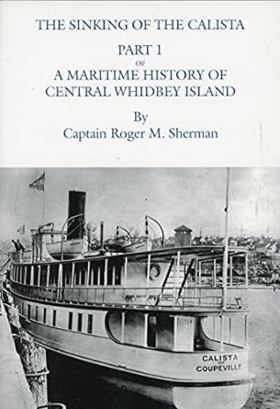
Authored by maritime historian Roger M. Sherman, A Maritime History of Central Whidbey Island, Part 1: The sinking of the Calista details the dramatic local shipping losses and aquatic commerce that shaped the marine highway of Washington's Puget Sound. The volume centers on the fateful shipwreck of the steamer Calista, exploring the intricate mechanics of early 20th-century coastal navigation, passenger travel, and the relentless dangers posed by shifting winds and hidden reefs. Through detailed archival research, contemporary newspaper accounts, and maritime logs, the text brings to light the perilous conditions faced by the small vessels that served as the primary lifeblood of island communities. A keen insight drawn from the work is how maritime disasters served as tragic catalysts for regulatory and technological reform in inland sea transport; the loss of vessels like the Calista forced an unyielding reckoning with corporate safety standards, transforming public attitudes toward the accountability of commercial navigation lines operating in dangerous Pacific Northwest waters. xii, 144 pages : illustrations, maps ; 26 cm Non-circulating [ 1 ]
|
1998 |
|
Legends of the Cowlitz Indian tribe by Roy I. Wilson 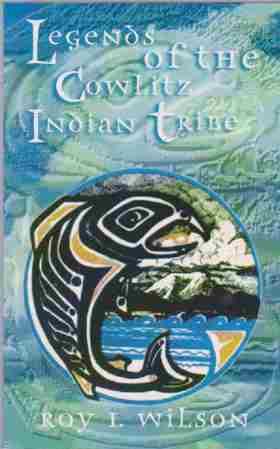
Authored by tribal elder and historian Roy I. Wilson, Legends of the Cowlitz Indian Tribe preserves the sacred oral literature, historical memory, and traditional values of the Cowlitz people of southwest Washington. The volume compiles foundational creation narratives, animal fables, and cultural teachings that explain the spiritual and physical geography of the river valleys and mountain passes sacred to the tribe. Through these transcribed stories, the text honors an ancient literary heritage that connects contemporary generations to their ancestral homelands and customary laws. A keen insight drawn from the work is how indigenous oral narratives function as enduring frameworks for tribal sovereignty; by binding specific geographical landmarks to moral and historical laws, the legends established an unwritten title to the land that colonial mapping could neither erase nor replace. 401 pages ; 21 cm Non-circulating [ 1 ]
|
1998 |
|
Washington's Westport by Ruth McCausland 
Authored by local historian Ruth McCausland, Washington’s Westport chronicles the dramatic transformation of the coastal Pacific Northwest town from a remote, seasonal fishing camp into a bustling commercial harbor and tourist destination. The book draws on vintage photographs, local archives, and personal interviews to detail the hazardous maritime conditions, resilient fishing families, and cannery operations that sustained the isolated community at the mouth of Grays Harbor. Through its vivid pictorial and narrative layout, the text captures the grit required to build a permanent settlement on a shifting, wave-battered spit of land. A keen insight drawn from the work is how coastal outposts maintained an uneasy economic dualism; by relying simultaneously on the volatile fortunes of commercial deep-sea fishing and the fleeting whims of summer tourists, towns like Westport were forced to constantly reinvent their identity to survive the unpredictable rhythms of the Pacific Ocean. 192 pages : illustrations, map ; 26 cm Non-circulating [ 1 ]
|
1998 |
|
North Bank claiming a place on the Rogue by Robin Carey 
It was a fly fisher's dream - a cabin on the lower Rogue River in southern Oregon. But for Robin Carey, this new home also meant learning a new home river. In North Bank, Carey explores how new places gradually become familiar. His engaging essays describe how old memories - of family, of certain fish, of other rivers - and fresh experiences - scouting river canyons, volunteering at a fish hatchery, remodeling the cabin - have combined to shape this place on the Rogue into a place he calls home. That process, of creating home ground in a new place, is the subject of North Bank, a rich and poignant look at fly fishing, favorite rivers, and the desire for familiar landscapes 122 pages : illustrations ; 24 cm Non-circulating [ 1 ]
|
1998 |
|
Cecil Andrus politics western style by Cecil D. Andrus, Joel Connelly 
The immensely popular governor of Idaho from 1970 to 1994--and former U.S. Secretary of Interior--tells it like it is in this frank and perceptive memoir of his life as a Western politician 248 pages : illustrations ; 22 cm Desiderata
|
1998 |
|
From Here to There and In-Between From the Log of S.V. Stone Spirit by Donna Winter 
From the logbook of the 33’ ferro-cement, cutter-rigged “Stone Spirit“. Follow Donna, her husband Dave, and Montague the cat as they travel around the southern inside passage of British Columbia, Canada. 99 pages illustrations, map Non-circulating [ 1 ]
|
1998 |
|
The story of Sidney by Peter Grant 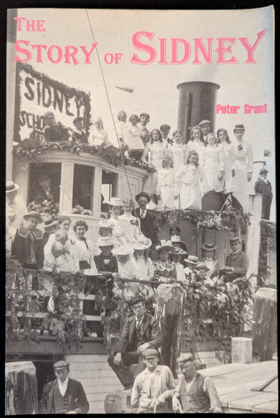
Authored by Peter Grant, The Story of Sidney chronicles the evolution of the coastal town on Vancouver Island, British Columbia, from its early Indigenous presence and 19th-century agricultural settlement into a vibrant modern community. The book details the establishment of local farms, the arrival of the railway, and the maritime connections that bridged the Saanich Peninsula to the broader Salish Sea region. Drawing on local archives, historical photographs, and personal accounts, the text highlights the community's persistent drive to balance commercial growth with small-town coastal character. A keen insight drawn from the work is how transportation revolutions dictate the very heartbeat of coastal towns; just as the transition from neighborhood steamships to the Swartz Bay ferry terminal radically reshaped Sidney's economic destiny, it proved that the survival of an island-adjacent community depends entirely on how successfully it manages its role as a regional gateway. 96 pages : illustrations ; 23 cm Non-circulating [ 1 ]
|
1998 |
|
Barlow Road by Wasco County Historical Society, Clackamas County Historical Society 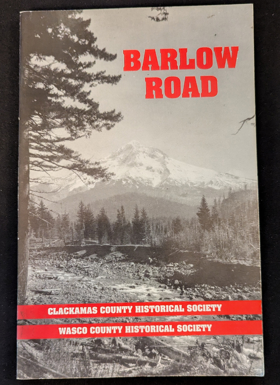
Authored collaboratively by the Wasco County Historical Society and the Clackamas County Historical Society, Barlow Road chronicles the construction and historical legacy of the final, grueling overland leg of the historic Oregon Trail. The book traces how Sam Barlow’s 1845 toll road carved a hazardous wagon route around the treacherous southern flank of Mount Hood, offering exhausted pioneers a perilous alternative to navigating the dangerous rapids of the Columbia River. Through archival maps, journals, and photographs, the text details the monumental physical labor required to hack a wagon track through dense old-growth forests and volcanic terrain. A keen insight drawn from the work is how the creation of the Barlow Road transformed a humanitarian struggle into a capitalist enterprise; by privatizing the final mountain obstacle of the migration route, the toll road proved that the westward movement was driven as much by entrepreneurial toll-gate economics as it was by Manifest Destiny. vii, 97 pages : illustrations, maps ; 21 cm Non-circulating [ 2 ]
|
1998 |