Catalog of British Columbiana and Pacific Northwest Americana
The Encyclopedia Cascadia Catalog indexes mostly non-fiction literature covering the Pacific Northwest coast of North America, with an emphasis on British Columbia, Idaho, Oregon, and Washington State.
| Catalog Title | Published |
|---|---|
|
Neighbor power building community the Seattle way by Jim Diers 
Building on the lessons of early labor leaders, civil rights volunteers, and political activists, Jim Diers has developed his own models and successful strategies for community development. Neighbor Power chronicles his involvement with Seattle’s communities. This book not only gives hope that participatory democracy is possible, but it offers practical applications and invaluable lessons for ordinary, caring citizens who want to make a difference. It also provides government officials with inspiring stories and proven programs to help them embrace citizen activists as true partners. Diers’s experience is extensive. He began as a community organizer in 1976, then moved on to help establish and staff a system of consumer-elected medical center councils. This led him to Seattle city government, where he served under three mayors as the first director of the Department of Neighborhoods, recognized as the national leader in such efforts. In the 1990s, Jim Diers helped Seattle neighborhoods face challenges ranging from gang violence to urban growth. The Neighborhood Matching Fund grew to support over 400 community self-help projects each year while a community-driven planning process involved 30,000 people. Diers provides evidence that productive community life is thriving, not just in Seattle, Washington, but in towns and cities across the globe. Both practical and inspiring, Neighbor Power offers real-life examples of how to build active, creative neighborhoods and enjoy the rich results of community empowerment. x, 202 pages : illustrations, maps ; 23 cm Desiderata
|
2004 |
|
Nehalem Tillamook tales by Elizabeth derr Jacobs, Melville Jacobs 
Elizabeth Derr Jacobs and Melville Jacobs’s Nehalem Tillamook Tales chronicles the oral traditions of an indigenous coastal society whose entire cultural and economic existence was forged by the rugged, rain-drenched topography of the northern Oregon seaboard. The recorded narratives map how the impenetrable barrier of the coastal temperate rainforest and the treacherous maritime climate forced the Nehalem Tillamook to orient their survival exclusively around the region's volatile estuarine networks and salmon-rich river systems. By preserving these ancestral accounts, the text illustrates how the mastery of advanced cedar-craft infrastructure—specifically the construction of monumental dugout canoes and weather-resilient plank houses—was strictly dictated by the necessity of navigating and enduring this wet, heavily timbered environment. Ultimately, the collection demonstrates that for these early maritime populations, profound physical and cultural adaptation to a geographically isolated, water-bound landscape was the absolute prerequisite for long-term endurance along the unforgiving Pacific edge. 216 s Non-circulating [ 1 ]
|
1959 |
|
Necktie parties a history of legal executions in Oregon, 1851-1905 by Diane L. Goeres-Gardner 
Diane Goeres-Gardner makes readers eyewitnesses to frontier justice in Necktie Parties. This is the story of the men who climbed the gallows steps and faced the hangman's noose during the early years of settlement in Oregon. Today, capital punishment is a controversial topic, in the United States and around the world. That wasn?t the case during the 1800s on America's western frontier. Executions were public events drawing hundreds?sometimes thousands?of residents from miles around. The xxiv, 316 pages : illustrations, maps, portraits ; 23 cm Desiderata
|
2005 |
|
Nch'i-wána, "the big river" Mid-Columbia Indians and their land by Eugene S. Hunn, James Selam 
The mighty Columbia River cuts a deep gash through the Miocene basalts of the Columbia Plateau, coursing as well through the lives of the Indians who live along its banks. Known to these people as Nch’i-Wana (the Big River), it forms the spine of their land, the core of their habitat. At the turn of the century, the Sahaptin speakers of the mid-Columbia lived in an area between Celilo Falls and Priest Rapids in eastern Oregon and Washington. They were hunters and gatherers who survived by virtue of a detailed, encyclopedic knowledge of their environment. Eugene Hunn’s authoritative study focuses on Sahaptin ethnobiology and the role of the natural environment in the lives and beliefs of their descendants who live on or near the Yakima, Umatilla, and Warm Springs reservations. xi, 378 pages : illustrations, maps ; 24 cm Non-circulating [ 1 ]
|
1990 |
|
Navigating the coast a history of the Union Steamship Company by Peter Chapman, John Haskell Kemble (Donor), Provincial Archives of British Columbia 
Navigating the Coast: A History of the Union Steamship Company chronicles the vital maritime lifeline that sustained isolated industrial and pioneer communities scattered along the rugged, deeply indented seaboard of British Columbia. Chapman details how the region's formidable physical barriers—specifically the towering, impenetrable slopes of the Coast Mountains that plunge directly into the sea—rendered overland transportation virtually impossible, forcing early canneries, logging camps, and Native villages to rely absolutely on the ocean for survival and commerce. By mapping the intricate, dangerous routes of the Union fleet through the treacherous tidal narrows, fog-bound fjords, and storm-battered straits of the Inside Passage, the narrative highlights the immense navigational skill required to maintain this precarious coastal network. The complete dependence on these coastal steamers for freight, mail, and human movement underscores the profound geographic isolation of these remote water-bound outposts. Ultimately, this historical record serves as a deeply localized spatial history, demonstrating how the unforgiving marine topography and sheer vertical extremes of the Pacific Northwest coast inherently dictated the absolute necessity of a specialized maritime infrastructure to conquer the rugged coastal frontier. 77 pages : illustrations, color map ; 27 cm. Non-circulating [ 1 ]
|
1977 |
|
Naval Station Puget Sound at Sand Point by Dennis Stuhaug, United States Department of the Navy Morale, Welfare and Recreation Department 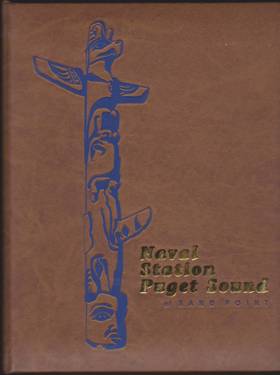
Published by the Department of the Navy alongside local author Dennis Stuhaug, Naval Station Puget Sound at Sand Point chronicles the fascinating military and aviation heritage of Seattle’s historic waterfront base. The book details the facility's evolution from a vital 1920s naval air station—famous as a key stop for the 1924 round-the-world flight—into a crucial World War II training and logistics hub. Through archival photographs and military records, the text captures how the installation served as a dynamic nexus between civilian urban life and naval defense along Lake Washington. A keen insight drawn from the work is how the transformation of military bases into public parks reflects the shifting priorities of modern cities; as Sand Point was decommissioned and turned into Magnuson Park, it demonstrated how post-industrial urban spaces are reclaimed to heal the ecological and social splits left behind by military-industrial expansion. 104 pages : illustrations (1 color), portraits (1 color) ; 29 cm Desiderata
|
1992 |
|
Nature's justice writings of William O. Douglas by William O. Douglas, James O'Fallon 
As the longest serving Justice in the history of the U.S. Supreme Court, William O. Douglas was known for writing a host of dissenting opinions. He was also a prolific writer off the bench, a man whose work was as much concerned with nature as with law. This collection brings together writings that represent the wide range of Douglas's interests. It includes selections from his autobiographical and political books, and opinions from landmark cases—all reflecting not only his love of justice but also his roots in the Northwest and his lifelong commitment to the environment. Several selections from Douglas's first book Of Men and Mountains portray his abiding love of the outdoors—particularly the Northern Cascades—and the rugged people who live there. These personal writings warmly recall events of his youth and celebrate the power of the mountains to renew the human spirit. Other selections evoke Douglas's professional activities: as a New Deal insider and Supreme Court Justice, a champion of civil liberties and the rights of minorities, a strong internationalist, and an unflagging supporter of environmental issues. These latter writings include passages from My Wilderness and his dissenting opinion in Sierra Club v. Morton arguing that trees have legal standing to bring lawsuits. These writings demonstrate that Douglas never shied from controversy—whether over interpretation of the Fourteenth Amendment or the choice between flies and bait for trout fishing—and offer inspiration for both environmentalists and all who yearn for a more just society. Whether extolling the joys of the wild or defending the rights of citizens, Douglas shows in this work that he truly was Nature's Justice—and one of a kind. x, 310 pages : illustrations ; 24 cm. Desiderata
|
2000 |
|
Nature rambles in the Wallowas sketches of the natural history of northeastern Oregon by Elmo Nall Stevenson 
Elmo Nall Stevenson’s Nature rambles in the Wallowas: sketches of the natural history of northeastern Oregon explores the profound ecological richness and thoughtful human appreciation of the dramatic, high-altitude landscapes of the state's northeastern corner. The narrative illustrates how the demanding yet majestic environmental realities of this alpine topography—defined by the sheer granite peaks of the Wallowa Mountains, deep glacial valleys, and vibrant, diverse biological zones—encouraged a deep, localized ecological awareness. By detailing the careful observation and natural history of the region's unique flora, fauna, and geological formations, the text highlights how developing a profound respect and scientific understanding of this rugged wilderness was essential for sustainable interaction with the land. Ultimately, the account demonstrates that collaboratively documenting these biological networks and fostering a patient, community-driven stewardship of the Wallowas were vital steps in cultivating an enduring cultural and environmental heritage that harmonizes with the awe-inspiring realities of the Pacific Northwest's interior alpine ecosystems. 100 pages including plates : illustrations, map ; 23 cm Non-circulating [ 1 ]
|
1937 |
|
Natural vegetation of Oregon and Washington by Jerry F. Franklin, C. T. Dyrness 
Natural Vegetation of Oregon and Washington by Jerry F. Franklin and C. T. Dyrness is a seminal 1973 ecological reference work that provides an exhaustive classification and description of the diverse plant communities across the Pacific Northwest. Widely considered the definitive text for regional botany, the book meticulously details the distinct environmental zones, major forest types, and steppe landscapes native to the two states. It remains an indispensable foundational resource for ecologists, land managers, and researchers studying the complex flora and ecosystems of the region. 452 pages : illustrations, charts, maps ; 27 cm Non-circulating [ 1 ]
|
1988 |
|
Native Seattle histories from the crossing-over place by Coll-Peter Thrush 
In traditional scholarship, Native Americans have been conspicuously absent from urban history. Indians appear at the time of contact, are involved in fighting or treaties, and then seem to vanish, usually onto reservations. In Native Seattle, Coll Thrush explodes the commonly accepted notion that Indians and cities--and thus Indian and urban histories--are mutually exclusive, that Indians and cities cannot coexist, and that one must necessarily be eclipsed by the other. Native people and places played a vital part in the founding of Seattle and in what the city is today, just as urban changes transformed what it meant to be Native. On the urban indigenous frontier of the 1850s, 1860s, and 1870s, Indians were central to town life. Native Americans literally made Seattle possible through their labor and their participation, even as they were made scapegoats for urban disorder. As late as 1880, Seattle was still very much a Native place. Between the 1880s and the 1930s, however, Seattle's urban and Indian histories were transformed as the town turned into a metropolis. Massive changes in the urban environment dramatically affected indigenous people's abilities to survive in traditional places. The movement of Native people and their material culture to Seattle from all across the region inspired new identities both for the migrants and for the city itself. As boosters, historians, and pioneers tried to explain Seattle's historical trajectory, they told stories about Indians: as hostile enemies, as exotic Others, and as noble symbols of a vanished wilderness. But by the beginning of World War II, a new multitribal urban Native community had begun to take shape in Seattle, even as it was overshadowed by the city's appropriation of Indian images to understand and sell itself. After World War II, more changes in the city, combined with the agency of Native people, led to a new visibility and authority for Indians in Seattle. The descendants of Seattle's indigenous peoples capitalized on broader historical revisionism to claim new authority over urban places and narratives. At the beginning of the twenty-first century, Native people have returned to the center of civic life, not as contrived symbols of a whitewashed past but on their own terms. In Seattle, the strands of urban and Indian history have always been intertwined. --From publisher's description 1 online resource (xxi, 326 pages) : illustrations Non-circulating [ 1 ]
|
2007 |
|
Native river the Columbia remembered : Priest Rapids to the international boundary by William D. Layman 
In images and narratives, Native River recreates the untamed Mid-Columbia--the river as it once was, before the building of seven major dams. Featuring a wealth of illustrations, maps, and photographs, many never before published, this finely crafted book focuses on the 350-mile reach of the middle Columbia River from Priest Rapids in south-central Washington to the U.S. Canadian border. William Layman affords each segment of this waterway with its own rich visual documentation, forming a backdrop to many absorbing river stories. -- Amazon xii, 195 pages : illustrations, maps ; 24 x 29 cm Non-circulating [ 1 ]
|
2002 |
|
Native Arts of the Columbia Plateau The Doris Swayze Bounds Collection of Native American Artifacts by Susan E. Harless, Orr Staff High Desert Museum Mbend 
Colorfully beaded handbags, superbly tanned and decorated deerskin shirts, finely woven baskets, exquisitely beaded and fringed horse trappings -- these distinctive Native arts of the Columbia River Plateau have been overshadowed in the public eye by the arts of the Northwest Coast, Great Plains, and American Southwest. But Indians in the region where present-day Washington, Oregon, and Idaho share boundaries have for centuries combined function and beauty in the items they made for even the most mundane of uses, and their traditional arts are still vital today. This book brings overdue recognition to the artistry and craftsmanship of the Plateau Indians by focusing on the remarkable collection amassed by the late Doris Swayze Bounds, a banker in Hermiston, Oregon, who grew up with and deeply loved Native people and their culture. She was loved in return, and many of the nearly 1,000 Plateau items in her collection came to her as gifts from her Indian friends, who expressed their respect and affection through the time-honored tradition of gift-giving. Exposed to Euro-Americans relatively late, the Plateau Indians managed to retain many of their traditional lifeways of fishing, hunting, and gathering, as well as a vigorous ethic of generosity and respect for others. The pieces in the Bounds collection, which date mainly from the 1870s to the 1960s, reflect all these aspects of Plateau culture. They range from sturdy baskets made to hold roots or berries to elaborately beaded elkhide “tail dresses” worn on festive occasions. In five essays, both Native and non-Native experts describe the art styles and the uses and cultural meanings of the items; two other recount Doris Bound’s life, collecting practices, and relationships with Native Americans. The essays are handsomely illustrated with items from the Bounds collection. This book offers and introduction to this visually stunning art tradition. Desiderata
|
1998 |
|
Native and ornamental conifers in the Pacific Northwest identification, botany, and natural history by Elizabeth A. Price 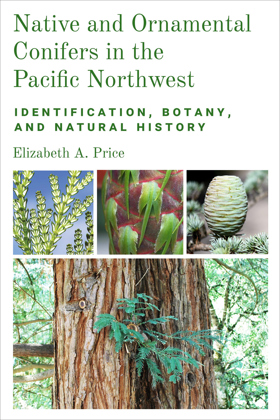
"There are a number of conifer guides available for the Pacific Northwest. Most of these guides, however, focus on native cultivars. Master gardener Elizabeth Price has put together a new guide that includes ornamentals alongside natives, arguing that most people are not necessarily concerned with distinguishing between the two, especially in a residential setting. Based on her experiences teaching workshops on conifer identification and cultivation, Price has developed identification charts that are suitable for specialists but focused on making the information as accessible as possible for amateurs. Although the book's primary goal is identification, it also weaves in natural history and a little personal narrative"-- Provided by publisher xii, 330 pages : color illustrations ; 23 cm Desiderata
|
2022 |
|
Native American wives of San Juan settlers by Karen Jones Lamb 
Karen Jones Lamb’s biographical and genealogical chronicle, Native American Wives of San Juan Settlers, recovers the foundational domestic, familial, and cross-cultural relationships that anchored mid-to-late nineteenth-century non-Indigenous settlement across the San Juan Archipelago. The work documents how early homestead claims, sheep stations, and lime-quarrying ventures across San Juan, Orcas, and Lopez islands were established directly within the ancestral marine territories, reef net locations, and seasonal harvesting sites of Northern Straits Salish peoples, including the Lummi, Samish, Songhees, and Saanich. Lamb details how settler survival on isolated island homesteads depended profoundly on the labor, ecological knowledge, and extensive kinship networks of Indigenous women, whose open-water canoe navigation and foraging skills maintained isolated households long before the advent of regular steamship service. Ultimately, these biographical accounts illustrate how cross-cultural marriages bridged the turbulent transition from the joint military occupation of the Pig War to formalized American civilian governance, highlighting the central role of Native women in sustaining the archipelago's early civic and maritime communities. 94 pages : illustrations ; 27 cm Desiderata
|
1994 |
|
Native American Placenames of the United States by William Bright
|
2007 |
|
Native accounts of Nootka ethnography by Edward Sapir, Morris Swadesh 
This volume constitutes a continuation of Nootka Texts, Tales, and Ethnological Narratives, with Grammatical Notes and Lexical Materials, published in 1939. A third volume, Nootka Legends and Stories, is in preparation. Edward Sapir died while Nootka Texts was in press. The material for the subsequent volumes was already collected, the general plan laid out, the translation and editing begun by Sapir or by myself working under his guidance. However, a great deal remained to be carried out with- out his help. Editorial economy was a major problem. If the full body of Sapir's native Nootka collection were to be published in the manner followed in Nootka Texts, it would require eight or ten comparable volumes. Some simplification for the subsequent volumes, such as omissions of interlinear translation and linguistic commentary, were already envisaged by Sapir. However, it proved desirable to go much farther-- to adopt a terser style of translation, to limit materials given in notes, to use simple phonetic symbols which eliminate diacritics and allow more compact printing. For people familiar with Vancouver Island it has to be explained that the present materials do not come from the town of Nootka, but from the vicinity of Alberni. We say Nootka, because anthropologists are in the habit of using that term for all the west coast Indians from Alberni Canal to Kyuquot Sound. . Indiana University, 1, v. 21, no. 4, pt. 2 457 pages 26 cm Desiderata
|
1955 |
|
National park, city playground Mount Rainier in the twentieth century by Theodore Catton 
The majestic beauty of Mount Rainier, which dominates the Seattle and Tacoma skyscapes, has in many ways defined the Pacific Northwest. At the same time, those two major cities have strongly influenced the development of Rainier as a national park. From the late 1890s, when the Pacific Forest Reserve became Mount Rainier National Park, the evolving relationship between the mountain and its surrounding residents has told a history of the region itself. That story also describes the changing nature of our national park system. From the late nineteenth century to the present, park service representatives and other officials have created policies, built roads and hotels, and regulated public use of and access to Mount Rainier. Conflicting interests have shaped the decision-making process and characterized human interaction with the park. The Rainier National Park Company promoted Paradise Inn as a destination resort for East Coast tourists; Cooperative Campers of the Pacific Northwest developed backcountry camps for working-class recreationists; Asahel Curtis of the Good Roads Association wanted a road encircling the mountain; The Mountaineers promoted free public campgrounds and a roadless preserve; others focused on managing and protecting the upper mountain. The National Park Service mediated among the various parties while developing their own master plan for the park. In an engaging and accessible style, historian Theodore Catton tells the story of Mount Rainier, examining the controversies and compromises that have shaped one of America's most beautiful and beloved parks. National Park, City Playground reminds us that the way we manage our wilderness areas is a vital concern not only for the National Park Service, but for all citizens. ix, 236 pages, 16 unnumbered pages of plates : illustrations, maps ; 23 cm Desiderata
|
2006 |
|
Narrative of the exploring expedition to the Rocky Mountains in the year 1842 And to Oregon and North California in the years 1843-44 by John C. Fremont
Published together in 1846 for a British readership, these reports of two westward expeditions shed light on the challenges of exploration in nineteenth-century North America. Led by the army officer and future presidential candidate John Charles Frémont (1813-90), who became known as 'the Pathfinder', the first expedition ranged west of the Missouri River, while the second pushed beyond the Rocky Mountains, north to Fort Vancouver and then south into Mexican-held California. Frémont's detailed accounts are accessible to the non-specialist: this edition omits 'only the portions which are altogether astronomical, scientific, and philosophical, and, therefore, not adapted for general utility'. When originally published separately in 1843 and 1845, the narratives enthused a great many Americans, encouraging them to migrate west by providing stirring inspiration, valuable maps and practical information. Frémont's words and deeds remain of interest in the debate surrounding the 'manifest destiny' of the United States. 186 pages ; 24 cm ONLINE Circulation [ 1 ]
|
1846 |
|
Narrative of a Voyage to the Northwest Coast of America in the Years 1811, 1812, 1813, and 1814 The First American Settlement on the Pacific by Gabriel Franchère, translated by J.V. Huntington
The author, a Canadian, was one of the party sent out by John Jacob Astor to establish his colony at Astoria and he describes the voyage up the Columbia 376 pages, 4 unnumbered leaves of plates + 8 unnumbered pages of publisher's advertisements : frontispiece, illustrations (plates) ; 19 cm ONLINE Circulation [ 1 ]
|
1854 |
|
Narrative of a journey across the Rocky Mountains to the Columbia River by John Kirk Townsend 
"The Narrative chronicles a journey of discovery by the first trained naturalist to cross the American continent. As a member of Nathaniel Wyeth's 1834 expedition to the Oregon country, John Kirk Townsend journeyed west through a "rich and unexplored region" that offered scientists an "almost inexhaustible field of study". Townsend's account of his travels is an engaging, personal record of the first transcontinental trek along the route that would soon become the Oregon Trail." "The Wyeth expedition was a venture that united commerce, religion, and science. Among the company's seventy men was Jason Lee, the first American missionary to the Oregon Country, and Thomas Nuttall, the renowned English botanist. It was Nuttall who invited Townsend, a young ornithologist, to join the expedition. The Narrative documents the expedition's role in the opening of the West and records the author's scientific contributions." "This Northwest Reprints edition of the Narrative restores the original full text, including Townsend's account of his two years at Fort Vancouver on the Columbia River and of his return home by way of the Hawaiian Islands and Chile. Also included is the original scientific appendix of bird and mammal life. George Jobanek's introduction provides a new appreciation of Townsend's accomplishments, and of his role as a scientific explorer in a new land."--Jacket xxix, 290 pages ; 23 cm. Desiderata
|
1999 |
|
Narcissa Whitman pioneer of Oregon by Jeanette Eaton , Woodi Ishmael (Illustrator), Cairns Collection of American Women Writers
Jeanette Eaton’s Narcissa Whitman pioneer of Oregon explores the profound personal endurance and complex cultural transitions that defined the earliest American homesteading efforts in the inland Pacific Northwest. The narrative illustrates how the demanding environmental realities of this vast landscape—spanning the grueling overland expanse of the Rocky Mountains and the isolated, arid plains of the Walla Walla Valley—required immense resilience and deep daily adaptation from the region's first pioneer families. By detailing Whitman’s foundational work to establish the Waiilatpu mission and the immense logistical challenges of sustaining an agrarian and medical outpost far from established supply lines, the text highlights the sheer determination necessary to cultivate a supportive community on the frontier. Ultimately, the account demonstrates that patiently enduring the profound geographic isolation of the Columbia Plateau and attempting to thoughtfully navigate the delicate, deeply complex cross-cultural intersections with the indigenous Cayuse people were defining elements in the early efforts to bridge the continental divide. 5 unnumbered preliminary leaves of plates, pages 3-318 : illustrations, map ; 23 cm Non-circulating [ 1 ]
|
1941 |
|
Nanaimo retrospective the first century by E. Blanche Norcross, Nanaimo Historical Society 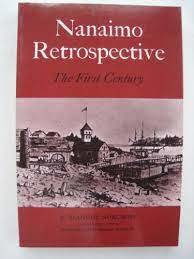
Edited by E. Blanche Norcross and published by the Nanaimo Historical Society, Nanaimo Retrospective: The First Century offers a scholarly yet accessible chronicle of the region's formative hundred years. The volume carefully examines the area's early industrial development, including coal mining and logging, alongside the intricate social dynamics between Indigenous communities and diverse waves of immigrants. Drawing upon archival materials and historical photographs, the text provides researchers and local history enthusiasts with a comprehensive foundational study of the municipality's evolution. xxi, 169 p., [28] p. of plates : ill., map, ports. ; 23 cm. Non-circulating [ 1 ]
|
1996 |
|
Nanaimo the harbour city by Goody Niosi, Terry Patterson 
Published in 2004, Nanaimo: The Harbour City is an engaging travel guide and visual keepsake written by Goody Niosi with photography by Terry Patterson. The book chronicles the history and cultural evolution of this Vancouver Island community, tracing its growth from an early Aboriginal settlement into a thriving, modern port city. Alongside Patterson's vibrant images of the bustling harbour and local seascape, Niosi provides readers with detailed walking tours of historic neighborhoods and insights into the area's natural beauty. It serves as both a practical resource for travelers and a colorful celebration of Nanaimo's unique coastal heritage. 112 pages : illustrations (chiefly color), 1 color map, portraits ; 28 cm Non-circulating [ 1 ]
|
2004 |
|
Naming, opening, and dedication of Stanley Park, Vancouver, Canada, 1888-1889 by Archives of Vancouver Society 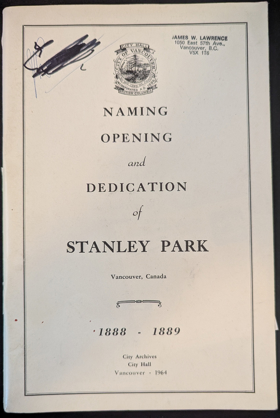
The Archives of Vancouver Society’s documentary record of the Naming, opening, and dedication of Stanley Park, Vancouver, Canada, 1888-1889 chronicles the civic preservation of a massive, densely forested peninsula situated at the strategic maritime gateway to British Columbia’s booming railway terminus. The historical narrative maps the rugged estuarine topography separating English Bay from Burrard Inlet, detailing how this imposing promontory of ancient western red cedar and Douglas fir historically functioned as a vital military reserve and indigenous settlement overlooking the treacherous tidal rips of the First Narrows. By documenting the transformation of this unlogged coastal rainforest into a sprawling municipal sanctuary amidst the rapid late-nineteenth-century industrialization of the adjacent Vancouver townsite, the text illustrates a deliberate civic effort to protect the region's formidable natural scale. Ultimately, the account captures a defining moment in the urban geography of the Pacific Northwest, demonstrating how the conscious preservation of this impenetrable, deep-water coastal wilderness permanently anchored the cultural and spatial identity of Canada’s primary Pacific metropolis. With the compliments of the Commissioners of the Park Board, past and present. On the seventy-fifth anniversary of the dedication of Stanley Park, 1889. 60 pages illustrations 23 cm Non-circulating [ 1 ]
|
1964 |
|
Names of Idaho Counties by Lalla Phipps Boone
Article from Names publication in 1968 where author discusses the origin of Idaho County names. pp 19-26 Non-circulating [ 1 ]
|
1968 |