Catalog of British Columbiana and Pacific Northwest Americana
Encyclopedia Cascadia Catalog contains book titles of mostly non-fiction Pacific Northwest Coast of North America Titles (primarially British Columbia, Idaho, Oregon and Washington State) in an easy-to-understand title catalog. If you see a link with this badge ONLINE CIRC it means that there is an online institution that provides free access to that title. In some cases there may be more than one institution hosting the title digitally.
| Catalog Title | Published |
|---|---|
|
Camps and calluses the Civilian Conservation Corps in Southwestern Oregon by William A. Lansing 
For most of us, the Great Depression that gripped the nation for almost 10 years in the late 1920's and '30's is only something that we vaguely recall from reading history books. In 1933 Franklin Delano Roosevelt took the reins of the nation and created the NEW DEAL. One of the most successful programs of the NEW DEAL was the creation of the Civilian Conservation Corps. It focused on getting the unemployed young men off the streets of America's largest cities and transporting them by train to their new home in camps spread across the country. These camps would be their home for a minimum of six months. The book "Camps and Calluses" discusses what lead up to the Great Depression and where and how the CCC camps in southwestern Oregon played their part. This book follows my other ones in style and narrative. It highlights with photographs the camps and work projects in the region while being supported by a detailed narrative on each camp. Sadly, there is little evidence left to prove the CCC boys were here. The camp sites have all disappeared and only a few rock walls have stood the test of time to demonstrate their work. So, I decided to write a book about what they did. --author 224 pages : illustrations (some color) ; 29 cm + 1 map CIRC [ 0 ]
|
2014 |
|
Campfire tales of eastern Idaho Volume I by Louis J. Clements
|
1989 |
|
Camera eye on Idaho pioneer photography, 1863-1913 by Arthur A. Hart 
This book is a collection of the most compelling and beautiful photographs made of early Idaho people, places, and events in Idaho from 1863 through 1913. Virtually nothing had been published on Idaho’s pioneer photographers when Arthur A. Hart began his research a dozen years ago. 201 pages : illustrations ; 29 cm CIRC [ 0 ]
|
1990 |
|
Camas Prairie Railroad by Robert Perret , Amy Thompson 
"Incorporated in 1909, the Camas Prairie Railroad (CPRR) was a successful joint venture between two major competing companies, the Union Pacific and Northern Pacific Railroads. Despite covering less than 300 miles total, the Camas Prairie Railroad connected the region's largest exporters of wheat and lumber and was the last vital section of rail to directly connect the eastern United States with the Pacific Northwest. In addition to freight, the CPRR was the most reliable method of transportation for people and the postal service in this rural area, even allowing for the creation of new towns along the line. The Camas Prairie itself ranged from desert to mountainous forests, with rugged river canyons in between. Infamously known as the "Railroad on Stilts," one subdivision alone boasts 44 bridges, many of them made from heavy timber. No longer in business, portions of the track have been removed while some remain active, carrying freight to larger markets. Trestles and tunnels still dot the landscape, giving a peek into the not-so-distant past" 127 pages : illustrations, map ; 24 cm. CIRC [ 0 ]
|
2022 |
|
California condors in the Pacific Northwest by Jesse D'Elia, Susan M. Haig 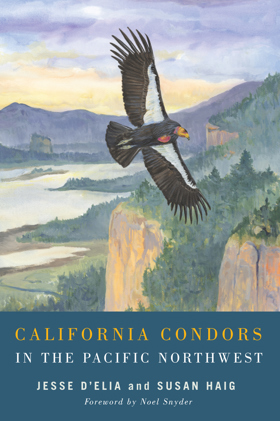
Despite frequent depiction as a bird of California and the desert southwest, North America’s largest avian scavenger once graced the skies of the Pacific Northwest, from northern California to British Columbia. This important volume documents the condor’s history in the region, from prehistoric times to the early twentieth century, and explores the challenges of reintroduction. Jesse D’Elia and Susan Haig investigate the paleontological and observational record as well as the cultural relationships between Native American tribes and condors, providing the most complete assessment to date of the condor’s occurrence in the Pacific Northwest. They evaluate the probable causes of regional extinction and the likelihood that condors once bred in the region, and they assess factors that must be considered in determining whether they could once again thrive in Northwest skies. Incorporating the newest research and findings and more than eighty detailed historical accounts of human encounters with these birds of prey, California Condors in the Pacific Northwest sets a new standard for examining the historical record of a species prior to undertaking a reintroduction effort. It is a vital reference for academics, agency decision makers, conservation biologists, and readers interested in Northwest natural history. The volume is beautifully illustrated by Ram Papish and includes a number of previously unpublished photographs. xvi, 208 pages : illustrations, maps ; 24 cm CIRC [ 0 ]
|
2013 |
|
Calamity Jane and her siblings the saga of Lena and Elijah Canary by Janice Brozik Cerney 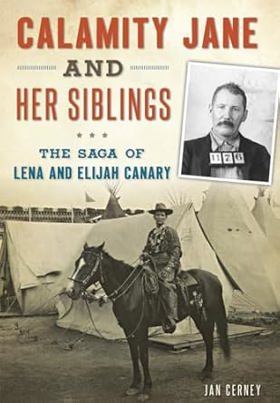
The mere mention of Calamity Jane conjures up images of buckskins, bull whips and dance halls, but there's more to the woman than the storied legend she became. Born Martha Canary, she was orphaned as a child and assumed the responsibility of caring for her siblings. Much too young and ambitious to rear a family, she found homes for all. After setting off on her own, Martha tried to reconnect with her fractured family in her typical haphazard fashion, all the while transforming into Calamity Jane. Soon, her own foibles and her siblings' choices rendered the attempt futile. From brother Elijah's horse thieving to sister Lena's denial of Martha's tales, author Jan Cerney uncovers the tumultuous Canary family often overlooked in the Calamity canon. 157 pages : illustrations ; 23 cm CIRC [ 0 ]
|
2016 |
|
Calamity the Heppner flood of 1903 by Joann Green Byrd 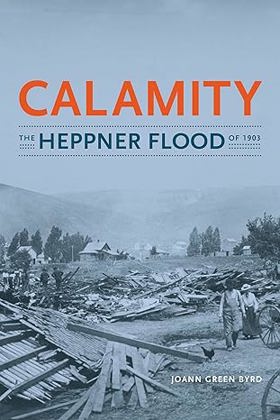
June 14, 1903, was a typical, hot Sunday in Heppner, a small farm town in northeastern Oregon. People went to church, ate dinner, and relaxed with family and friends. But late that afternoon, calamity struck when a violent thunderstorm brought heavy rain and hail to the mountains and bare hills south of town. When the fierce downpour reached Heppner, people gathered their children and hurried inside. Most everyone closed their doors and windows against the racket. The thunder and pounding hail masked the sound of something they likely could not have imagined: a roaring, two-story wall of water raging toward town. Within an hour, one of every five people in the prosperous town of 1,300 would lose their lives as the floodwaters pulled apart and carried away nearly everything in their path. The center of town was devastated. Enormous drifts of debris, tangled around bodies, snaked down the valley. The telegraph was down, the railroads were out, and the mayor was in Portland. Stunned survivors bent immediately to the dreadful tasks of searching for loved ones and carrying bodies to a makeshift morgue in the bank. By the next afternoon, thousands of individuals and communities had rushed to the town's aid, an outpouring of generosity that enabled the self-reliant citizens of Heppner to undertake the town's recovery. In Calamity, Joann Green Byrd, a native of eastern Oregon, carefully documents this poignant story, illustrating that even the smallest acts have consequences - good or bad. She draws on a wealth of primary sources, including a moving collection of photographs, to paint a rare picture of how a small town in the West coped with disaster at the turn of the twentieth century. xviii, 202 pages : illustrations, maps ; 23 cm CIRC [ 0 ]
|
2009 |
|
Calabash a guide to the history, culture, and art of African Americans in Seattle and King County, Washington by Esther Hall Mumford 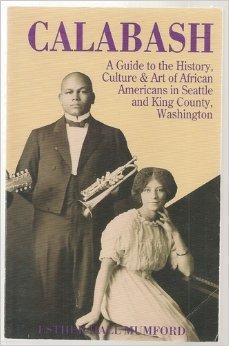
"This guide is intended to acquaint county residents and visitors with some of the more easily accessible landmarks of African-American history. These include works of art and cultural and historical sites which have been passed or driven by, for years while their existence, significance or association with African Americans in King County over the past century and a half has gone unnoted. This book provides information to give the user a sense of the creators and participants, the places and the activities associated with them ... Except for private homes and corporations most of the art and sites included here are accessible to public viewers. They are marked on the maps accompanying each section." from author's preface xii, 158 pages : illustrations, maps ; 22 cm CIRC [ 1 ]
|
1993 |
|
By Juan de Fuca's strait pioneering along the northwestern edge of the continent by James G. McCurdy 
In this provocative and illuminating book, Marianna Torgovnick explores the psychology of our profound attraction to cultures we call "primitive." Whether located in Africa, the South Pacific, or the American Southwest, the primitive has become synonymous in the Western imagination with a range of emotions and experiences thought to be lost in modern life: reverence for the land and for nature; strong communal bonds; sexual plentitude; and, perhaps most intriguing, and ecstatic sense of connection to the universe and the life force. Torgovnick investigates the numerous ways we have turned toward the primitive out of spiritual hunger for such deeply human experiences - a hunger that could once be satisfied within the West's own mystical traditions but that often no longer can be. Brilliantly encompassing religion, art, psychology, literature, and other aspects of our culture, Primitive Passions offers new insight into our ideas of spirituality and gender, and, ultimately, into the hidden but vital parts of ourselves 312 pages frontispiece (map), illustrations (including portraits, facsimiles) 22 cm CIRC [ 1 ]
|
1937 |
|
By canoe and sailing ship they came a history of Whidbey's Island by Dorothy Neil, Lee Brainard
|
1989 |
|
Burning sage poems from the Lytton fire by Meghan Fandrich 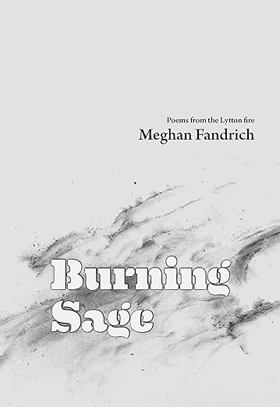
"On the day that Lytton, BC burned to the ground, Meghan Fandrich ran from the flames. She saw the village turn into a black pillar of smoke, and went home after a month-long evacuation to its ashes. Her house, on the edge of the fire, was saved; her community and her small business were not. Life as she knew it was gone, and somehow, in spite of the trauma and the ongoing onslaught of natural disasters, she had to keep going. Living. Surviving. Burning Sage shares Meghan's deeply personal story of the fire, the ensuing trauma, and the path out of it. But it is also a human story, a universal story, of loneliness, fragility and beauty. The poems follow the arc of shock, fear, and anger, and the impossibility of single parenting in a burned-up town. They tell of a connection, a love, and the way that feeling understood can help us understand ourselves. The poems in Burning Sage share a vivid portrait of grief and heartbreak and, ultimately, of healing."-- Provided by publisher 88 pages : illustrations ; 21 cm CIRC [ 0 ]
|
2023 |
|
Building the Skagit a century of Upper Skagit Valley history, 1870-1970 by Paul C. Pitzer 
This brief history tells the story of a small valley in Washington State's North Cascades. Over the century since its discovery, it has been developed into a National Parks and Recreation Area, and a large hydroelectric resource that supplies much of Seattle's power. First there were the gold miners who came in 1880 and returned in 1908. Next came the homesteaders who fought the weather and the government for their land. After World War I, Seattle City Light gained control of the Skagit. Would they ever finish building the first dam at Gorge Creek? Why did the Mayor fire J.D. Ross, Seattle City Light's superintendent? What was the Old Skagit Tour like? Construction o all Skagit dams was difficult. The weather and the geology made completion of the project a notable achievement. Building the Skagit is one example of the struggles that have led to the development of our nation's natural resources 105 pages : illustrations, maps, portrait ; 21 cm CIRC [ 1 ]
|
1978 |
|
Building Portland 150 years of outstanding architecture in today's central Portland by Victor Graf 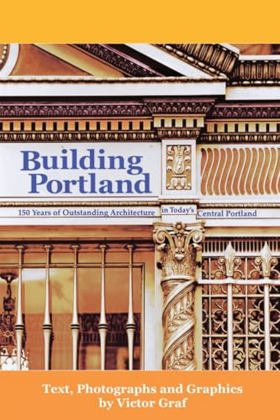
"A treasure trove of facts and factoids, original photos, people, events, weird and picturesque Portland... Your indispensable reference and compact field guide to the great architecture in the one square mile of today's central Portland." --Back cover viii, 106 pages : chiefly color illustrations, map, charts ; 23 cm CIRC [ 0 ]
|
2023 |
|
Building a state Washington, 1889-1939 by Washington State Historical Society, Charles Miles , Ottis Bedney Sperlin
|
1940 |
|
Building a better nest living lightly at home and in the world by Evelyn Searle Hess 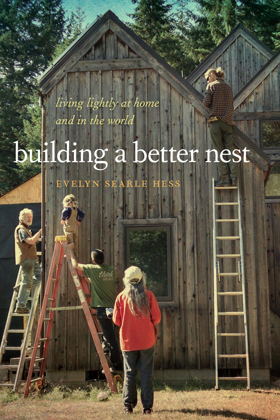
For fifteen years, Evelyn Hess and her husband David lived in a tent and trailer, without electricity or running water, on twenty acres of wild land in the foothills of the Oregon Coast Range. When they decided to build a house – a real house at last – they knew it would have to respect the lessons of simple living that they learned in their camping life. They knew they could not do it alone. Building a Better Nest chronicles their adventures as they begin to construct a house of their own, seeking a model for sustainable living not just in their home, but beyond its walls. What does it mean to build a better nest? Better for whom? Is it better for the individual or family? The planet? Green building and sustainable design are popular buzzwords, but to Hess, sustainable building is not a simple matter of buying and installing the latest recycled flooring products. It is also about cooperative work: working together in employment, in research, in activism, and in life. Hess is concerned with her local watershed, but also with the widening income gap, disappearing species, and peak resources. She actively works to reduce overconsumption and waste. For Hess, these problems are both philosophical and practical. As Hess and her husband age, the questions of how to live responsibly arise with greater frequency and urgency. With unfailing wit and humor, she looks for answers in such places as neuroscience, Buddhism, and her ancestral legacy. Building a Better Nest will appeal to anyone with an interest in sustainable building, off-grid living, or alternative communities. The questions it asks about the way we live are earnest and important, from an author whose voice is steeped in wisdom and gratitude. 191 pages ; 23 cm CIRC [ 0 ]
|
2015 |
|
Bugles in the valley Garnett's Fort Simcoe by Heister Dean Guie
Through such rolling hills and prairies, over rocks and across valleys with views of cascade peaks, army troops and indians evaded and confrtoned each other during the Yakima War that brought Fort Simcoe's begining viii, 196 pages : illustrations ; 23 cm CIRC [ 1 ]
|
1977 |
|
Buck Mountain poems by Anne Kennedy
|
1988 |
|
Brooklawn reverie by Elizabeth Gamble Wahl 
Poems and short stories written by Elizabeth Gamble Wahl. From the foreword by David Wahl: “When my grandfather, Daniel Gamble, returned from Goldendale and Victoria to his homestead on Paradise Ridge, he built a new home for his family. Following Irish tradition, he gave his home a name: Brooklawn. It was here that my mother grew up on a farm with the woods nearby. She learned to love the flowers and birds of field and woodland, and the passing seasons. The seasons show themselves distinctly here in the Palouse Country, and sometimes all four seasons come on one March day. Both her father and her brother Bert could write poetry. Before she was eleven, she and her sister Lola would make up their own stories. She decided that she would like to be a writer. She payed close attention to people, seemingly ordinary people, who worked in the fields with her brothers, or helped with chores and cooking. Among these people was “Shorty Hill”, a ranch hand and a real cowboy. Although he was not a writer, he was a master storyteller, and he helped my mother learn how to write the way that people speak. The short stories are fiction, but they have the good times among the hard times, the closeness of nature, and both the mischief and the warmth and caring of real people woven into them. Our family has enjoyed her stories and poems, and it is my hope that this book will bring as much pleasure to many others. Perhaps her words will help you to see that there are no ordinary people, and that today is no ordinary day.” 30 cm : illustrations ; 28 cm CIRC [ 0 ]
|
1988 |
|
Brookfield the Joe Megler story (Wahkiakum County) Washington by Carlton E. Appelo
|
1966 |
|
British investments and the American mining frontier, 1860-1901 by Clark C. Spence, American Historical Association 
This significant study offers information on the British investors who brought capital to America's mining industry in the late nineteenth century. The author devotes primary attention to the promotional activities that led to the organization and operation of more than 500 English joint venture stock companies between 1860 and 1901 ix, 288 pages : illustrations ; 24 cm CIRC [ 0 ]
|
1958 |
|
British establishments on the Columbia & the state of the fur trade by William Henry Ashley, Donald R. Johnson 
Pages 16-35 contain the report of Joshua Pilcher of his experiences in the Hudson's Bay Company posts, including Flathead Post, during the winter of 1829-30. Probably written in the fall of 1830 61 pages : illustrations ; 24 cm CIRC [ 1 ]
|
1981 |
|
British Columbia, one hundred years of geographical change by J. Lewis Robinson, Walter G. Hardwick
|
1973 |
|
British Columbia's magnificent parks the first 100 years by James D. Anderson 
"In 1910 a highly unlikely party of politicians, poets, social butterflies and an overweight cook, all led by a Shakespeare-quoting bushrat named Hughie Horatio Nelson Baron Bacon, set out from the Willows Hotel in Campbell River to explore the wild interior of Vancouver Island. They were launched on a noble, and for its time, highly imaginative mission: to assess the fitness of the region to become a wilderness park, the first in BC history. They survived with only minor injuries and produced such a glowing report that Strathcona Park, BC's first provincial park, was duly created on 19 March 1911"--Jacket 264 p. : ill. (chiefly col.), map ; 28 cm. CIRC [ 0 ]
|
2011 |
|
British Columbia waters the explorations of Vancouver and the Spanish by Richard W. Blumenthal 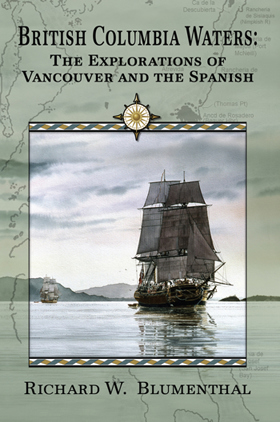
British Columbia Waters: The Explorations of Vancouver and the Spanish is a continuation of the author’s previous narratives which included the original source material from the earliest maritime exploration in the Pacific Northwest. The author’s first two books traced the visits by the Spanish and George Vancouver to inland Washington waters. These books included transcriptions of the actual journals of our earliest explorers. This follow-up book resumes the saga and follows Vancouver and the Spanish in 1792 through British Columbia waters while they complete their circumnavigation of Vancouver Island. It contains the journals of George Vancouver, Alcala Galiano and Cayetano Valdéz and four of Vancouver’s men. These journals provide the first European descriptions and observations of our inland waters as well as the First Nations encountered while they rowed their longboats through previously uncharted territory. Complete with all of their charts, this is a fascinating read directly from the men who made our early history. 288 pages : illustrations, maps ; 23 cm CIRC [ 0 ]
|
2014 |
|
British Columbia recalled a picture history 1741-1871 by Derek Pethick, Susan Im Im Baumgarten
|
1974 |