Catalog of British Columbiana and Pacific Northwest Americana
Encyclopedia Cascadia Catalog contains book titles of mostly non-fiction Pacific Northwest Coast of North America Titles (primarially British Columbia, Idaho, Oregon and Washington State) in an easy-to-understand title catalog. If you see a link with this badge ONLINE CIRC it means that there is an online institution that provides free access to that title. In some cases there may be more than one institution hosting the title digitally.
| Catalog Title | Published |
|---|---|
|
Bowron chain of lakes place names and people by Jean E. Speare
|
1983 |
|
Bowen Island, 1872-1972 by Irene Howard 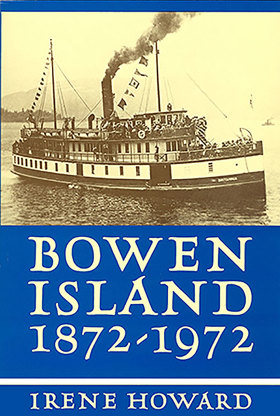
BC writer Irene Howard has woven together years of correspondence, historical records, anecdotes, and interview material to create this textual account of Bowen Island history. The book covers the lives of the early settlers, the days of the steamships, significant events, and notable islanders who have shaped the Bowen Island we now know. 190 pages, 10 unnumbered leaves of plates illustrations, maps, portraits 24 cm CIRC [ 1 ]
|
1973 |
|
Bound for Idaho the 1864 trail journal of Julius Merrill by Julius Merrill, Irving R. Merrill
|
1988 |
|
Boss whistle the coal miners of Vancouver Island remember by Lynne Bowen
|
1982 |
|
Boosting a New West Pacific Coast Expositions, 1905-1916 by John C. Putman , Project Muse (Distributor) 
Inspired by Chicago's successful 1893 World Columbian Exposition, the cities of Portland, Seattle, San Diego, and San Francisco all held fairs between 1905 and 1915. From the start of the Lewis and Clark Exposition to the close of the Panama-California Exposition a decade later, millions of Americans visited exhibits, watched live demonstrations and performances, and wandered amusement zones. Millions more thumbed through brochures or read news articles. Fair publicity directors embraced the emerging science of consumer marketing. Conceived to attract new citizens, showcase communities, and highlight farming and industrial opportunities, the four expositions' promotional campaigns and vendor and exhibit choices offer a unique opportunity to examine western leaders' perceptions of their city and region, as well as their future goals and how they both fed and tried to mitigate misconceptions of a wild, wooly West. They also expose biased attitudes toward Native Americans, Mexican Americans, Filipinos, and others. "Boosting a New West" explores the fairs' cultural and social meaning by focusing on and comparing the promotions that surrounded them. It details their origins and describes why each city chose to host, conveying the expected economic, social, and cultural benefits. It also shows how organizers articulated their significance to urban, regional, and national audiences, and how they attempted to shape a new western identity. 1 online resource (pages cm) CIRC [ 0 ]
|
2020 |
|
Booming and panicking on Puget Sound by George H. Bacon
|
1970 |
|
Boom towns & relic hunters of northeastern Washington a comprehensive guide to ghost towns in six historic counties by Jerry Smith 
Hold on to your hats! Jerry's second edition of Boom Towns & Relic Hunters of Washington State has hit the news stands and book shelves. Interested in reading about long-lost forgotten ghost towns, million-dollar mines, boomtown mining camps and historical sites in Washington State? Find out more about these histories and mysteries in this second edition book, Boom Towns & Relic Hunters of Washington State....Exploring Washington's Historic Ghost Towns & Mining Camps, your complete guide to ghost towns and historical sites in Washington State by noted local author, tour guide, historian and famed ghost town and treasure hunter Jerry Smith. Jerry's book is a comprehensive and detailed history of ghost towns, mining camps and picturesque locations in six historic counties, which include: Okanogan, Chelan, Ferry, Kittitas, Pend-Oreille, and Stevens. The book s author transports one back in time to the boomtown days of yesteryear, bringing back to life the ageless Old West mining-era days of prosperous boomtowns, miners, prospectors, pioneers and million-dollar gold and silver mines. Here is a literary work chalked full of rich concentrates of history. Jerry has prospected and sluiced out the hardships and tragedies of those early pioneering and prospecting days, literally filling one s reading cache with hours of high-grade pleasure and fascinating relics from his well-researched and personal treasure trove. Don t miss out! This second edition book is back by popular demand and provides over one hundred ghost town and mining camp locations, 137 of Jerry s rare and historic award-winning photographs, 23 rare and one-of-a-kind historic mining documents, 32 new adventure stories, 250 pages, and is complete with exact GPS coordinates. In one reader s words, This is a must for ghost town and gold prospecting buffs. In addition, the book, loaded with information and directions, makes a great self-guided ghost town tour book to carry in one s automobile. For those planning a trip to Washington State, the guide will provide advanced information for a greater appreciation of the historic sites and their relics which one can experience upon arrival. The book also serves as a wonderful educational tool for students and teachers prospecting the history of this unique part of Washington State. The chapter, Information on Metal Detecting and Relic Hunting, is an added bonus. The chapter includes several chapters on how to search out and locate long-lost, valuable treasures from the past. In the literal sense of the word, arming one s self with a little knowledge about using a metal detector, one s research can actually lead to pay-dirt. As a reader, if you re not looking to strike it rich, but would like to visit those colorful Old West days and relive some of Washington State's history, excitement is awaiting you in Jerry s new book. xi, 124 pages : illustrations, maps ; 26 cm CIRC [ 1 ]
|
2002 |
|
Boise, the peace valley by Annie Laurie Bird 
Published in 1934 by Idaho educator and regional historian Annie Laurie Bird, Boise, the Peace Valley is a localized civic history charting the evolution of the Boise River basin from a prominent fur-trade waypoint into the urban and agricultural epicenter of the state. Drawing upon early explorer journals, pioneer diaries, and territorial records, Bird chronicles the expeditions of Wilson Price Hunt, the establishment of the original Hudson's Bay Company Fort Boise, the massive migrations along the Oregon Trail, and the eventual 1862 gold rush that catalyzed permanent American settlement. The narrative leans heavily into the romantic motif of the valley as an idyllic, timbered sanctuary—an essential oasis of respite for weary overland emigrants navigating the punishing, arid expanses of the Snake River Plain. Operating as a classic regional monument, the book is designed to immortalize the pioneer endurance and capitalist enterprise that transformed an untamed geographic resting stop into a prosperous, irrigated metropolis. A keen insight drawn from the work is how the strategic branding of the region as a "peace valley" functions to fundamentally depoliticize a fiercely contested landscape. By defining the basin primarily as an innate, natural sanctuary destined by geography to nurture and shelter Anglo-American travelers, Bird’s narrative effectively recharacterizes a vital Indigenous homeland—traditionally managed and defended by the Shoshone, Bannock, and Northern Paiute peoples—as a passive, welcoming haven awaiting colonial occupancy. This historiographical maneuver subtly sanitizes the violent realities of the era, notably the 1863 establishment of a United States military fort specifically designed to crush Native resistance and enforce territorial enclosure. By framing the landscape as inherently cooperative to pioneer settlement, the text allows readers to view the subsequent systemic displacement of Indigenous populations not as a hostile military invasion, but as the peaceful, inevitable inheritance of a valley practically begging for American cultivation. 408 pages illustrations 20 cm CIRC [ 1 ]
|
1934 |
|
Boise, Idaho, 1882-1910 prosperity in isolation by Carol Lynn MacGregor 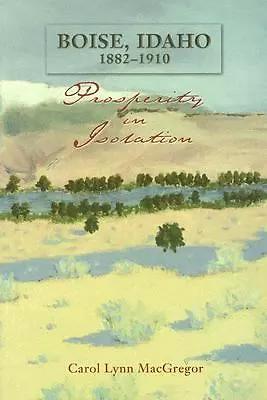
MacGregor's study of Boise begins with the removal of the Northern Shoshoni and follows the progress of government, infrastructure, business, and social institutions in the area. Along the way, MacGregor (history, Boise State) describes Boise's architecture, arts, culture and changing demographics. She creates in all its details the peculiar history of this unusually prosperous and progressive city. The text includes photographs and maps of the evolving city. Annotation ©2006 Book xiv, 306 pages : illustrations, maps ; 23 cm CIRC [ 1 ]
|
2006 |
|
Boise baseball the first 125 years by Arthur A. Hart 
Here are stories about some of the great players and fascinating characters, as well as many yarns that Arthur A. Hart has collected through years of research and interviews with former players and those closely connected with the game. 109 pages : illustrations ; 21 cm CIRC [ 0 ]
|
1994 |
|
Boise an illustrated history by Merle W. Wells, Arthur A. Hart, Greater Boise Chamber of Commerce
|
1982 |
|
Boats, bucksaws, and blisters pioneer tales of the Powell River area by G. W. Thompson, Powell River Heritage Research Association
|
1990 |
|
Blood and sweat over the railway tracks Chinese labourers constructing the Canadian Pacific Railway (1880-1885) by Lily Chow , Chinese Canadian Historical Society of British Columbia (Issuing body) 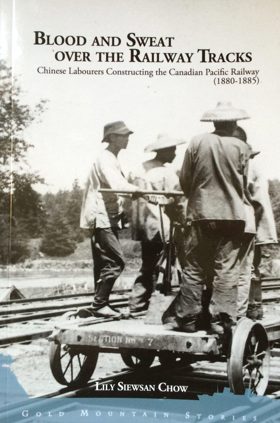
This is a recollection of an important historical event, the Canadian Pacific Railway construction which employed thousands of Chinese labourers to build the transcontinental railway linking this country from coast to coast. In her writing, Chow reveals the reasons for constructing the railway, why and how the Chinese labourers were recruited and transported from Guangdong to various construction sites in British Columbia. She illustrates the difficult and dangerous tasks that the Chinese labourers had to perform bearing testimonies to the challenges, hardships, struggles, and endurance of these workers. Despite the hard labour, these men displayed excellent work ethic, and were diligent and dependable people. Included are some poems and verses by a several Chinese labourers and their family members to show their anguish, anxiety, and longing - human feelings and emotions that had been repressed. This book is a testament to remarkable endeavour, generous spirit, sacrifices and contributions of the Chinese labourers that helped build the CPR. xvii, 116 pages : illustrations, maps, portraits, charts ; 23 cm. CIRC [ 0 ]
|
2014 |
|
Blisters and bliss a trekker's guide to the West Coast Trail by David Foster , Nelson Dewey (Illustrator), Wayne Aitken 
The bestselling Blisters and Bliss has been the trekker’s guide to the West Coast Trail since 1989. The 75-kilometre trail on Vancouver Island is rated as one of the world’s greatest hikes. This revised 8th edition once again provides a practical and easy-to-use resource for the thousands of hikers who visit the West Coast Trail every year. Combining current and accurate trail information with hundreds of safety and planning tips, this is the ideal guide for novices and experienced trekkers alike. 143 pages : illustrations ; 22 cm CIRC [ 0 ]
|
2016 |
|
Blazing a wagon trail to Oregon a weekly chronicle of the great migration of 1843 by Lloyd W. Coffman 
A determined group of American pioneers set out to move their families on wheeled vehicles from the settled frontier in Missouri to the far Pacific shore. Their incentive was simple enough. Times were tough in 1843, and they had heard of a lush new land existing in a place called Oregon, a land ready to be settled by hard-working farmers. Although a new life seemed to await them just over the horizon, none of them suspected how formidable that horizon really was vii, 192 pages : illustrations, maps ; 23 cm CIRC [ 0 ]
|
2012 |
|
Blanket Bill Jarman northwest Washington mystery man : first pioneer settler in Whatcom and Skagit counties by Percival Robert Jeffcott 
Published in 1958, Percival Robert Jeffcott's book is a biographical account of William Robert "Blanket Bill" Jarman, recognized as the first white pioneer to settle in Washington's Whatcom and Skagit counties. The work seeks to untangle the factual history of Jarman's frontier life from the dense web of myths, legends, and tall tales that had grown around him over the decades. By meticulously cross-referencing interviews and local lore with documentary evidence—such as Hudson's Bay Company records—Jeffcott systematically investigates and debunks several exaggerated stories, including a famous tale about Jarman being ransomed. Ultimately, the text serves as both a detailed character study of an elusive regional figure and a rigorous examination of early Pacific Northwest pioneer folklore. xii, 202 p. : ill. ; 24 cm. CIRC [ 1 ]
|
1958 |
|
Blakely Island in time by JoAnn Roe 
Blakely Island is typical of many other islands in the San Juans and adjacent Gulf Islands of Canada. What is fascinating is that pioneers found them in their isolated maritime settings, made homes and schools, and developed a living for families. In the late 20th century, several of the islands such as Blakely have become sites for vacation homes, as well. The author tells a lively tale of the people, both pioneers and modern dwellers, who have dealt with the problems inherent in island life, especialy an island accessed only by air or sea. Read about the Spencer Mill, winter storms, humorous interactions with animals, pranks, early air services, and environmental and political issues--P. [4] of cover v, 151 pages : illustrations ; 23 cm CIRC [ 1 ]
|
2005 |
|
Black woman in green Gloria Brown and the unmarked trail to forest service leadership by Gloria D. Brown , Donna L. Sinclair 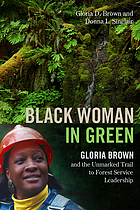
"Black Woman in Green tells the story of a young widow who left the urban East for the forested West seeking a better life for her children. It highlights Gloria Brown's determination and grit in working her way up in a primarily white, male organization to become the first female African American forest supervisor in the US Forest Service. From raising children alone to conducting civil rights trainings to breaking glass ceilings, Gloria Brown's humor and willingness to believe in the basic goodness of humanity makes possible a powerful and instructive leadership journey. Black Woman in Green provides a case study for public administration, contributes to understanding the overlapping environmental and civil rights movements of the twentieth century, and highlights issues of representation in the federal government, women's history, the history of the American West, and literature associated with African American experiences in predominately white societies"-- Provided by publisher 1 online resource CIRC [ 0 ]
|
2020 |
|
Black Diamond mining the memories by Diane Olson, Cory Olson, Black Diamond Historical Society 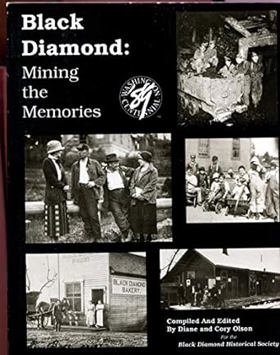
Published by Diane Olson, Cory Olson, and the Black Diamond Historical Society, Black Diamond: Mining the Memories chronicles the rich, coal-fuelled history of a historic Washington company town situated in the shadow of the Cascade foothills. The book draws on extensive archival photographs, oral histories, and company records to detail the dangerous underground labor, multi-ethnic immigrant communities, and daily hardships of families who worked the rich seams for the Pacific Coast Company. Through these intimate vignettes, the text preserves the vanishing social fabric of a bustling industrial hub that once supplied coal across the entire Puget Sound. A keen insight drawn from the work is how company-owned mining towns functioned as isolated, corporate-feudal microcosms; by controlling everything from housing to currency, the coal company engineered a fragile social stability that ultimately fractured the moment laborers sought independent political and economic autonomy. xvi, 274 pages : illustrations, map ; 28 cm CIRC [ 1 ]
|
2003 |
|
Bittersweet oasis a history of Ashcroft and district, 1885-2002 by Brian Belton 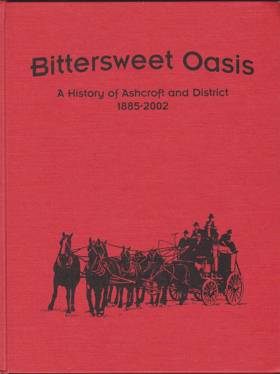
Bittersweet Oasis: A History of Ashcroft and District, 1885-2002, originally authored by Brian Belton, provides a comprehensive historical account of the development of the village of Ashcroft in British Columbia's Thompson region. The book chronicles Ashcroft's foundational years as the bustling "Gateway to the Cariboo," detailing how its position at the intersection of the Canadian Pacific Railway and the Cariboo Wagon Road fueled its early economic boom. It further explores the community's cultural and economic evolution, highlighting the vital contributions of early pioneers, Chinese laborers, and a thriving agricultural sector famous for its tomatoes and potatoes. Ultimately, the narrative captures the enduring resilience of the district's residents as they successfully navigated devastating fires, shifts in regional transportation routes, and changing industries over more than a century. 160 pages : illustrations, facsimiles, portraits ; 29 cm CIRC [ 1 ]
|
2002 |
|
Bitterbrush country living on the edge of the land by Diane Josephy Peavey 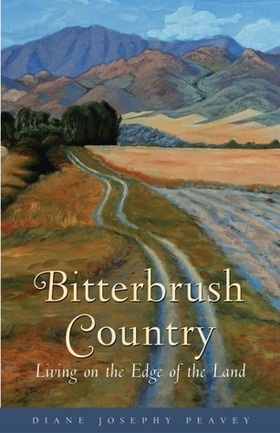
When author Diane Josephy Peavey first arrived in south-central Idaho twenty years ago, she did not know it was possible to become as connected to a place as she is now, nor, she claims, did she understand the "meaning of love, of home, of commitment. That would come to me here, 24 dirt-road miles from town." Story by story, readers will pass through the seasons of a ranching life, discovering the power of a landscape that inspires passion in so many. Book jacket xvi, 239 pages ; 23 cm CIRC [ 1 ]
|
2001 |
|
Birds of Oregon a general reference by David B. Marshall, Matthew G. Hunter, Alan Contreras, Oregon Breeding Bird Atlas Project 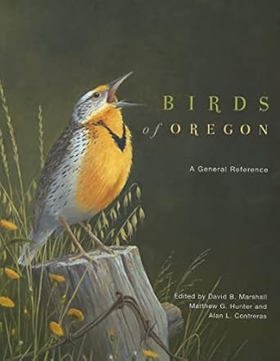
Birds of Oregon is the first complete reference work on Oregon's birds to be published since Gabrielson and Jewett's landmark book in 1940. This comprehensive volume includes individual accounts of the approximately 500 species now known to occur in Oregon (about 150 more than in 1940), including detailed accounts of the 353 species that regularly occur and briefer accounts of another 133 species that are considered vagrants. A separate chapter covers extirpated and questionable species as well as those which have been introduced but have not become established. Oregon is long overdue for a book of this kind. Although northern states generally support fewer species of birds than more southerly ones, Oregon ranks fifth behind only Florida, New Mexico, Texas, and California in terms of numbers of species. This is due to its varied climate, its wide range of habitats, and the mild winters over much of the state, which make it an important wintering area. Birds of Oregon is not a field guide for identifying birds, although it describes the appearance and any unique or special characteristics of each species, and approximately 100 species are illustrated with attractive line drawings. Instead, it compiles and presents in a single large volume what is known today about the population status and distribution of each species, as well as their habitat requirements and diet, their seasonal activities and behavior, where and how they might be found, and any conservation problems. It includes about 200 range maps that reflect the work of more than 700 volunteers who participated in the Oregon Breeding Bird Atlas project, as well as other sources. Subspecies--of which Oregon has many because of the variability of the state's avian habitats--are listed with their ranges, thus providing the first accounting of subspecies in the state since 1957. In addition to the species accounts, Birds of Oregon also includes a discussion of changes among Oregon's birds since 1940 and a description of the state's nine ecoregions and how they relate to bird species. Approximately 100 contributing authors volunteered their time and expertise to create Birds of Oregon, and numerous other individuals reviewed drafts of the species accounts to insure that they are as accurate and up-to-date as possible. Although heavily referenced with approximately 4,000 literature citations, Birds of Oregon is written in nontechnical language and will appeal to a broad audience, including birders, wildlife biologists, land managers, conservationists, naturalists, hunters, and wildlife enthusiasts in general. This new paperback edition includes an annotated list of species that have been added to the official state bird list since the book was first published in 2003. xvi, 752 pages : illustrations, maps ; 29 cm CIRC [ 0 ]
|
2006 |
|
Birds of Malheur National Wildlife Refuge, Oregon by Carroll D. Littlefield 
The Malheur National Wildlife Refuge in southeast Oregon is internationally known to ornithologists and birders. Throughout the year, but especially during spring and autumn migrations, hundreds of thousands of birds can be seen on the refuge. Birds of Malheur National Wildlife Refuge provides the first exhaustive report on the 312 species recorded here over the last 110 years. For each species you'll learn: how common it is on the refuge; where it is likely to be found on the refuge; dates of its earliest, latest, and most frequent sightings on the refuge. C. D. Littlefield is a legendary figure to western birders and an internationally recognized expert on the birds of Malheur, particularly the Sandhill Crane. 294 pages : illustrations ; 22 cm CIRC [ 0 ]
|
1990 |
|
Birds of Lane County, Oregon by Alan Contreras 
Birds of Lane County is the essential guide for anyone - backyard birder or serious observer - interested in the birds of western Oregon. Lane County's bird life is rich with variety; over three hundred bird species may be found in the county during the year. Within an hour's drive of Eugene, birders may encounter Black Oystercatchers, Pelagic Cormorants, and Snowy Plovers on the coast or Black-backed Woodpeckers, Northern Goshawks, and Mountain Bluebirds in the Cascades. With this comprehensive guide, birders at all levels can enjoy this incredible diversity. In Birds of Lane County, editor Alan Contreras and a team of expert contributors describe the one hundred best birding sites in the county, with detailed information on what may be found, and where and when to seek particular birds. All sites are publicly accessible with clear, easy-to-follow directions and maps, and many of the sites are at least partly wheelchair accessible, provide species accounts with basic information about the status, distribution, abundance, and movements of each species known to have occurred in Lane County. It also offers useful resources for birders including migrant arrival and departure tables, seasonal charts, a gazetteer, contact information for local birding and natural history organizations, and a species checklist. 366 pages : illustrations, maps ; 24 cm CIRC [ 0 ]
|
2006 |
|
Big promises, small government doing less with less in the BC Liberal new era by George M. Abbott 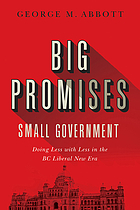
"The BC Liberal Party, under Gordon Campbell, won a massive majority in 2001 on the strength of its New Era electoral platform. On his first day in office, Campbell fulfilled the party's campaign pledge to dramatically reduce personal income taxes in British Columbia. "Big Promises, Small Government" demonstrates the integral relationship between effective tax policy and sustainable social programs. In this important and original case study, George Abbott provides a rigorous analysis of an intense and often controversial period in the province's political history. Despite sharply declining economic indices, the new premier expected that lower taxes would spur investment and growth, essentially paying for themselves. Instead, the Campbell government's precipitous and ideological decision to cut taxes and exempt health and education - some 70 percent of the provincial budget - from any decrease in expenditures, left smaller ministries scrambling to save $4.4 billion to meet a balanced budget. Severe budget cuts extended throughout social ministries with direct impact on their often vulnerable clients. "Big Promises, Small Government" demonstrates the inherent difficulties that tax cuts present to small, open trading economies such as British Columbia's, which could not hope to reshape its local fortunes quickly amid broader global shifts. George Abbott's insider perspective and compelling insights on the genesis, implementation, and real-world consequences of a tax policy offer vital lessons to future governments and gripping reading on the effects of short-sighted tax cuts on a province."-- Provided by publisher xvii, 259 pages ; 23 cm CIRC [ 0 ]
|
2020 |