Catalog of British Columbiana and Pacific Northwest Americana
Encyclopedia Cascadia Catalog contains book titles of mostly non-fiction Pacific Northwest Coast of North America Titles (primarially British Columbia, Idaho, Oregon and Washington State) in an easy-to-understand title catalog. If you see a link with this badge ONLINE CIRC it means that there is an online institution that provides free access to that title. In some cases there may be more than one institution hosting the title digitally.
| Catalog Title | Published |
|---|---|
|
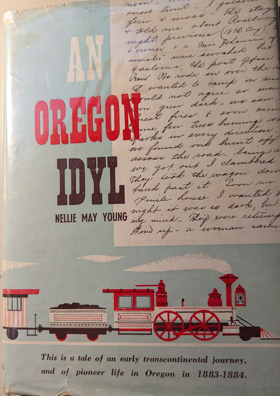
An Oregon idyl a tale of a transcontinental journey, and life in Oregon in 1883-1884, based on the diary of Janette Lewis Young by Nellie May Young, Janette Lewis Young
|
1961 |
|
An open pit visible from the moon the Wilderness Act and the fight to protect Miners Ridge and the public interest by Adam M. Sowards 
Situated among the North Cascade Mountains of Washington State, in the Glacier Peak Wilderness Area, Miners Ridge contains vast quantities of copper. Kennecott Copper Corporation’s plan to develop an open-pit mine there was, when announced in 1966, the first test of the mining provision of the Wilderness Act passed by Congress in 1964. The battle over the proposed “Open Pit, Big Enough to Be Seen from the Moon,” as activists called it, drew the attention of both local and national conservationists, who vowed to stop the desecration of one of the West’s most scenic places. Kennecott Copper had the full force of the law and mining industry behind it in asserting its extractive rights. Meanwhile the U.S. Forest Service was determined to defend its authority to manage wilderness. An Open Pit Visible from the Moon tells the story of this historic struggle to define the contours of the Wilderness Act—its possibilities and limits. Combining rigorous analysis and deft storytelling, Adam M. Sowards re-creates the contest between Kennecott and its shareholders on one hand and activists on the other, intent on maintaining wilderness as a place immune to the calculus of profit. A host of actors cross these pages—from cabinet secretaries and a Supreme Court justice to local doctors and college students—all contributing to a drama that made Miners Ridge a cause célèbre for the nation’s wilderness movement. As locals testified at public hearings and writers penned profiles in the nation’s magazines and newspapers, the volatile political economy of copper proved equally influential in frustrating Kennecott’s plans. No law or court ruling could keep Kennecott from mining copper, but the pit was never dug. Identifying the contingent factors and forces that converged and coalesced in this case, Sowards’s narrative recalls a critical moment in the struggle over the nation’s wild places, even as it puts the unpredictability of history on full display. xiii, 236 pages : illustrations, maps ; 24 cm. CIRC [ 0 ]
|
2020 |
|
An introduction to Quinault Valley rain forest by Irene O'Connor
|
1962 |
|
An international idiom; a manual of the Oregon trade language, or "Chinook jargon" by Horatio Hale 
Published in 1890, Horatio Hale’s An International Idiom; A Manual of the Oregon Trade Language, or "Chinook Jargon" presents a sophisticated linguistic defense of the Pacific Northwest's unique contact language as a viable instrument for broader human communication. Building upon his earlier work as the philologist for the 1838-1842 Wilkes Exploring Expedition, Hale meticulously outlines the grammar and vocabulary of the Chinook Jargon while arguing that its cross-cultural adaptability rendered it a legitimate "international idiom." A keen insight drawn from the text is how Hale’s late-19th-century academic elevation of the Jargon stands as a paradoxical act of preservation; even as the pidgin was rapidly dying out due to aggressive English-only assimilation policies and the physical displacement of Indigenous populations, he framed its historical utility as proof of a harmonious, multicultural genesis that conveniently sanitized the brutal realities of frontier conquest. 63 pages ; 19 cm ONLINE CIRC [ 1 ]
|
1890 |
|
An independent folk a history of early Wheeler County, Oregon by Mary Fitzgerald 
The settling of Wheeler County, Oregon, makes for rich storytelling combined with the historical facts. Excerpting from interviews with old timers, their stories are told in their own words. The story tells of the courageous and very independent people that still populate Wheeler County,. These folks are representative of the pioneer spirit that gives such backbone and character to rural life in America. 336 pages : illustrations, map ; 23 cm CIRC [ 1 ]
|
2011 |
|
An illustrated history of Walla Walla County, state of Washington by W. D. Lyman
Published in 1901, W. D. Lyman’s comprehensive volume chronicles the pioneer settlement, agricultural expansion, and civic maturation of Walla Walla County in southeastern Washington. A keen insight drawn from the text is how Walla Walla's strategic evolution from a chaotic gold-rush supply post into a highly stable, wheat-producing powerhouse allowed it to economically and politically dominate the early Washington Territory long before the rise of the Puget Sound cities. The narrative meticulously details this transformation alongside the complex pioneer interactions with Native American tribes, including the profound regional impact of the Whitman Massacre. Like similar historical works of its era, the book ultimately serves as a vital genealogical archive by preserving hundreds of detailed biographical sketches of the resilient farmers, merchants, and civic leaders who built the region. ONLINE CIRC [ 1 ]
|
1901 |
|
An illustrated history of the state of Washington containing biographical mention of its pioneers and prominent citizens by H. K. Hines
Published in 1893 by Reverend Harvey K. Hines, this voluminous work chronicles the early exploration, pioneer settlement, and rapid economic expansion that culminated in Washington's 1889 statehood. The narrative details the establishment of early Protestant missions, the turbulent era of the territorial Indian Wars, and the foundational growth of the region's timber, agricultural, and railroad industries. A keen insight drawn from the text is how the publication exemplifies the classic 19th-century "mug book" or subscription history model, where the grand, providential narrative of Manifest Destiny was explicitly monetized by pairing regional history with hundreds of highly flattering biographical portraits of the affluent citizens who paid to have their legacies immortalized in print. Consequently, while the historical analysis remains heavily shaped by Hines's religious and colonial biases, the volume survives today as an indispensable genealogical archive of the commercial and civic leaders who built Washington's early institutions. 933, [1] pages, 36 unnumbered leaves of plates : illustrations, portraits ; 30 cm ONLINE CIRC [ 1 ]
|
1893 |
|
Published in 1893 by the Reverend Harvey K. Hines, this expansive volume provides a comprehensive chronicle of Oregon's development from early European maritime exploration through its pioneer settlement and eventual statehood. The narrative emphasizes the pivotal role of Protestant missionaries and early overland pioneers in securing the region for the United States, while extensively documenting the political and economic evolution of the territory. A keen insight drawn from the text is how Hines’s own background as a Methodist clergyman deeply colors the historical narrative, actively framing the American colonization of the Pacific Northwest not merely as a secular triumph of Manifest Destiny, but as a divinely ordained Protestant mission to civilize the frontier. Furthermore, the work functions as a classic Gilded Age "subscription history," preserving hundreds of highly flattering biographical sketches of the prominent citizens and merchants who funded the book's publication while actively promoting the region to outside investors. 1300 pages frontispiece, plates, portrait 30 cm ONLINE CIRC [ 1 ]
|
1893 |
|
An illustrated history of the state of Idaho containing a history of the state of Idaho from the earliest period of its discovery to the present time, together with glimpses of its auspicious future ; illustrations ... and biographical mention of many pioneers and prominent citizens of to-day .. by Lewis Publishing Company (Publisher)
Published in 1899 by the Lewis Publishing Company, this expansive volume offers a comprehensive chronicle of Idaho’s evolution from its earliest European exploration and volatile territorial days through its first crucial decade of statehood. A keen insight drawn from the text is how its enthusiastic, progress-driven narrative actively attempts to rebrand Idaho—deliberately transitioning its public reputation from a transient, lawless mining frontier into a stable, unified agricultural and civic powerhouse ready for outside investment. To reinforce this vision of civilized permanence, the text devotes substantial space to extensive biographical sketches of the prominent pioneers, merchants, and ranchers who built the state's foundational institutions. Ultimately, the work stands as both a vital genealogical archive and a fascinating artifact of Gilded Age boosterism designed to cement a cohesive identity for the newly formed state. xv, 726 pages, 105 unnumbered leaves of plates : frontispiece (portrait) illustrations, portraits ; 30 cm ONLINE CIRC [ 1 ]
|
1899 |
|
An illustrated history of the Big Bend country, embracing Lincoln, Douglas, Adams, and Franklin counties, state of Washington by Richard F. Steele , Arthur P. Rose 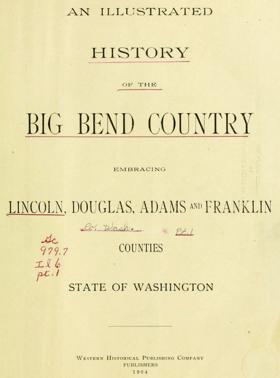
Published in 1904, this comprehensive volume documents the pioneer settlement, agricultural development, and civic formation of the Columbia River's Big Bend region in eastern Washington. A keen insight drawn from the text is how the seemingly barren, arid landscape was rapidly transformed into a highly lucrative wheat-producing powerhouse through the advent of dry farming techniques and the critical expansion of railroad infrastructure. The authors chronicle this dramatic economic and cultural shift across Lincoln, Douglas, Adams, and Franklin counties, detailing their transition from harsh frontier to thriving agricultural communities. Furthermore, the book serves as an invaluable genealogical archive by providing extensive biographical sketches of the resilient early settlers who drove this remarkable regional transformation. xxiv, 1024 pages : plates, portraits ; 31 cm ONLINE CIRC [ 2 ]
|
1904 |
|
An illustrated history of Stevens, Ferry, Okanogan and Chelan counties, state of Washington by Western Historical Publishing Company
Published in 1904 by the Western Historical Publishing Company, this comprehensive volume chronicles the pioneer settlement, civic foundation, and industrial emergence of four rugged counties in northern Washington state. A keen insight drawn from the text is how the sudden, controversial opening of former Native American reservation lands (such as the Colville Reservation) to white prospectors triggered explosive mining booms, acting as the primary catalyst that rapidly transformed this isolated northern frontier into permanent communities. The narrative details the distinct economic drivers across the region, from the rich mineral districts of Ferry and Stevens to the vast cattle ranges and early orchard irrigation projects of Okanogan and Chelan counties. Furthermore, the book preserves the area's pioneer legacy by featuring hundreds of detailed biographical sketches of the resilient prospectors, ranchers, and civic leaders who built these foundational settlements. xxii, 867 pages, 43 unnumbered leaves of plates : illustrations, portraits ; 31 cm ONLINE CIRC [ 1 ]
|
1904 |
|
An Illustrated history of southeastern Washington, including Walla Walla, Columbia, Garfield and Asotin counties, Washington by Frederic Ambrose Shaver, Richard F. Steele, Arthur P. Rose, Western Historical Publishing Company, Spokane, Wash
Published by the Western Historical Publishing Company and compiled by regional historians, An Illustrated History of Southeastern Washington provides an exhaustive, county-by-county chronicle of early pioneer settlement across Walla Walla, Columbia, Garfield, and Asotin counties. The massive volume details the region's transformation from indigenous territories and early missionary outposts into a dominant agricultural empire driven by dryland wheat farming and regional railroad expansion. Through detailed biographical sketches of prominent citizens and extensive civic records, the text serves as a foundational archive for understanding the economic ambitions and social structures of the inland Pacific Northwest. A keen insight drawn from the work is how subscription-based county histories operated as early forms of civic boosterism; by heavily emphasizing the successes of local patriarchs and agricultural wealth while marginalizing the indigenous displacement that made it possible, the volume illustrates how frontier communities intentionally curated their own historical memory to attract further investment and institutional legitimacy. xxii, 874 p. illus., plates, ports. 31 x 25 cm. ONLINE CIRC [ 1 ]
|
1906 |
|
An Illustrated history of Skagit and Snohomish Counties, their people, their commerce and their resources with an outline of the early history of the State of Washington, endorsed as authentic by local committees of pioneers by The Interstate Publishing Company
Published by the Interstate Publishing Company, An Illustrated History of Skagit and Snohomish Counties offers a sweeping, encyclopedia-style chronicle of early pioneer settlement and economic development in northwestern Washington. The extensive volume traces the rapid transformation of the region's dense primeval forests and fertile river valleys into thriving hubs of the timber, agricultural, and maritime industries. Through exhaustive biographical sketches of prominent families—explicitly endorsed as "authentic" by local pioneer committees—the text serves as a monumental archive documenting the civic ambition and commercial resource extraction that defined the Puget Sound hinterlands. A keen insight drawn from the work is how the overt endorsement by pioneer committees reveals the manufactured nature of early frontier historiography; by tightly controlling the published narrative to validate their own commercial successes, the region's founding elite actively engineered a sanitized, triumphant origin story designed to cement their social authority and attract future investment. 1117 pages : portraits ; 29 cm ONLINE CIRC [ 1 ]
|
1906 |
|
An illustrated history of north Idaho : embracing Nez Perces, Idaho, Latah, Kootenai and Shoshone counties, state of Idaho by Western Historical Publishing Company
Published in 1903, this extensive volume chronicles the pioneer settlement, Native American history, and rapid industrial development across the rugged panhandle region of northern Idaho. A keen insight drawn from the text is how the area's extreme geographic isolation from southern Idaho forced these northern counties to develop a distinct, fiercely independent culture driven by the volatile boom-and-bust cycles of the Coeur d'Alene mining districts and vast timber operations. The book details the civic and economic growth within Nez Perces, Idaho, Latah, Kootenai, and Shoshone counties, documenting their transition from frontier wilderness to established industrial hubs. Like similar regional histories of its era, the narrative ultimately serves as a vital genealogical resource by preserving hundreds of biographical sketches of the prospectors, farmers, and civic leaders who built the region. xxviii, 1238 pages, [113] leaves of plates : illustrations, portraits ; 31 cm ONLINE CIRC [ 1 ]
|
1903 |
|
An illustrated history of central Oregon, embracing Wasco, Sherman, Gilliam, Wheeler, Crook, Lake and Klamath counties, state of Oregon by F. A. Shaver, Arthur P. Rose,Richard F. Steele,A. E. Adams, Western historical publishing company
Published in 1905 by the Western Historical Publishing Company, this extensive volume chronicles the early pioneer settlement and economic development of central and south-central Oregon. A keen insight drawn from the text is how the region's severe geographic isolation—cut off from the coast by the Cascade Mountains and defined by an expansive, arid high desert—forced early settlers to build an exceptionally self-reliant culture that depended heavily on massive livestock operations and fierce competition for scarce water rights. The authors provide comprehensive local histories for Wasco, Sherman, Gilliam, Wheeler, Crook, Lake, and Klamath counties, documenting their gradual transition from rugged frontier outposts into established civic and agricultural centers. Like other regional histories of its era, the narrative ultimately serves as a vital genealogical archive by preserving hundreds of detailed biographical sketches of the resilient ranchers, merchants, and civic leaders who built these foundational communities. xxx, 1097 pages : plates, portraits ; 31 cm ONLINE CIRC [ 1 ]
|
1905 |
|
An Illustrated history of Baker, Grant, Malheur and Harney counties, with a brief outline of the early history of the state of Oregon by Western Historical Publishing Company
Published in 1902 by the Western Historical Publishing Company, this comprehensive volume documents the early settlement and economic foundation of eastern Oregon's vast frontier. Following a brief overview of the state's early years, the text provides detailed local histories and extensive biographical sketches of the pioneers who built communities across Baker, Grant, Malheur, and Harney counties. A keen insight drawn from the narrative is how the region's harsh, arid geography necessitated an economy based heavily on cattle ranching and mining, forging a rugged cultural identity that sharply contrasted with the agrarian settlements of the Willamette Valley. Ultimately, the book serves as both a valuable genealogical resource for these four counties and a historical testament to the sheer endurance required to establish industry in the high desert. 788 pages, 70 unnumbered leaves of plates : illustrations, portraits ONLINE CIRC [ 1 ]
|
1902 |
|
An identification guide to the larval marine invertebrates of the Pacific Northwest by Alan L. Shanks 
The study of larval invertebrates is a vital and growing field in contemporary marine science. The key ecological role of larvae in determining adult population sizes has been recognized for decades and has inspired extensive research. This volume, the first of its kind, is an identification guide to the planktonic larvae of shallow subtidal and intertidal invertebrates common to the Pacific Northwest coast. Each chapter provides a brief background to the larval biology of an invertebrate group; keys, line drawings, and descriptions for the identification of larvae; a list of the species present in the Pacific Northwest; and a reference section. The geographic range covered is roughly from southeast Alaska to northern California; however many of the species are found along the entire coast of California, as far south as Baja California. An essential reference for anyone attempting to identify larval invertebrates from zooplankton samples, this working manual is intended for students as well as scientists and researchers. It offers an important new resource for marine biologists, biological oceanographers, marine and intertidal ecologists, and especially larval biologists. 314 pages : illustrations ; 27 cm CIRC [ 0 ]
|
2001 |
|
An historical guide to Pender Islands landmarks, events, activities, parks, beaches, plants & wildlife, accomodations, restaurants, shops & services by V. A. Lindholm 
Published in local editions by V. A. Lindholm, An Historical Guide to Pender Islands Landmarks, Events, Activities, Parks, Beaches, Plants & Wildlife... serves as a comprehensive regional compendium for navigating the natural and human history of the Southern Gulf Islands. The guide meticulously catalogs local heritage sites, indigenous place names, early pioneer settlements, and the diverse marine and terrestrial ecosystems that define the Pender Islands. By weaving practical travel logistics together with deep historical context, the book bridges the gap between a standard visitor directory and an environmental chronicle. A keen insight drawn from the text is how community-compiled island guidebooks often act as quiet acts of ecological and cultural preservation; by meticulously detailing the specific natural habitats and historical idiosyncrasies of a small archipelago, the text implicitly teaches visitors how to respectfully inhabit a fragile insular ecosystem without loving it to death. 111, [26] pages : illustrations ; 21 cm CIRC [ 1 ]
|
2006 |
|
An eye for injustice Robert C. Sims and Minidoka by Susan M. Stacy , Robert C. Sims 
The book, about the Minidoka War Relocation Center in Idaho, contains a selection of Robert Sims's published articles, conference papers, speeches, and slide shows on Minidoka and Japanese internment. Includes a new essay documenting the transformation of the forgotten post-WWII patch of desert to the Minidoka National Historical Site; short biographical essays by people who worked with him describing Sims' passion for social justice, history, and education, and an essay about the Robert C. Sims Collection at Boise State University. As wartime hysteria mounted following the December 1941 attack on Pearl Harbor, President Franklin D. Roosevelt issued Executive Order 9066, and the U.S. government began forcibly relocating all West Coast individuals with Japanese ancestry to one of ten sites in inland states. Totaling close to 120,000, the majority were American citizens. The Minidoka War Relocation Center, a newly constructed camp at Hunt, Idaho, first opened in August 1942. Most of its approximately 9,300 incarcerees came from Portland, Seattle, Tacoma, and surrounding regions. It was a painful experience with lasting repercussions. Minidoka's last occupant left in October 1945. Dr. Robert C. Sims devoted nearly half his life to research, writing, and education related to the unjust World War II Japanese American incarceration. Six of his previously published articles, as well as selections from conference papers and speeches, focus on topics such as Idaho Governor Chase Clark's role in the involuntary removal decision, life in camp, the impact of Japanese labor on Idaho's sugar beet and potato harvests, the effects of loyalty questionnaires, and more. His impassioned yet still academic approach to Minidoka is an important addition to others' published memoirs and photo collections. In new essays, contributors share insights into Sims' passion for social justice and how Minidoka became his platform, along with information about the Robert C. Sims Collection at Boise State University. Finally, the book recounts the thirty-five year effort to memorialize the Minidoka site. Now part of the National Park System, it highlights a national tragedy and the resilience of these victims of injustice. xx, 225 pages : illustrations, map ; 23 cm CIRC [ 0 ]
|
2020 |
|
An excellent little bay A history of Gig Harbor Peninsula by J. A. Eckrom , Gig Harbor Peninsula Historical Society & Museum (Publisher) 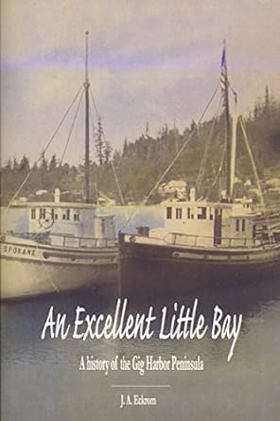
An Excellent Little Bay covers the history of the Gig Harbor peninsula up to 1967, one hundred years after the first non-native settlers arrived in the harbor. In 1867, three fishermen rowed their way into the calm waters of Gig Harbor, Washington, in search of salmon. They decided to stay and call the harbor home. Living alongside the resident Nisqually Indians, these white settlers, and those that soon followed, established roots of what would become a thriving commercial fishing and agricultural community. From the early steamboats of the Mosquito Fleet that moved residents and cargo back and forth across Puget Sound, to one of the largest fishing fleets on the west coast, this book tells the story of the people and events that made the Gig Harbor Peninsula what it is today. Author Jerry Eckrom weaves this history into an entertaining and enlightening read while documenting the important milestones through in-depth research and personal interviews. 2 volumes : illustrations, map ; 23 cm CIRC [ 1 ]
|
2004 |
|
An editor for Oregon Charles A. Sprague and the politics of change by Floyd J. McKay 
In chronicling the life of Oregon governor and newspaper editor Charles A. Sprague, Floyd McKay guides readers through the politics and journalism of twentieth-century Oregon. Sprague's remarkable career, writes McKay, "is in effect the life of a state through Depression, war and recovery, and into the era of Tom McCall and the Oregon Story." Newspaperman Charles Sprague, a progressive Republican, had lived in Oregon for only thirteen years when he became the surprise victor of the 1938 gubernatorial race. Although a capable governor, Sprague gained greater prominence during his forty-year tenure as editor and publisher of The Oregon Statesman in Salem. McKay examines the influence of Sprague's involvement in the Progressive politics of Theodore Roosevelt, his return to Republican orthodoxy, and his later emergence as a spokesman for liberal positions on race and justice, an evolution shaped by his governorship and service at the United Nations. Sprague's decisions -and later atonements- concerning ultra-patriotism in World War I and internment of Japanese Americans in World War II reveal an editor and governor torn by issues of his day. A major contribution to Oregon political history, An Editor for Oregon also offers a valuable look at one Oregon newspaper and its role in the community during the middle part of this century. x, 342 pages : illustrations ; 24 cm CIRC [ 0 ]
|
1998 |
|
An early history of Spirit Lake & the Toutle River Valley by Leland G. Jackson, Trudy Howarth 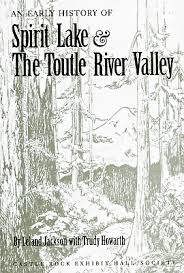
Authored by Leland G. Jackson and Trudy Howarth, An Early History of Spirit Lake & the Toutle River Valley chronicles the pioneer settlement, timber extraction, and rugged recreation that defined the remote wilderness surrounding Mount St. Helens before the 1980 cataclysmic eruption. The book draws on historical photographs, diaries, and local records to document the daring homesteaders, early cabin builders, and resilient loggers who carved out a living in the shadow of the active volcano. Through these preserved vignettes, the text captures the idyllic, rustic era of lakeside resorts and mountain trails that existed prior to the mountain's dramatic reconfiguration. A keen insight drawn from the work is how human history in volcanic zones is defined by a collective, deliberate amnesia regarding natural hazards; by building permanent communities and thriving tourist hubs directly beneath a dormant geological giant, early settlers demonstrated an irrepressible human tendency to mistake temporary mountain stability for a permanent guarantee. v, 113 pages : illustrations, maps ; 23 cm CIRC [ 1 ]
|
1995 |
|
An archival and oral history inventory of the White Salmon and Klickitat Rivers by Daniel L. Boxberger, Lynn Arnold Robbins
Published by researchers Daniel L. Boxberger and Lynn Arnold Robbins, An Archival and Oral History Inventory of the White Salmon and Klickitat Rivers compiles extensive documentary research and personal interviews to map the human and ecological history of these two vital Washington watersheds. The book catalogs indigenous resource use, early Euro-American settlement, and the complex socioeconomic impacts of logging, fishing, and hydro-electric development along the Columbia River's dramatic northern tributaries. By blending rigorous archival records with direct oral accounts from local residents and tribal members, the authors preserve the shifting lifeways tied directly to these rushing alpine waters. A keen insight drawn from the work is how oral history inventories disrupt purely technocratic resource management; by centering the lived memories of those displaced or altered by industrial river modification, the text exposes the deep cultural amnesia inherent in viewing dynamic watersheds as mere power sources. 204 pages : maps ; 28 cm CIRC [ 0 ]
|
1994 |
|
An architectural guidebook to Portland by Bart King 
Portland strikes a graceful balance between the rich traditions of its past and the creative developments of modern architecture. Written for both layperson and professional, An Architectural Guidebook to Portland is filled with history and photos that demonstrate why this city is one of the most admired in the nation. Portland's civic planning, historic preservation, and overall attractiveness are all explored in detailed profiles of structures ranging from 19th-century cast-iron front buildings to sleek modern skyscrapers. Now revised and updated to reflect Portland's explosive growth in the 21st century, this second edition includes an added focus on the development of "green buildings" and sustainable design, a chapter on downtown bridges, and expanded coverage of the city's vibrant neighborhoods. With over 250 entries that tell the stories behind Portland's celebrated cityscape, this comprehensive guide is an indispensable resource for visitors and Portlanders alike. Don't miss Bart King's Architecural Guide to Portland, a mobile site for the Web and mobile devices, which features rotating content from the book. viii, 320 pages : illustrations, maps ; 23 cm CIRC [ 0 ]
|
2007 |
|
An annotated bibliography of Oregon bird literature published before 1935 by George A. Jobanek 
George Jobanek's exhaustive, richly annotated bibliography fills an important gap in Oregon bird literature and offers a valuable new resource for professional and informed amateur ornithologists, wildlife managers, biologists, ecologists, and anyone with a serious interest in the natural history of the Pacific Northwest. In compiling this unique book, George Jobanek carefully researched early ornithological, scientific, and natural history publications, from American Field to Zoe, for records of Oregon birds. Most of these early articles are today relatively rare; many were overlooked or ignored by previous bibliographers. In his annotations for each of the nearly two thousand entries, Jobanek conveys the salient points of each article and reveals its usefulness for contemporary readers. Direct quotations from the references allow for a glimpse of an earlier, golden age in ornithology. References are organized by author and cross-indexed by species (e.g., 86 entries for Sage Grouse), county (e.g., 220 entries for Klamath County), and key word (e.g., "behavior," "conservation," "distribution," "introduction," "migration," "nesting," "taxonomy"). A gazetteer identifies localities mentioned in the annotations. xii, 481 pages : illustrations ; 24 cm CIRC [ 0 ]
|
1997 |