Catalog of British Columbiana and Pacific Northwest Americana
Encyclopedia Cascadia Catalog contains book titles of mostly non-fiction Pacific Northwest Coast of North America Titles (primarially British Columbia, Idaho, Oregon and Washington State) in an easy-to-understand title catalog. If you see a link with this badge ONLINE CIRC it means that there is an online institution that provides free access to that title. In some cases there may be more than one institution hosting the title digitally.
| Catalog Title | Published |
|---|---|
|
Bella Bella texts by Franz Boas 
Published in 1928 by Franz Boas, the foundational architect of modern American anthropology, Bella Bella Texts is a dense, bilingual ethnographic repository preserving the oral literature of the Heiltsuk (historically referred to by colonists as the Bella Bella) people of the central coast of British Columbia. Relying on Indigenous informants, Boas systematically transcribed creation histories, family crest narratives, and shamanistic lore into rigorous phonetic notation alongside literal English translations. The volume reflects Boas’s massive, career-long mandate of "salvage anthropology"—a scientifically urgent rush to document the complex Indigenous societies of the Pacific Northwest Coast before their anticipated erasure under the intense pressures of Canadian assimilation policies, residential schools, and the strict federal prohibition of the potlatch. A keen insight drawn from the work is how the supposedly objective methodology of anthropological transcription actively divorced Indigenous oral traditions from their inherent legal and territorial authority. In Heiltsuk society, these narratives were not mere "folklore" or public entertainment; they were highly guarded intellectual property that codified family lineages, governed resource rights, and asserted territorial sovereignty. By extracting these sacred histories, stripping them of their performative and ceremonial contexts, and flattening them into standardized, bilingual data points for Western academic consumption, Boas’s project subtly disarmed them. The text inadvertently functioned as a mechanism of colonial containment, transforming active, legally binding Indigenous constitutional frameworks into static, depoliticized scientific specimens housed safely within the American academic archive. ix, 291 ; 24 cm ONLINE CIRC [ 1 ]
|
1928 |
|
Pacific steamers by Will Lawson
Detailed history and listing of steam ships in the Pacific, changes in technology, with ships mainly from Australia, New Zealand, United States, and Canada xx, 244 pages, 72 unnumbered leaves of plates : illustrations ; 22 cm CIRC [ 1 ]
|
1927 |
|
The Pacific Northwest a syllabus by Edmond S. Meany
Compiled in the early twentieth century by University of Washington professor Edmond S. Meany—the premier institutional architect of the state's historical canon—The Pacific Northwest: A Syllabus operated as a formal pedagogical framework designed to standardize the teaching of regional history in higher education. Functioning as a strict curriculum guide, the text organized the region’s past into a rigid, highly structured taxonomy of chronological eras: maritime discovery, the fur trade, missionary settlement, the pioneer migrations, and the triumphant march to statehood. By dictating the precise historical milestones, key figures, and required readings for university students, Meany’s syllabus built the foundational academic infrastructure that determined exactly how the next generation of teachers, politicians, and civic leaders would learn and transmit their region's origins. A keen insight drawn from the work is how the seemingly neutral, objective format of a university syllabus functioned as a profound instrument of epistemological erasure; by plotting the region’s history strictly along a timeline of Anglo-American achievements, treaties, and legal milestones, Meany conceptually banished millennia of Indigenous civilization to the static realm of "pre-history" or mere environmental obstacles to be overcome. The syllabus weaponized the authority of the university to institutionalize a teleological narrative of colonial progress, ensuring that the violent displacement of Native peoples was academically processed by future civic leaders not as an ongoing injustice, but as a concluded, natural phase in the inevitable maturation of the American state. 18 unnumbered pages ; 22 cm ONLINE CIRC [ 1 ]
|
1927 |
|
History of Pierce County, Washington by W. P. Bonney 
Published in 1927 by William P. Bonney, the long-serving secretary of the Washington State Historical Society, History of Pierce County, Washington is an exhaustive, multi-volume civic chronicle detailing the rapid industrial and demographic transformation of the southern Puget Sound. The text traces the region's development from the early commercial operations of the Hudson's Bay Company at Fort Nisqually and the contentious Medicine Creek Treaty, through the violent Puget Sound War of 1855–1856, culminating in the massive economic boom sparked by Tacoma securing the terminus of the Northern Pacific Railroad. Following the established model of commercial pioneer literature, the primary historical narrative is heavily subsidized by subsequent volumes of flattering biographical sketches of local merchants, politicians, and industrialists, effectively functioning as a sprawling monument to the capitalist triumph of the local elite. A keen insight drawn from the work is how the institutionalization of local history was utilized to posthumously litigate and justify the most controversial acts of frontier violence; by framing the Puget Sound War and the deeply contested execution of Nisqually Chief Leschi as tragic but necessary assertions of territorial law, Bonney's narrative effectively absolves the pioneer government of its aggressive, fraudulent land seizures. By anchoring the legal origins of Pierce County in the triumph of martial and judicial order over Indigenous resistance, the text actively sanitizes the violent foundations of Tacoma's industrial prosperity, demanding that readers accept the systemic dispossession of the Nisqually and Puyallup peoples not as a localized atrocity, but as the unavoidable, legally sanctioned price of modern civic civilization. 3 volumes : illustrations, portraits ; 28 cm CIRC [ 2 ]
|
1927 |
|
History of Teton Valley, Idaho by B.W. Driggs
Published in 1926 by local attorney and pioneer descendant Benjamin Woodbury Driggs, History of Teton Valley, Idaho chronicles the transformation of the high-altitude Teton Basin—historically known as Pierre's Hole—from a seasonal Indigenous gathering ground and legendary fur-trade rendezvous into a settled agricultural community. The narrative explicitly bridges two distinct eras: the romanticized, lawless epoch of early mountain men and the subsequent, highly organized colonization of the valley by Mormon (LDS) pioneers. Driggs meticulously records the foundational efforts of these early agrarian settlers, emphasizing their communal resilience in taming a harsh, isolated environment and establishing permanent civic and religious institutions on the eastern edge of Idaho. A keen insight drawn from the work is how the narrative strategically bifurcates the frontier experience to legitimize permanent settler occupation; by romanticizing the early fur trade era as a chaotic, adventurous prelude dominated by transient white trappers and shifting Native American tribes, Driggs effectively frames the subsequent arrival of Mormon pioneers not as an invasion, but as the valley's inevitable maturation into civil order. This historiographical maneuver subtly consigns Indigenous peoples to a closed chapter of frontier antiquity, ensuring that the eventual agricultural enclosure of the Teton Valley is celebrated as the righteous, divinely ordained culmination of American progress rather than an ongoing act of territorial dispossession. 227 pages, 9 unnumbered leaves of plates ONLINE CIRC [ 1 ]
|
1926 |
|
The Oregon constitution and proceedings and debates of the Constitutional Convention of 1857 by Oregon, Charles Henry Carey , Oregon Historical Society (Issuing body), Oregon Constitutional Convention (1857)
Edited by prominent jurist and historian Charles Henry Carey and published by the Oregon Historical Society in 1926, The Oregon Constitution and Proceedings and Debates of the Constitutional Convention of 1857 serves as the definitive legal archive of the state's founding legislative assembly. The massive volume meticulously compiles the daily transcripts, committee reports, and fierce political arguments that culminated in Oregon's 1857 constitution, capturing the territory's transition to formal statehood. The detailed records highlight the pressing political concerns of the pioneer delegates: state finance, the regulation of corporations, and, most prominently, the deeply contested issues of slavery, suffrage, and racial exclusion in the looming shadow of the Civil War. A keen insight drawn from the work is how the archive explicitly exposes the foundational legal architecture of the state as a meticulously engineered white supremacist project. By preserving the raw, unvarnished debates of the delegates, the text inadvertently shatters the myth of the pioneer as a purveyor of universal democratic liberty; instead, it reveals how the architects of Oregon statehood utilized the highest form of democratic bureaucracy to systematically codify racial exclusion—most notably through the infamous constitutional clause banning free Black people from the state, alongside strict prohibitions denying suffrage and property rights to Native Americans and Chinese immigrants. The preservation and publication of these proceedings in the 1920s subtly institutionalized this exclusionary heritage, framing the calculated legal construction of a white utopia not as a profound moral failure, but as a sober, deliberate act of frontier statesmanship. 543 pages : facsimile ; 24 cm CIRC [ 1 ]
|
1926 |
|
Early history of the province of British Columbia by Bruce Alistair McKelvie
Published in 1926 by prominent Canadian journalist and popular historian Bruce Alistair McKelvie, Early History of the Province of British Columbia serves as a sweeping, romanticized narrative of the region's colonial formation. The text traces the province's origins from early maritime expeditions and the grueling overland treks of fur trade explorers to the highly structured corporate administration of the Hudson’s Bay Company. McKelvie meticulously chronicles the era of Governor James Douglas, the frantic influx of the gold rushes, and the political maneuvering that ultimately secured British Columbia's entry into the Canadian Confederation, framing the entire era as a triumphant defense of British sovereignty against both an untamed wilderness and the looming threat of American expansionism. A keen insight drawn from the work is how the narrative weaponizes the specter of American Manifest Destiny to morally launder British imperialism; by framing the colonization of the Pacific Northwest primarily as a heroic, defensive geopolitical chess match to save the territory from aggressive United States annexation, McKelvie effectively casts the British Crown and the Hudson's Bay Company not as invading conquerors, but as benevolent, stabilizing protectors. This historiographical strategy successfully sanitizes the devastating impacts of colonial settlement, transforming the systemic displacement and economic subjugation of First Nations peoples into a mere background condition of a noble, state-building enterprise designed to preserve "civilized" British order on the Pacific coast. 118 pages : illustrations ONLINE CIRC [ 1 ]
|
1926 |
|
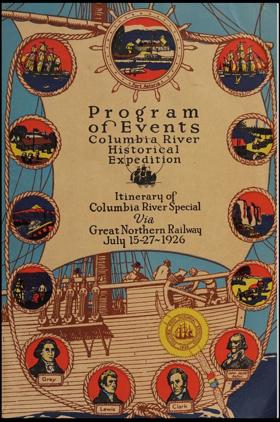
Program of Columbia River Historical Expedition, July 15-27, 1926. Itinerary of Columbia River special via Great Northern Railway by Columbia River Historical Expedition
|
1926 |
|
A history of Oregon by Robert Carlton Clark, Robert Horace Down, George Verne Blue
Published in 1925 as an officially sanctioned textbook for the state's public school system, A History of Oregon by Robert Carlton Clark, Robert Horace Down, and George Verne Blue is a foundational educational narrative designed to institutionalize the pioneer origin story for the next generation of citizens. The book comprehensively traces the region's trajectory from early European maritime exploration and the fur trade era through the mass overland migrations, ultimately culminating in the triumphant establishment of the 1843 Provisional Government and formal statehood. Authored by academic historians aiming to elevate regional history to the level of rigorous civic education, the text meticulously details legislative milestones, international boundary treaties, and the systematic agricultural development of the Willamette Valley. A keen insight drawn from the work is how the authors weaponized the rhetoric of legal and bureaucratic evolution to sanitize the inherent violence of territorial conquest; by disproportionately emphasizing the legislative triumphs of early settlers—specifically framing the creation of the Provisional Government as the definitive, miraculous birth of civilization in the region—the textbook actively taught generations of students to view the American occupation of the Pacific Northwest not as an aggressive colonial displacement of Indigenous nations, but as a peaceful, legally ordained transition from an empty wilderness to an organized democracy. xii, 356 pages : illustrations ; 19 cm CIRC [ 1 ]
|
1925 |
|
Mount Multnomah, ancient ancestor of the Three Sisters by Edwin T. Hodge, University of Oregon (Publisher)
Mount Multnomah is an invalidated hypothetical ancient volcano postulated in a 1925 publication by geologist Edwin T. Hodge. It was proposed to exist in central Oregon at the present day location of the Three Sisters region. It was estimated to have been around 16,000-foot (4,900 m) tall, and was believed destroyed in a fashion similar to Mount Mazama's eruption resulting in what is now Crater Lake in southern Oregon. 1 preliminary leaf, v, [1], 158, [2] pages, 1 unnumbered leaf of plates : illustrations, folded color map (in pocket) ; 26 cm CIRC [ 1 ]
|
1925 |
|
Origin of Washington geographic names by Edmond S. Meany 
Published in 1923 by the University of Washington Press, Origin of Washington Geographic Names is a comprehensive reference work compiled by noted regional historian and professor Edmond S. Meany. The book catalogs the etymology and historical background of place names across Washington State, serving as a foundational text for Pacific Northwest history. Originally serialized as a collection of articles in the Washington Historical Quarterly, the 357-page volume documents how various towns, waterways, and landforms received their designations. Today, it remains a valuable resource for understanding the geographic, indigenous, and pioneer heritage of the region ix, 357 pages ; 21 cm ONLINE CIRC [ 2 ] CIRC [ 1 ]
|
1923 |
|
The journal of John Work, a chief-trader of the Hudson's Bay Co. during his expedition from Vancouver to the Flatheads and Blackfeet of the Pacific Northwest by John Work, William S. Lewis, Paul C. Phillips 
The journal of John Work, a chief-trader of the Hudson's Bay Co. during his expedition from Vancouver to the Flatheads and Blackfeet of the Pacific Northwest, edited, and with an account of the fur trade in the Northwest, and life of Work 209 pages including plates, map frontispiece (portrait) 25 cm ONLINE CIRC [ 1 ]
|
1923 |
|
Northern Idaho resources & opportunities by North Idaho Chamber of Commerce (Issuing body)
Published circa 1922 by the North Idaho Chamber of Commerce, Northern Idaho: Resources & Opportunities functions as a classic example of aggressive civic boosterism designed to lure Eastern capital, agricultural settlers, and corporate investment to the rugged Idaho Panhandle. The promotional pamphlet meticulously inventories the region's vast timber reserves, lucrative mining districts, and fertile river valleys, marketing the Inland Northwest as an untapped utopia of unlimited economic potential. Operating simultaneously as a geographic catalog and a capitalist manifesto, the booklet reflects the organized efforts of local commercial elites to accelerate northern Idaho's transition from a remote frontier into a highly structured, resource-extraction economy. A keen insight drawn from the work is how civic promotional literature operated as a profound mechanism of both ecological and cultural erasure; by exclusively framing the complex natural landscapes of the Panhandle as a blank slate of commodified raw materials awaiting Anglo-American harvest, the Chamber of Commerce actively marketed a vision of the region that structurally erased the ongoing presence and sovereignty of Indigenous peoples such as the Coeur d'Alene and Nez Perce. This rhetorical strategy successfully sanitized the colonial project, presenting the imminent, large-scale industrial logging and mining of the territory not as a devastating ecological rupture or an act of territorial dispossession, but as the righteous, inevitable manifestation of modern progress. 40 pages : illustrations, 1 map ; 23 cm CIRC [ 1 ]
|
1922 |
|
Ox-team days on the Oregon trail by Ezra Meeker, Howard R. Driggs
Published in 1922 as a collaborative revision between iconic pioneer Ezra Meeker and educational author Howard R. Driggs, Ox-Team Days on the Oregon Trail is a heavily sanitized, accessible autobiography aimed directly at the American public school system. The book recounts Meeker’s grueling 1852 overland migration to the Pacific Northwest by ox-drawn wagon, his early homesteading struggles, and his famous early twentieth-century crusade to retrace the route and erect physical monuments along the fading Oregon Trail. Serving as both a personal memoir and a pedagogical tool, the text was meticulously engineered to immortalize the pioneer experience as the ultimate expression of American grit and national destiny. A keen insight drawn from the work is how the authors actively weaponized pioneer nostalgia for civic indoctrination; by repackaging the ecologically disruptive and inherently colonial act of westward expansion into an uplifting, state-sanctioned children’s textbook, Meeker and Driggs effectively cleansed the Oregon Trail of its violent realities. Their narrative actively shielded subsequent generations from the brutal consequences of Indigenous displacement, ensuring that the massive demographic invasion of the Pacific Northwest was memorialized purely as a righteous, patriotic pilgrimage essential to the American character. viii, 225 pages : illustrations ; 21 cm. ONLINE CIRC [ 1 ]
|
1922 |
|
Pacific Northwest Americana a checklist of books and pamphlets relating to the history of the Pacific Northwest by Charles W. Smith
Compiled in 1921 by University of Washington librarian Charles W. Smith (expanding upon a 1909 preliminary edition), Pacific Northwest Americana: A Checklist of Books and Pamphlets Relating to the History of the Pacific Northwest serves as a foundational bibliography designed to definitively catalog the region's historical literature. Acting as a master inventory for subscribing libraries, historical societies, and private collectors, the extensive checklist standardized the historical canon of Washington, Oregon, Idaho, and British Columbia by organizing thousands of pioneer memoirs, government surveys, and missionary tracts into a cohesive, searchable archive. By establishing the institutional parameters of what constituted legitimate scholarly material, the work effectively built the academic infrastructure for studying the region. A keen insight drawn from the work is how the seemingly neutral, bureaucratic act of archival cataloging functioned as a powerful tool of colonial gatekeeping; by strictly defining regional history as a collection of published, settler-produced texts and government pamphlets, Smith's bibliography institutionalized an academic canon that elevated pioneer narratives to the realm of empirical fact while structurally erasing Indigenous oral histories from the official scholarly record. xi, [1], 329 pages 27 cm ONLINE CIRC [ 2 ] CIRC [ 1 ]
|
1921 |
|
Seventy years of progress in Washington by Ezra Meeker
Published in 1921 by the Pacific Northwest's most famous and self-promoted trailblazer, Ezra Meeker, Seventy Years of Progress in Washington is a deeply personal memoir that doubles as a triumphalist history of the territory's evolution. The text chronicles Meeker’s grueling 1852 overland migration via the Oregon Trail, his early homesteading struggles in the Puget Sound region, his highly lucrative tenure as the "Hop King of the World" in Puyallup, and the rapid industrial urbanization of Washington State. Serving as both an autobiographical adventure and a civic retrospective, the book captures the staggering velocity of change from remote wilderness to modern industrial state within a single human lifetime. A keen insight drawn from the work is how Meeker successfully weaponized his own longevity to elevate the pioneer generation into an untouchable moral aristocracy; by actively marketing himself as the living embodiment of westward expansion, Meeker transformed the ecologically and socially destructive realities of colonization into a nostalgic, heroic spectacle. His narrative effectively demanded that modern residents revere the pioneer struggle not merely as history, but as the state's sacred founding mythology, thereby insulating the colonial project from any critical moral scrutiny. 381, [2], 52 pages, 14 unnumbered leaves of plates : illustrations, portraits ; 24 cm ONLINE CIRC [ 1 ] CIRC [ 1 ]
|
1921 |
|
The ceremonial societies of the Quileute Indians by Leo Joachim Frachtenberg
Published in 1921 in the American Anthropologist by ethnologist Leo Joachim Frachtenberg, The Ceremonial Societies of the Quileute Indians offers a detailed taxonomy of the ritualistic organizations governing the spiritual and social life of the Quileute people on Washington's Olympic Peninsula. Drawing from extensive fieldwork conducted on the reservation in 1915 and 1916, Frachtenberg meticulously catalogs the initiation rites, esoteric dances, and specialized spiritual powers associated with distinct tribal guilds, such as the prominent Wolf (Tlokwala), Elk Hunter, and Whaler societies. The resulting text serves as a dense ethnographic record of the complex, formalized frameworks that traditionally dictated status, professional obligation, and spiritual authority within the community prior to the aggressive enforcement of federal assimilation policies. A keen insight drawn from the work is how the anthropological taxonomy of Indigenous spiritual practices often functioned as a subtle form of cultural vivisection; by categorizing deeply integrated socio-political systems into isolated, easily digestible "secret societies" implicitly modeled after Western fraternal orders, Frachtenberg’s analysis inadvertently stripped these ceremonies of their holistic governing authority, reducing active Indigenous legal and spiritual structures to mere ethnographic curiosities prepared for academic consumption. 33 unnumbered pages 30 cm ONLINE CIRC [ 1 ]
|
1921 |
|
The ceremonial societies of the Quileute Indians by Leo Joachim Frachtenberg
Published in 1921 in the American Anthropologist, Leo Joachim Frachtenberg’s The Ceremonial Societies of the Quileute Indians provides a highly structured taxonomy of the esoteric ritual organizations that ordered social and spiritual life for the Quileute people on Washington's Olympic Peninsula. Based on fieldwork conducted in 1915 and 1916, the monograph meticulously documents the tribe's complex guild systems—including the prestigious Wolf (Tlokwala), Elk Hunter, and Whaler societies—detailing their exclusive initiation rites, ceremonial dances, and the specialized powers they conferred. Conceived during the height of salvage anthropology, the text operates as a dense scholarly archive attempting to preserve the mechanics of Quileute ceremonial life during a period of intense federal assimilation efforts. A keen insight drawn from the work is how the academic categorization of Indigenous practices often served to depoliticize active systems of Native governance; by analyzing these highly integrated bodies purely as esoteric "secret societies" akin to Western fraternal orders, Frachtenberg's ethnographic framework conceptually stripped them of their inherent legal, economic, and political authority. This scholarly approach subtly reinforced colonial objectives by redefining complex Indigenous systems of resource management and social control as mere religious curiosities, cataloging them for scientific posterity just as the state was actively dismantling their real-world power on the reservation. 33 unnumbered pages 30 cm ONLINE CIRC [ 1 ]
|
1921 |
|
Down the Columbia by Lewis R. Freeman 
The day on which I first conceived the idea of a boat trip down the Columbia hangs in a frame all its own in the corridors of my memory. It was a number of years ago—more than a dozen, I should say. Just previously I had contrived somehow to induce the Superintendent of the Yellowstone National Park to grant me permission to attempt a winter journey on ski around this most beautiful of America’s great playgrounds. He had even sent a Government scout along to keep, or help, me out of trouble. We were a week out from the post at Mammoth Hot Springs. xx pages, 4 leaves, 383 pages frontispiece, plates, portraits, map 23 cm ONLINE CIRC [ 1 ]
|
1921 |
|
Oregon—Its Meaning, Origin and Application by John E. Rees 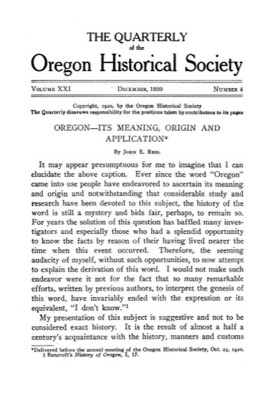
Published in 1920 by pioneer historian John E. Rees, Oregon—Its Meaning, Origin and Application is a brief etymological tract dedicated to deciphering the heavily contested linguistic roots of the state's name. Expanding upon the speculative methodologies he applied to neighboring Idaho, Rees argues that "Oregon" derives from specific Native American phonetic roots, attempting to definitively anchor the title in regional Indigenous dialects rather than European cartographic errors. By weaving together regional folklore, early exploration accounts, and localized vocabulary, the monograph attempts to construct a seamless narrative of authentic native pedigree for the broader Oregon Territory. A keen insight drawn from the work is how early regional scholars felt compelled to anchor new geopolitical entities to an imagined, romanticized Indigenous past; by fiercely claiming a "pure" Native origin for the state's name, historians like Rees actively commodified Indigenous heritage to lend an air of ancient, natural legitimacy to a recently manufactured colonial government. 1 volume (unpaged) ; 24 cm ONLINE CIRC [ 1 ]
|
1920 |
|
History of Idaho the gem of the mountains by James H. Hawley
Authored in 1920 by former governor and prominent frontier attorney James H. Hawley, History of Idaho: The Gem of the Mountains is a massive, multi-volume subscription history chronicling the state's rapid evolution from a rugged mining territory into an organized industrial powerhouse. Drawing heavily upon his own political career and pioneer experiences, Hawley weaves a triumphalist narrative that traces the early fur trade and violent frontier conflicts through to the establishment of robust civic and legal institutions. Like many regional histories of the era, the primary text is heavily subsidized by hundreds of flattering biographical sketches of local merchants, ranchers, and politicians, transforming the publication into a commercial vanity project for the state's ruling elite. A keen insight drawn from the work is how the authorship of a former state executive explicitly weaponized the concept of legal order to validate colonial conquest; by framing the violent dispossession of Idaho's Indigenous tribes and the aggressive extraction of natural resources as necessary milestones in the righteous march toward constitutional civilization, Hawley’s narrative effectively uses the veneer of state law to legally absolve the pioneer generation of its systemic ruthlessness. 4 volumes : frontispiece, illustrations (plates), map, portraits ; 29 cm ONLINE CIRC [ 4 ]
|
1920 |
|
Alsea texts and myths by Leo Joachim Frachtenberg
Published in 1920 as a federal bulletin for the Bureau of American Ethnology, linguist Leo Joachim Frachtenberg’s Alsea Texts and Myths presents a meticulously translated, bilingual repository of the oral literature of the Alsea people from the central Oregon coast. Relying on a handful of the last surviving fluent speakers residing on the Siletz Reservation, Frachtenberg rigorously transcribed creation narratives, shamanistic rituals, and animal lore into phonetic notation alongside literal English translations. Designed as a definitive scientific record of a Yakonan language on the verge of extinction, the volume reflects the frantic urgency of the era's "salvage anthropology." A keen insight drawn from the work is how the academic process of textualizing Indigenous oral traditions operated as a subtle mechanism of colonial containment; by severing these sacred narratives from their dynamic, performative contexts and freezing them as rigid, bilingual data points within a government archive, anthropologists effectively neutralized the living cultural power of these myths, transforming them from the active voice of a surviving people into the static, owned property of the American scientific establishment. 304 pages ; 24 cm ONLINE CIRC [ 1 ]
|
1920 |
|
Oregon's famous Columbia River Highway a descriptive view book in colors, reproducing from actual photographs the most prominent views of America's now most famous and featured highway by Lipschuetz and Katz (Publisher) 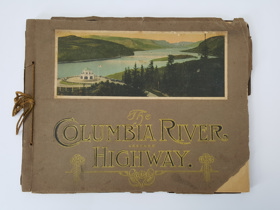
Oregon's Famous Columbia River Highway: A Descriptive View Book in Colors reproducing from Actual Photographs the most Prominent Views of America's now most Famous and Featured Highway 61 unnumbered pages : color illustrations ; 21 x 27 cm ONLINE CIRC [ 1 ] CIRC [ 1 ]
|
1920 |
|
History of the Yakima Valley, Washington; comprising Yakima, Kittitas, and Benton Counties by W. D. Lyman
Authored in 1919 by Whitman College professor William Denison Lyman, History of the Yakima Valley, Washington is an expansive, subscription-based chronicle detailing the rapid agricultural and industrial transformation of the region's arid interior. The multi-volume text traces the development of Yakima, Kittitas, and Benton counties, emphasizing the shift from the violent frontier conflicts of the Yakima War to the systematic implementation of massive irrigation projects that turned sagebrush plains into highly profitable orchards. Heavily subsidized by the inclusion of flattering biographical sketches of prominent local ranchers, politicians, and businessmen, the work serves as a triumphant civic monument celebrating Anglo-American engineering and agrarian capitalism. A keen insight drawn from the work is how the narrative weaponizes the rhetoric of ecological transformation to justify colonial occupation; by framing the irrigation and agricultural cultivation of the valley as the heroic redemption of a "useless" desert, Lyman’s text morally validates the dispossession of the Yakama Nation by equating legitimate land ownership exclusively with capitalist, industrial-scale agricultural productivity. 2 volumes : illustrations, portraits ; 27 cm ONLINE CIRC [ 2 ]
|
1919 |
|
Lyman's history of old Walla Walla County, embracing Walla Walla, Columbia, Garfield and Asotin counties by W. D. Lyman
Authored in 1918 by Whitman College professor William Denison Lyman, Lyman's History of Old Walla Walla County is an expansive, subscription-based chronicle of the agricultural and civic development of southeastern Washington. The multi-volume work traces the region's transformation from the fiercely contested era of early fur traders to its establishment as the prosperous, wheat-producing epicenter of the Inland Empire. Intertwining the history of early Protestant missionaries with hundreds of flattering biographical sketches of local pioneer patriarchs, the text actively mythologizes the Anglo-American conquest of the Columbia Basin. Typical of early twentieth-century regional literature, the book functions simultaneously as a sweeping civic monument and a commercial vanity project for the area's ruling merchant and agricultural elites. A keen insight drawn from the work is how early historians weaponized the trauma of pioneer martyrdom to morally anchor the colonization process; by framing the 1847 Whitman Massacre as a holy sacrifice that explicitly consecrated the land for white civilization, Lyman's narrative effectively rebranded the subsequent violent dispossession of the Cayuse and Walla Walla peoples as a righteous, divinely ordained destiny rather than an act of aggressive territorial conquest. 2 volumes : frontispiece, plates (illustrations, portraits) ; 28 cm ONLINE CIRC [ 2 ]
|
1918 |