Catalog of British Columbiana and Pacific Northwest Americana
Encyclopedia Cascadia Catalog contains book titles of mostly non-fiction Pacific Northwest Coast of North America Titles (primarially British Columbia, Idaho, Oregon and Washington State) in an easy-to-understand title catalog. If you see a link with this badge ONLINE CIRC it means that there is an online institution that provides free access to that title. In some cases there may be more than one institution hosting the title digitally.
| Catalog Title | Published |
|---|---|
|
Thirty-one years in Baker County. A history of the county from 1861 to 1893 by Isaac Hiatt 
Published in 1893, Isaac Hiatt’s regional history chronicles the first three decades of pioneer settlement in Baker County, Oregon, beginning with the foundational 1861 gold strike at Griffin's Gulch. The narrative documents the rapid influx of prospectors, the establishment of the explosive boomtown of Auburn, and the region's subsequent economic transition toward permanent agriculture and civic development centered in Baker City. Hiatt provides valuable firsthand perspectives on frontier justice, early political organization, and the inevitable, often violent conflicts with indigenous populations as white settlers claimed the eastern Oregon landscape. A keen insight drawn from the text is how its granular account of Auburn's meteoric rise and subsequent total collapse vividly illustrates the fragile, transient nature of frontier mining booms, demonstrating that long-term regional stability relied entirely on the less glamorous pivot to agrarian permanence. 208 pages 22 cm CIRC [ 1 ]
|
1893 |
|
Published in 1893 by the Reverend Harvey K. Hines, this expansive volume provides a comprehensive chronicle of Oregon's development from early European maritime exploration through its pioneer settlement and eventual statehood. The narrative emphasizes the pivotal role of Protestant missionaries and early overland pioneers in securing the region for the United States, while extensively documenting the political and economic evolution of the territory. A keen insight drawn from the text is how Hines’s own background as a Methodist clergyman deeply colors the historical narrative, actively framing the American colonization of the Pacific Northwest not merely as a secular triumph of Manifest Destiny, but as a divinely ordained Protestant mission to civilize the frontier. Furthermore, the work functions as a classic Gilded Age "subscription history," preserving hundreds of highly flattering biographical sketches of the prominent citizens and merchants who funded the book's publication while actively promoting the region to outside investors. 1300 pages frontispiece, plates, portrait 30 cm ONLINE CIRC [ 1 ]
|
1893 |
|
An illustrated history of the state of Washington containing biographical mention of its pioneers and prominent citizens by H. K. Hines
Published in 1893 by Reverend Harvey K. Hines, this voluminous work chronicles the early exploration, pioneer settlement, and rapid economic expansion that culminated in Washington's 1889 statehood. The narrative details the establishment of early Protestant missions, the turbulent era of the territorial Indian Wars, and the foundational growth of the region's timber, agricultural, and railroad industries. A keen insight drawn from the text is how the publication exemplifies the classic 19th-century "mug book" or subscription history model, where the grand, providential narrative of Manifest Destiny was explicitly monetized by pairing regional history with hundreds of highly flattering biographical portraits of the affluent citizens who paid to have their legacies immortalized in print. Consequently, while the historical analysis remains heavily shaped by Hines's religious and colonial biases, the volume survives today as an indispensable genealogical archive of the commercial and civic leaders who built Washington's early institutions. 933, [1] pages, 36 unnumbered leaves of plates : illustrations, portraits ; 30 cm ONLINE CIRC [ 1 ]
|
1893 |
|
|
1893 |
|
|
1893 |
|
History of Washington, Idaho, and Montana 1845-1889 by Hubert Howe Bancroft
Published in 1890 as the thirty-first volume of his exhaustive western history series, Hubert Howe Bancroft’s History of Washington, Idaho, and Montana 1845-1889 chronicles the violent transition of the Pacific Northwest's rugged interior from indigenous homelands to industrialized American states. The narrative meticulously documents the chaotic influx of prospectors during the inland gold rushes, the establishment of early territorial governments, and the brutal succession of regional Indian Wars that systematically cleared the land for transcontinental railroads. A keen insight drawn from the volume is how its rigorous documentation of these conflicts—painstakingly researched and written by the uncredited historian Frances Fuller Victor—serves as a surprisingly sharp indictment of federal incompetence and broken treaty promises. Yet, despite explicitly exposing the government's corrupt mismanagement of indigenous affairs, the text ultimately rationalizes this systemic violence as the tragic but inevitable cost of securing the inland frontier for capitalist expansion. xxvi, 836 pages : illustrations, maps ; 24 cm. ONLINE CIRC [ 1 ]
|
1890 |
|
History of Portland, Oregon by H. W. Scott 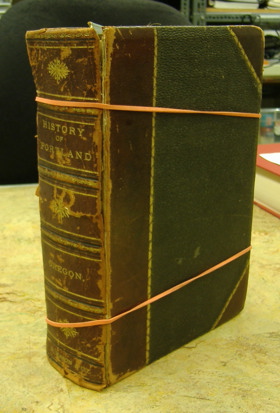
Published in 1890 and compiled by Harvey W. Scott, the formidable long-time editor of The Oregonian, History of Portland, Oregon offers a sweeping civic chronicle of the city's rise from a muddy clearing on the Willamette River to the dominant commercial metropolis of the Pacific Northwest. The exhaustive volume details early municipal struggles, infrastructural triumphs, and the fiercely competitive navigation of regional river trade, culminating in extensive biographical sketches of the city's pioneer elites. A keen insight drawn from the text is how Scott leverages his dual authority as a historian and the region's most powerful journalist to actively manufacture, rather than merely record, Portland's civic mythology. By inextricably linking the city's economic progress to the moral and financial virtues of its conservative merchant class, the book functions as a sophisticated ideological tool designed to cement the hegemony of the local business establishment while deliberately marginalizing labor movements and competing frontier narratives. 651 pages, 69 unnumbered leaves of plates : illustrations, portraits ; 26 cm ONLINE CIRC [ 1 ]
|
1890 |
|
An international idiom; a manual of the Oregon trade language, or "Chinook jargon" by Horatio Hale
Published in 1890, Horatio Hale’s An International Idiom; A Manual of the Oregon Trade Language, or "Chinook Jargon" presents a sophisticated linguistic defense of the Pacific Northwest's unique contact language as a viable instrument for broader human communication. Building upon his earlier work as the philologist for the 1838-1842 Wilkes Exploring Expedition, Hale meticulously outlines the grammar and vocabulary of the Chinook Jargon while arguing that its cross-cultural adaptability rendered it a legitimate "international idiom." A keen insight drawn from the text is how Hale’s late-19th-century academic elevation of the Jargon stands as a paradoxical act of preservation; even as the pidgin was rapidly dying out due to aggressive English-only assimilation policies and the physical displacement of Indigenous populations, he framed its historical utility as proof of a harmonious, multicultural genesis that conveniently sanitized the brutal realities of frontier conquest. 63 pages ; 19 cm ONLINE CIRC [ 1 ]
|
1890 |
|
The log school-house on the Columbia a tale of the pioneers of the great Northwest by Hezekiah Butterworth
|
1890 |
|
|
1890 |
|
History of Oregon by Hubert Howe Bancroft
The more remote in Oregon affairs has been given in my History of the Northwest Coast, which is indeed a part of the History of Oregon, as elsewhere explained. The later volumes deal with events which occurred within the memory of men now living; they are wrought out from yet more original sources, a large proportion of the facts herein presented never having before appeared in print. 2 volumes : illustrations (maps) folded map ; 24 cm ONLINE CIRC [ 2 ]
|
1888 |
|
Names and places studies in geographical and topographical nomenclature by J. D. Whitney
Published in 1888, Josiah Dwight Whitney’s Names and Places: Studies in Geographical and Topographical Nomenclature offers a pioneering scholarly examination of the origins, evolution, and cultural significance of place names across the expanding American landscape. Drawing on his extensive experience directing the California Geological Survey, Whitney analyzes how Indigenous appellations, Spanish colonial titles, and subsequent Anglo-American designations were layered, corrupted, or erased as the western frontier was systematically mapped. The text critiques the often arbitrary or politically motivated naming practices of early explorers, miners, and surveyors, advocating for a more rigorous and scientifically accurate approach to standardizing geographic markers. A keen insight drawn from the text is how Whitney’s linguistic study inadvertently reveals the imperial power dynamics inherent in cartography; by documenting the systematic replacement or anglicization of Indigenous toponyms, the book illustrates how the bureaucratic act of naming functioned as a definitive tool of cultural conquest, literally overwriting native geographies to assert and legitimize white territorial control. 239 pages 18 cm ONLINE CIRC [ 1 ]
|
1888 |
|
History of British Columbia Bancroft's works, vol. xxxii by Hubert H. Bancroft 
Published in 1887 as the thirty-second volume of his colossal western history series, Hubert Howe Bancroft’s History of British Columbia meticulously traces the region's development from late 18th-century maritime explorations through its 1871 integration into the Canadian Confederation. The narrative provides an exhaustive account of the Hudson's Bay Company's autocratic rule under Chief Factor James Douglas, the disruptive influx of American prospectors during the Fraser River Gold Rush, and the subsequent political unification of the mainland and Vancouver Island. A keen insight drawn from the volume is how Bancroft—an American historian steeped in the ideology of Manifest Destiny—inherently filters the Canadian colonial experience through a distinctly U.S. nationalist lens. By frequently contrasting the paternalistic, corporate monopoly of the British administration with the chaotic, democratic individualism of American miners, the text inadvertently functions as a fascinating comparative study of two competing imperial philosophies vying for economic and cultural dominance across the 19th-century Pacific Northwest. xxxi, 792 pages : maps ONLINE CIRC [ 1 ] CIRC [ 1 ]
|
1887 |
|
History of the Willamette Valley by Herbert O. Lang
being a description of the valley and its resources, with an account of its discovery and settlement by white men, and its subsequent history : together with personal reminiscences of its early pioneers xiv, [17]-902, xiii pages, 8 unnumbered leaves of plates : illustrations, facsimiles, portrait ; 25 cm ONLINE CIRC [ 1 ]
|
1885 |
|
History of Benton County, Oregon by David D. Fagan
including its geology, topography, soil and productions, together with the early history of the Pacific Coast, compiled from the most authentic sources : a full political history ... incidents of pioneer life and biographical sketches of early and prominent citizens : also containing the history of the cities, towns, churches, schools, secret societies, etc. .. 532 pages : illustrations ; 30 cm ONLINE CIRC [ 1 ]
|
1885 |
|
History of the Northwest Coast by Hubert Howe Bancroft
Published in 1884 as a two-volume installment of his monumental thirty-nine-volume series on western North America, Hubert Howe Bancroft’s History of the Northwest Coast provides an exhaustive chronicle of the region from initial maritime exploration through the 1846 Oregon Treaty. The sweeping narrative details the intense imperial competition among Spain, Russia, Great Britain, and the United States, meticulously tracking the evolution of the lucrative fur trade from early coastal shipping to the vast overland monopolies of the North West and Hudson's Bay Companies. By aggressively collecting and synthesizing thousands of primary manuscripts, pioneer diaries, and oral histories, the publication effectively centralized the region's scattered historical memory into a single authoritative archive. A keen insight drawn from the text is that while it famously bears Bancroft's sole authorship, the volume was actually researched and written by a stable of uncredited assistants—most notably the pioneering historian Frances Fuller Victor—revealing how the foundational historiography of the Pacific Northwest was constructed through a highly industrialized, corporate approach to scholarship. 2 volumes : illustrations, maps. ONLINE CIRC [ 2 ]
|
1884 |
|
Life at Puget Sound With sketches of travel in Washington territory, British Columbia, Oregon, and California, 1865-1881 by Caroline C Leighton
First person account of Western travel. Between 1865 and 1881 the author travelled extensively along the northwest coast describing localities, natural history, native customs and missionary activities. Her comments on the Chinese community in San Francisco are particularly interesting ONLINE CIRC [ 1 ]
|
1884 |
|
History of southern Oregon, comprising Jackson, Josephine, Douglas, Curry and Coos counties by Albert G. Walling 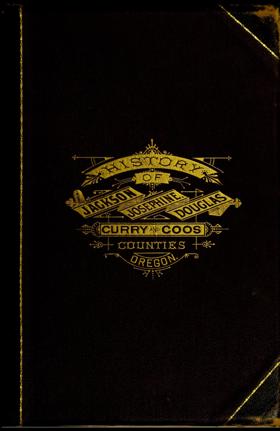
545, [1] pages, [126] leaves of plates : illustrations, folded maps, portraits ; 30 cm ONLINE CIRC [ 1 ]
|
1884 |
|
Historic sketches of Walla Walla, Whitman, Columbia and Garfield counties, Washington Territory, and Umatilla County, Oregon by Frank T. Gilbert
Published in 1882, Frank T. Gilbert's expansive regional history chronicles the rapid transformation of the Inland Empire—spanning eastern Washington and northeastern Oregon—from indigenous territory and fur-trade outposts to an agrarian powerhouse. The narrative meticulously details the violent conflicts of the Cayuse and Yakima Indian Wars, the establishment of early pioneer settlements, and the subsequent explosion of the region's lucrative dry-land wheat economy. A keen insight drawn from the text is how it perfectly exemplifies the Gilded Age "subscription history" model, where the grand, often brutal narrative of westward conquest was explicitly monetized by pairing regional chronicles with flattering biographical portraits of the affluent farmers and merchants who financed the publication. Consequently, while the volume remains an indispensable civic and genealogical archive, its historical framing intentionally sanitizes the systematic displacement of Native American tribes to celebrate the inevitable triumph of white, capitalist agriculture in the Columbia Basin. 447, [2], [449]-488, [12], 66 pages, [63] leaves of plates : illustrations, portraits ; 31 cm ONLINE CIRC [ 1 ]
|
1882 |
|
Two years in Oregon by Wallis Nash 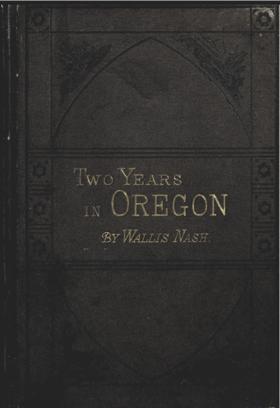
‘The evening is closing in; the sun has set, leaving a hot, red glow, where his copper disk has just sunk beyond the Pacific horizon; and the eye wanders out from the infant waves, at foot just tinged with red, and reflecting the light as they move up in turn to catch it, to the blue and still darker blue water beyond, out to the sharp indigo line where sky and water meet.' And so Wallis Nash concludes his brief passage on his brief expedition to hack off rock oysters, along the coast toward the Yaquina Head lighthouse. For anyone interested in the early history of Oregon, Wallis Nash's Two Years in Oregon is a mine of information. In an easy and highly readable narrative, Nash provides extensive detail on society, farming, hunting, fishing and community life. He wrote the book in 1882 after his first two years of residence whilst the initial impressions were still sharp in his mind. [2], 311 pages, 8 unnumbered leaves of plates + 9 pages press notes : frontispiece, illustrations (plates) ; 20 cm ONLINE CIRC [ 1 ]
|
1882 |
|
Oregon there and back in 1877 by Wallis Nash 
Nash, a prominent London attorney, came to Oregon in 1877 to investigate possibilities for railroad building and land development. When he returned to England, he wrote this book, here reprinted with a foreword and notes. Wallis Nash, a native of England, was a Benton County lawyer and entrepreneur. He was on the initial Board of Regents for Oregon Agricultural College (now Oregon State University). xviii pages, 2 leaves, 285 pages including frontispiece, illustrations, plates, double map 20 cm CIRC [ 0 ]
|
1878 |
|
Reisebilder und Skizzen aus Amerika by Theodor Kirchhoff 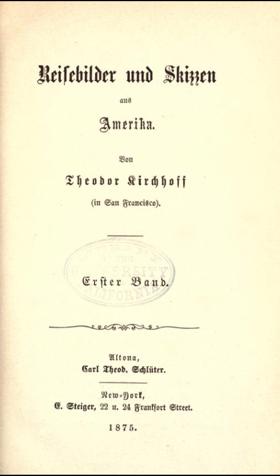
Published in 1875, Theodor Kirchhoff's Reisebilder und Skizzen aus Amerika offers a rich, descriptive travelogue of the American West as observed by a German immigrant, poet, and former Pacific Northwest shopkeeper. The narrative vividly captures the rapid economic and infrastructural transformation of the frontier, documenting early transit oddities like the primitive Walla Walla and Columbia River Railroad alongside the bustling, chaotic atmosphere of regional gold rush boomtowns like The Dalles. A keen insight drawn from the text is how Kirchhoff's position as a European intellectual provides a refreshing outsider's perspective on American expansion; unburdened by the nationalistic mythology of Manifest Destiny, he documents the eccentricities, raw commercialism, and unvarnished realities of the Pacific Northwest with a critical, cosmopolitan detachment often completely absent from domestic colonial boosterism. 2 volumes 19 cm ONLINE CIRC [ 2 ]
|
1875 |
|
Fusang The discovery of America by Chinese Buddhist priests in the fifth century by Charles G. Leland
This book, first published in 1875 and reissued in 1973, analyses the limited evidence from the works of early Chinese historians that explorers from China had discovered a country they called Fusang – possibly western America, and in all probability Mexico. The original document on which Chinese historians based their accounts of Fusang was the report of a Buddhist monk called Hoei-shin, who, in the year 499 AD, returned from a long journey to the east. xix, 212 pages ONLINE CIRC [ 1 ]
|
1875 |
|
History of the Provisional Government of Oregon by J. Quinn Thorton
Written by former Provisional Supreme Judge J. Quinn Thornton, this historical account chronicles the 1843 establishment of Oregon's Provisional Government at Champoeg and its subsequent legislative evolution. The narrative details the transition of the Willamette Valley from a loosely governed frontier outpost into an organized American political entity, emphasizing the drafting of its organic laws and the urgent lobbying for official U.S. territorial recognition. A keen insight drawn from the text is how Thornton’s intense personal vanity and staunchly anti-British prejudices transform this administrative history into a highly subjective, partisan autobiography. By actively framing himself as the indispensable architect of the 1848 Territorial Act and the primary crusader responsible for explicitly banning slavery in the region, Thornton weaponizes the historical record to settle old political vendettas and artificially inflate his own legacy in Pacific Northwest statecraft. 54 p. ONLINE CIRC [ 1 ]
|
1873 |
|
A dictionary of the Chinook jargon, or Indian trade language, of the north Pacific Coast by George Gibbs
Published in 1863 by the Smithsonian Institution, George Gibbs’s A Dictionary of the Chinook Jargon serves as a foundational linguistic catalog of the widespread pidgin used for commerce and communication between Indigenous tribes and European settlers across the Pacific Northwest. The text systematically standardizes the vocabulary of this highly adaptable contact language, meticulously tracing the etymological roots of its words back to their original Nuu-chah-nulth, lower Chinookan, French, and English sources. A keen insight drawn from the publication is how Gibbs’s rigorous codification of the Jargon was not merely a disinterested scholarly exercise, but a highly utilitarian tool designed to serve the federal government's expansionist agenda. By formalizing a fluid trade pidgin into a standardized, legible dictionary, Gibbs provided federal agents and treaty commissioners with the exact linguistic infrastructure required to efficiently negotiate the sweeping land cessions that systematically dispossessed the region's Indigenous populations 29 pages 21 cm ONLINE CIRC [ 1 ]
|
1871 |