Catalog of British Columbiana and Pacific Northwest Americana
Encyclopedia Cascadia Catalog contains book titles of mostly non-fiction Pacific Northwest Coast of North America Titles (primarially British Columbia, Idaho, Oregon and Washington State) in an easy-to-understand title catalog. If you see a link with this badge ONLINE CIRC it means that there is an online institution that provides free access to that title. In some cases there may be more than one institution hosting the title digitally.
| Catalog Title | Published |
|---|---|
|
Patos Island Lighthouse by Edrie Vinson , Terri Vinson 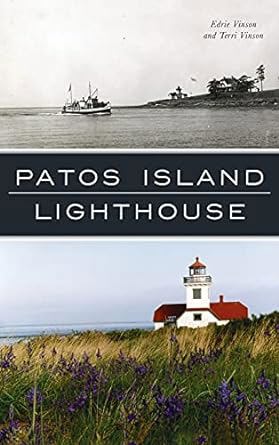
Since 1893, a light has been shining from Patos Island, the northernmost island in Puget Sound. Built to guide ships through treacherous waters, the lighthouse was also a happy home for many, including Edward Durgan and his family in the early 1900s. Boundary waters smugglers and rumrunners once visited the island to stash their contraband, and it was a front-line guard for the nation during World War II. Manned for eighty-one years by the U.S. government, the light was automated in 1974 and is now maintained by the Coast Guard. Join authors Edrie Vinson and Terri Vinson, members of the Keepers of the Patos Light, as they explore the history of this unique Washington landmark. 144 pages : illustrations, maps ; 23 cm CIRC [ 1 ]
|
2020 |
|
Deep and sheltered waters the history of Tod Inlet by David Robert Gray , Royal British Columbia Museum (Issuing body) 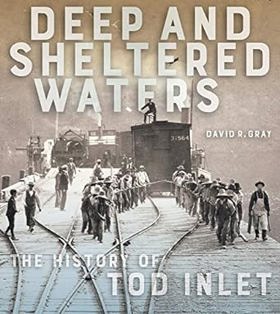
"This book brings to light the fascinating story of a community and place: Tod Inlet, near Victoria, BC. From the original inhabitants from the Tsartlip First Nation to the lost community of immigrant workers from China and India, from a company town to the development of parkland, the wealth of history in this rich area reflects much of the history of the entire province. The story of Tod Inlet and its communities spans from Vancouver Island to the BC coast north to Ocean Falls, south to California, and east to Golden, BC. David Gray draws from interviews with elders of the Tsartlip First Nation, descendants of the Chinese and Sikh workers, and the local community, and from archives held in Victoria and Ottawa. This detailed, illustrated book by an award-winning filmmaker tells the whole story of the natural area, the archaeological sites, the community of Tod Inlet, the Vancouver Portland Cement Company and cement plant (an industrial first), and the development of the Butchart Gardens."-- Provided by publisher xii, 248 pages : illustrations (some color), maps ; 23 cm CIRC [ 1 ]
|
2020 |
|
Idaho myths & legends the true stories behind history's mysteries by Randy Stapilus 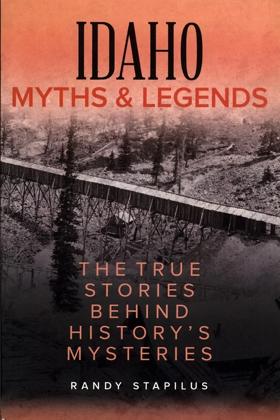
"Did one woman single-handedly save the members of the Lewis and Clark expedition from certain death? According to legend, a woman from the Niimíipuu tribe who had been rescued from slavery by a white family felt led to advocate for the travelers. If not for her courage and compassion, the story of the American West might have taken a much different trajectory. Could there really be a monstrously large serpent plying the depths of Bear Lake? Many dismiss the stories as Native American legends originally told to keep whites from settling in the area. Yet, for over a century, alleged eyewitness accounts, newspaper articles, and even TV shows continue to feed belief in the existence of a Bear Lake Monster. Is it true that the town of Kellogg almost was named Jackass? According to legend, the discovery of ore that led to a massive silver rush in Idaho's panhandle should be credited not to Noah Kellogg, but to the down-on-his-luck prospector's mule, Bill. Unfortunately, neither Noah nor Bill reaped the full benefits of what became one of the world's richest mining districts. From President Cleveland's alleged love child to the UFO highway, Idaho Myths and Legends of makes history fun and pulls back the curtain on some of the Gem State's most fascinating and compelling stories"-- Provided by publisher xxi, 193 pages : illustrations, map ; 23 cm. CIRC [ 0 ]
|
2020 |
|
Teaching Native pride Upward Bound and the legacy of Isabel Bond by Tony Tekaroniake Evans 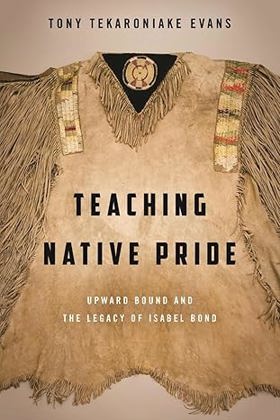
Based on more than thirty interviews with students and staff, Teaching Native Pride employs both Native and non-Native voices to tell the story of the University of Idaho’s Upward Bound program. Their personal anecdotes and memories intertwine with accounts of the program’s inception and goals, as well as regional tribal history and Isabel Bond’s Idaho family history. A federally sponsored program dedicated to helping low-income and at-risk students attend college, Upward Bound came to Moscow, Idaho, in 1969. Isabel Bond became director in the early 1970s and led the program there for more than three decades. Those who enrolled in the experimental initiative—part of Lyndon B. Johnson’s War on Poverty—were required to live within a 200-mile radius and be the first in their family to pursue a college degree. Living on the University of Idaho campus each summer, they received six weeks of intensive instruction in mathematics, laboratory sciences, composition, literature, foreign languages, and study skills. Recognizing that most participants came from nearby Nez Perce and Coeur d’Alene communities, Bond and her teachers designed a curriculum that celebrated and incorporated their Native American heritage—one that offers insights for educators today. Many of the young people they taught overcame significant personal and academic challenges to earn college degrees. Native students broke cycles of poverty, isolation, and disenfranchisement that arose from a legacy of colonial conquest, and non-Indians gained a new respect for Idaho’s first peoples. Today, Upward Bounders serve as teachers, community leaders, entrepreneurs, and social workers, bringing positive change to future generations. x, 230 pages : illustrations (black and white) ; 23 cm CIRC [ 0 ]
|
2020 |
|
An eye for injustice Robert C. Sims and Minidoka by Susan M. Stacy , Robert C. Sims 
The book, about the Minidoka War Relocation Center in Idaho, contains a selection of Robert Sims's published articles, conference papers, speeches, and slide shows on Minidoka and Japanese internment. Includes a new essay documenting the transformation of the forgotten post-WWII patch of desert to the Minidoka National Historical Site; short biographical essays by people who worked with him describing Sims' passion for social justice, history, and education, and an essay about the Robert C. Sims Collection at Boise State University. As wartime hysteria mounted following the December 1941 attack on Pearl Harbor, President Franklin D. Roosevelt issued Executive Order 9066, and the U.S. government began forcibly relocating all West Coast individuals with Japanese ancestry to one of ten sites in inland states. Totaling close to 120,000, the majority were American citizens. The Minidoka War Relocation Center, a newly constructed camp at Hunt, Idaho, first opened in August 1942. Most of its approximately 9,300 incarcerees came from Portland, Seattle, Tacoma, and surrounding regions. It was a painful experience with lasting repercussions. Minidoka's last occupant left in October 1945. Dr. Robert C. Sims devoted nearly half his life to research, writing, and education related to the unjust World War II Japanese American incarceration. Six of his previously published articles, as well as selections from conference papers and speeches, focus on topics such as Idaho Governor Chase Clark's role in the involuntary removal decision, life in camp, the impact of Japanese labor on Idaho's sugar beet and potato harvests, the effects of loyalty questionnaires, and more. His impassioned yet still academic approach to Minidoka is an important addition to others' published memoirs and photo collections. In new essays, contributors share insights into Sims' passion for social justice and how Minidoka became his platform, along with information about the Robert C. Sims Collection at Boise State University. Finally, the book recounts the thirty-five year effort to memorialize the Minidoka site. Now part of the National Park System, it highlights a national tragedy and the resilience of these victims of injustice. xx, 225 pages : illustrations, map ; 23 cm CIRC [ 0 ]
|
2020 |
|
Boosting a New West Pacific Coast Expositions, 1905-1916 by John C. Putman , Project Muse (Distributor) 
Inspired by Chicago's successful 1893 World Columbian Exposition, the cities of Portland, Seattle, San Diego, and San Francisco all held fairs between 1905 and 1915. From the start of the Lewis and Clark Exposition to the close of the Panama-California Exposition a decade later, millions of Americans visited exhibits, watched live demonstrations and performances, and wandered amusement zones. Millions more thumbed through brochures or read news articles. Fair publicity directors embraced the emerging science of consumer marketing. Conceived to attract new citizens, showcase communities, and highlight farming and industrial opportunities, the four expositions' promotional campaigns and vendor and exhibit choices offer a unique opportunity to examine western leaders' perceptions of their city and region, as well as their future goals and how they both fed and tried to mitigate misconceptions of a wild, wooly West. They also expose biased attitudes toward Native Americans, Mexican Americans, Filipinos, and others. "Boosting a New West" explores the fairs' cultural and social meaning by focusing on and comparing the promotions that surrounded them. It details their origins and describes why each city chose to host, conveying the expected economic, social, and cultural benefits. It also shows how organizers articulated their significance to urban, regional, and national audiences, and how they attempted to shape a new western identity. 1 online resource (pages cm) CIRC [ 0 ]
|
2020 |
|
Lewis & Clark reframed examining ties to Cook, Vancouver, and Mackenzie by David L. Nicandri , Clay Jenkinson 
Spanish, British, and French explorers reached the Pacific Northwest before Meriwether Lewis and William Clark. The American captains benefited from those predecessors, even carrying with them copies of their published accounts. James Cook, George Vancouver, and Alexander Mackenzie--and to a lesser extent fur traders John Meares and Robert Gray--directly and indirectly influenced the expedition. Based on new material as well as revised essays from popular history journals, "Lewis and Clark Reframed" examines several curious and seemingly inexplicable aspects of the journey after the Corps of Discovery crossed the Rocky Mountains. The captains' journals demonstrate that they relied on Mackenzie's 1801 "Voyages from Montreal" as a trail guide. They borrowed field techniques and favorite literary expressions--at times plagiarizing entire paragraphs. Cook's literature also informed the pair, and his naming conventions evoke fresh ideas about an enduring expedition mystery--the identity of the two or three journalists whose records are now missing. Additional journal text analysis dispels the notion that the captains were equals, despite expedition lore. Lewis claimed all the epochal discoveries for himself, and in one of his more memorable passages, drew on Mackenzie for inspiration. Parallels between Cook's and other exploratory accounts offer evidence that like many long-distance voyagers, Lewis grappled with homesickness. His friendship with Mahlon Dickerson lends insights into Lewis's shortcomings and eventual undoing. As secretary of the navy, Dickerson drew from Lewis's troubled past to impede the 1840s ocean expedition set to emulate Cook and solidify America's claim, through Lewis and Clark, to the region. xxvii, 156 pages : illustrations (some color), maps ; 23 cm CIRC [ 0 ]
|
2020 |
|
Endless pressure endlessly applied the autobiography of an eco-warrior by Brock Evans , George Venn , Wake-Robin Press (Issuing body) 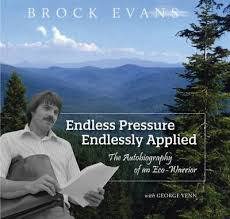
Primarily a collection of Brock Evans' contemporaneous writings, including witness testimony, diary entries, and speeches, Endless Pressure Endlessly Applied highlights and documents his 50-year career as a leader in the environmental movement 491 pages : illustrations (some color), portraits (some color) ; 27 x 28 cm CIRC [ 0 ]
|
2020 |
|
The mills that built Coos Bay, Oregon and the men who made it happen by William A. Lansing 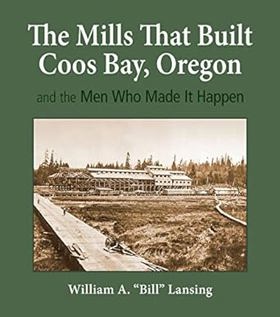
The author states that the purpose of this book is to "identify and describe the scores of mills that populated the shores of Coos Bay from the 1850s to the 1960s; to record how these mills came into existence, then drifted into history; and to tell the stories of the entrepreneurs who made it all happen."--Dust jacket xviii, 574 pages : illustrations (some color), facsimiles, maps (some color) ; 29 cm + 2 maps (color ; 77 x 61 cm and 81 x 61 cm) CIRC [ 0 ]
|
2020 |
|
Pioneer doctors of Coos County Oregon by William A. Lansing 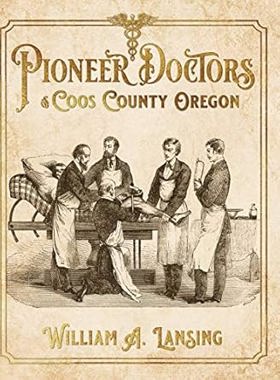
"In total, the Pioneer Doctors of Coos County, Oregon covers 40 physicians (mostly those with medical degrees--but a few with only minimal formal medical training), who practiced in the area--the bulk of them starting from around the turn of the twentieth century through the 1940s, and some a bit beyond that era. The book also expands into the history of the hospitals in Coos County, as well as pioneer dentists and the area's early drug stores. And for fun, there's a chapter on 'quackery'--featuring those whose ads for cure-all remedies splashed throughout the classified pages of local newspapers for decades"-- Back cover xvii, 196 pages : illustrations, portraits ; 29 cm CIRC [ 0 ]
|
2020 |
|
William S. U'ren Oregon father of the initiative, referendum, and recall by Richard W. Etulain , John Thomas 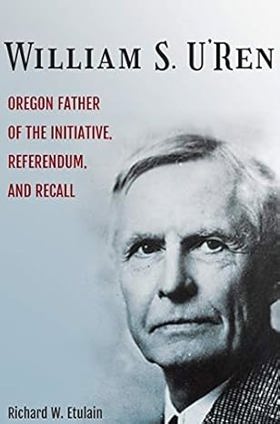
This slim volume collects essays, speeches, and letters written by Oregon political reformer and one-term legislator William S. U'Ren. Historian Richard Etulain's twenty-five-page biographical overview that precedes these primary documents is the most comprehen- sive coverage of U'Ren's life and impact on the state's politics to date. In the overview, Etulain calls U'Ren "one of the state's chief political thinkers and activists," who was known for promoting the Initiative and the Referen- dum, both of which were political reforms that Oregon voters adopted in 1902. Despite his short career as an elected official, U'Ren was Influential in Oregon and well beyond. His writing covers advocacy for the single tax and reflections on the efficacy of political reforms. Also included in the volume are the few photographs of U'Ren that exist, a short historiographic essay by Etulain, and Etulain's call for future research. x, 185 pages : photographs ; 23 cm CIRC [ 0 ]
|
2020 |
|
The river that made Seattle a human and natural history of the Duwamish by B. J. Cummings 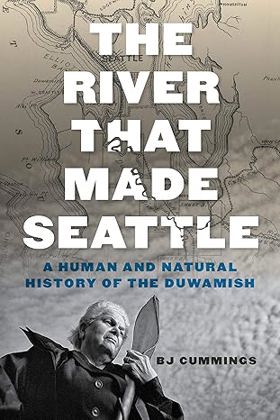
"With bountiful salmon and fertile plains, the Duwamish River has drawn people to its shores over the centuries for trading, transport, and sustenance. Chief Se'alth and his allies fished and lived in villages here and white settlers established their first settlements nearby. Industrialists later straightened the river's natural turns and built factories on its banks, floating in raw materials and shipping out airplane parts, cement, and steel. Unfortunately, the very utility of the river has been its undoing, as decades of dumping led to the river being declared a Superfund cleanup site. Using previously unpublished accounts by Indigenous people and settlers, BJ Cummings's compelling narrative restores the Duwamish River to its central place in Seattle and Pacific Northwest history. Writing from the perspective of environmental justice-and herself a key figure in river restoration efforts-Cummings vividly portrays the people and conflicts that shaped the region's culture and natural environment. She conducted research with members of the Duwamish Tribe, with whom she has long worked as an advocate. Cummings shares the river's story as a call for action in aligning decisions about the river and its future with values of collaboration, respect, and justice."-- Provided by publisher xiv, 222 pages : illustrations, maps ; 24 cm CIRC [ 0 ]
|
2020 |
|
Big promises, small government doing less with less in the BC Liberal new era by George M. Abbott 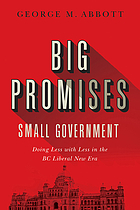
"The BC Liberal Party, under Gordon Campbell, won a massive majority in 2001 on the strength of its New Era electoral platform. On his first day in office, Campbell fulfilled the party's campaign pledge to dramatically reduce personal income taxes in British Columbia. "Big Promises, Small Government" demonstrates the integral relationship between effective tax policy and sustainable social programs. In this important and original case study, George Abbott provides a rigorous analysis of an intense and often controversial period in the province's political history. Despite sharply declining economic indices, the new premier expected that lower taxes would spur investment and growth, essentially paying for themselves. Instead, the Campbell government's precipitous and ideological decision to cut taxes and exempt health and education - some 70 percent of the provincial budget - from any decrease in expenditures, left smaller ministries scrambling to save $4.4 billion to meet a balanced budget. Severe budget cuts extended throughout social ministries with direct impact on their often vulnerable clients. "Big Promises, Small Government" demonstrates the inherent difficulties that tax cuts present to small, open trading economies such as British Columbia's, which could not hope to reshape its local fortunes quickly amid broader global shifts. George Abbott's insider perspective and compelling insights on the genesis, implementation, and real-world consequences of a tax policy offer vital lessons to future governments and gripping reading on the effects of short-sighted tax cuts on a province."-- Provided by publisher xvii, 259 pages ; 23 cm CIRC [ 0 ]
|
2020 |
|
Fool's gold the life and legacy of Vancouver's official town fool by Jesse Donaldson 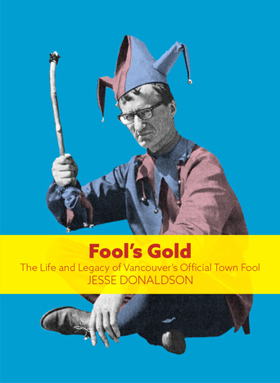
"Fool's Gold explores the life and times of Joachim Foikis, Vancouver's "Official Town Fool" who spread "joy and confusion" during the late 60s and early 1970s."-- Provided by publisher 123 pages : illustrations ; 17 cm. CIRC [ 0 ]
|
2020 |
|
Slashburner hot times in the British Columbia woods by Nick Raeside 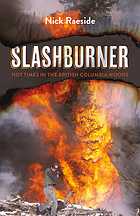
"Nick Raeside worked at many jobs in the logging business but the one that he specialized in was starting forest fires--small, (hopefully) controlled forest fires that were approved by the Forest Service--indeed, required by them--as a means of cleaning up logging slash or debris-laden sites left after the merchantable timber had been removed. It was a crude way of reducing fire hazard and clearing the ground for replanting, and there was a constant danger that the controlled burns would get away and become real wildfires, destroying millions of dollars' worth of standing timber. Raeside found this challenge irresistible. In Slashburner, Raeside recounts many hilarious anecdotes from his career in the BC woods during the 1970s, '80s and '90s. He worked as a forest firefighter for a time, but discovered he was more interested in starting fires than putting them out, and found his calling in slashburning. In between pissing on rain gauges to fake wetter weather and lighting each other's pants on fire, Raeside and his slashburning crews rampaged throughout southern BC armed with drip torches, chainsaws and homemade explosives. They lit fires. They put some of them out. They survived rockslides, animal encounters and flare fights. Slashburner is a rollicking tale of the good old times in the logging business when danger and excitement were the order of the day and almost everyone you met was a memorable character. Raeside captures the flavour of that era as few have done before. Including thirty colour photos that prove it actually did all happen, Slashburner is the first book to take readers beneath the smoke cloud to find out what really takes place on a slashburn."-- Provided by publisher xii, 228 pages, 16 unnumbered pages of plates : color illustrations, map ; 22 cm CIRC [ 0 ]
|
2020 |
|
A pocket guide to the Unheralded artists of BC series by Marsha Lederman (Writer of introduction) 
"This small attractive full-colour book, will gather thirteen forgotten and accomplished artists from the acclaimed Unheralded Artists of BC series, in one place, for the first time. There will be a short bio and a selection of art from each one. These artists were painters, sculptors, watercolourists, draftsmen, portraiture artists, abstractionists, surrealists, visionaries, art teachers, travellers, adventurists, printmakers, immigrants and most importantly passionate British Columbia artists. In British Columbia between 1900 and the 1960s over 16,000 artists worked and lived. It was the height of an immense creative surge in the province. Beyond the handful of names of successful artists there is little documented evidence of others. Art was made invisible by socioeconomic or political forces and by a lack of public/private galleries."-- Provided by publisher 187 pages : chiefly colour illustrations ; 18 cm. CIRC [ 0 ]
|
2020 |
|
Black woman in green Gloria Brown and the unmarked trail to forest service leadership by Gloria D. Brown , Donna L. Sinclair 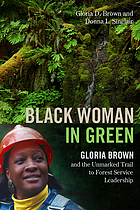
"Black Woman in Green tells the story of a young widow who left the urban East for the forested West seeking a better life for her children. It highlights Gloria Brown's determination and grit in working her way up in a primarily white, male organization to become the first female African American forest supervisor in the US Forest Service. From raising children alone to conducting civil rights trainings to breaking glass ceilings, Gloria Brown's humor and willingness to believe in the basic goodness of humanity makes possible a powerful and instructive leadership journey. Black Woman in Green provides a case study for public administration, contributes to understanding the overlapping environmental and civil rights movements of the twentieth century, and highlights issues of representation in the federal government, women's history, the history of the American West, and literature associated with African American experiences in predominately white societies"-- Provided by publisher 1 online resource CIRC [ 0 ]
|
2020 |
|
Clifford Gleason the promise of paint by Roger Hull , Clifford Gleason (Artist), Hallie Ford Museum of Art (Host institution) 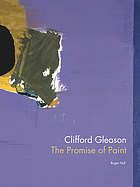
Clifford Gleason (1913-1978), who grew up in Salem and spent his adult life in both Salem and Portland, was a talented and highly original artist whose work remains of keen interest to a small and loyal group of collectors and artists but whose accomplishments are less generally known than those of other Oregon mid-century artists. Clifford Gleason: The Promise of Paint' serves as both an introduction and a definitive study of an 'artist's artist,' who until now has not received the sustained attention that he and his work are due. It traces his career from the 1930s until the last months of his difficult life-difficult because of alcoholism, near poverty, and homosexuality in a repressive era. In paint, Gleason found the only realm in which he felt competent, confident, and successful; paint offered the promise of accomplishment.0Roger Hull's knowledgeable text offers a chronological study combining biography, analysis of Gleason's artworks, and assessment of his place within the broader context of contemporary and Pacific Northwest art.0Published in conjunction with an exhibition at the Hallie Ford Museum of Art at Willamette University, this richly illustrated monograph examines Gleason's identity as a modern artist as he responded to the rapid changes in artistic modernism from the late 1930s, when he studied with Louis Bunce at the Salem Federal Art Center, to the 1970s, when he rethought the legacy of Abstract Expressionism in works that are unique to him, visually beautiful and poetically expressive. Exhibition: Hallie Ford Museum of Art, Salem, USA (20.08-31.10.2020) 95 pages : illustrations (chiefly color) ; 32 cm CIRC [ 0 ]
|
2020 |
|
Echoes of exclusion and resistance voices from the Hanford Region by Robert Bauman , Robert Franklin 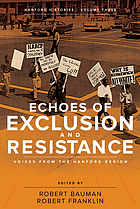
"Four scholars draw from oral histories to focus on experiences of non-white groups such as the Wanapum, Chinese immigrants, interned Japanese Americans, and African American migrant workers, whose lives were deeply impacted by the Hanford Site. Each group resisted segregation and discrimination, and in the process, challenged the region's dominant racial norms"-- Provided by publisher x, 261 pages : illustrations, maps ; 23 cm. CIRC [ 0 ]
|
2020 |
|
Unsettled ground the Whitman Massacre and its shifting legacy in the American West by Cassandra Tate 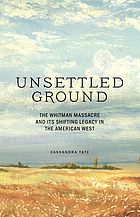
"Historian Cassandra Tate proposes to assemble the story of the Whitman Massacre from the many accounts while including the native point of view to provide a greater context to the event"-- Provided by publisher xx, 283 pages : illustrations, maps ; 23 cm CIRC [ 0 ]
|
2020 |
|
An open pit visible from the moon the Wilderness Act and the fight to protect Miners Ridge and the public interest by Adam M. Sowards 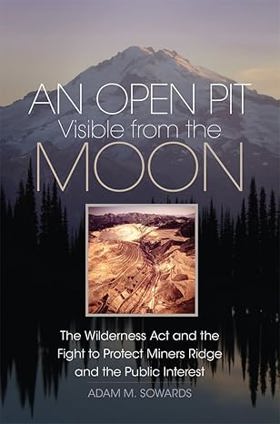
Situated among the North Cascade Mountains of Washington State, in the Glacier Peak Wilderness Area, Miners Ridge contains vast quantities of copper. Kennecott Copper Corporation’s plan to develop an open-pit mine there was, when announced in 1966, the first test of the mining provision of the Wilderness Act passed by Congress in 1964. The battle over the proposed “Open Pit, Big Enough to Be Seen from the Moon,” as activists called it, drew the attention of both local and national conservationists, who vowed to stop the desecration of one of the West’s most scenic places. Kennecott Copper had the full force of the law and mining industry behind it in asserting its extractive rights. Meanwhile the U.S. Forest Service was determined to defend its authority to manage wilderness. An Open Pit Visible from the Moon tells the story of this historic struggle to define the contours of the Wilderness Act—its possibilities and limits. Combining rigorous analysis and deft storytelling, Adam M. Sowards re-creates the contest between Kennecott and its shareholders on one hand and activists on the other, intent on maintaining wilderness as a place immune to the calculus of profit. A host of actors cross these pages—from cabinet secretaries and a Supreme Court justice to local doctors and college students—all contributing to a drama that made Miners Ridge a cause célèbre for the nation’s wilderness movement. As locals testified at public hearings and writers penned profiles in the nation’s magazines and newspapers, the volatile political economy of copper proved equally influential in frustrating Kennecott’s plans. No law or court ruling could keep Kennecott from mining copper, but the pit was never dug. Identifying the contingent factors and forces that converged and coalesced in this case, Sowards’s narrative recalls a critical moment in the struggle over the nation’s wild places, even as it puts the unpredictability of history on full display. xiii, 236 pages : illustrations, maps ; 24 cm. CIRC [ 0 ]
|
2020 |
|
The man who ate too much the life of James Beard by John Birdsall 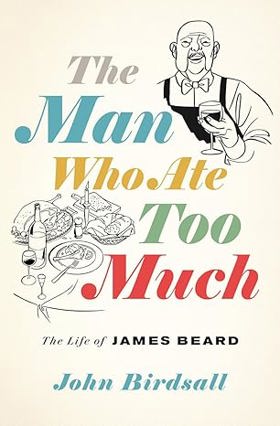
"The definitive biography of America's best-known and least understood food personality, and the modern culinary landscape he shaped. After World War II, a newly affluent United States reached for its own gourmet culture, one at ease with the French international style of Escoffier, but also distinctly American. Enter James Beard, authority on cooking and eating, his larger-than-life presence and collection of whimsical bow ties synonymous with the nation's food for decades, even after his death in 1985. In the first biography of Beard in twenty-five years, acclaimed writer John Birdsall argues that Beard's struggles as a closeted gay man directly influenced his creation of an American cuisine. Starting in the 1920s, Beard escaped loneliness and banishment by traveling abroad to places where people ate for pleasure, not utility, and found acceptance at home by crafting an American ethos of food likewise built on passion and delight. Informed by never-before-tapped correspondence and lush with details of a golden age of home cooking, The Man Who Ate Too Much is a commanding portrait of a towering figure who still represents the best in food"-- Provided by publisher xiv, 449 pages, 16 unnumbered pages of plates : illustrations ; 25 cm CIRC [ 0 ]
|
2020 |
|
Unsettling Native art histories on the Northwest coast by Kathryn B. Bunn-Marcuse , Aldona Jonaitis 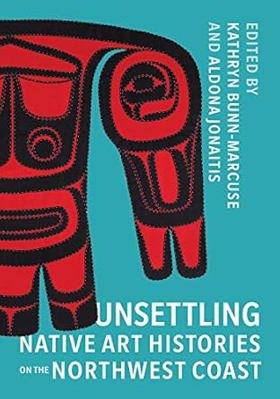
Inseparable from its communities, Northwest Coast art functions aesthetically and performatively beyond the scope of non-Indigenous scholarship, from demonstrating kinship connections to manifesting spiritual power. Contributors to this volume foreground Indigenous understandings in recognition of this rich context and its historical erasure within the discipline of art history. By centering voices that uphold Indigenous priorities, integrating the expertise of Indigenous knowledge holders about their artistic heritage, and questioning current institutional practices, these new essays "unsettle" Northwest Coast art studies. Key themes include discussions of cultural heritage protections and Native sovereignty; re-centering women and their critical role in transmitting cultural knowledge; reflecting on decolonization work in museums; and examining how artworks function as living documents. The volume exemplifies respectful and relational engagement with Indigenous art and advocates for more accountable scholarship and practices. 334 pages : illustrations (chiefly color) ; 27 cm. CIRC [ 0 ]
|
2020 |
|
Walking the High Desert encounters with rural America along the Oregon Desert Trail by Ellen Waterston 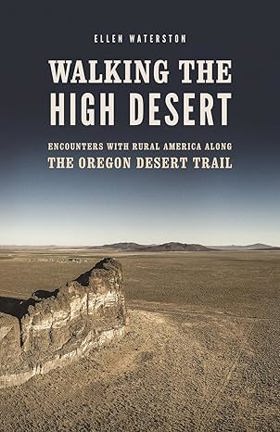
Former high desert rancher Ellen Waterston writes of a wild, essentially roadless, starkly beautiful part of the American West. Following the recently created 750-mile Oregon Desert Trail, she embarks on a creative and inquisitive exploration, introducing readers to a “trusting, naïve, earnest, stubbly, grumpy old man of a desert” that is grappling with issues at the forefront of national, if not global, concern: public land use, grazing rights for livestock, protection of sacred Indigenous ground, water rights, and protection of habitat for endangered species. Blending travel writing with memoir and history, Waterston profiles a wide range of people who call the high desert home and offers fresh perspectives on nationally reported regional conflicts such as the Malheur Wildlife Refuge occupation. Walking the High Desert invites readers—wherever they may be—to consider their own beliefs, identities, and surroundings through the optic of the high desert of southeastern Oregon. xiii, 231 pages : map ; 22 cm CIRC [ 0 ]
|
2020 |
|
Lake City a novel by Thomas B. Kohnstamm 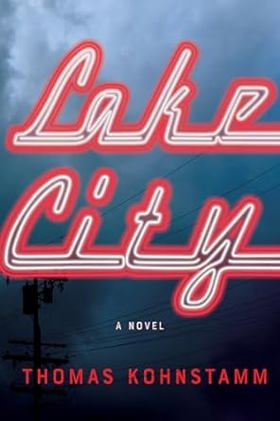
"Hunkered down in his childhood bedroom in Seattle's worn-out Lake City neighborhood, idealistic but self-serving striver Lane Bueche licks his wounds and hatches a plot to win back his estranged Manhattanite wife. He discovers a precarious path forward when he is contracted by a wealthy adoptive couple to seduce and sabotage a troubled birth mother from his neighborhood. Lane soon finds himself in a zero-sum game between the families as he straddles two cultures, classes, and worlds. Until finally, with the well-being of the toddler at stake, Lane must choose between wanting to do the right thing (if he could only figure out what that is) and reclaiming his idea of privilege"-- Provided by publisher 304 pages ; 22 cm CIRC [ 1 ]
|
2019 |