Catalog of British Columbiana and Pacific Northwest Americana
Encyclopedia Cascadia Catalog contains book titles of mostly non-fiction Pacific Northwest Coast of North America Titles (primarially British Columbia, Idaho, Oregon and Washington State) in an easy-to-understand title catalog. If you see a link with this badge ONLINE CIRC it means that there is an online institution that provides free access to that title. In some cases there may be more than one institution hosting the title digitally.
| Catalog Title | Published |
|---|---|
|
Taming of the Slough the intriguing story of the Sammamish Slough Race, "the crookedest race in the world" : plus ... the history of the Seattle Outboard Association and the Seattle to Lake Sammamish race course by Jim A. Benson, Carolyn Benson, Craig Fjarlie, Craig Smith 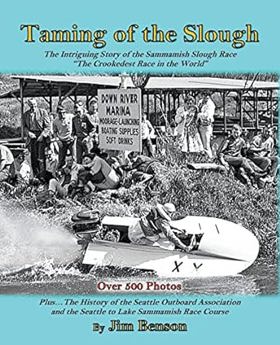
"There is an old adage that says, 'Truth is stranger than fiction.' This is the way it was told in the fascinating stories about the famous Sammamish Slough Race. Your Author covers a boat racing era from the 1920s to the 1970s. His personal knowledge, being born into a racing family, has given him insight that few people still living have. In the Pacific Northwest, the area where the Slough Race took place, significant changes occurred that had a long-term effect on outboard racing of that period. He leads you through the years that made boat racing a competition as exciting as major-league sports are today. The contest started from various locations on Lake Washington, ran across the lake and proceeded into a narrow-crooked river that wound through several small towns. It took a brief stop at one of the resorts on the upper connecting lake--Lake Sammamish. The competitors restarted their race boats after stopping and headed back downstream to the starting point, finishing their long grueling marathon. You will learn about some of the local history along the path of the racecourse, which is fascinating in itself. Many alterations were made to the terrain-history was rewritten as a result. The River took some vicious twists and turns, which was the exciting attraction for thousands of spectators. It nearly killed some of the drivers. You are treated to hundreds of wonderful photographs while reading about some of the wild events that happened along the way of this 'Crookedest Race in the World'"--Page 4 of cover 544 pages : illustrations, maps, portraits ; 24 cm CIRC [ 1 ]
|
2018 |
|
A home on the South Fork an early history of Acme--a northwest Washington community by Margaret A. Hellyer 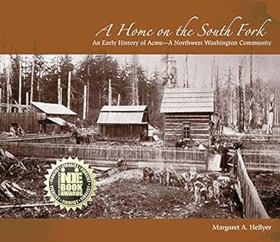
"Coast Salish people were the only occupants of the Northwest corner of Washington State for millennia. They retained their unique reign over the land until the mid-1850s when European Americans arrived on the shores of Bellingham Bay. Those early businessmen, adventurers, and settlers seeking a new beginning would forever change the Northwest landscape. Washington Territory had not yet become a state and the land was not surveyed by the federal government when the first outsiders arrived. Once the small towns lining Bellingham Bay began to grow, a handful of settlers traveled inland to stake land claims. The pioneers who made their way up the South Fork of the Nooksack River faced immense hardship and extreme isolation as they established homesteads and put down roots in the wilderness of Whatcom County. This is the story of those settlers and the small town they built in the South Fork valley of Whatcom County, including early contact with the Nooksack Indians. Their stories are told through records, interviews, letters, and a wealth of early images that document their lives and progress as they transformed their corner of Northwest Washington wilderness into a community called Acme."--Page 4 of cover 296 pages : illustrations, maps ; 24 x 28 cm CIRC [ 1 ]
|
2018 |
|
Seattleness a cultural atlas by Tera Hatfield , Jenny Kempson , Natalie Ross , Timothy R. Wallace 
"This visually rich cultural atlas of Seattle explores the mercurial nature of place through the lens of one of the fastest growing cities in America. Through both experiential and data-driven cartography, Seattleness lends itself to longtime residents, newcomers to the city, and those curious about the moody borough that has brought us airplanes, grunge, gourmet coffee, and e-commerce. In the style of Infinite City and Portlandness, this illustrated book examines an expansive range of topics from UFO sightings to pinball legacies, gray skies to frontier psychology, strong women and strong coffee. Compelling infographic visuals emerge from deep dives into data, unraveling over 50 real and strange narratives about the green metropolis perched at the edge of the Salish Sea"-- Provided by publisher xi, 175 pages : illustrations (some color), maps ; 26 cm CIRC [ 1 ]
|
2018 |
|
Trail north the Okanagan Trail of 1858-68 and its origins in British Columbia and Washington by Ken Mather 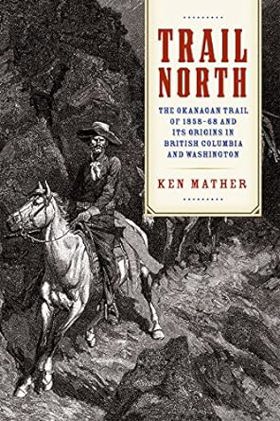
"Trails are the most enduring memorials of human transportation and occupation. Long before stone monuments were created, pathways throughout the world were being worn in hardness by human feet. Travellers along the stretch of Highway 97 from Brewster, Washington, to Kamloops, BC, may not know that they are travelling a route as old as humankind's presence in the region. In fact, this north-south valley, a natural corridor linking the two major river systems that drain the Interior Plateu, has served as a transportation route for tens of thousand of years. Trail North traces the origins of this iconic trail among the Indigenous people of the Interior Plateau and its uses by three diffierent fur trading companies, before turning its focus on the period of 1858 to 1868, when the trail was used by miners, packers, and cattlemen as the major entry point into British Columbia from Washington Territory."--Back cover 299 pages : illustrations, maps ; 23 cm CIRC [ 1 ]
|
2018 |
|
Words marked by a place local histories in Central Oregon by Jarold Ramsey 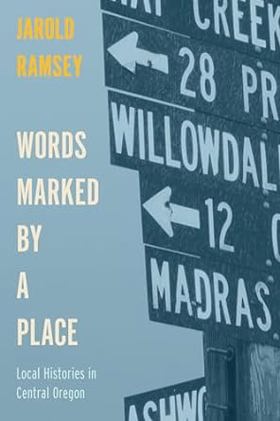
"Words Marked by a Place is a book of interconnected writings reflecting on the human and natural history of central Oregon. This chronological collection presents the reader with key episodes of central Oregon history, from nineteenth-century exploration to the railroading and homesteading era to the era of community-building and development that followed. While telling these local stories, Jarold Ramsey explores alternative ways of engaging history in the act of writing, breaking new ground by discovering and exploring primary sources that bear on the region's colorful but little-known past. Throughout the collection, he interrogates "local history" as a subject. What is local history? How is it related to mainstream academic history? What are legitimate ways of doing it? How do the details of what we call local history inform "history-at-large," and vice-versa? From the opening narrative concerning Lieutenant Henry Larcom Abbot's "Railroad Survey" of the region in 1855 to the concluding account of Lieutenant Robert Cranston's last months and dramatic death, when his "Airacobra" fighter plane crashed near Madras in 1944, Words Marked by a Place sheds new light on the ongoing story of central Oregon by illuminating forgotten corners of its past. Through both theory and example, it represents an important contribution to the history of the region and the endeavors of local historians, wherever they happen to work"-- Provided by publisher xviii, 204 pages : illustrations, maps ; 23 cm CIRC [ 1 ]
|
2018 |
|
Hidden history of Yakima by Ellen Allmendinger 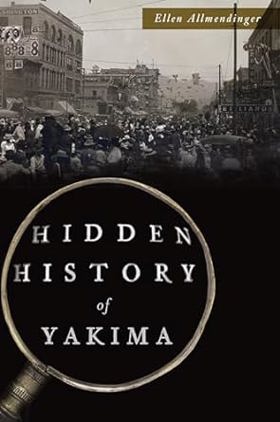
"Forgotten events, buildings, businesses and people helped shape Yakima. Vice dominated the city's early landscape when it was called North Yakima. Gambling halls and saloons like the Alfalfa Saloon bustled, while hotels such as the Sydney and Empire offered respite. Primitive circuses, underground tunnels, South Front Street opium dens and the arrival of a crossdresser named Nell Pickerell created further strife. City hall's understaffed police force and overcrowded jail complicated matters. Fires in 1890 and 1907 consumed several of the early structures--sometimes twice--keeping firefighters frayed. The Asian community thrived despite racial tensions until the forced evacuation of Japanese residents in 1942. Author Ellen Allmendinger uncovers what remains overlooked and veiled from sight." -- Amazon.com viewed May 15, 2020 126 pages : illustrations ; 23 cm. CIRC [ 1 ]
|
2018 |
|
George Washington of Centralia how the pioneering son of a slave crossed the continent, founded a town, and saved it during its darkest hours by Brian Mittge, Kerry MacGregor Serl 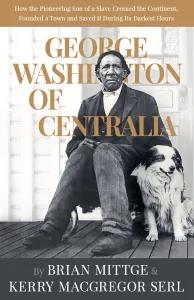
Although George Washington has been in the public eye since facing a racially-charged court case in the 1840s and a quick vote of support by the Missouri Legislature, his full life’s story has never been completely told — until now. Local historians Brian Mittge and Kerry MacGregor Serl have pulled together public documents, little-known archival materials and oral histories into a 200-page story that reads like the full history of the 19th century. From slavery to the frontier, from the Oregon Trail to the Pacific Northwest, this is a story that is sweeping in its scope but human to its core. You’ll read about the ways that George Washington nurtured ties during a time of division, creating unity in the community he created and sustaining his neighbors through the depth of dire economic depression. xviii, 198 pages : illustrations, maps ; 23 cm CIRC [ 1 ]
|
2018 |
|
Nowhere to remember Hanford, White Bluffs, and Richland to 1943 by Robert Bauman (Editor of compilation), Robert Franklin (Editor of compilation) 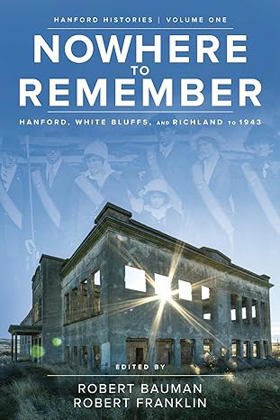
Euro-American Priest River Valley settlers turned acres of sagebrush into fruit orchards. Although farm life required hard work and modern conveniences were often spare, many former residents remember idyllic, close-knit communities where neighbors helped neighbors. Then, in 1943, families received forced evacuation notices. "Fruit farmers had to leave their crops on their trees. And that was very hard on them, no future, no money...they moved wherever they could get a place to live," Catherine Finley recalled. Some were given just thirty days, and Manhattan Project restrictions meant they could not return. Drawn from Hanford History Project personal narratives, Nowhere to Remember highlights life in Hanford, White Bluffs, and Richland--three small agricultural communities in eastern Washington's mid-Columbia region. It covers their late 1800s to early 1900s origins, settlement and development, the arrival of irrigation, dependence on railroads, Great Depression struggles, and finally, their unique experiences in the early years of World War II. David W. Harvey examines the impact of wagon trade, steamships, and railroads, grounding local history within the context of American West history. Robert Franklin details the tight bonds between early residents as they labored to transform scrubland into an agricultural Eden. Laura Arata considers the early twentieth century experiences of women who lived and worked in the region. Robert Bauman utilizes oral histories to tell forced removal stories. Finally, Bauman and Franklin convey displaced occupants' reactions to their lost spaces and places of meaning--and explore ways they sought to honor their heritage. xvi,196 pages : illustrations, maps, portraits ; 23 cm CIRC [ 0 ]
|
2018 |
|
Painters of the Northwest Impressionism to Modernism, 1900-1930 by John E. Impert 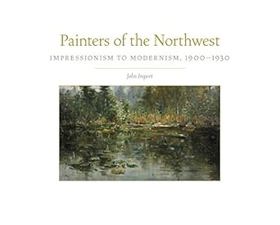
From its sweeping coastlines to its soaring inland mountains, verdant valleys, and volcanoes standing in splendid isolation, the Pacific Northwest has long inspired artists to capture the unique spirit of its varied landscape. Yet the early years of twentieth-century Pacific Northwest painting remain shrouded in mystery. In this groundbreaking work, John Impert introduces readers to the rich and varied array of artists and works of art that defined the region's artistic transition from a nature-bound impressionism to the arrival of modernism. Focusing on nine artists--Paul Morgan Gustin, C. C. McKim, Clyde Keller, J. Edgar Forkner, Clara Jane Stephens, Dorothy Dolph Jensen, Eustace Paul Ziegler, Mark Tobey, and C. S. Price--art historian John Impert organizes his work around the landscapes, people, and city scenes they painted. He identifies the influence of impressionism, in particular the singular way in which each artist's biography, style, and iconography contribute to a distinctive northwestern sensibility. Painters of the Northwest shows us for the first time how a spectacular natural environment, one that conformed aesthetically to nineteenth-century ideals of romanticism and transcendental reverence, combined with an emphasis on subject over style to create a body of work far more concerned with the natural environment than with the socioeconomic issues that occupied city-bound artists of the day. Establishing a chronology, history, and art historical canon for this little-studied place and time, this book is a long-overdue foundational history of early twentieth-century painting in the Pacific Northwest.--Google Books xi, 208 pages : illustrations (chiefly color) ; 23 x 28 cm CIRC [ 0 ]
|
2018 |
|
Canadian Pacific Railway on the Revelstoke Division by Douglas R. Mayer 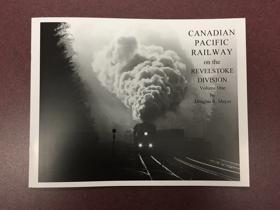
The volumes contain photographs of the Canadian Pacific Railway along the Revelstoke region. They include photographs from the Revelstoke Railway Museum as well as the author's own volumes : illustrations, maps ; 22 x 28 cm CIRC [ 0 ]
|
2018 |
|
On the line a history of the British Columbia Labour Movement by Rod Mickleburgh 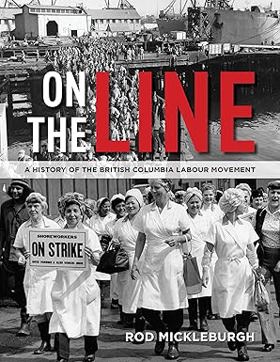
The BC tradition of fighting back against unfair pay and unsafe working conditions has been around since before the colony joined Confederation. In 1849 Scottish labourers at BC’s first coal mine at Fort Rupert went on strike to protest wretched working conditions, and it’s been a wild ride ever since. For years the BC labour movement was the most militant in the land, led by colourful characters like Ginger Goodwin, murdered for his pains, and pull-no-punches communist Harvey Murphy, who brought the house of labour down on himself with his infamous “underwear speech.” Through years of battles with BC’s power elite and small victories followed by bitter defeats, BC unions established the five-day work week, the eight-hour day, paid holidays, the right to a safe, non-discriminatory workplace and many more taken-for-granted features of the modern work landscape. But unions’ enemies never sleep and, well into the second decade of the twenty-first century, battles still go on, like that of BC teachers in their long and ultimately successful struggle to improve classroom conditions. On the Line also highlights the role played by women, Indigenous and minority workers in working toward equality and democracy in workplaces and communities. In prose that is both accessible and engaging, accompanied by over two hundred archival photos, Mickleburgh tells the important story of how BC’s labour organizations have shaped the economic, political and social fabric of the province―at a cost of much blood, sweat, toil and tears. This volume is the most comprehensive overview of labour’s struggle in BC and will be of particular interest to union members, community activists, academics and readers of regional history. xii, 300 pages : illustrations ; 29 cm CIRC [ 0 ]
|
2018 |
|
Journeys of hope challenging discrimination and building on Vancouver Chinatown's legacies by author: Henry Yu ; editors: Sarah Ling, Szu Shen, Baldwin Wong ; translator: Szu Shen = 希望之旅 : 挑戰歧視及傳承溫哥華唐人街的歷史文化遺產 / 作者, 余全毅 ; 編輯, 凌慧意, 沈思, 黃永安 ; 翻譯, 沈思., Henry Yu / author: Henry Yu ; editors: Sarah Ling, Szu Shen, Baldwin Wong ; translator: Szu Shen = Xi wang zhi lu : tiao zhan qi shi yi chuan c 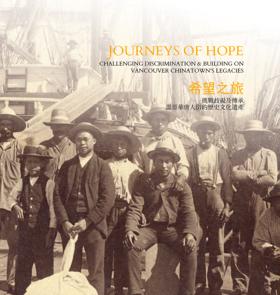
Created through a continued partnership between the City of Vancouver and the University of British Columbia, this book is an indication of both partners’ commitments to collaboratively plan and develop a UNESCO World Heritage Status application for Vancouver’s Chinatown. This edition builds on the commemorative version unveiled at the Vancouver City Council’s special meeting in Chinatown on April 22, 2018, capturing the historical moment when the City formally apologized for its past involvement in the discrimination and racism against early Chinese Canadian immigrants and their families. Chinese migrants arrived in what is now known as Canada as early as 1788. Their contributions were often forgotten as part of a long history of racism and discrimination in Canada. Journeys of Hope: Challenging Discrimination and Building on Vancouver Chinatown’s Legacies captures the story of how early Chinese migrants helped transform societies around the world, and how Vancouver’s Chinatown and other Chinatowns throughout Canada and the Pacific region are the living legacies of that transformation. Written in both English and Chinese, Journeys of Hope reaffirms the importance of multilingual engagement in community building, outreach, and education. Authored by Henry Yu and co-edited by Sarah Ling, Baldwin Wong and Szu Shen. 87 pages : illustrations (some color) ; 21 cm CIRC [ 0 ]
|
2018 |
|
Don't never tell nobody nothin' no how the real story of West Coast rum running by Rick James 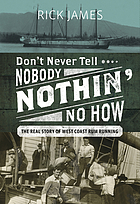
'"We operated perfectly legally. We considered ourselves philanthropists! We supplied good liquor to poor thirsty Americans ... and brought prosperity back to the Harbour of Vancouver ..." Captain Charles Hudson At the stroke of one minute past midnight, January 17, 1920, the National Prohibition Act was officially declared in effect in the United States. From 1920 to 1933 the manufacture, sale, importation and transportation of alcohol and, of course, the imbibing of such products, was illegal. Prohibition was already a bust in Canada and it wasn't long before fleets of vessels, from weather-beaten old fish boats to large ocean-going steamers, began filling their holds with liquor to deliver their much-valued cargo to their thirsty neighbours to the south. Contrary to popular perception, rum-running along the Pacific coast wasn't dominated by violent encounters like those portrayed in the movies. Instead, it was usually carried out in a relatively civilized manner, with an oh-so-Canadian politeness on the British Columbian side. Most operated within the law. But there were indeed shootouts, hijackings and even a particularly gruesome murder associated with the business. Using first-hand accounts of old-time rum-runners, extensive research using primary and secondary documentation, and the often-sensational newspaper coverage of the day, Don't Never Tell Nobody Nothin' No How sets out to explain what really went down along the West Coast during the American "Noble Experiment."'-- Provided by publisher 312 pages : illustrations, maps ; 24 cm CIRC [ 0 ]
|
2018 |
|
The Spokane River by Paul J. Lindholdt 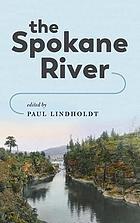
"From Lake Coeur d Alene to its confluence with the Columbia, the Spokane River travels 111 miles of varied and often spectacular terrain rural, urban, in places wild. The river has been a trading and gathering place for Native peoples for thousands of years. With bountiful trout, accessible swimming holes, and challenging rapids it is a recreational mecca for residents and tourists alike. The Spokane also bears the legacy of industrial growth and remains caught amid interests competing over natural resources."--Google books viewed Jan. 14, 2021 1 online resource (283 pages) CIRC [ 0 ]
|
2018 |
|
Settlers as conquerors free land policy in Antebellum America by Julius Wilm , German Historical Institute (Washington, D.C.) 
In early America, the notion that settlers ought to receive undeveloped land for free was enormously popular among the rural poor and social reformers. Well into the Jacksonian era, however, Congress considered the demand fiscally and economically irresponsible. Increasingly, this led proponents to cast the idea as a military matter: Land grantees would supplant troops in the efforts to take the continent over from Indian nations and rival colonial powers. Julius Wilm's book examines the free land debates of the 1790s to 1850s and reconstructs the settlement experiences under the donation laws for Florida (1842) and the Oregon Territory (1850). Both laws promised to bring the interests of poorer whites and their government into a more harmonious relation - to the exclusion of African Americans and for the explicit purpose of displacing Native peoples. Drawing on new records, Wilm details the trajectory of settlements and shows how the settler-imperialist experiments fell apart and undermined the rationale of the donation laws. After home seekers fled Florida due to malaria and militias in Oregon triggered uncontrollable violence, settlers came to be seen as unreliable agents of government aims. "This is the single most detailed exploration of free land in antebellum America. Wilm does a marvelous job exploring the limits of settler colonialism as a framework for settlement in Florida, where it failed. For the case of Oregon, he shows that settler occupation was appealing to federal legislators because it would 'substitute the ax, the plow, and the hoe, for the gun, the sword, and the bayonet.' That the government knowingly held out a promise of free land in order to encourage squatter sovereignty is a most compelling argument." Amy S. Greenberg, Pennsylvania State University "This is a skillful study of American proposals for the distribution of free public lands that predated the Homestead Act of 1862. Tracing discussions of land policy in Congress, distribution schemes in Arkansas, Florida, and Oregon, and the actual consequences of these schemes on the ground, Settlers as Conquerors offers both political and social history, showing how 'free land' shaped Indian Removal, settler colonialism, and race in the antebellum American West." Christopher Clark, University of Connecticut 284 pages : illustrations ; 24 cm. CIRC [ 0 ]
|
2018 |
|
Palouse rails Granger railroads of the inland Northwest by Thomas Hillebrant 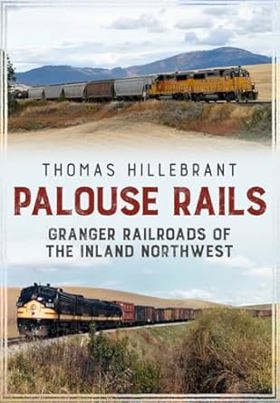
The Palouse region of Eastern Washington and North Idaho produces the highest yields of any wheat-growing district in North America, followed closely by farmlands in the adjoining Walla Walla and Camas Prairie regions. Early farmers clamored for railroads to carry their harvests to world markets, and soon a veritable spider's web of competing rail routes left few corners of the Inland Northwest untouched. Some lines also reached into nearby forests to haul timber to local sawmills and ship out finished lumber. As the principal transporter of people and goods prior to World War II, railroads served an integral role in the communities they served. Despite traffic losses to competing trucks and river barges, railroads still haul considerable grain and wood products tonnage on these lines today. Palouse Rails tells the stories of seven major railroads serving these regions, from their origins to the present day, through the eyes of contemporary railroad photographers. These images capture the railroad equipment, locations, personnel, and operations that, for generations, have connected Inland Northwest's agricultural regions with each other and with the world. 180 pages, 12 unnumbered pages of plates : illustrations (some color) ; 25 cm CIRC [ 0 ]
|
2018 |
|
21 Things You May Not Know about the Indian Act Helping Canadians Make Reconciliation with Indigenous Peoples a Reality by Bob Joseph 
Since its creation in 1876, the Indian Act has dictated and constrained the lives and opportunities of Indigenous Peoples, and is at the root of many enduring stereotypes. Bob Joseph's book comes at a key time in the reconciliation process, when awareness from both Indigenous and non-Indigenous communities is at a crescendo. Joseph examines how Indigenous Peoples can return to self-government, self-determination, and self-reliance and why doing so would result in a better country for every Canadian. He dissects the complex issues around the Indian Act, and demonstrates why learning about its cruel and irrevocable legacy is vital for the country to move toward true reconciliation. Bob Joseph, founder of Indigenous Corporate Training Inc., has provided training on Indigenous relations since 1994. As a certified Master Trainer, Bob has assisted both individuals and organizations in building Indigenous relations. His Canadian clients include all levels of government, Fortune 500 companies, financial institutions, including the World Bank, small and medium-sized corporate enterprises, and Indigenous Peoples. He has worked internationally for clients in the United States, Guatemala, Peru, and New Caledonia in the South Pacific. Bob Joseph is an Indigenous person, or more specifically a status Indian, and is a member of the Gwawaenuk Nation. The Gwawaenuk is one of the many Kwakwaka'wakw tribes located between Comox and Port Hardy on Vancouver Island and the adjacent mainland of British Columbia. He comes from a proud potlatch family and is an initiated member of the Hamatsa Society. As the son of a hereditary chief, he will one day, in accordance with strict cultural laws, become a hereditary chief. Advance praise: "I have a deep hope for Canada that there can be reconciliation. I want every Canadian to imagine a Canada in which every person will live with dignity, value, and purpose. But to do that, there must be reflection on our shared history and the harmful periods and events that continue to haunt us as a nation. Understanding the Indian Act is fundamental to understanding why those harmful periods and events took place. Bob Joseph's book is an invaluable tool for Canadians who want to understand the past in order to contribute to reconciliation in our country." ?Chief Dr. Robert Joseph, O.B.C., Ambassador, Reconciliation Canada "From declaring cultural ceremonies illegal, to prohibiting pool hall owners from granting Indigenous Peoples entrance, from forbidding the speaking of Indigenous languages, to the devastating policy that created residential schools, Bob Joseph reveals the hold this paternalistic act, with its roots in the 1800s, still has on the lives of Indigenous Peoples in Canada in the twenty-first century. This straightforward book is an invaluable resource. There is much for non-Indigenous people to learn and to do. But equally important, there is much to unlearn and to undo. The time is right for this book. Thank you, Bob Joseph. Gilakas'la." Shelagh Rogers, O.C., Truth and Reconciliation Commission of Canada "Increasing Canadians' knowledge about the terrible foundation this country has been built on is a critical part of reconciliation. Bob Joseph has highlighted some of the unbelievable provisions of the Indian Act and how they have impacted First Nations in Canada, and gives a brief overview of what we may replace it with going forward. His book provides helpful context to the dialogue that needs to take place in Canada." ?Kim Baird, O.C., O.B.C.; Owner, Kim Baird Strategic Consulting; Member of the Tsawwassen First Nation 160 pages CIRC [ 0 ]
|
2018 |
|
Explore the Salish Sea a nature guide for kids by Joseph K. Gaydos , Audrey D. Benedict 
The SeaDoc Society has published a book for the next generation. Filled with beautiful photography and engaging stories, Explore the Salish Sea: A Nature Guide for Kids inspires children to explore the unique marine ecosystem that encompasses the coastal waters from Seattle’s Puget Sound up to the Strait of Juan de Fuca and the Georgia Strait of British Columbia. Discover the Salish Sea and learn about its vibrant ecosystem in this engaging non-fiction narrative that inspires outdoor exploration. Filled with full-color photography, this book covers wildlife habitats, geodiversity, intertidal and subtidal sea life, and highlights what is unique to this Pacific Northwest ecosystem. The book was written by SeaDoc Science Director Joe Gaydos and board member Audrey Benedict.Puget Sound up to the Strait of Juan de Fuca and the Georgia Strait of British Columbia. Discover the Salish Sea and learn about its vibrant ecosystem in this engaging non-fiction narrative that inspires outdoor exploration. Filled with full-color photography, this book covers wildlife habitats, geodiversity, intertidal and subtidal sea life, and highlights what is unique to this Pacific Northwest ecosystem"-- Provided by publisher ix, 53 pages : color illustrations, color map ; 23 x 29 cm CIRC [ 0 ]
|
2018 |
|
Indian fishing early methods on the Northwest Coast by Hilary Stewart 
First published in 1977 and unavailable for several years, Indian Fishing is more than a sterile account of the technology of fishing; it considers the momentous role of fish and fishing in the lives of the Northwest Coast peoples. A classic, thoroughly researched and informative text, it examines fishing techniques of the peoples who have lived on the coast for over nine thousand years, revealing their rich and complex culture. Hilary Stewart gathered material from museum archives, fish camps, and coastal village elders to document the Native heritage of handmade hooks, lines, sinkers, lures, floats, clubs, spears, harpoons, nets, traps, rakes, gaffs, and more. With more than 300 clear and detailed drawings, she illustrated how these tools were made and used. She twisted cedar bark and nettle fibers into cod fishing lines, and steam-bent a stem of yew into a halibut hook. Here, reprinted in full, is her original work, covering everything from how the catch was butchered, cooked, and preserved, to the prayers and ceremonies in gratitude to the fish, as well as customs and taboos that demonstrated the peoples' respect for this life-giving resource. Though there have been transformations in knowledge and scholarship since its first publication, Stewart's benchmark work, with its usefulness, artistry, and appreciation of Native culture, will be welcomed back into print. 181 pages : illustrations, map, portraits ; 26cm CIRC [ 0 ]
|
2018 |
|
Governing Oregon continuity and change by Richard A. Clucas , Mark Henkels , Priscilla L. Southwell , Edward P. Weber 
At the end of the twentieth century, the state government of Oregon was routinely entangled in intense partisan conflict, with opposing sides waging bitter battles in elections, the legislature, and the courts. Many of the most important state laws—such as Measure 5, which capped property taxes—were decided through the initiative process rather than by lawmakers in Salem. As the twenty-first century began, this political dynamic began to shift. Partisan conflict in the capitol grew less rancorous, legislative gridlock eased, and ballot initiatives lost their central role in defining Oregon politics. Less visible changes reshaped issues from agricultural policy to tribal government. This shifting dynamic coincided with significant transformations in Oregon’s economy and cultural life. The state’s economy sustained severe blows twice in the early 2000s, but by 2014, Oregon boasted one of the fastest-growing economies in the nation. Along with economic expansion, Oregon’s population grew in both size and diversity. Despite these powerful forces of change, other aspects of Oregon political life remained entrenched, including the deep urban-rural divide and the state’s problematic fiscal system. With contributions from twenty-seven leading experts and political insiders, Governing Oregon: Continuity and Change offers insight into the people, political practices, governing institutions, and public policies of Oregon. It will be of tremendous value to political scientists, public servants, and engaged citizens alike. xii, 372 pages : illustrations, maps ; 23 cm CIRC [ 0 ]
|
2018 |
|
Grit and ink an Oregon family's adventures in newspapering, 1908-2018 by William F. Willingham 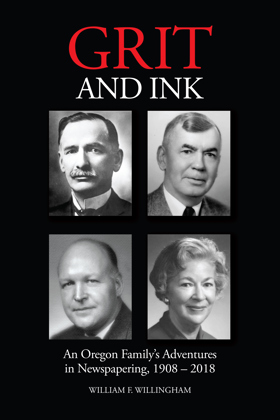
"Beneath the 24/7 national news cycle and argument over "fake news," there is a layer of journalism that communities absolutely depend upon. Grit and Ink offers a rare look inside the financial struggles and family dynamic that has kept a Pacific Northwest publishing group alive for more than a century. The newspapers of the Aldrich-Forrester-Bedford-Brown family depict the histories of towns like Pendleton, Astoria, John Day, Enterprise, and Long Beach, Washington. Written by noted historian William Willingham, Grit and Ink describes threats presented by the Ku Klux Klan, the Great Astoria Fire of 1923, the Great Depression, the Aryan Nation, the Malheur National Wildlife Refuge occupation, the Digital Revolution, and more." 218 pages : illustrations (some color), maps ; 23 cm CIRC [ 0 ]
|
2018 |
|
Power in the telling Grand Ronde, Warm Springs, and intertribal relations in the casino era by Brook Colley , David G. Lewis 
From 1998 through 2013, the Confederated Tribes of Warm Springs sought to develop a casino in Cascade Locks, Oregon. This prompted objections from the Confederated Tribes of Grand Ronde, who already operated a lucrative casino in the region. Brook Colley’s in-depth case study unravels the history of this disagreement and challenges the way conventional media characterizes intertribal casino disputes in terms of corruption and greed. Instead, she locates these conflicts within historical, social, and political contexts of colonization. Through extensive interviews, Colley brings to the forefront Indigenous perspectives on intertribal conflict related to tribal gaming. She reveals how casino economies affect the relationship between gaming tribes and federal and state governments, and the repercussions for the tribes themselves. Ultimately, Colley’s engaging examination explores strategies for reconciliation and cooperation, emphasizing narratives of resilience and tribal sovereignty. xx, 203 pages : illustration, maps ; 23 cm CIRC [ 0 ]
|
2018 |
|
The flora and fauna of the Pacific Northwest coast by Collin Varner 
The Flora and Fauna of the Pacific Northwest Coast is an extensive, easy-to-follow resource guide to the plant and animal life of the vast and diverse bioregion stretching from Juneau, Alaska, south to coastal British Columbia, Washington, Oregon, down to California's San Francisco Bay. Encompassing over eight hundred native and invasive species, and including more than two thousand colour photos, this is the most complete book of its kind on the market. The book is divided into flora and fauna, with detailed subsections for flowering plants, berries, ferns, shrubs and bushes, trees, fungi, birds, mammals, amphibians, reptiles, and insects. Each species (identified by common and scientific name) is illustrated by clear photography and a concise description of its appearance, biology, and habitat, as well as its traditional use and medicinal properties (where applicable). The book also contains detailed maps, a glossary, and a complete index of species 461 pages : color illustrations, color map ; 26 cm CIRC [ 0 ]
|
2018 |
|
Sun, shadows, stone the photography of Terry Toedtemeier by Terry Toedtemeier (Photographer), Julia Dolan , Tacoma Art Museum 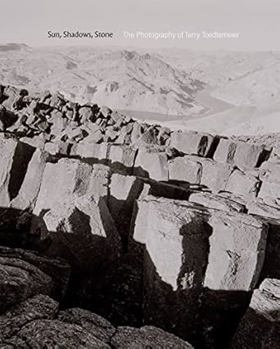
Photographer and curator Terry Toedtemeier (1947–2008) began his career in the 1970s with extensive photographic experiments to capture his close circle of friends and colleagues. Largely self-taught, he began to attract wider critical attention with his landscape images, initially snapshots from his moving car and later exquisite compositions influenced by his deep understanding of both historical and contemporary photography traditions of the American West. His haunting photographs often focused on the Oregon desert and coastline, and magnificent basalt formations of the Pacific Northwest. Sun, Shadows, Stone is the first scholarly monograph of the photography of Terry Toedtemeier. His photographs were featured in the nationally traveling exhibition Framing the West: The Survey Photographs of Timothy H. O’Sullivan and are in the collections of many museums including the Museum of Fine Arts in Houston, the Philadelphia Art Museum, and the San Francisco Museum of Modern Art. 134 pages : illustrations (some color) ; 27 cm CIRC [ 0 ]
|
2018 |
|
Wheat country railroad the Northern Pacific's Spokane & Palouse and competitors by Phil Beach 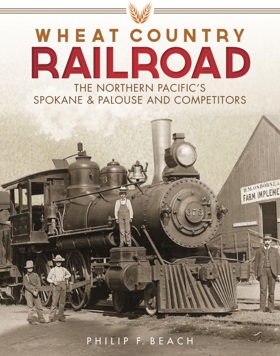
"A detailed history and reference work concerning railroads south of Spokane, Washington, and north of the Snake River."--Provided by publisher xviii, 349 pages : illustrations, maps ; 29 cm CIRC [ 0 ]
|
2018 |