Catalog of British Columbiana and Pacific Northwest Americana
Encyclopedia Cascadia Catalog contains book titles of mostly non-fiction Pacific Northwest Coast of North America Titles (primarially British Columbia, Idaho, Oregon and Washington State) in an easy-to-understand title catalog. If you see a link with this badge ONLINE CIRC it means that there is an online institution that provides free access to that title. In some cases there may be more than one institution hosting the title digitally.
| Catalog Title | Published |
|---|---|
|
Oregon's names, how to say them and where are they located? an illustrated pronunciation guide by Bert Webber 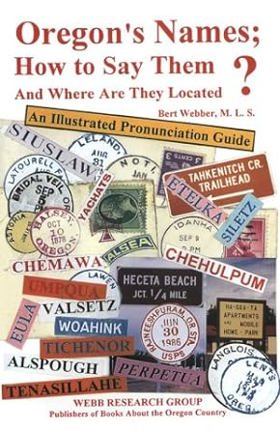
Authored by regional writer Bert Webber, Oregon's Names, How to Say Them and Where Are They Located? serves as a practical, illustrated guide designed to help travelers and newcomers correctly pronounce and locate the state's diverse geographic and town names. The book tackles the tricky indigenous, French, and pioneer phonetic quirks embedded across Oregon's map, stripping away common mispronunciations that easily betray an outsider. Through clear entries and local historical context, the text acts as an accessible linguistic bridge across the state's varied cultural landscapes. A keen insight drawn from the work is how regional place-name pronunciations function as an unwritten local citizenship test; by preserving the idiosyncratic local dialects of names like Willamette or Umatilla, the guide highlights how mastering native and pioneer linguistics is the ultimate tool for claiming authentic belonging in an adopted home. 109 pages : illustrations, maps ; 22 cm CIRC [ 1 ]
|
1995 |
|
Ashland, an Oregon oasis an Oregon documentary by Janelle Davidson, Bert Webber 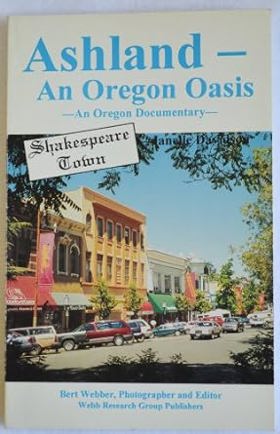
Authored by Janelle Davidson and Bert Webber, Ashland, an Oregon Oasis: An Oregon Documentary chronicles the development of the southern Oregon town from a pioneer milling settlement into a vibrant cultural haven renowned for its natural mineral springs and the Oregon Shakespeare Festival. The book weaves together historical photographs, local archives, and narrative documents to trace how the community leveraged its unique natural geography and artistic ambitions to survive economic shifts. Through these collected records, the text captures the deliberate transformation of a remote Rogue Valley stopover into a thriving destination for travelers and intellectuals alike. A keen insight drawn from the work is how intentional cultural institutions can insulate a regional economy from resource dependency; by pivoting from local timber and agriculture toward world-class theater and holistic tourism, Ashland demonstrated that remote communities can engineer their own prosperity by transforming local geographic assets into an internationally recognized cultural brand. 160 pages : illustrations, maps ; 22 cm CIRC [ 1 ]
|
1995 |
|
Just east of sundown the Queen Charlotte Islands by Charles Lillard 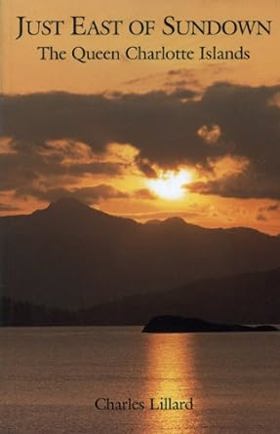
"The Queen Charlotte Islands have always been a half-legendary land of mists and mystery, set off and seemingly different from the rest of the coast. Human occuption goes back some 9,000 years, with intriguing hints of a people there before the Haida. Although the islands were "discovered" by Juan Perez, a Spaniard, in 1774, records indicate that voyagers from Asia had arrived much earlier. This is a story of people - Edenshaw, Weah, Davidson, Dawson, Collison and others - from Haida chiefs and carvers to European explorers and settlers xii, 180 pages : illustrations, map ; 22 cm CIRC [ 1 ]
|
1995 |
|
The Great Columbia Plain a historical geography, 1805-1910 by D. W. Meinig 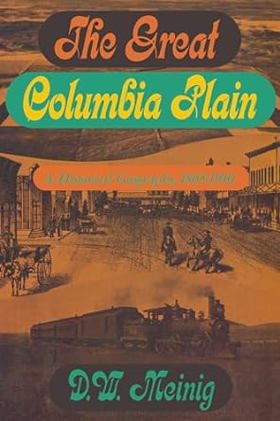
Dismissed in early years as a wasteland, the rolling open country that covers the interior parts of Washington, Oregon, and Idaho is today one of the richest farmlands in the nation. This work is the story of its transformation. Meinig traces all of the aspects of its development by combining geographic description with historical narrative xxiv, 576 pages, [1] folded leaf : illustrations, maps ; 24 cm. CIRC [ 1 ]
|
1995 |
|
There is only one Enumclaw pioneer history and early years by Louise Ross Poppleton 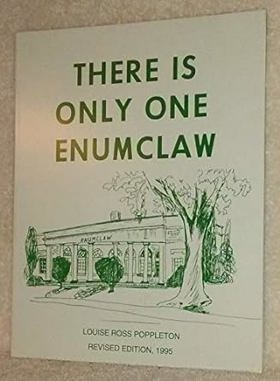
Authored by local historian Louise Ross Poppleton, There Is Only One Enumclaw: Pioneer History and Early Years chronicles the establishment and agricultural development of the plateau community nestled beneath Mount Rainier in western Washington. The book draws on early homestead records, family journals, and vintage photographs to trace how rugged pioneers cleared dense timberlands to build dairy farms and small-town institutions at the gateway to the Cascades. Through these localized archives, the text preserves the grit and mutual dependence required to tame a damp, heavily forested frontier. A keen insight drawn from the work is how geographical positioning at the foot of a major mountain pass shaped the town's unique identity; by acting as the mandatory staging ground for travelers and resource extraction moving into the high country, Enumclaw forged an enduring commercial resilience rooted entirely in its role as a transitional hub between wilderness and civilization. v, 123 pages : illustrations, maps ; 28 cm CIRC [ 1 ]
|
1995 |
|
Wapato heritage the history of the Chelan and Entiat Indians by Tom Hackenmiller 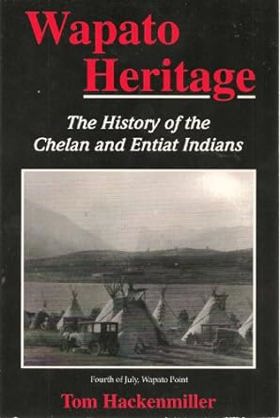
Authored by historian Tom Hackenmiller, Wapato Heritage: The History of the Chelan and Entiat Indians documents the traditional lifeways, displacement, and survival of Indigenous bands native to the dramatic river valleys and lake shores of north-central Washington. The book draws on oral histories, government documents, and ethnographic records to trace how native communities harvested abundant wapato roots and salmon runs before facing rapid encroachment by Euro-American miners, orchardists, and homesteaders. Through these documented accounts, the text chronicles the severe pressures of forced reservation confinement and the systematic erasure of native geography along the Columbia River watershed. A keen insight drawn from the work is how botanical and food-gathering sites served as the true geopolitical anchors of Indigenous sovereignty; by documenting how the loss of specific seasonal root-digging grounds like wapato beds dismantled native self-sufficiency far more effectively than military defeat, the book reveals that colonial land dispossession was fundamentally an assault on a people's nutritional and ecological autonomy. 187 pages : illustrations, maps ; 23 cm CIRC [ 1 ]
|
1995 |
|
Guide to Northeast Oregon by Robert H. Dreisbach 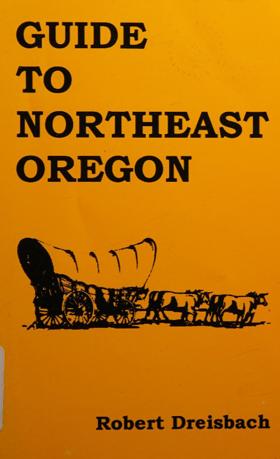
Authored by regional writer Robert H. Dreisbach, Guide to Northeast Oregon provides a comprehensive travel companion and historical handbook exploring the rugged canyons, high desert plateaus, and forgotten mining towns of Oregon's Blue Mountains and Wallowa country. The book details backroad itineraries, local geological anomalies, and the fascinating remnants of frontier settlement scattered across the state's most isolated eastern terrain. Through precise route descriptions and historical context, the text encourages travelers to look past the damp Willamette Valley to discover a radically different, arid landscape defined by deep gorges and pioneer grit. A keen insight drawn from the work is how regional geography directly dictates historical consciousness; by guiding modern explorers through a landscape shaped by ancient basalt flows and grueling wagon trails, the book illustrates how northeastern Oregon's vast, unforgiving topography has preserved a sense of frontier time that more densely populated urban centers have long since paved over. 156 pages ; 22 cm CIRC [ 1 ]
|
1995 |
|
The pioneers of Lake View a guide to Seattle's early settlers and their cemetery by Robert L. Ferguson 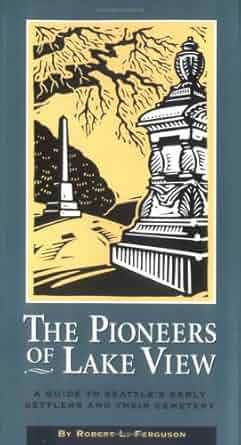
Authored by regional historian Robert L. Ferguson, The Pioneers of Lake View: A Guide to Seattle's Early Founders and Their Cemetery provides a compelling biographical and historical tour of Lake View Cemetery, the final resting place for many of the Emerald City's most prominent 19th-century figures. The book connects the physical monuments and headstones to the turbulent lives of the lumber barons, politicians, and ordinary settlers who laid the foundational infrastructure of frontier Seattle. Through meticulous research into pioneer genealogies, the text unearths the personal triumphs and tragedies hidden beneath manicured urban turf. A keen insight drawn from the work is how historic urban cemeteries function as subterranean archives of class stratification and civic myth-making; by examining who was granted prominent burial plots versus who was relegated to unmarked ground, the book reveals how city founders carefully engineered their own posthumous legacies to sanitize the brutal corporate ruthlessness of early Pacific Northwest capitalism. 119 pages : illustrations ; 20 cm CIRC [ 1 ]
|
1995 |
|
Fool's hill a kid's life in an Oregon coastal town by John Quick 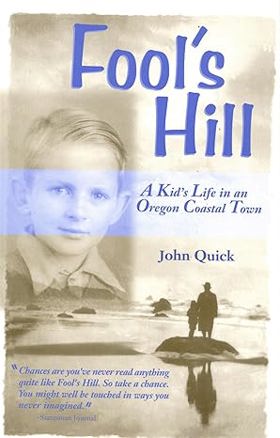
Port Orford, Oregon, in the 1930s and 40's. Here a curious, blabbermouth boy learns more at the bottom of a ditch than in kindergarten and finds real home in a booth at Red's Bar holding hands with Dorothy, who he is never supposed to talk to. With a little help from his friends, young Johnny learns about life and death and sex and Indians. And, with his help, we remember what it is to be a kid viii, 304 pages : illustrations ; 24 cm CIRC [ 0 ]
|
1995 |
|
Cohassett Beach chronicles World War II in the Pacific Northwest by Kathy Hogan, Klancy Clark De Nevers, Lucy Hart 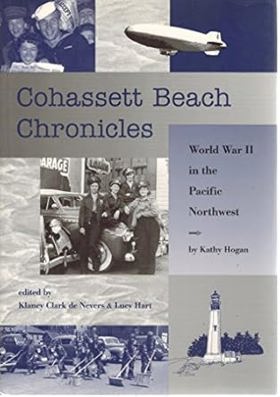
In 1940, the Grays Harbor Post in Aberdeen, Washington, introduced its readers to "The Kitchen Critic," a new column chronicling life in nearby Cohassett Beach. Within a year the U.S. was at war, and columnist Kathy Hogan's weekly dispatches turned to soldiers, rationing, and the barbed wire that lined the sand dunes around her weathered cottage. 50 years later, Kathy Hogan's writings provide a window onto how one Pacific Northwest community responded to World War II. Cohassett Beach Chronicles, a collection of Hogan's columns from the war years, offers a remarkable social history of the war at home. The attack on Pearl Harbor brought U.S. troops to Cohassett Beach and to towns up and down the West Coast. With wit and perception, Hogan writes of civilians valiantly coping with this friendly occupation and wartime scarcity. Her neighbors — loggers, commercial fishermen, Finnish cranberry farmers — learn to live with blackouts, blimps, and a ban on beachcombing. Hogan's weekly descriptions of life on the home front capture America's wartime mood. Together, her columns document the war's tremendous impact at home, from the internment of Japanese Americans and the spread of government regulations to the changing role of women. They also reveal that in spite of the war effort life, in many ways, continued as it always had. There was still time to pick blackberries, gossip at the local tavern, and attend the occasional Friday night dance. As children, the editors spent summers in the Cohassett Beach cottages that still, in the late 1940s, bore scars of the Army's occupation. xxx, 290 pages : illustrations, maps ; 27 cm CIRC [ 0 ]
|
1995 |
|
Reptiles of Washington and Oregon by Herbert A. Brown, Robert M. Storm, William P. Leonard, Seattle Audubon Society 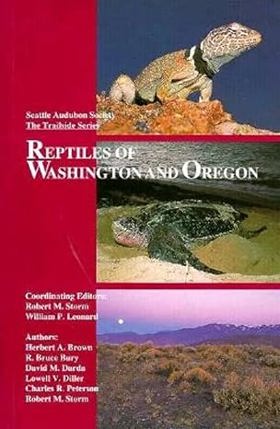
"A guide to turtles, lizards, and snakes. Each species entry includes: description, distribution, ranges, habits, comparison to similar species, and remarks regarding the uniqueness of the species. Also the only field guide to cover all marine and freshwater turtles in the region" --back cover viii, 176 pages : illustrations (chiefly color), maps ; 22 cm. CIRC [ 0 ]
|
1995 |
|
Forest dreams, forest nightmares the paradox of old growth in the Inland West by Nancy Langston 
Across the inland West, forests that once seemed like paradise have turned into an ecological nightmare. Fires, insect epidemics, and disease now threaten millions of acres of once-bountiful forests. Yet no one can agree what went wrong. Was it too much management—or not enough—that forced the forests of the inland West to the verge of collapse? Is the solution more logging, or no logging at all? In this gripping work of scientific and historical detection, Nancy Langston unravels the disturbing history of what went wrong with the western forests, despite the best intentions of those involved. Focusing on the Blue Mountains of northeastern Oregon and southeastern Washington, she explores how the complex landscapes that so impressed settlers in the nineteenth century became an ecological disaster in the late twentieth. Federal foresters, intent on using their scientific training to stop exploitation and waste, suppressed light fires in the ponderosa pinelands. Hoping to save the forests, they could not foresee that their policies would instead destroy what they loved. When light fires were kept out, a series of ecological changes began. Firs grew thickly in forests once dominated by ponderosa pines, and when droughts hit, those firs succumbed to insects, diseases, and eventually catastrophic fires. Nancy Langston combines remarkable skills as both scientist and writer of history to tell this story. Her ability to understand and bring to life the complex biological processes of the forest is matched by her grasp of the human forces at work—from Indians, white settlers, missionaries, fur trappers, cattle ranchers, sheep herders, and railroad builders to timber industry and federal forestry managers. The book will be of interest to a wide audience of environmentalists, historians, ecologists, foresters, ranchers, and loggers—and all people who want to understand the changing lands of the West. xii, 368 pages : illustrations, maps ; 25 cm. CIRC [ 0 ]
|
1995 |
|
Sm'algyax a reference dictionary and grammar for the Coast Tsimshian language by John Asher Dunn 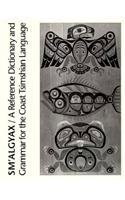
In the mid-1970s, Sm’algyax, the language of the Coast Tsimshian people, came under the protection of Canada’s Urgent Ethnology Programme, which commissioned a dictionary by linguist John Dunn. With the help of many Tsimshian consultants, Dunn completed the dictionary in 1978 and the first written grammar of the language in 1979. The dictionary quickly became the spelling authority for teachers, and together with the grammar has established a standard writing system for Sm’algyax that is in use throughout Alaska and British Columbia. This 1995 publication, with a new preface and revisions by John Dunn, brings these two classic works back into print in a single volume. part I-- “A Practical Dictionary of the Coast Tsimshian Language”--includes for each word a transcription, morphological information, English glosses, and phonetic transcriptions showing local variants of the entry. Part II-- “A Reverence Grammar for the Coast Tsimshian Language”-- is a nontechnical introduction to phonology, morphology, and syntax. It includes summaries showing the basic sentence types and their grammatical relationships. The new one-volume format of the dictionary and grammar will facilitate their use by teachers, students, and the Tsimshian community for years to come. xii, x, 145, xiii, 79 pages ; 28 cm CIRC [ 0 ]
|
1995 |
|
British Columbia a natural history by Richard J. Cannings, Sydney G. Cannings 
A comprehensive review of the physical and natural environments of the Province, written for interested laypersons, describing the natural history of BC by ecological region. Also discusses threatened ecosystems, climate change and introduced species 310 pages : illustrations (some color) ; 27 cm CIRC [ 1 ]
|
1996 |
|
Handbook of North American Indians Volume 17, Languages by Ives Goddard, William C. Sturtevant, Smithsonian Institution 
This volume is part of the Smithsonian Institution’s Handbook of North American Indians series, the ultimate resource for Native American history across various regions of North America. The set is intended to give an encyclopedic summary of what is know about the prehistory, history, and cultures of the aboriginal peoples of North America north of the urban civilizations of central Mexico. Volume 17 provides a basic reference work on the Native languages of North America, their characteristics and uses, their historical relationships, and the history of research on these languages. Contains copyrighted material. 10th volume to be published in a 20 volume set. xiii, 957 pages : illustrations, maps ; 29 cm CIRC [ 1 ]
|
1996 |
|
Roadside history of Idaho by Betty B. Derig 
The best way to enjoy Idaho's rich heritage is to visit the sites where history happened. Roadside History of Idaho makes you feel like you've got a native guide at hand as it transports you to those places through well-researched, well-told stories and vivid historical photographs xx, 362 pages : illustrations, maps ; 24 cm. CIRC [ 1 ]
|
1996 |
|
The interwoven lives of George Vancouver, Archibald Menzies, Joseph Whidbey, and Peter Puget exploring the Pacific Northwest Coast by John Michael Naish 
The Vancouver Voyage exemplifies the extraordinary upsurge in optimism and adventure in the last two decades of the 18th century. Four men were the lynch-pins of that enterprise and this volume examines their achievements and sufferings. It particularly examines the interplay and stress between the men, both physical and psychological, during the voyage. Evidence as to the nature of Vancouver's own chronic disease (which killed him in his 41st year) is presented, and his psychological state is analysed. The achievement of both Vancouver and Menzies in defeating scurvy during the voyage is described. Menzies' largely unpublished and voluminous journal provides the major source of information on the lands explored and the peoples encountered, and the work also contains original material about Whidbey's later life and relationships. Although unusual in format, this work seeks to illuminate the history of those times by applying a physician's eye to four outstanding representatives of an age of optimism. With nineteen photos and eight maps. 537 pages ; 24 cm. CIRC [ 1 ]
|
1996 |
|
A Traveler's History of Washington A Roadside Historical Guide by Bill Gulick 
What happened here? Travelers interested in history want to know about the history of the sites that they pass in the Evergreen State. Who but veteran author Bill Gulick could write the premier historical travel book on Washington? xxviii, 559 pages : illustrations, maps ; 23 cm CIRC [ 1 ]
|
1996 |
|
Northwest history articles from the Pacific Northwesterner Quarterly by Jerome Peltier 
Authored by regional historian Jerome Peltier, Northwest History Articles from the Pacific Northwesterner Quarterly compiles a diverse collection of scholarly essays exploring the colorful characters, military engagements, and economic milestones of the inland Pacific Northwest. The volume draws upon meticulous archival research to examine forgotten pioneer trails, early territorial politics, and the complex interactions between native populations and American settlers across Washington, Idaho, and Montana. Through these rigorously detailed historical vignettes, the text preserves the intricate texture of frontier life beyond the Cascade Mountains. A keen insight drawn from the work is how regional historical journals serve as vital repositories for the micro-histories that grand national narratives routinely overlook; by rescuing obscure local disputes and personal journals from archival obscurity, the collection demonstrates that the true fabric of westward expansion was woven from countless localized conflicts and compromises rather than sweeping political decrees. vxiii, 164 pages : illustrations ; 26 cm CIRC [ 1 ]
|
1996 |
|
Indian battles along the Rogue River, 1855-56 one of America's wild and scenic rivers by Frank K. Walsh 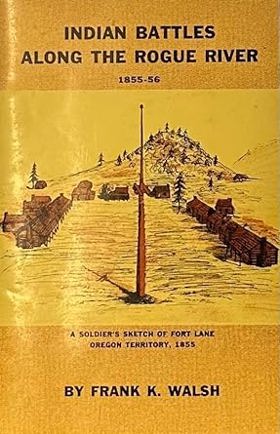
Authored by local historian Frank K. Walsh, Indian battles along the Rogue River, 1855-56: One of America's wild and scenic rivers details the violent armed conflict between regional indigenous bands and white miners and settlers during the height of the Oregon gold rush. The book combines historical accounts, maps, and archival photographs to chronicle the brutal military campaigns, displacement tactics, and fortified engagements that defined the Rogue River Indian War. Through a detailed chronology of the hostilities, the text illustrates the catastrophic human cost of rapid mineral exploitation and land seizure in southwest Oregon. A keen insight drawn from the work is how the romanticized iconography of wild western rivers deliberately obscures the bloody ethnic cleansing required to secure them; by contrasting the pristine, scenic beauty of the modern Rogue River with the suppressed history of the forced removal camps along its banks, the narrative exposes how modern recreational landscapes are frequently built directly over the hidden graves of frontier warfare. iv, 28 pages : illustrations, maps, portraits ; 22 cm CIRC [ 1 ]
|
1996 |
|
The faces of history Portraits of the men and women who shaped life in Boundary County, Idaho by Stan DeHart 
Authored by local historian Stan DeHart, The Faces of History: Portraits of the Men and Women Who Shaped Life in Boundary County, Idaho compiles a rich photographic and biographical archive of the pioneers, homesteaders, and laborers who carved a community out of the remote panhandle of northern Idaho. The book uses vintage portrait photography and detailed oral histories to resurrect the individual stories of those who braved isolation, harsh winters, and demanding resource industries near the Canadian border. Through these personal profiles, the text honors the human grit that transformed an untamed river valley into a permanent, functioning society. A keen insight drawn from the work is how frontier portraiture functioned as a deliberate act of civilizing permanence; by meticulously dressing up and sitting for traveling photographers, isolated homesteaders used visual self-representation to project dignity and social order onto an unforgiving wilderness that constantly threatened to swallow their hard-won achievements. Oversized paperback CIRC [ 0 ]
|
1996 |
|
Barns of the West a vanishing legacy by Arthur A. Hart 
Text and photos illustrate a variety of barn structures and styles, including hops drying barns. Barns photographed are in Montana, Idaho, Oregon, Washington, and Alaska 112 pages : chiefly illustrations (some color) ; 29 cm CIRC [ 0 ]
|
1996 |
|
So Incredibly Idaho! seven landscapes that define the gem state by Carlos A. Schwantes 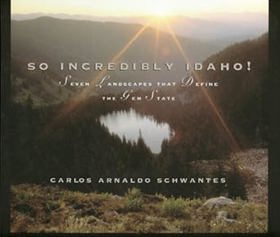
Using colorful images from his photographic collection, Carlos Schwantes describes the hidden forces and historical events that have impacted the landscape of Idaho. xxi, 146 pages : color illustrations, color maps ; 24 cm CIRC [ 0 ]
|
1996 |
|
Nez Perce women in transition, 1877-1990 by Caroline James 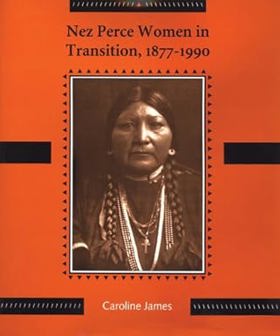
Traditionally Nez Perce Indian women have held important roles within the tribe. The women conducted vital, routine, day-in and day-out domestic chores as well as maintaining a strong influence in tribal community, culture, and tradition. As white encroachment on Nez Perce lands increased and the missionaries increased their influence, the lives of the Nez Perce changed dramatically. This volume is the first look into the lives and contributions of Nez Perce women as they struggled to maintain their families and communities in times of great change. Nez Perce Women in Transition includes unique individual accounts recorded directly from personal interviews with Nez Perce women ranging in age from twenty to ninety. The narratives, in combination with a broad selection of photographs, present some of the major historical, political, and cultural changes that have occurred and provide an opportunity to view Nez Perce women as they made and continue to make dramatic transitions xxix, 245 pages : illustrations, maps ; 27 cm CIRC [ 0 ]
|
1996 |
|
Sketching in the San Juans--and a bit beyond sketches, paintings, comments by Barbara M. Meyer 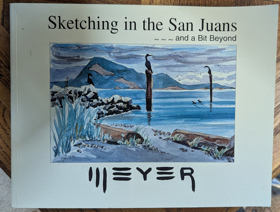
Hold on to your heart as you step into the world of Barbara Meyer's watercolor sketches. Immerse yourself in the tranquility and serenity of every brush stroke as she shares her keenness for empty, wind-swept beaches, new-mown hay and rough -wooded barns. Smile out loud at her humorous and ironic observations of those pesky island birds who insist on occupying every post and piling, especially if it says "No Trespassing". This collection, gently lifted from her sketchbooks, represents the unique observations of one woman's 25-year journey through the timeless space that is the San Juan Islands. Pick up this book as often as you wish, to find a new corner in which to visit and escape. Take a deep breath and inhale the atmosphere. By Barbara Meyer. 1996. Paper Jam Publishing 94 pages : illustrations (some color) ; 22 cm CIRC [ 0 ]
|
1996 |