Catalog of British Columbiana and Pacific Northwest Americana
Encyclopedia Cascadia Catalog contains book titles of mostly non-fiction Pacific Northwest Coast of North America Titles (primarially British Columbia, Idaho, Oregon and Washington State) in an easy-to-understand title catalog. If you see a link with this badge ONLINE CIRC it means that there is an online institution that provides free access to that title. In some cases there may be more than one institution hosting the title digitally.
| Catalog Title | Published |
|---|---|
|
Idaho Chronology, Nomenclature, Bibliography by John E. Rees, B. Sc. 
The book provides a comprehensive overview of the history and development of the state of Idaho, including a detailed chronology of important events, a thorough exploration of the state's place names and their origins, and an extensive bibliography of literature related to Idaho's history. The book is a valuable resource for anyone interested in the history of Idaho, and provides a fascinating glimpse into the state's past. 125 pages ; 22 cm ONLINE CIRC [ 1 ]
|
1918 |
|
Idaho, its meaning, origin and application by John E. Rees 
Published in 1917 by pioneer historian and Indian trader John E. Rees, Idaho: Its Meaning, Origin and Application is a focused etymological monograph attempting to definitively trace the linguistic roots of the state's name. The text argues that the word originates from the Shoshone exclamation "Ee-dah-how," romantically translated as "the sun comes down the mountain," drawing heavily upon Rees's personal interactions with local tribes and early frontier lore. By compiling linguistic fragments, regional myths, and legislative records, the booklet served to establish a poetic Indigenous pedigree for the newly minted state, one that was enthusiastically embraced by local civic boosters despite subsequent linguistic disputes. A keen insight drawn from the work is how the pioneer-era appropriation of Native language functioned as a form of cultural trophy-hunting; by cementing a highly romanticized, settler-translated Indigenous phrase as the official state identity, early historians actively co-opted Native heritage to give the colonial government an aura of natural, ancient legitimacy while simultaneously overseeing the systemic marginalization of the very people whose language they claimed to honor. Vol. 18, No. 2 (Jun., 1917), pp. 83-92 (10 pages) ONLINE CIRC [ 1 ]
|
1917 |
|
Ka-mi-akin, the last hero of the Yakimas by A. J. Splawn 
Authored in 1917 by Washington cattleman and pioneer A. J. Splawn, Ka-mi-akin, the Last Hero of the Yakimas serves as a hybrid memoir and regional history chronicling the violent 1855-1858 Yakima War. Drawing heavily upon his personal interactions with local tribes, Splawn reconstructs the life of Chief Kamiakin, framing the prominent Indigenous leader not as a savage enemy, but as a brilliant, tragic patriot defending his homeland against the inevitable tide of white encroachment. The text operates dually as an adventurous autobiography of Splawn’s early cattle drives and an elegiac tribute to the regional resistance that preceded the agricultural settlement of the Yakima Valley. A keen insight drawn from the work is how the pioneer adoption of the "noble but doomed" Native American trope functioned as a psychological mechanism to absolve colonial guilt; by elevating Kamiakin to the status of a tragic, mythological hero only after his permanent defeat, the settler-author actively romanticized the violence of dispossession while cementing Indigenous erasure as a melancholic but unalterable act of historical fate. 6 preliminary leaves, 438, [6] pages front (portrait) illustrations (including portraits) 24 cm ONLINE CIRC [ 1 ] CIRC [ 1 ]
|
1917 |
|
A geographic dictionary of Washington by Henry Landes
Compiled in 1917 by State Geologist Henry Landes, A Geographic Dictionary of Washington served as an exhaustive, state-sponsored gazetteer meticulously cataloging the topography, towns, and waterways of the region. Published as an official bulletin of the Washington Geological Survey, the reference work standardized the elevations, physical locations, and nomenclatures of thousands of natural features and nascent pioneer settlements. By transforming the vast, rugged landscape into an organized, alphabetical ledger of geographic data, the text provided the essential bureaucratic infrastructure required for industrial resource extraction, railroad expansion, and systemic territorial administration. A keen insight drawn from the work is how supposedly objective geological catalogs functioned as absolute instruments of imperial consolidation; by codifying a standardized map that permanently overwrote traditional Indigenous spatial networks with federal and pioneer names, Landes's scientific inventory effectively cemented American administrative ownership over the physical landscape. 346, [3] pages, 1 unnumbered leaf of plates : charts, maps (1 folded) ; 23 cm. CIRC [ 1 ]
|
1917 |
|
Myths of the Alsea Indians of northwestern Oregon by Leo Joachim Frachtenberg
Published in 1920 by anthropologist Leo Joachim Frachtenberg, Myths of the Alsea Indians of Northwestern Oregon is a vital ethnographic compilation preserving the oral traditions and linguistic structures of the heavily displaced Alsea people. Working under the auspices of the Bureau of American Ethnology during the frantic era of "salvage anthropology," Frachtenberg meticulously transcribed cosmologies, animal tales, and cultural taboos directly from some of the tribe's very last fluent speakers. The resulting volume serves as both a dense linguistic archive and a haunting cultural repository of a complex coastal civilization that had been systematically decimated by disease and forced relocation to the Siletz Reservation. A keen insight drawn from the work is how early twentieth-century ethnography often functioned as a bureaucratic autopsy of the very cultures the federal government was actively extinguishing; by transforming the sacred, living oral traditions of the Alsea into sterile, standardized data for state archives, anthropologists inadvertently completed a final act of colonial extraction, mining Indigenous intellectual wealth only after the physical communities had been thoroughly marginalized. pages 64-75 ONLINE CIRC [ 2 ]
|
1917 |
|
Siuslawan (Lower Umpqua) an illustrative sketch by Leo Joachim Frachtenberg, Franz Boas, Smithsonian Institution Bureau of American Ethnology
Co-authored by anthropologists Leo Joachim Frachtenberg and Franz Boas under the auspices of the Smithsonian Institution, Siuslawan (Lower Umpqua): An Illustrative Sketch provides a rigorous grammatical analysis of a severely endangered language native to the central Oregon coast. Published as part of Boas’s monumental Handbook of American Indian Languages, the monograph meticulously diagrams the phonetics, morphology, and complex verbal structures of the Siuslaw and Lower Umpqua dialects. By documenting these intricate linguistic mechanics directly from a dwindling number of fluent elders, the researchers created an invaluable, highly technical repository of a coastal culture that had been systematically fractured by pioneer settlement and forced relocations to the Siletz Reservation. A keen insight drawn from the work is how the federal sponsorship of "salvage anthropology" created a profound institutional hypocrisy; by utilizing the Bureau of American Ethnology to painstakingly catalog the structural brilliance of the Siuslaw language, the United States government funded the academic preservation of Indigenous intellectual heritage while simultaneously enforcing the devastating assimilation policies that actively drove these very languages to the brink of extinction. pages 433-629 ; 25 cm. ONLINE CIRC [ 1 ]
|
1917 |
|
Report of the Commission appointed to delimit the boundary between the provinces of Alberta and British Columbia by Alberta and British Columbia Boundary Commission
Published in multiple parts during the early twentieth century by a joint provincial and federal effort, the Report of the Commission Appointed to Delimit the Boundary Between the Provinces of Alberta and British Columbia documents the grueling topographical expedition tasked with permanently mapping the region's legal borders. The exhaustive technical volumes detail the surveying of the treacherous Rocky Mountain Continental Divide and the 120th meridian, translating high-altitude wilderness into precise trigonometric data, contour maps, and physically erected boundary monuments. Beyond a mere geographic catalog, the commission's multi-year undertaking established the absolute jurisdictional clarity required by both provinces to manage lucrative natural resources, timber rights, and emerging alpine tourism. A keen insight drawn from the work is how the rigorous application of topographical science functioned as a profound mechanism of state enclosure; by mathematically carving a rigid, artificial political barrier across the natural landscape, the Boundary Commission successfully overwrote fluid Indigenous territorial networks with an absolute, permanent geometry of colonial jurisdiction. volumes : illustrations ; 26 cm ONLINE CIRC [ 4 ]
|
1917 |
|
Early days in old Oregon by Katharine Berry Judson
Authored by Katharine Berry Judson, Early Days in Old Oregon (1916) offers a romanticized, highly accessible history of the Pacific Northwest explicitly tailored for school children and general readers. The narrative traces the standard pioneer trajectory—from the Lewis and Clark expedition and early fur traders through the grueling overland migrations and the establishment of settler institutions—while vividly describing the region's geography and drawing heavily upon Indigenous myths. Typical of early twentieth-century educational literature, the book celebrates white westward expansion as a heroic civilizing mission. A keen insight drawn from the work is how educational histories actively codified frontier mythology for the next generation; by blending romanticized Native American folklore with sanitized accounts of pioneer perseverance, Judson's text illustrates how early state curricula intentionally crafted an innocent, adventurous origin story that effectively shielded young citizens from the brutal realities of territorial conquest and Indigenous displacement. ([12], 263 pages, 13 unnumbered leaves of plates) : illustrations, maps, photographs ONLINE CIRC [ 1 ]
|
1916 |
|
All about Victoria, British Columbia by Alfred Emberson 
Originally published in the late nineteenth and early twentieth centuries, Alfred Emberson’s All About Victoria, British Columbia serves as a comprehensive travel guide and promotional handbook for the rapidly modernizing provincial capital. The book meticulously catalogs the city’s geography, local customs, transportation networks, and burgeoning hospitality industry, effectively marketing Victoria to tourists and potential investors as a sophisticated enclave of British gentility on the edge of the Pacific wilderness. A keen insight drawn from the work is how the early travel guide actively commodified a highly sanitized version of colonial settlement; by charting hotels and scenic attractions while completely omitting the ongoing displacement of the region's Coast Salish peoples, the guidebook sold Victoria not as a contested frontier, but as an exclusive, fully conquered playground designed solely for Anglo-American leisure. 104 pages illustrations 16 cm ONLINE CIRC [ 1 ]
|
1916 |
|
Tacoma, its history and its builders a half century of activity by Herbert Hunt
Published in 1916 by journalist Herbert Hunt, Tacoma, Its History and Its Builders: A Half Century of Activity offers an exhaustive chronicle of the city’s aggressive rise from a rugged Puget Sound mill town to a major industrial railroad terminus. The multi-volume text details the ruthless corporate maneuvering of the Northern Pacific Railway, the fierce regional rivalry with Seattle, and the foundational lumber and maritime industries that fueled Tacoma's ambitions as the self-proclaimed "City of Destiny." A keen insight drawn from the work is how early civic boosterism actively sanitized the city's history of racial violence to protect its commercial reputation; by framing the brutal 1885 expulsion of Tacoma's entire Chinese community as a tragic but necessary measure for labor stability, Hunt's narrative demonstrates how pioneer-era historians deliberately rewrote organized xenophobia as an acceptable cost of maintaining civic order and industrial progress. 3 volumes frontispieces, plates, portraits, maps 27 cm ONLINE CIRC [ 3 ]
|
1916 |
|
The Cariboo trail a chronicle of the gold-fields of British Columbia by Agnes C. Laut 
Authored by prominent Canadian journalist and historian Agnes C. Laut in 1916, The Cariboo Trail: A Chronicle of the Gold-Fields of British Columbia offers a dramatized, fast-paced narrative of the 1860s gold rush that violently transformed the province's remote interior. The text recounts the perilous journeys of the "Overlanders," the grueling construction of the Cariboo Wagon Road, and the frantic transition of the region from a quiet Hudson’s Bay Company fur monopoly into a booming British colony under Governor James Douglas. Driven by the era's taste for frontier romance, Laut emphasizes the grit, eccentricities, and triumphant endurance of white prospectors battling a rugged, unforgiving wilderness. A keen insight drawn from the work is how early popular histories weaponized the romanticism of the gold rush to legitimize colonial occupation; by framing the chaotic, ecologically destructive extraction of mineral wealth as an epic saga of Anglo-Saxon perseverance and British legal triumph, Laut effectively obscured the catastrophic impact this sudden influx of miners had on the sovereignty and survival of the region's First Nations. viii, 115 pages, 13 unnumbered leaves of plates (1 color) : illustrations, folded map ; 19 cm ONLINE CIRC [ 1 ]
|
1916 |
|
Pacific coast survey of 1849 and 1850 by Lewis A. McArthur
Originally published in 1915 as a reprint from the Oregon Historical Quarterly, Pacific Coast Survey of 1849 and 1850 by Lewis A. McArthur chronicles the first systematic United States Coast Survey expeditions along the western seaboard. The monograph details the arduous hydrographic and topographic mapping efforts led by the author’s grandfather, naval lieutenant William Pope McArthur, which transformed the rugged Pacific coastline and the treacherous Columbia River into navigable, standardized maritime charts. Through detailed geographic logs and biographical accounts of the grueling expedition, the text documents the foundational cartographic work that literally put the newly acquired territories on the American administrative map. A keen insight drawn from the work is how supposedly objective scientific surveys functioned as the primary vanguard of colonial incorporation; by systematically translating indigenous coastlines into legible, federal hydrographic data, early surveyors provided the essential infrastructure that accelerated commercial shipping, military control, and rapid settler expansion in the Pacific Northwest. [246]-274 pages : portrait ; 24 cm ONLINE CIRC [ 1 ]
|
1915 |
|
The history of Bannock County, Idaho by Arthur C. Saunders 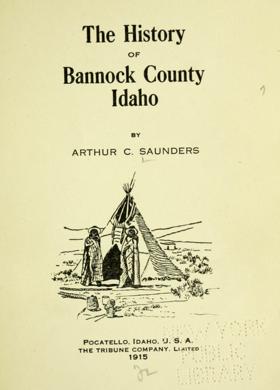
Published in 1915 by Arthur C. Saunders, The History of Bannock County, Idaho provides a localized chronicle of southeastern Idaho’s transition from a vital fur-trading crossroads to a booming agricultural and railroad hub. The volume traces the evolution of the region from the early days of the historic Fort Hall outpost through the aggressive expansion of the Oregon Short Line Railroad, which cemented the city of Pocatello as the undisputed commercial gateway of the state. Typical of early twentieth-century civic literature, the text meticulously documents the commercial achievements of white pioneers while framing the systematic reduction of the Fort Hall Indian Reservation as a necessary, triumphant precondition for modern progress. A keen insight drawn from the work is how the narrative explicitly weds regional prosperity to the legal dispossession of Indigenous lands; by celebrating the federal government's opening of Shoshone-Bannock reservation tracts to white settlement as the county’s crowning economic victory, Saunders illustrates how early frontier boosterism actively conflated the bureaucratic erasure of Native sovereignty with righteous industrial destiny. 143 pages 20 cm ONLINE CIRC [ 1 ]
|
1915 |
|
Pioneers of the Pacific coast a chronicle of the sea rovers and fur hunters by Agnes C. Laut 
In the early sixteenth century, the first exploratory ships arrived on the Pacific Coast of North America. These rovers were seeking gold and silver, fur pelts, a safe passage from the Pacific to the Atlantic, and above all, adventure. Though many of the voyagers didn’t survive the dangerous sea crossings or the perils that awaited them on land, their stories live on in Pioneers of the Pacific Coast. Agnes C. Laut chronicles long-forgotten true stories packed with hazards and surprise. In the 1500s, The Golden Hind breaks into the Pacific Ocean, despite harsh warnings from the Spaniards that it was a “closed sea.” Years later, the Russian explorer Vitus Bering and his crew are stranded on an island when their ship is caught in a storm. In the 17th century, British Captain Vancouver meets with Spanish Captain Quadra at Nootka Sound to decide who owns the Pacific Coast. All these explorers risked their lives to find out whether this perilous land was worthy of settlement. 139 pages : color frontispiece, plates, portraits, folded map ONLINE CIRC [ 1 ]
|
1915 |
|
History of Idaho by Hiram T. French
Authored by agricultural academic Hiram T. French, History of Idaho is a sweeping, multi-volume encyclopedic account that traces the state’s rapid transition from a rugged mining frontier to a structured, resource-rich engine of the American West. The exhaustive text chronicles the early era of fur trapping and frantic gold rushes before heavily emphasizing the steady, "civilizing" forces of agricultural development, massive irrigation projects, and the establishment of civic institutions. Like many subscription histories of the era, the work bolsters its grand narrative of manifest destiny with hundreds of glowing biographical sketches of the state’s prominent politicians, merchants, and pioneering patriarchs. A keen insight drawn from the work is how the commercial mechanics of the early 20th-century "subscription history" genre fundamentally dictated the state's official historical record; by literally selling pages of history to the highest-bidding local elites, French’s volumes seamlessly merged civic boosterism with personal vanity, cementing a regional mythology where aggressive land speculation and ecological extraction were permanently rebranded as honorable pioneer virtues. 3 volumes : illustrations, plates, portraits ; 28 cm ONLINE CIRC [ 3 ]
|
1914 |
|
Lower Umpqua texts and notes on the Kusan dialects by Leo Joachim Frachtenberg
Authored by early 20th-century anthropologist Leo Joachim Frachtenberg, Lower Umpqua Texts and Notes on the Kusan Dialects serves as a vital linguistic archive of the highly endangered Indigenous languages of the southern Oregon coast. Operating within the frantic era of "salvage anthropology," Frachtenberg meticulously transcribed the complex grammatical structures, mythologies, and oral histories of the Lower Umpqua and Coos peoples directly from some of their very last fluent speakers. The resulting volume operates as both a dense academic lexicon and a poignant cultural artifact of coastal tribal communities whose societal structures were systematically dismantled by pioneer encroachment. A keen insight drawn from the work is how the foundational premise of salvage anthropology reveals a devastating colonial paradox; by urgently cataloging these complex Indigenous dialects as dying academic curiosities, researchers like Frachtenberg unwittingly produced an empirical ledger detailing the lethal efficiency of America's own aggressive policies of forced displacement and cultural erasure. vi, 156 pages ; 25 cm. ONLINE CIRC [ 1 ]
|
1914 |
|
Coos, an illustrative sketch by Leo Joachim Frachtenberg, Franz Boas
Co-authored by pioneering anthropologists Leo Joachim Frachtenberg and Franz Boas, Coos, an Illustrative Sketch provides a rigorous, structural analysis of the severely endangered Hanis Coos language native to the southern Oregon coast. Published as part of Boas’s monumental initiative to map North American Indigenous linguistics, the text meticulously breaks down the complex phonology, morphology, and syntactic architecture of a tribal language heavily decimated by forced relocation and settler encroachment. By formally diagramming these intricate grammatical rules directly from the region's last fluent speakers, the authors produced a vital ethnographic artifact that preserved the mechanical brilliance of coastal oral traditions. A keen insight drawn from the work is how the rigorous application of Boasian linguistics functioned as a subtle but powerful critique of pioneer-era racial hierarchies; by scientifically demonstrating that the Coos language possessed a structural logic and grammatical complexity equal to or surpassing European tongues, the text implicitly dismantled the self-serving settler myth that the region's Indigenous populations were culturally or intellectually primitive. 1 preliminary leaf, pages 297-429. 25 cm ONLINE CIRC [ 1 ]
|
1914 |
|
British Columbia from the earliest times to the present by E. O. S. Scholefield, F. W. Howay
Co-authored by Provincial Librarian E. O. S. Scholefield and historian F. W. Howay, British Columbia from the Earliest Times to the Present is a monumental four-volume history detailing the province's evolution from Indigenous territories and fur-trade outposts into a modernized Canadian province. The exhaustive 1914 work extensively chronicles the era of maritime exploration, the monopoly of the Hudson’s Bay Company, and the chaotic gold rushes that forced the rapid implementation of British colonial administration. In keeping with the era's subscription-based publishing model, the historical narrative is heavily supplemented with flattering biographical sketches of prominent local patriarchs, effectively celebrating the region's industrial and political development as a triumph of Anglo-Saxon enterprise. A keen insight drawn from the work is how the collaboration between the state's chief archivist and a sitting judge served to officially institutionalize a legalistic justification for colonial expansion; by framing the province's history as an orderly, bureaucratic progression from corporate rule to British law, the authors deliberately obscured the unceded nature of First Nations land behind a veneer of inevitable constitutional progress. 4 volumes frontispieces, plates, portraits, maps, facsimiles 27 cm ONLINE CIRC [ 4 ]
|
1914 |
|
Early history of Thurston County, Washington together with biographies and reminiscences of those identified with pioneer days by Georgiana Mitchell Blankenship
Compiled by Georgiana Mitchell Blankenship in 1914, Early History of Thurston County, Washington serves as an exhaustive anthology of biographical sketches and firsthand memoirs documenting the foundational years of the Puget Sound region. The volume weaves together the personal recollections of early white settlers, chronicling their grueling overland migrations, the establishment of Olympia, and the swift political and commercial dominance achieved by the pioneer class. Operating simultaneously as a community scrapbook and a civic monument, the text elevates the hardships of these foundational families while meticulously recording the social networks that solidified their territorial authority. A keen insight drawn from the work is how the genre of locally compiled pioneer reminiscences functioned as a highly insulated form of collective myth-making; by exclusively centering the frontier triumphs of their own peer group, compilers like Blankenship actively curated a historical memory that legitimized settler colonialism as a heroic destiny while systematically minimizing the concurrent displacement of the region's Indigenous populations. 392, [3] pages, 23 unnumbered leaves of plates : frontispiece, illustrations, portraits ; 23 cm ONLINE CIRC [ 1 ]
|
1914 |
|
The Naming of Counties in the State of Washington by Charles W. Smith
Authored by prominent Pacific Northwest librarian and historian Charles W. Smith, The Naming of Counties in the State of Washington offers a precise etymological and legislative record charting the geopolitical organization of the region. The monograph traces the administrative debates and territorial acts that carved up the regional map, documenting the linguistic origins of each boundary, from early districts retaining Anglicized Indigenous names to those explicitly honoring military generals, presidents, and pioneer politicians. A keen insight drawn from the work is how the seemingly mundane bureaucratic act of naming local geography served as a subtle but permanent mechanism of frontier assimilation; by chronicling how early lawmakers increasingly favored the names of distant federal authorities over local indigenous terminology, the text exposes how achieving statehood required actively overwriting the native landscape with the linguistic markers of American imperial control. 15 pages ; 23 cm. ONLINE CIRC [ 1 ]
|
1913 |
|
Puget Sound and western Washington; cities--towns--scenery by Robert A Reid
Compiled by publisher Robert A. Reid, Puget Sound and Western Washington: Cities—Towns—Scenery serves as a highly visual, promotional catalog of the region's rapid early 20th-century urban and industrial expansion. Through extensive photographic plates and glowing captions, the book captures a sweeping panorama of bustling deep-water ports, sprawling timber operations, and modernizing civic architecture emerging from the dense coastal forests. Designed primarily for tourists and prospective investors, the pictorial volume functioned to visually prove that the untamed Pacific Northwest had successfully been transformed into a sophisticated, economically robust cornerstone of the American empire. A keen insight drawn from the work is how the strategic curation of early commercial photography operated as an irrefutable tool of regional boosterism; by relying on the presumed objectivity of the camera to document gleaming cityscapes and orderly timber yards while meticulously omitting the displaced indigenous communities and scarred clear-cuts, the volume crafted a sanitized, visual mythology of painless industrial progress. 192 pages : frontispiece, illustrations, map ; 27 cm ONLINE CIRC [ 1 ]
|
1912 |
|
Civil government of Idaho for the use of schools by Clinton Emmett Rose
Authored by prominent educator Clinton Emmett Rose, Civil Government of Idaho for the Use of Schools served as a foundational civic textbook designed to instruct early 20th-century students on the structural mechanisms of their newly established state. The volume systematically details the constitutional framework, legislative processes, and local administrative duties that governed Idaho, translating complex legal statutes into standardized classroom lessons. Through its pedagogical focus on civic duty and institutional mechanics, the book aimed to mold the children of frontier settlers and diverse immigrants into a unified, patriotic citizenry. A keen insight drawn from the work is how progressive-era public education functioned as a powerful instrument of state legitimization; by teaching Idaho’s legal and political frameworks as the absolute, unquestionable culmination of civilized order, early textbooks actively normalized settler-colonial authority for the next generation while completely erasing the pre-existing Indigenous governance structures that the new state had so recently displaced. 151 pages ; 19 cm ONLINE CIRC [ 2 ] CIRC [ 1 ]
|
1912 |
|
The centennial history of Oregon, 1811-1912 by Joseph Gaston
Authored by railroad promoter and pioneer historian Joseph Gaston, The Centennial History of Oregon, 1811-1912 is a massive, multi-volume retrospective chronicling the state’s evolution from the early fur-trading expeditions to a modernized, twentieth-century society. The exhaustive work details a century of territorial expansion, pioneer struggles, and agricultural growth, dedicating significant focus to the fierce transportation rivalries and infrastructure developments that connected the Pacific Northwest to the national economy. Packed with extensive biographical sketches of prominent local patriarchs, the text serves as a sweeping celebration of the pioneer generation's triumph over the wilderness and their establishment of robust civic institutions. A keen insight drawn from the work is how the author's own background as a corporate developer fundamentally shaped the state's historical memory; by centering railroad battles and commercial industrialization as the defining milestones of Oregon's progress, Gaston's narrative illustrates how the early architects of regional capitalism literally wrote the history books to ensure their economic ambitions were immortalized as heroic statecraft. 4 volumes : frontispiece, illustrations (plates), facsimiles, maps, portraits ; 27 cm ONLINE CIRC [ 4 ]
|
1912 |
|
Some reminiscences of old Victoria by Edgar Fawcett 
Authored by early pioneer Edgar Fawcett, Some Reminiscences of Old Victoria offers a deeply personal, nostalgic chronicle of British Columbia's capital city during its chaotic transition from a quiet Hudson's Bay Company outpost to a booming gold rush epicenter. Drawing upon his own arrival in 1859 and decades of civic observation, Fawcett meticulously reconstructs the social fabric of the 19th-century port, detailing early dirt streetscapes, the sudden influx of transient miners, local eccentricities, and the establishment of colonial institutions. Through conversational anecdotes and vivid recollections, the text serves as a vibrant, street-level time capsule of a frontier society rapidly attempting to replicate British gentility on the edge of the Pacific wilderness. A keen insight drawn from the work is how pioneer nostalgia inherently sanitizes the disruption of colonial expansion; by fondly mythologizing the eccentricities and genteel aspirations of Victoria's early British settlers, Fawcett’s memoir illustrates how the pioneer elite actively constructed an insulated, aristocratic social hierarchy to maintain cultural dominance amidst the overwhelming demographic shifts of the gold rush era. 4 unnumbered pages, [5]-294 pages : plates, portraits ; 20 cm ONLINE CIRC [ 1 ]
|
1912 |
|
Early Okanogan history by William C. Brown 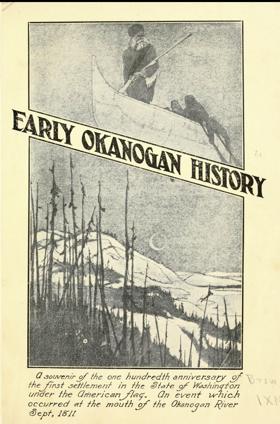
A souvenir of the one hundredth anniversary of the first settlement in the State of Washington under the American flag. An event which occurred at the mouth of the Okanogan River in Sept 1811. 27 pages : illustrations, portraits ; 23 cm ONLINE CIRC [ 1 ]
|
1911 |