Catalog of British Columbiana and Pacific Northwest Americana
Encyclopedia Cascadia Catalog contains book titles of mostly non-fiction Pacific Northwest Coast of North America Titles (primarially British Columbia, Idaho, Oregon and Washington State) in an easy-to-understand title catalog. If you see a link with this badge ONLINE CIRC it means that there is an online institution that provides free access to that title. In some cases there may be more than one institution hosting the title digitally.
| Catalog Title | Published |
|---|---|
|
A force for change Beatrice Morrow Cannady & the struggle for civil rights in Oregon, 1912-1936 by Kimberley Mangun 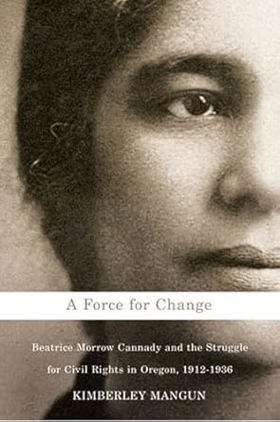
"A Force for Change is the first full-length study of the life and work of one of Oregon's most dynamic civil rights activists, Beatrice Morrow Cannady." "Between 1912 and 1936, Cannady tirelessly promoted interracial goodwill and fought segregation and discrimination. She gave hundreds of lectures to high school and college students and shared her message with radio listeners across the Pacific Northwest. She was assistant editor, and later publisher, of The Advocate, Oregon's largest African American newspaper. Cannady was the first black woman to graduate from law school in Oregon, and the first to run for state representative. She held interracial teas in her home in Northeast Portland and protested repeated showings of the racist film The Birth of a Nation. And when the Ku Klux Klan swept into Oregon, she urged the governor to act quickly to protect black Oregonians' right to live and work without fear. Despite these accomplishments, Beatrice Cannady fell into obscurity when she left Oregon in the late 1930s." "A Force for Change illuminates Cannady's key role in advocating for better race relations in Oregon in the early decades of the twentieth century. It describes her encounters with the period's leading black artists, editors, politicians, and intellectuals, including W. E. B. Du Bois, Langston Hughes, Oscar De Priest, Roland Hayes, and James Weldon Johnson. It dispels the myth that African Americans played little part in Oregon's history and it enriches our understanding of the black experience in Oregon and the civil rights movement across the country."--BOOK JACKET [vii], 344 pages : illustrations, portraits ; 23 cm CIRC [ 0 ]
|
2010 |
|
A father and an island reflections on loss by O. Alan Weltzien 
As author Ann Ronald notes, "Simultaneously a paean to his father and a personal memoir about a changing landscape caught by a ‘rising tide of affluence,’ Alan Weltzein’s A Father and an Island:Reflections on Loss, echoes my own Pacific Northwest youth—the endless saltwater summers, the quirky behavior of a bookworm, the sweet sharp tang of blackberry cobbler, the fierce games of badminton, the beachcombing days of discovery, the blessedness of parents well loved. Anyone who’s grown up in and around Puget Sound will find familiar memories triggered on every delicious page. Some sweet,some nostalgic, some downright sad, they’re all here in this poignant remembrance of things past." Northwest author Mary Clearman Blew writes, "In this moving tribute to his father and his family’s home on a Puget Sound island,Alan Weltzein returns us to a time when summers were glorious and children played all day long on beaches that were still unexploited and unrestricted—a pleasure to read." Weltzien's memoir is an essential book for Northwest Letters. 288 pages ; 22 cm CIRC [ 1 ]
|
2008 |
|
A failed vision of empire the collapse of Manifest Destiny, 1845-1872 by Daniel J. Burge 
Since the early twentieth century, historians have traditionally defined manifest destiny as the belief that the United States was destined to expand from coast to coast. This generation of historians has posed manifest destiny as a unifying ideology of the nineteenth century, one that was popular and pervasive and ultimately fulfilled in the late 1840s when the United States acquired the Pacific Coast. However, the story of manifest destiny was never quite that simple. In A Failed Vision of Empire Daniel J. Burge examines the belief in manifest destiny over the nineteenth century by analyzing contested moments in the continental expansion of the United States, arguing that the ideology was ultimately unsuccessful. By examining speeches, plays, letters, diaries, newspapers, and other sources, Burge reveals how Americans debated the wisdom of expansion, challenged expansionists, and disagreed over what the boundaries of the United States should look like. A Failed Vision of Empire is the first work to capture the messy, complicated, and yet far more compelling story of manifest destiny’s failure, debunking in the process one of the most pervasive myths of modern American history. xvii, 246 pages : illustrations ; 24 cm CIRC [ 0 ]
|
2022 |
|
A drum in one hand, a sockeye in the other stories of indigenous food sovereignty from the Northwest Coast by Charlotte Coté 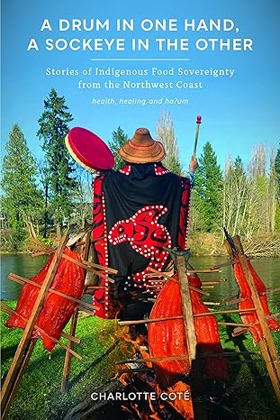
In the dense rainforest of the west coast of Vancouver Island, the Somass River (c̓uumaʕas) brings sockeye salmon (miʕaat) into the Nuu-chah-nulth community of Tseshaht. C̓uumaʕas and miʕaat are central to the sacred food practices that have been a crucial part of the Indigenous community's efforts to enact food sovereignty, decolonize their diet, and preserve their ancestral knowledge. In A Drum in One Hand, a Sockeye in the Other, Charlotte Coté shares contemporary Nuu-chah-nulth practices of traditional food revitalization in the context of broader efforts to re-Indigenize contemporary diets on the Northwest Coast. Coté offers evocative stories of her Tseshaht community's and her own work to revitalize relationships to haʔum (traditional food) as a way to nurture health and wellness. As Indigenous peoples continue to face food insecurity due to ongoing inequality, environmental degradation, and the Westernization of traditional diets, Coté foregrounds healing and cultural sustenance via everyday enactments of food sovereignty: berry picking, salmon fishing, and building a community garden on reclaimed residential school grounds. This book is for everyone concerned about the major role food plays in physical, emotional, and spiritual wellness. xxi, 184 pages : illustrations, maps ; 24 cm. CIRC [ 0 ]
|
2022 |
|
A dictionary of the Chinook jargon, or Indian trade language, of the north Pacific Coast by George Gibbs 
Published in 1863 by the Smithsonian Institution, George Gibbs’s A Dictionary of the Chinook Jargon serves as a foundational linguistic catalog of the widespread pidgin used for commerce and communication between Indigenous tribes and European settlers across the Pacific Northwest. The text systematically standardizes the vocabulary of this highly adaptable contact language, meticulously tracing the etymological roots of its words back to their original Nuu-chah-nulth, lower Chinookan, French, and English sources. A keen insight drawn from the publication is how Gibbs’s rigorous codification of the Jargon was not merely a disinterested scholarly exercise, but a highly utilitarian tool designed to serve the federal government's expansionist agenda. By formalizing a fluid trade pidgin into a standardized, legible dictionary, Gibbs provided federal agents and treaty commissioners with the exact linguistic infrastructure required to efficiently negotiate the sweeping land cessions that systematically dispossessed the region's Indigenous populations 29 pages 21 cm ONLINE CIRC [ 1 ]
|
1871 |
|
A deadly wind the 1962 Columbus Day storm by John Dodge 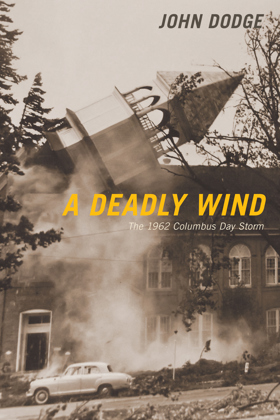
The Columbus Day Storm of 1962 was a freak of nature, a weather outlier with deadly winds topping one hundred miles per hour. The storm killed dozens, injured hundreds, damaged more than fifty thousand homes, and leveled enough timber to build one million homes. To find an equally ferocious storm of its kind, fast-forward fifty years and cross the continent to Superstorm Sandy's 2012 attack on the East Coast. While Superstorm Sandy was predicted days in advance, the Columbus Day Storm caught ill-equipped weather forecasters by surprise. This unrivalled West Coast windstorm fueled the Asian log export market, helped give birth to the Oregon wine industry, and influenced the 1962 World Series. It remains a cautionary tale and the Pacific Northwest benchmark for severe windstorms in this era of climate change and weather uncertainty. From its genesis in the Marshall Islands to its final hours on Vancouver Island, British Columbia, the storm plowed an unparalleled path of destruction. In A Deadly Wind, veteran journalist John Dodge tells a compelling story spiced with human drama, Cold War tension, and Pacific Northwest history. This is a must-read for the tens of thousands of storm survivors, for history buffs, and for anyone interested in the intersection of severe weather events and climate change xvii, 238 pages : illustrations, maps ; 23 cm CIRC [ 0 ]
|
2018 |
|
A country strange and far the Methodist Church in the Pacific Northwest, 1834-1918 by Michael C. McKenzie 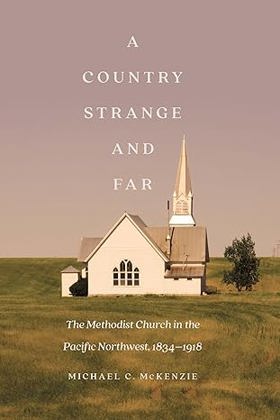
In 1834 the weary missionary Jason Lee arrived on the banks of the Willamette River and began to build a mission to convert the local Kalapuya and Chinook populations to the Methodist Church. The denomination had become a religious juggernaut in the United States, dominating the religious scene throughout the mid-Atlantic and East Coast. But despite its power and prestige and legions of clergy and congregants, Methodism fell short of its goals of religious supremacy in the northwest corner of the continent. In A Country Strange and Far Michael C. McKenzie considers how and why the Methodist Church failed in the Pacific Northwest and how place can affect religious transplantation and growth. Methodists failed to convert local Native people in large numbers, and immigrants who moved into the rural areas and cities of the Northwest wanted little to do with Methodism. McKenzie analyzes these failures, arguing the region itself—both the natural geography of the place and the immigrants’ and clergy’s responses to it—was a primary reason for the church’s inability to develop a strong following there. The Methodists’ efforts in the Pacific Northwest provide an ideal case study for McKenzie’s timely region-based look at religion. xviii, 330 pages : illustrations ; 24 cm CIRC [ 0 ]
|
2022 |
|
A concise dictionary of the Nuuchahnulth language of Vancouver Island by John T. Stonham 
For some 20 years, Stonham (linguistics, U. of Newcastle-upon-Tyne) has been researching the language of the Nuuchahnulth, a group of First Nations peoples occupying the west coast of Vancouver Island. His dictionary is the first attempt to provide a detailed account of the lexicon of the Nuuchahnulth language, complete with examples and grammatical information. The work is based primarily on fieldnotes gathered by Edward Sapir between 1910 and 1922, fieldnotes by Morris Swadesh in the 1940s, and Stonham's own field research since the 1980s. The volume includes a Nuuchahnulth-English dictionary with some 7,000 main entries, an English-Nuuchahnulth glossary of some 8,500 entries consisting of English headwords and their Nuuchahnulth equivalents, and appendices of grammatical paradigms and place names. Annotation : 2004 Book News, Inc., Portland, OR (booknews.com) xviii, 537 pages ; 24 cm CIRC [ 1 ]
|
2005 |
|
A coastal range by Charles Lillard
|
1984 |
|
A century of Coos County railroads by Steven Greif
Published by local historian Steven Greif, A Century of Coos County Railroads chronicles the ambitious, logistically treacherous, and economically volatile history of rail development along southwest Oregon’s rugged coast. The book details the immense engineering feats required to carve rail lines through dense timber, cross treacherous waterways, and connect isolated coastal timber and shipping towns to the national grid. Through detailed archival photographs, corporate records, and local lore, the text charts how steel tracks served as the primary economic lifeline that transitioned the region from maritime isolation into a heavy industrial timber economy. A keen insight drawn from the work is how railroads on the Pacific Northwest frontier acted as both liberators and tyrants; while steel lines successfully shattered geographic isolation, they simultaneously bound local communities to boom-and-bust corporate monopolies, making the region's economic survival entirely dependent on external market demands. 57 pages : illustrations, facsimiles, map ; 28 cm CIRC [ 1 ]
|
2001 |
|
A century of Coos and Curry history of southwest Oregon by Emil R. Peterson, Alfred Powers, Coos Curry Pioneer & Historical Association 
The nearly 600 pages of the pioneer history includes a 100+ page alphabetical Biographical Appendix with short entries for several hundred people. The history section begins with descriptions of Coos and Curry counties. This history proper starts in 1795 and includes a number of anecdotes, reminiscences, biographical portraits, and city histories, as well as historical narratives. Topics include Battle Rock, Rogue River, southern Curry County, report of an Indian agent, Coos Bay Colony, Bandon Beach, Coos Bay, Coquille Valley, Coos economic activity for 1897, Curry County, Nosler emigration, mineral belt, and crimes, casualties and miscellaneous happenings. Includes photographs of significant buildings and local residents. 599 pages : illustrations, portraits, maps ; 23 cm CIRC [ 1 ]
|
1952 |
|
A centennial history of the Kendrick-Juliaetta area by Kenrick-Juliaetta Centennial Committee (Publisher) 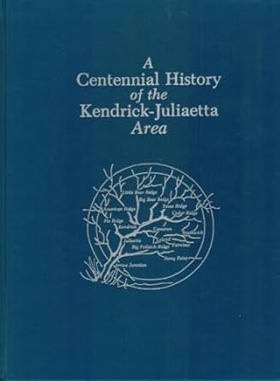
Published by the Kendrick-Juliaetta Centennial Committee, A Centennial History of the Kendrick-Juliaetta Area chronicles the agricultural settlement, rugged pioneer endurance, and community-building along the steep, fertile canyon lands of north-central Idaho's Potlatch River valley. The book details how hardy homesteaders transformed an isolated wilderness into a thriving agrarian hub driven by wheat farming, timber harvesting, and the arrival of regional railroad lines. Through extensive family histories, rare photographs, and local archives, the text preserves the granular records of everyday survival in a striking canyon landscape. A keen insight drawn from the work is how topographical isolation forced early farming communities to engineer their own economic survival; by relying on narrow-gauge railroads to bridge the seemingly impassable gorges of the Palouse region, these rural settlements proved that agricultural prosperity in the Inland Northwest depended entirely on conquering hostile vertical geography. vii, [3], 246 pages : illustrations, maps, portraits ; 29 cm CIRC [ 1 ]
|
1990 |
|
A brief history of Waldron Island by Charles H. Ludwig 
HISTORY OF A SEASONAL CAMPING SITE OF THE LUMMI INDIANS. The second edition was published in 1972 in response to requests for copies of the original mimeographed first edition. The preface to the second edition contains some comments on the more recent history of the island and Frederick Marks, one of the very early settlers on Waldron. 44 pages map, table CIRC [ 0 ]
|
1959 |
|
A brief history of Franklin, first permanent settlement in the state of Idaho by Idaho Pioneer Association, Boise Public Library Idaho Collection
|
1960 |
|
A brief historical sketch of Port Townsend, Washington by William D. Welsh, Port Townsend Chamber of Commerce, Crown Zellerbach Corporation
|
1959 |
|
A bridge back the early days of Florence, Oregon by Ellen Traylor 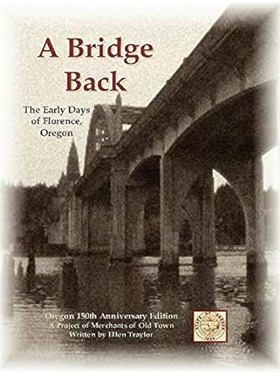
A Bridge Back, The Early Days of Florence, Oregon is an entertaining romp into the early history of a rollicking town, at once "wild west" and "gentle natured." It was a small town with a big heart and many colorful characters. They followed in the footsteps of greatness, on the trail of Lewis and Clark, Jedediah Smith and in the shadow of railroad barons and spruce-winged airplanes. Meet the adventuresome dreamer-founder and his bandito-turned-poet brother; meet the bold editor of the town paper, who went on to be a senator; meet the brave settler who saved a wagon master from mob attack; meet the lovely Rhododendron Queen who married the founder's nephew; meet the fishermen who blew up bombs in the river and the young man who sauntered nude down the beach; meet the greedy publisher who sided with grasping barons to his own downfall; and meet the bumbling Romeo who snapped a photo of his girl as she sank in quicksand. If you know Florence, you will never see her the same way again. If you do not know Florence, prepare to fall in love. A project of Merchants of Old Town Florence for the 150th Anniversary of Oregon. 110 pages : illustrations ; 28 cm CIRC [ 1 ]
|
2009 |
|
A bit off center by Margaret Philbrick 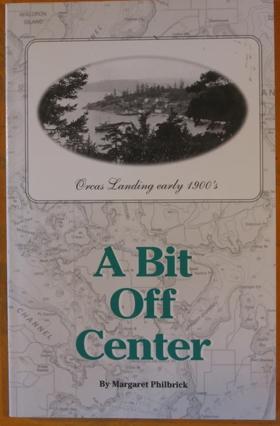
Authored by longtime resident and community historian Margaret Philbrick, A Bit Off Center presents a personal, highly localized history of Orcas Island in Washington's San Juan archipelago. Drawing on vintage photographs, maps, and oral recollections, the book chronicles the development of local landmarks, marine transport, small cottage industries, and the eccentric characters who anchored early island life. Through intimate vignettes of community hubs like the Orcas Hotel and Grindstone Harbor, the text captures the peculiar charm and texture of self-reliant island living. A keen insight drawn from the work is how insular communities derive their unique resilience from eccentricity; by documenting the colorful, non-conformist personalities that populated the margins of society, the narrative reveals that living "off center" was not just a geographic descriptor, but a vital cultural ethos that allowed isolated pioneers to thrive. 97 pages : illustrations, maps ; 21 cm CIRC [ 1 ]
|
2000 |
|
A Bibliography of The Pacific Northwest by Washington State School Library Association
|
1964 |
|
A bibliography of Pacific Northwest history by Oregon Historical Society (Compiler), Thomas Vaughan (Compiler), Priscilla Knuth (Compiler)
"This bibliography of Pacific Northwest history has been compiled by the staff of the Oregon Historical Society, especially for high school and college students and teachers. Necessarily the range is broad and qualified by what is available for various study levels. Included are books, articles and documents published up to the fall of 1957."--Page i 44 leaves ; 28 cm. CIRC [ 1 ]
|
1958 |
|
A bibliography of British Columbia laying the foundations, 1849-1899 by Barbara J. Lowther (Compiler), Muriel Laing (Compiler), University of Victoria (B.C.). Social Sciences Research Centre
Every effort has been made to include the government publications of the two colonies of Vancouver Island and British Columbia and, after their union in 1866, of the united colony of British Columbia to 1871. xii, 328 pages ; 29 cm ONLINE CIRC [ 1 ] CIRC [ 1 ]
|
1968 |
|
A bibliography of American county histories by P. William Filby 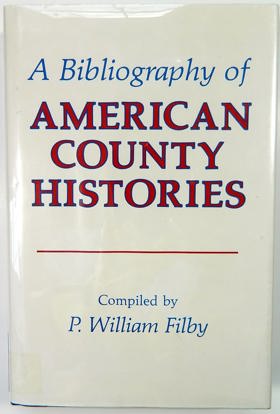
The intention of this work is to compile a work which contains bibliographical references to all county histories of any consequence up to 1984. The author has attempted to give full bibliographical information as accurate as possible on each title xiv, 449 pages ; 24 cm CIRC [ 1 ]
|
1985 |
|
7,003 days 21 years in the Frank Church River of No Return Wilderness by Jim Akenson , Holly Akenson 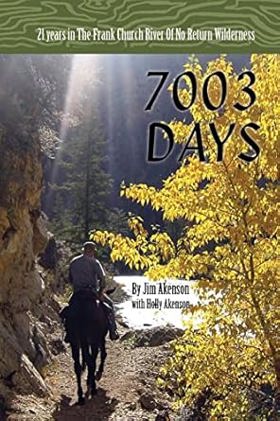
"Deep in the Idaho wilderness the last vestiges of Old Idaho linger. In 1982, an eager young couple seeking adventure and challenge, Jim and Holley Akenson, moved to a log cabin in the back country to manage Taylor Ranch, the University of Idaho's wilderness research station. In 7,003 Days, Jim describes their encounters with wildlife and nature: tracking wolves and cougars, using mules for transportation and ranch work, and introducing university stuedents to life in the rugged Salmon River Mountains of Central Idaho"--Provided by publisher 266 pages : illustrations, map ; 23 cm CIRC [ 0 ]
|
2016 |
|
50 years on the Klamath by John C. Boyle 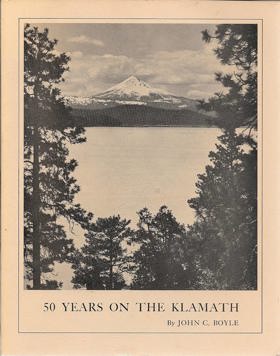
1982 marked the 50th anniversary for the Boyd family on the Klamath River. The family has continued to visit the camp in almost all of the years between then and today. This book tells many stories and tells of many events and happenings that occurred during these years: the burgeoning growth of the families, the construction of additional cabins at the camp, good fishing years and not so good years, and the varied and interesting experiences of life at the Klamath. Most importantly, this book portrays the incalculable value that spending time with family and friends at a place without electricity, television, phones, computers or other modern distractions provides to both young and old. 59, [8] pages of plates : illustrations, maps (some folded) ; 26 cm CIRC [ 1 ]
|
1976 |
|
50 keystone flora species of the Pacific Northwest a pocket guide by Collin Varner 
A keystone species is an organism that defines and supports an entire ecosystem, filling a vital ecological niche. Without these species, ecosystems would be radically altered or even collapse. This full-color, pocket-sized field guide by best-selling naturalist Collin Varner highlights fifty keystone trees, flowering plants, fruit-bearing plants, marine plants, and fungi found across the Pacific Northwest bioregion. Each entry features clear photography, etymology, descriptions, habitat information, and risks and warnings. This convenient and easy-to-use reference is perfect for walkers, hikers, campers, and beachcombers and important for raising awareness of the need to conserve and protect these vital species. -- back cover 123 pages : color illustrations, color map ; 18 cm CIRC [ 0 ]
|
2024 |
|
50 keystone fauna species of the Pacific Northwest a pocket guide by Collin Varner 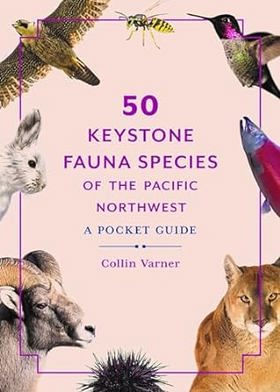
A keystone species is an organism that defines and supports an entire ecosystem, filling a vital ecological niche. Without these species, ecosystems would be radically altered or even collapse. This full-color, pocket-sized field guide by best-selling naturalist Collin Varner highlights fifty keystone birds, mammals, amphibians, insects, fish, shellfish, and mollusks found across the Pacific Northwest bioregion. Each entry features clear photography, etymology, descriptions, habitat information, and risks and warnings. This convenient and easy-to-use reference is perfect for walkers, hikers, campers, beachcombers, sailors, paddlers, and whale watchers and important for raising awareness of the need to conserve and protect these vital species. -- back cover 123 pages : color illustrations, color map ; 18 cm CIRC [ 0 ]
|
2024 |