Catalog of British Columbiana and Pacific Northwest Americana
Encyclopedia Cascadia Catalog contains book titles of mostly non-fiction Pacific Northwest Coast of North America Titles (primarially British Columbia, Idaho, Oregon and Washington State) in an easy-to-understand title catalog. If you see a link with this badge ONLINE CIRC it means that there is an online institution that provides free access to that title. In some cases there may be more than one institution hosting the title digitally.
| Catalog Title | Published |
|---|---|
|
This bloody deed the Magruder incident by Ladd Hamilton 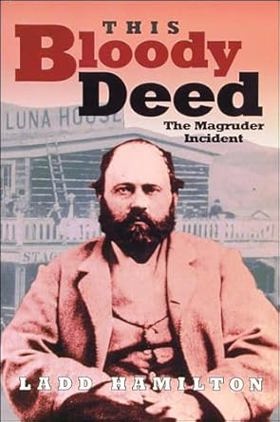
The infamous murder and robbery of Lewiston merchant Lloyd Magruder and his companions during the 1860s gold rush is legendary in Idaho, Montana, and Washington. Ladd Hamilton constructs a compelling account of the destruction of Magruder’s pack train while traveling on the Southern Nez Perce Trail in the Bitterroot Mountains, and the subsequent quest by Magruder’s friend Hill Beachey to track his killers to San Francisco, escort them back to Lewiston, and then protect them from mob justice until they could be tried in court. By appraising written evidence and community lore, Hamilton has created an intriguing account based on fact and documentation. But he also blends in historical fiction when required to complement the narrative in those places where events are known to have occurred but the historical sources are sparse or virtually nonexistent. Underlying Hamilton’s work is his exact and familiar knowledge of early Idaho Territory, which in 1863 stretched hundreds of miles from Lewiston at the Snake-Clearwater confluence to the gold camps of Virginia City, Bannack, and beyond in what is now Montana. Hamilton’s imaginative characterizations of Magruder, Beachey, outlaw sheriff Henry Plummer, and large cast of other historical figures in Idaho, Montana, and California is based on his years of knowing the many and varied peoples of the West. Also underlying Hamilton's work is his insightful knowledge of the early gold camps in Idaho and Montana territories. xviii, 253 pages, 8 unnumbered pages of plates : illustrations, portrait ; 23 cm CIRC [ 0 ]
|
1994 |
|
This blessed wilderness Archibald McDonald's letters from the Columbia, 1822-44 by Archibald McDonald, Jean Murray Cole 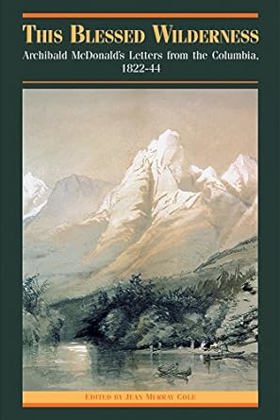
"The twenty-five years between 1821 and 1846 were turbulent but important years in the history of the fur trade in the Pacific Northwest: 1821 saw the merger of the Hudson's Bay Company and the North West Company, and 1846 saw the signing of the Oregon Treaty, which established the Canada-US border." "Archibald McDonald was a man who experienced these changes first-hand. As a senior HBC officer, he was sent to the Columbia District headquarters at Fort George in 1821 to oversee the recently absorbed NWC posts and assets. After the merger, McDonald went on to direct operations at Thompson River (1826-28), Fort Langley (1829-33), and Fort Colvile (1834-44)." "During his tenure in the Pacific Northwest, letters were McDonald's only link with the outside world. Collected here for the first time by Jean Murray Cole, these public and private letters to friends, business colleagues, missionaries, botanists, and many others provide a fascinating narrative of the expansion of the fur trade at a critical time in its history."--Jacket ix, 297 pages : illustrations, map ; 24 cm CIRC [ 1 ]
|
2001 |
|
This & that. Part II by Irene Kellar Mueller 
A collection of Irene Mueller's first 80 columns published in the Coupeville examiner 173 pages ; 21 cm CIRC [ 1 ]
|
2000 |
|
Thirty-one years in Baker County. A history of the county from 1861 to 1893 by Isaac Hiatt
Published in 1893, Isaac Hiatt’s regional history chronicles the first three decades of pioneer settlement in Baker County, Oregon, beginning with the foundational 1861 gold strike at Griffin's Gulch. The narrative documents the rapid influx of prospectors, the establishment of the explosive boomtown of Auburn, and the region's subsequent economic transition toward permanent agriculture and civic development centered in Baker City. Hiatt provides valuable firsthand perspectives on frontier justice, early political organization, and the inevitable, often violent conflicts with indigenous populations as white settlers claimed the eastern Oregon landscape. A keen insight drawn from the text is how its granular account of Auburn's meteoric rise and subsequent total collapse vividly illustrates the fragile, transient nature of frontier mining booms, demonstrating that long-term regional stability relied entirely on the less glamorous pivot to agrarian permanence. 208 pages 22 cm CIRC [ 1 ]
|
1893 |
|
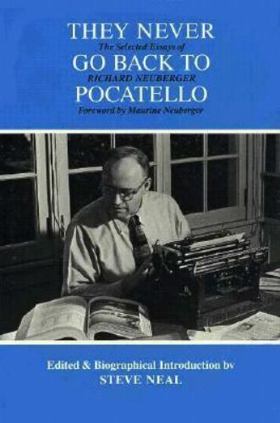
They never go back to Pocatello the selected essays of Richard Neuberger by Richard L. Neuberger, Steve Neal
|
1988 |
|
They never asked senryū poetry from the WWII Portland Assembly Center by Shelley Baker-Gard , Michael J. Freiling , Satsuki Takikawa , Duane Watari, Portland Assembly Center (Portland, Or) 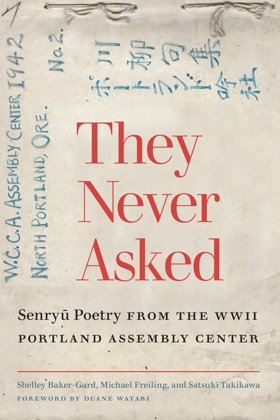
In 1942, after Executive Order 9066 was issued, Japanese families were removed from their homes in Oregon and the Yakima Valley and sent to the Portland International Livestock Exposition Center, where they were housed in converted animal stalls. The Wartime Civil Control Administration forcibly held these Japanese Americans at the Portland Assembly Center until September 1942, when they were transferred to newly built permanent incarceration camps at Minidoka, Heart Mountain, and Tule Lake. The Japanese American communities in Oregon and southern Washington were relatively small and many of the detainees knew each other; they drew on existing family and community networks to help each other through the long summer, living in inhumane conditions under the constant threat of violence. Several members of Bara Ginsha, a Portland poetry group, decided to continue their work while imprisoned at the center, primarily by writing senryū, a type of Japanese poetry related to haiku. They Never Asked is a collection of work produced by Bara Ginsha members in the WCCA camp, based on a journal kept by Masaki Kinoshita. The senryū collected here were written by a group of twenty-two poets, who produced hundreds of poems. Individually, the poems reflect the thoughts and feelings the authors experienced while being detained in the center; collectively, they reflect the resilience and resistance of a community denied freedom. Editors Shelley Baker-Gard, Michael Freiling, and Satsuki Takikawa present translations of the poems alongside the originals, supplemented by historical and literary context and a foreword by Duane Watari, Masaki Kinoshita’s grandson. xiv, 185 pages : illustrations, portraits ; 23 cm CIRC [ 0 ]
|
2023 |
|
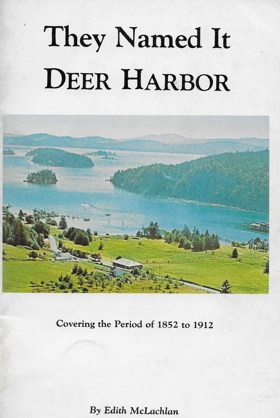
They named it Deer Harbor covering the period of 1852 to 1912 by Edith McLachlan, Washington State Library Rare Publications Collection
|
1972 |
|
They knew our valley by Maurice Helland
|
1975 |
|
They Cast a Long Shadow. A History of the Nonwhite Races on Bainbridge Island by Brian, Ed Roberts, Bainbridge Island School District 303, WA 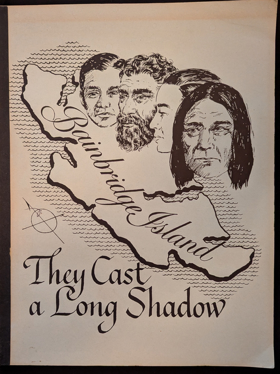
Written as a curriculum aid for students in the Bainbridge Island, Washington school district, this collection of stories about the Japanese, the Chinese, the Hawaiians, the Filipinos, the Vietnamese, and the American and Canadian Indians is an attempt to explain "what life is like for people who look different". The stories all relate the history of each of these ethnic groups on Bainbridge Island, an agricultural community, from the time of their arrival through the present. Accounts of individual's experiences from each group and black and white photographs are used to illustrate the stories. (PR) 122 CIRC [ 1 ]
|
1975 |
|
They came to six rivers the story of Cowlitz County by Virginia Urrutia, Cowlitz County Historical Society 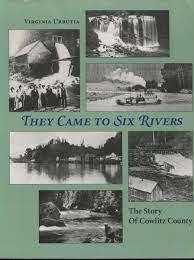
Though Cowlitz County is one of the smallest counties in Washington state, its past has been richly textured by the six rivers that flow through it: The Columbia, Kalama, Lewis, Coweeman, Toutle and Cowlitz rivers. Rivers throughout history have given rise to civilizations, so it is not surprising that Cowlitz County's rivers have lured settlers and industries. But each of these rivers had its own appeal, its own convenience or difficulty of settlement, its own methods of logging or fishing, its own vessels and bridges, and even its own scenery; each thus offered its own unique possibilities to the people who came here. Virginia Urrutia has taken these six strands and deftly woven them together with narratives of families, communities, governments, agriculture, industries, and events, creating a colorful and entertaining tapestry that will reward the attention of any reader, from the most casual tourist to the most knowledgeable citizen of the region. Book contains map of region and is illustrated with 100 photographs 223 pages : illustrations, map, portraits ; 29 cm CIRC [ 1 ]
|
1998 |
|
They came to a ridge by Ann Nilsson Driscoll, Maryann McKie 
This history was written with the hope that the pioneers of our area be remembered, and that the simple duties and pleasures of the pioneer people may be interesting to those who read it. The true pioneers of American and Driscoll Ridges are those who came here to establish their families and make a home in this new land. The period of the true pioneer to this area extends from when Frank May came in 1876 until about 1900. In my research I have carefully refrained from elaborating on the material so as to write it with as much authenticity as possible. -The Author 96 pages : illustrations, map, portraits ; 23 cm CIRC [ 1 ]
|
1975 |
|
They called me number one secrets and survival at an Indian residential school by Bev Sellars , Bill Wilson, Wendy C. Wickwire 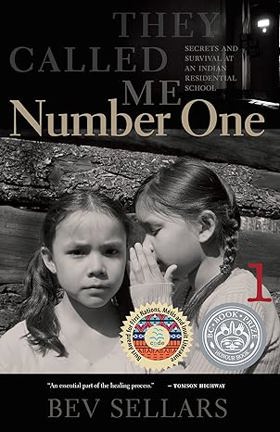
Like most Native children forced by law to attend schools across Canada and the United States, Sellars and other students of St. Joseph's Mission were allowed home only for two months in the summer and for two weeks at Christmas. The rest of the year they lived, worked, and studied at the school. St. Joseph's Mission is the site of the controversial and well-publicized sex-related offenses of Bishop Hubert O'Connor, which took place during Sellars's student days, between 1962 and 1967, when O'Connor was the school principal. After the school's closure, those who had been forced to attend came from surrounding reserves and smashed windows, tore doors and cabinets from the wall, and broke anything that could be broken. Overnight their anger turned a site of shameful memory into a pile of rubble. In this frank and poignant memoir, Sellars breaks her silence about the institution's lasting effects, and eloquently articulates her own path to healing xx, 227 pages : illustrations, map, portraits ; 22 cm. CIRC [ 0 ]
|
2013 |
|
They called him a radical the memoirs of Pete Maloff and the making of a Doukhobor pacifist by Pete Maloff , Vera Maloff 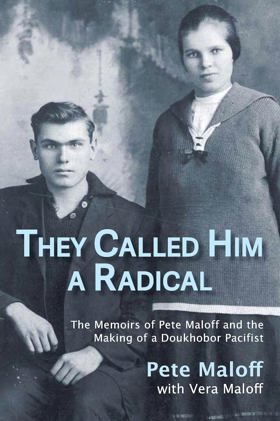
"Peter "Pete" Maloff was born in Saskatchewan in 1900, the year after the first Doukhobors, including his parents, immigrated to Canada. Living through the eras of WWI and WWII in a Doukhobor community strengthened his deep-rooted belief in pacifism and, at a young age, he dedicated himself completely to the idea that there must be another way to solve conflicts. This quest, as well as Maloff's status as an 'outsider,' was not always welcomed--judges and wardens considered him a radical and his influence a threat, and his outspokenness and peaceful protests resulted in house arrest and years in Canadian jails. Maloff was not deterred, and his perseverance garnered him many followers, including some who had formerly worked against him or had helped to incarcerate him. Today, his granddaughter Vera Maloff remembers Pete as a tall, strong, charismatic man. Growing up, she worked beside him in the family's gardens, and at the local markets where they sold produce, she recalls that he would be regularly surrounded by people wanting to hear him speak. He was a kind, caring man, and the time spent incarcerated, forced away from his family, did not seem to have dulled his spirit. He was an avid reader, who taught his family to consider all aspects and perspectives, instilling an awareness of other people and cultures and an eagerness to learn. In They Called Him a Radical: The Memoirs of Pete Maloff and The Making of a Doukhobor Pacifist, Vera revisits her grandfather's memoirs, written while under house arrest and covering the formative years from his birth to his late twenties, during which Pete's resolve to live as a pacifist was cemented. Here, Pete writes of growing up in the new Canadian Doukhobor community at the turn of the century, meeting influential figures in the pacifist movement in California, his time in a cooperative freedom colony in Oregon, and his turning to writing, as he truly believed that the pen could be mightier than the sword."-- Provided by publisher 226 pages : illustrations ; 23 cm CIRC [ 0 ]
|
2024 |
|
There must have been a tree by Max C. McClellan, Roy McClellan 
A FICTIONAL BIOGRAPHY AND HISTORY OF THE AUTHOR'S FAMILY INCLUDES FAMILY PHOTOGRAPHS vi, 240 pages : illustrations ; 22 cm CIRC [ 1 ]
|
1986 |
|
There is only one Enumclaw pioneer history and early years by Louise Ross Poppleton 
Authored by local historian Louise Ross Poppleton, There Is Only One Enumclaw: Pioneer History and Early Years chronicles the establishment and agricultural development of the plateau community nestled beneath Mount Rainier in western Washington. The book draws on early homestead records, family journals, and vintage photographs to trace how rugged pioneers cleared dense timberlands to build dairy farms and small-town institutions at the gateway to the Cascades. Through these localized archives, the text preserves the grit and mutual dependence required to tame a damp, heavily forested frontier. A keen insight drawn from the work is how geographical positioning at the foot of a major mountain pass shaped the town's unique identity; by acting as the mandatory staging ground for travelers and resource extraction moving into the high country, Enumclaw forged an enduring commercial resilience rooted entirely in its role as a transitional hub between wilderness and civilization. v, 123 pages : illustrations, maps ; 28 cm CIRC [ 1 ]
|
1995 |
|
Their day in court a history of the Indian Claims Commission by Harvey D. Rosenthal
|
1990 |
|
The York Factory Express Fort Vancouver to Hudson Bay, 1826-1849 by Nancy Marguerite Anderson 
"Every March between 1826 and 1854, the York Factory Express began its journey from the Hudson's Bay Company's headquarters on the Pacific Ocean. From Fort Vancouver, the express-men paddled their boats up the Columbia River to the base of the Rocky Mountains at Boat Encampment, a thousand miles to the east. At Jasper's House they were 3,000 feet above sea level. Their river route would return them to salt water once more, at York Factory, on the shores of Hudson Bay. It was an amazing climb and an amazing descent, and they would do another climb and descent on their journey home. The stories of the York Factory Express, and of the Saskatchewan Brigades they joined at Edmonton House, are told in the words of the Scottish traders and clerks who wrote the journals. However, the men who made the journey possible are the invisible, unnamed Canadiens, Orkney-men, Iroquois, and their Métis children and grand-children, who powered the boats across the continent every year. The voyageurs did all the heavy work and were almost entirely responsible for the success of the 5,400-mile journey. But their history was oral. If the traders had not preserved the stories the voyageurs told them, we would not know this history today."-- Provided by publisher 295 pages, 24 unnumbered pages of plates : illustrations, maps ; 23 cm CIRC [ 0 ]
|
2021 |
|
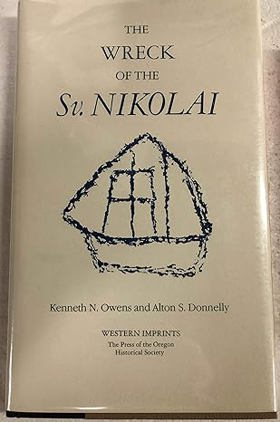
The Wreck of the Sv. Nikolai two narratives of the first Russian expedition to the Oregon country, 1808-1810 by Kenneth N. Owens, Timofeĭ. Tarakanov, Ben Hobucket
|
1985 |
|
The world of the Oregon fishboat a study in maritime folklife by Janet Crofton Gilmore 
Originally published in a limited cloth edition in 1986, this reissue of The World of the Oregon Fishboat brings an important and lively book to a wider audience. Here, in an easily-read narrative, Janet Gilmore describes life in the Coos Bay community of Charleston, based upon her years of interviewing and research. She recounts a precarious lifestyle, but one filled with tradition. Oregon fishboats, and the fishermen who work on them, have been a mainstay of the Northwestern way of life. Now, as Gilmore notes both in her narrative and in the new introduction to this edition, that way of life is dramatically changing. In the process, the fishboats used by Oregon's commercial fishermen are also changing. The World of the Oregon Fishboat records a way of life as it was in the late 1970s as it focuses on the fisherman's vessel--which serves as vehicle, shelter, home, and companion. The World of the Oregon Fishboat is both an elegant recording of an important aspect of twentieth century American life and a compassionate plea to understand a world of work that most of us rarely contemplate. 1 online resource (xiv, 271 pages) : illustrations, maps CIRC [ 1 ]
|
1999 |
|
The world of the Kalapuya a native people of western Oregon by Judy Rycraft Juntunen, May D. Dasch, Ann Bennett Rogers, Benton County Historical Society and Museum (Or) 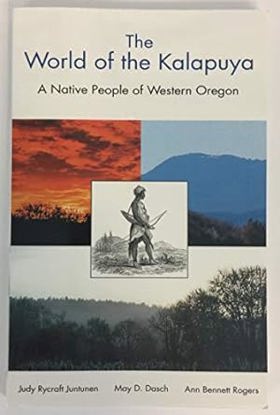
Published by the Benton County Historical Society and Museum, The World of the Kalapuya: A Native People of Western Oregon explores the rich history, culture, and lifeways of the indigenous inhabitants of the Willamette Valley prior to and following Euro-American settlement. Drawing on archaeological evidence, ethnohistorical records, and oral traditions, the authors detail the Kalapuya’s sophisticated land management practices—such as controlled burning to maintain open oak savannas—and their deep spiritual connection to the valley's seasonal rhythms. The volume highlights how the introduction of disease and forced displacement by pioneers devastatingly fractured a culture that had thrived in the region for millennia. A keen insight drawn from the text is how the Kalapuya's deliberate, centuries-old use of fire challenges the modern myth of the Pacific Northwest as a pristine, untouched wilderness; it reveals that the lush prairies encountered by early pioneers were actually meticulously cultivated cultural landscapes shaped by indigenous stewardship. 128 pages : illustrations, map ; 22 cm CIRC [ 1 ]
|
2005 |
|
The world of Chief Seattle how can one sell the air? by Warren Jefferson 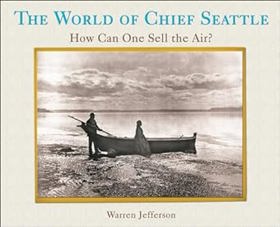
Chief Seattle gave his now famous speech in 1854 during treaty negotiations with the U.S. government, which was intent on forcing the Native people of Washington's Puget Sound onto reservations. This book puts Chief Seattle's life into the context of his time and gives a brief history of the region and its many tribes, with particular emphasis on Chief Seattle's tribe, the Suquamish 128 pages : illustrations, map ; 19 x 23 cm CIRC [ 1 ]
|
2001 |
|
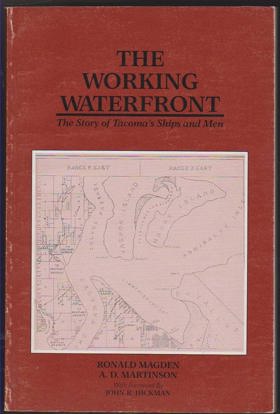
The working waterfront the story of Tacoma's ships and men by Ronald Magden, A. D. Martinson
|
1982 |
|
The Willamette Valley migration and settlement on the Oregon frontier by William A. Bowen
|
1978 |
|
The Wilkes expedition Puget Sound and the Oregon Country by Frances B. Barkan
|
1987 |
|
The wild horses of the Chilcotin their history and future by Wayne McCrory 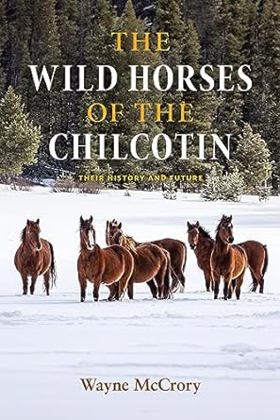
"The Chilcotin's wild horses are are romantic and beautiful, but they are also controversial: they are seen by government policy as intruders competing for range land with native species and domestic cattle and, as a result, they have been subject to culls and are not officially protected. In this compelling book, wildlife biologist Wayne McCrory draws upon two decades of research to make a case for considering these wonderful creatures, called qiyus in traditional Tŝilhqot'in culture, a resilient part of the area's balanced prey-predator ecosystem. McCrory also chronicles the Chilcotin wild horses' genetic history and significance to the Tŝilhqot'in, juxtaposing their efforts to protect qiyus against movements to cull them."-- Provided by publisher 332 pages, xxxii pages of plates : illustrations (some colour) ; 24 cm CIRC [ 0 ]
|
2023 |