Catalog of British Columbiana and Pacific Northwest Americana
Encyclopedia Cascadia Catalog contains book titles of mostly non-fiction Pacific Northwest Coast of North America Titles (primarially British Columbia, Idaho, Oregon and Washington State) in an easy-to-understand title catalog. If you see a link with this badge ONLINE CIRC it means that there is an online institution that provides free access to that title. In some cases there may be more than one institution hosting the title digitally.
| Catalog Title | Published |
|---|---|
|
History of British Columbia Bancroft's works, vol. xxxii by Hubert H. Bancroft 
Published in 1887 as the thirty-second volume of his colossal western history series, Hubert Howe Bancroft’s History of British Columbia meticulously traces the region's development from late 18th-century maritime explorations through its 1871 integration into the Canadian Confederation. The narrative provides an exhaustive account of the Hudson's Bay Company's autocratic rule under Chief Factor James Douglas, the disruptive influx of American prospectors during the Fraser River Gold Rush, and the subsequent political unification of the mainland and Vancouver Island. A keen insight drawn from the volume is how Bancroft—an American historian steeped in the ideology of Manifest Destiny—inherently filters the Canadian colonial experience through a distinctly U.S. nationalist lens. By frequently contrasting the paternalistic, corporate monopoly of the British administration with the chaotic, democratic individualism of American miners, the text inadvertently functions as a fascinating comparative study of two competing imperial philosophies vying for economic and cultural dominance across the 19th-century Pacific Northwest. xxxi, 792 pages : maps ONLINE CIRC [ 1 ] CIRC [ 1 ]
|
1887 |
|
History of Oregon by Hubert Howe Bancroft 
The more remote in Oregon affairs has been given in my History of the Northwest Coast, which is indeed a part of the History of Oregon, as elsewhere explained. The later volumes deal with events which occurred within the memory of men now living; they are wrought out from yet more original sources, a large proportion of the facts herein presented never having before appeared in print. 2 volumes : illustrations (maps) folded map ; 24 cm ONLINE CIRC [ 2 ]
|
1888 |
|
Names and places studies in geographical and topographical nomenclature by J. D. Whitney
Published in 1888, Josiah Dwight Whitney’s Names and Places: Studies in Geographical and Topographical Nomenclature offers a pioneering scholarly examination of the origins, evolution, and cultural significance of place names across the expanding American landscape. Drawing on his extensive experience directing the California Geological Survey, Whitney analyzes how Indigenous appellations, Spanish colonial titles, and subsequent Anglo-American designations were layered, corrupted, or erased as the western frontier was systematically mapped. The text critiques the often arbitrary or politically motivated naming practices of early explorers, miners, and surveyors, advocating for a more rigorous and scientifically accurate approach to standardizing geographic markers. A keen insight drawn from the text is how Whitney’s linguistic study inadvertently reveals the imperial power dynamics inherent in cartography; by documenting the systematic replacement or anglicization of Indigenous toponyms, the book illustrates how the bureaucratic act of naming functioned as a definitive tool of cultural conquest, literally overwriting native geographies to assert and legitimize white territorial control. 239 pages 18 cm ONLINE CIRC [ 1 ]
|
1888 |
|
History of Washington, Idaho, and Montana 1845-1889 by Hubert Howe Bancroft
Published in 1890 as the thirty-first volume of his exhaustive western history series, Hubert Howe Bancroft’s History of Washington, Idaho, and Montana 1845-1889 chronicles the violent transition of the Pacific Northwest's rugged interior from indigenous homelands to industrialized American states. The narrative meticulously documents the chaotic influx of prospectors during the inland gold rushes, the establishment of early territorial governments, and the brutal succession of regional Indian Wars that systematically cleared the land for transcontinental railroads. A keen insight drawn from the volume is how its rigorous documentation of these conflicts—painstakingly researched and written by the uncredited historian Frances Fuller Victor—serves as a surprisingly sharp indictment of federal incompetence and broken treaty promises. Yet, despite explicitly exposing the government's corrupt mismanagement of indigenous affairs, the text ultimately rationalizes this systemic violence as the tragic but inevitable cost of securing the inland frontier for capitalist expansion. xxvi, 836 pages : illustrations, maps ; 24 cm. ONLINE CIRC [ 1 ]
|
1890 |
|
History of Portland, Oregon by H. W. Scott 
Published in 1890 and compiled by Harvey W. Scott, the formidable long-time editor of The Oregonian, History of Portland, Oregon offers a sweeping civic chronicle of the city's rise from a muddy clearing on the Willamette River to the dominant commercial metropolis of the Pacific Northwest. The exhaustive volume details early municipal struggles, infrastructural triumphs, and the fiercely competitive navigation of regional river trade, culminating in extensive biographical sketches of the city's pioneer elites. A keen insight drawn from the text is how Scott leverages his dual authority as a historian and the region's most powerful journalist to actively manufacture, rather than merely record, Portland's civic mythology. By inextricably linking the city's economic progress to the moral and financial virtues of its conservative merchant class, the book functions as a sophisticated ideological tool designed to cement the hegemony of the local business establishment while deliberately marginalizing labor movements and competing frontier narratives. 651 pages, 69 unnumbered leaves of plates : illustrations, portraits ; 26 cm ONLINE CIRC [ 1 ]
|
1890 |
|
An international idiom; a manual of the Oregon trade language, or "Chinook jargon" by Horatio Hale
Published in 1890, Horatio Hale’s An International Idiom; A Manual of the Oregon Trade Language, or "Chinook Jargon" presents a sophisticated linguistic defense of the Pacific Northwest's unique contact language as a viable instrument for broader human communication. Building upon his earlier work as the philologist for the 1838-1842 Wilkes Exploring Expedition, Hale meticulously outlines the grammar and vocabulary of the Chinook Jargon while arguing that its cross-cultural adaptability rendered it a legitimate "international idiom." A keen insight drawn from the text is how Hale’s late-19th-century academic elevation of the Jargon stands as a paradoxical act of preservation; even as the pidgin was rapidly dying out due to aggressive English-only assimilation policies and the physical displacement of Indigenous populations, he framed its historical utility as proof of a harmonious, multicultural genesis that conveniently sanitized the brutal realities of frontier conquest. 63 pages ; 19 cm ONLINE CIRC [ 1 ]
|
1890 |
|
The log school-house on the Columbia a tale of the pioneers of the great Northwest by Hezekiah Butterworth
|
1890 |
|
|
1890 |
|
Thirty-one years in Baker County. A history of the county from 1861 to 1893 by Isaac Hiatt
Published in 1893, Isaac Hiatt’s regional history chronicles the first three decades of pioneer settlement in Baker County, Oregon, beginning with the foundational 1861 gold strike at Griffin's Gulch. The narrative documents the rapid influx of prospectors, the establishment of the explosive boomtown of Auburn, and the region's subsequent economic transition toward permanent agriculture and civic development centered in Baker City. Hiatt provides valuable firsthand perspectives on frontier justice, early political organization, and the inevitable, often violent conflicts with indigenous populations as white settlers claimed the eastern Oregon landscape. A keen insight drawn from the text is how its granular account of Auburn's meteoric rise and subsequent total collapse vividly illustrates the fragile, transient nature of frontier mining booms, demonstrating that long-term regional stability relied entirely on the less glamorous pivot to agrarian permanence. 208 pages 22 cm CIRC [ 1 ]
|
1893 |
|
Bibliography of the Chinookan languages (including the Chinook jargon) by James Constantine Pilling
Published in 1893 by the Bureau of American Ethnology, James Constantine Pilling’s Bibliography of the Chinookan Languages (Including the Chinook Jargon) provides an exhaustive catalog of early linguistic materials from the Pacific Northwest. The reference volume systematically documents books, articles, and unpublished manuscripts that captured the vocabulary and syntax of these complex regional dialects and their associated trade pidgin. A keen insight drawn from the work is how Pilling's meticulous inclusion of biographical details about the various authors transforms the book from a simple index into a vital historical record of the early missionaries, traders, and anthropologists who first interacted with the region's tribes. Ultimately, this comprehensive bibliography laid the essential academic foundation for all subsequent modern scholarship and dictionary compilation regarding the Chinookan language family. xiii, 81 pages : facsimiles ; 23 cm ONLINE CIRC [ 1 ]
|
1893 |
|
Published in 1893 by the Reverend Harvey K. Hines, this expansive volume provides a comprehensive chronicle of Oregon's development from early European maritime exploration through its pioneer settlement and eventual statehood. The narrative emphasizes the pivotal role of Protestant missionaries and early overland pioneers in securing the region for the United States, while extensively documenting the political and economic evolution of the territory. A keen insight drawn from the text is how Hines’s own background as a Methodist clergyman deeply colors the historical narrative, actively framing the American colonization of the Pacific Northwest not merely as a secular triumph of Manifest Destiny, but as a divinely ordained Protestant mission to civilize the frontier. Furthermore, the work functions as a classic Gilded Age "subscription history," preserving hundreds of highly flattering biographical sketches of the prominent citizens and merchants who funded the book's publication while actively promoting the region to outside investors. 1300 pages frontispiece, plates, portrait 30 cm ONLINE CIRC [ 1 ]
|
1893 |
|
An illustrated history of the state of Washington containing biographical mention of its pioneers and prominent citizens by H. K. Hines
Published in 1893 by Reverend Harvey K. Hines, this voluminous work chronicles the early exploration, pioneer settlement, and rapid economic expansion that culminated in Washington's 1889 statehood. The narrative details the establishment of early Protestant missions, the turbulent era of the territorial Indian Wars, and the foundational growth of the region's timber, agricultural, and railroad industries. A keen insight drawn from the text is how the publication exemplifies the classic 19th-century "mug book" or subscription history model, where the grand, providential narrative of Manifest Destiny was explicitly monetized by pairing regional history with hundreds of highly flattering biographical portraits of the affluent citizens who paid to have their legacies immortalized in print. Consequently, while the historical analysis remains heavily shaped by Hines's religious and colonial biases, the volume survives today as an indispensable genealogical archive of the commercial and civic leaders who built Washington's early institutions. 933, [1] pages, 36 unnumbered leaves of plates : illustrations, portraits ; 30 cm ONLINE CIRC [ 1 ]
|
1893 |
|
|
1893 |
|
|
1893 |
Also containing a description of the Hudson's Bay Company from its formation in 1670, down to the present time; biography of Captain McNeill; the narrative of a Fraser River prospector of 1859; historical momentoes of the Beaver's copper remains; the sad ending of the author's last trip in search of old-time naval relics; important developments in steam since its introduction in 1769, etc." -- Lowther, B. J., & Laing, M. (1968). A bibliography of British Columbia: Laying the foundations, 1849-1899. Victoria, BC: University of Victoria, p. 124. 99 pages : photographs, illustration ; 17 cm ONLINE CIRC [ 2 ]
|
1894 |
|
Chinook texts by Franz Boas, Charles Cultee 
Published in 1894, Chinook Texts is a foundational ethnolinguistic work compiled by anthropologist Franz Boas, who meticulously transcribed the myths, historical narratives, and cultural traditions of the Lower Chinook people directly from Charles Cultee, one of the last living fluent speakers. A keen insight drawn from the text is how the urgency of Boas's "salvage anthropology" highlights the devastating impact of colonization, demonstrating how the preservation of an entire linguistic system ultimately relied on the extraordinary memory of a single indigenous informant. By presenting the original phonetically transcribed Chinookan dialect alongside literal English translations, the volume rigorously documents the complex grammatical syntax and nuanced worldview of the lower Columbia River tribes. Consequently, the book stands not merely as a collection of regional folklore, but as an indispensable archival record that permanently secured the heritage of a vanishing Pacific Northwest civilization. 1 preliminary leaf, 278 pages, 2 leaves of plates : portraits ; 24 cm ONLINE CIRC [ 1 ]
|
1894 |
|
The Chinook jargon by Myron Eells
Published in the late 19th century, Myron Eells's work on the Chinook Jargon serves as both a linguistic record and a practical guide to the widely used trade pidgin of the Pacific Northwest. The text documents the vocabulary and pronunciation of a language born from the blending of Indigenous dialects, French, and English, which originally facilitated commerce between diverse tribes and incoming white settlers,. A keen insight drawn from Eells's scholarship is how his rigorous documentation of the language was inextricably bound to his religious mission; because the Jargon was already broadly understood, he utilized it as the most efficient medium for rapidly spreading Christian hymns and teachings across multiple distinct linguistic groups,. Consequently, the work exists as both a valuable ethnographic artifact of a unique contact language and a practical tool designed to aid in the cultural assimilation of Indigenous populations. pages 300-312 CIRC [ 0 ]
|
1894 |
|
History of British Columbia from its earliest discovery to the present time by Alexander Begg 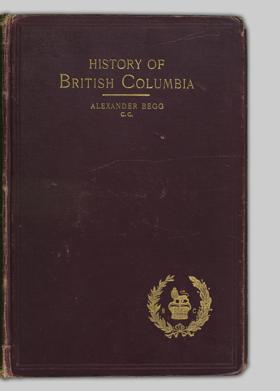
Published in 1894, Alexander Begg's comprehensive volume chronicles the political and economic evolution of British Columbia, tracing its trajectory from early maritime exploration and the fur trade era to its eventual confederation with Canada. A keen insight drawn from the text is how Begg’s narrative functions simultaneously as a historical record and a piece of deliberate economic boosterism, actively framing the region's transition from a guarded Hudson's Bay Company monopoly into a civilized province as a triumph of British imperial progress designed to attract settlers and investment. The author meticulously details the transformative impacts of the Fraser River and Cariboo gold rushes, the administrative leadership of James Douglas, and the critical unifying role of the Canadian Pacific Railway. Ultimately, the book stands as an exhaustive, albeit heavily pro-colonial, late 19th-century archive documenting the foundational events that integrated a rugged frontier into the Canadian dominion. xvii, [7]-568 pages : illustrations, folded map, portraits ; 23 cm ONLINE CIRC [ 1 ]
|
1894 |
|
The Siwash their life, legends and tales; Puget Sound and Pacific Northwest by Joseph A. Costello
Published in 1895, Joseph A. Costello’s The Siwash: Their Life, Legends and Tales is an early ethnographic compilation documenting the oral traditions, daily customs, and folklore of the Coast Salish peoples across the Puget Sound region. A keen insight drawn from the text is how the author's reliance on the Chinook Jargon term "Siwash"—derived from the French word for "savage"—exposes the inherent paradox of late 19th-century settler literature, which eagerly commodified and preserved Indigenous heritage while viewing the people themselves through a deeply paternalistic, colonial lens. The narrative compiles regional creation myths, spiritual practices, and historical anecdotes, filtering complex indigenous histories through the perspective of the incoming white pioneers. Ultimately, the volume stands as both a foundational, albeit flawed, archive of Pacific Northwest Native American legends and a revealing historical artifact of the era's complex attitudes toward indigenous displacement. vii, [3], 169 pages : frontispiece, plates, portraits ; 24 cm ONLINE CIRC [ 1 ]
|
1895 |
|
Salt Spring Island, British Columbia by Edward F. Wilson 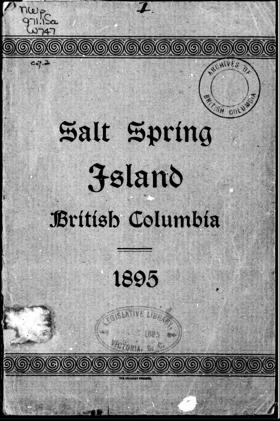
Originally marked on the naval charts of 1858 as "Admiral Island," it has of late years altogether dropped that name, and is now known both popularly, and also in the more recently published maps, as Salt Spring Island^ — the saline springs, of which there are some 14 or 15 on the island, being sufficient reason for its present name 30 pages : illustrations, map ONLINE CIRC [ 1 ]
|
1895 |
|
Indianische sagen von der nord-pacifischen küste Amerikas by Franz Boas
Published in 1895, Franz Boas's Indianische Sagen von der Nord-Pacifischen Küste Amerikas is a foundational German-language compilation of indigenous myths, legends, and oral traditions gathered from numerous tribes along the Pacific Northwest coast. The text meticulously documents the folklore of groups such as the Tlingit, Haida, and Coast Salish, focusing heavily on widespread cultural narratives like the Raven cycle and various regional creation myths. A keen insight drawn from the work is Boas's pioneering use of these folktales to prove the theory of cultural diffusion, demonstrating how specific narrative motifs spread across distinct linguistic barriers through extensive trade and intermarriage rather than developing independently. By mapping these shared story elements across vast geographic areas, Boas fundamentally challenged the era's prevailing theories of unilineal cultural evolution and established a new standard for rigorous comparative anthropology. vi, 363, [1] pages map 26 cm ONLINE CIRC [ 1 ]
|
1895 |
|
San Juan and secession possible relation to the War of the Rebellion by Granville O. Haller 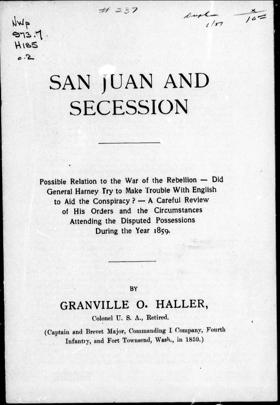
Published in 1896 by Major Granville O. Haller, this historical pamphlet re-examines the 1859 "Pig War" boundary dispute over San Juan Island between the United States and Great Britain. A keen insight drawn from the text is Haller's controversial thesis that the aggressive military escalations by Captain George Pickett and General William S. Harney were not merely localized bravado, but rather a deliberate conspiracy by Southern sympathizers to provoke a unifying national war with Britain to distract from the impending American Civil War. The author leverages his firsthand military experience during the crisis to reframe this bizarre frontier standoff as a high-stakes geopolitical gambit tied directly to the secessionist movement. Ultimately, the work transforms a seemingly comical regional squabble into a fascinating exploration of pre-Civil War political machinations in the Pacific Northwest. 15 pages ; 23 cm ONLINE CIRC [ 1 ]
|
1896 |
|
New light on the early history of the greater North-west. The manuscript journals of Alexander Henry ... and of David Thompson ... 1799-1814. Exploration and adventure among the Indians on the Red, Saskatchewan, Missouri, and Columbia rivers by Alexander Henry, David Thompson, Elliott Coues
Published in 1897 and meticulously annotated by historian Elliott Coues, this foundational three-volume work compiles the raw manuscript journals of North West Company fur trader Alexander Henry and master topographer David Thompson from 1799 to 1814. A keen insight drawn from the text is how Henry’s brutally candid daily entries shatter the romanticized myth of the heroic frontiersman, exposing the early North American fur trade as a ruthlessly pragmatic enterprise heavily reliant on the deliberate weaponization of alcohol to control and exploit Indigenous populations. The narrative tracks their extensive expeditions across the Red, Saskatchewan, Missouri, and Columbia river basins, providing granular details on frontier survival, commercial logistics, and complex tribal negotiations. Ultimately, by fusing Thompson’s unparalleled geographical surveys with Henry’s gritty cultural observations, the compilation stands as an indispensable primary source for understanding the harsh geopolitical realities of the early Pacific Northwest. 3 volumes frontispiece (portrait) maps (in pocket) 25 cm ONLINE CIRC [ 3 ]
|
1897 |
|
Notes on the cosmogony and history of the Squamish Indians of British Columbia by Charles Hill-Tout, Royal Society of Canada 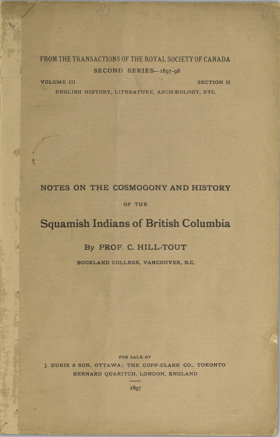
Published in 1897 within the Transactions of the Royal Society of Canada, Charles Hill-Tout’s ethnographic monograph provides an early, detailed record of the oral traditions, creation myths, and social structures of the Squamish (Sḵwx̱wú7mesh) people of British Columbia. A keen insight drawn from the text is how Hill-Tout’s underlying framework of "salvage anthropology"—the assumption that he was documenting a doomed, vanishing race—inadvertently highlights the immense, destructive pressure that colonial assimilation policies were already exerting upon Indigenous communities at the turn of the century. The work meticulously catalogs their ancestral stories, complex cosmology, and historical origins in a dedicated effort to preserve their cultural heritage. Despite being heavily filtered through the paternalistic academic lens of its era, the publication remains a crucial archival resource for understanding the early linguistic and cultural history of the Coast Salish peoples. 85-90 pages 25 cm ONLINE CIRC [ 1 ]
|
1897 |
|
Traditions of the Thompson River Indians of British Columbia by James Alexander Teit (Compiler, Annotator), Franz Boas (Writer of introduction) 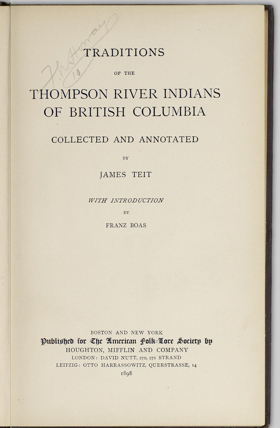
The following collection of traditions is the result of the long-continued studies of Mr. James Teit on the Thompson River Indians of British Columbia. The tales have been recorded with great care. The present collection contains the prevalent versions, while variants are given in notes accompanying the tales. I have added to the notes a number of references to similar tales found among other tribes of North America. These references do not claim to be exhaustive, but an attempt has been made to bring forward the more important points of similarity between the traditions of the Thompson River Indians and those of other tribes. I have also added brief abstracts of the tales, in order to facilitate the use of the collection by the student of comparative mythology. -Franz Boas viii pages, 1 leaf, 137 pages 25 cm. ONLINE CIRC [ 1 ]
|
1898 |