Catalog of British Columbiana and Pacific Northwest Americana
Encyclopedia Cascadia Catalog contains book titles of mostly non-fiction Pacific Northwest Coast of North America Titles (primarially British Columbia, Idaho, Oregon and Washington State) in an easy-to-understand title catalog. If you see a link with this badge ONLINE CIRC it means that there is an online institution that provides free access to that title. In some cases there may be more than one institution hosting the title digitally.
| Catalog Title | Published |
|---|---|
|
The Queen Charlotte Islands volume 1 ; 1774-1966 by Kathleen E. Dalzell
|
1981 |
|
The Queen Charlotte Islands volume 2 ; places and names by Kathleen E. Dalzell
|
1981 |
|
Settling Clayoquot by Bob Bossin
|
1981 |
|
Now you are my brother missionaries in British Columbia by Margaret Whitehead
|
1981 |
|
Along the way by Margaret Lang Hastings
|
1981 |
|
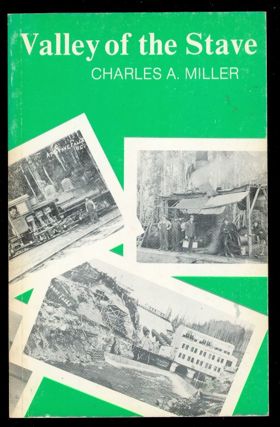
Valley of the Stave by Charles A. Miller
|
1981 |
|
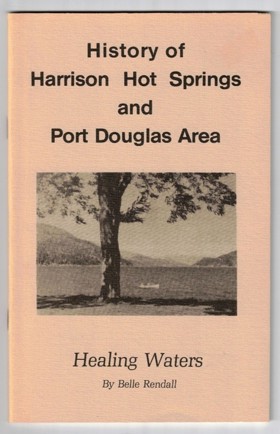
History of Harrison Hot Springs and Port Douglas area healing waters by Belle Rendall, Harrison Lake Historical Society
|
1981 |
|
Backroad adventures through interior British Columbia by Donovan Clemson 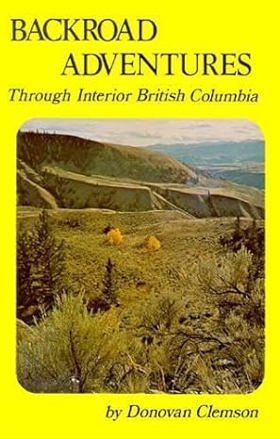
BACKROAD ADVENTURE takes us through the great stretch of country lying between the Coast range and the Rockies, south of Prince George. It is about the quiet remote places and the people one finds sheepherders in alpine pastures, ranchers in secluded valleys, fire watchers on isolated mountain tops, and the lonely ferrymen. The byways straggle and wander through the interior, leading to dry valleys where fantastic rock formations surprise the stranger; or to remote jack pine plateaux where back woods ranchers count many miles between neighbors. Threading the timbered Kootenay valleys, quiet and friendly roads trail past the fast fading relics of ghostly mining towns and rustic settlements which time has passed by. 192 pages : illustrations ; 21 cm CIRC [ 1 ]
|
1981 |
|
Chief Joseph country land of the Nez Perce by Bill Gulick 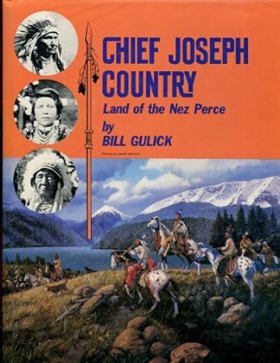
The relationship between Westering Americans and the Nez Perce Indians covers a time-span of one hundred years, from the meeting of the Lewis and Clark party with the Indians in 1805 to the death of Chief Joseph in 1904. It is epic drama, taking place on a vast stage during a critical period in the development of the United States. Certainly no setting could be more spectacular than the rugged, beautiful homeland of this tribe. No story can equal in historical importance the long-standing friendship given by the Nez Perces to the white newcomers in their country. And no event is more poignant, bitter, and tragic than the Nez Perce War. Before acquiring the horse around 1730, the Nez Perces occupied approximately 27,000 square miles of what is now north-central Idaho, northeastern Oregon, and southeastern Washington. After becoming a mounted people, they ranged over a much larger area, traveling east to the buffalo country claimed by Blackfeet, Crow, and Sioux, west to the great fishing and trading station on the lower Columbia, Celilo Falls. Uniquely situated as they were between the Plains and Coastal Indian cultures, they would play a key role in the struggle between Great Britain and the United States as to which nation would take title to the Pacific Northwest. In Chief Joseph Country: Land of the Nez Perce, author Bill Gulick lets the participants in the developing drama tell the story in their own words by excerpting diaries, letters, and statements made in contemporary accounts. Beginning with the prehistory of the Nez Perces, he relates how, after being pedestrians for eight thousand years, acquisition of the horse drastically altered their way of life. Then, in rapid succession, came firearms, American explorers, British fur traders, the Manifest Destiny struggle, missionaries, Oregon Trail emigrants, settlers, gold miners, farmers, and finally war. "If there is a bias in this book, it is that I have given more credence to statements made by Indians than to words written by white men," the author says. "Time and again in my research I have come across references to the importance the Indian placed on telling the plain, simple truth when relating any event in which he was involved. To the contrary, time and again I have found statements made by white leaders so contradictory and at variance with the truth that I began to question everything they wrote." In selecting the many historical photographs and sketches used to illustrate the book, the author examined the holdings of some twenty institutions from coast to coast, some of which dated back to the 1850s. As he did in Snake River Country, Bill Gulick applies skills learned as a novelist and dramatist to the non-fiction field of history, using the twin tools of dramatic narrative and sound research to bring history alive to the layman reader. He writes: "As in all epic dramas, forces beyond the understanding or control of the people involved were at work as the Nez Perces and the whites confronted one another, driving them toward a fate neither could forsee. "Here, I have recorded that confrontation from the Indian point of view." xiv, 316 pages : illustrations ; 29 cm CIRC [ 1 ]
|
1981 |
|
Tales of Eastern Idaho by David L. (David Lester) Crowder
|
1981 |
|
Puget's sound a narrative of early Tacoma and the southern Sound by Murray Morgan 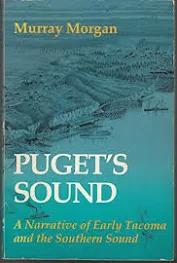
With the same ability to make personalities and events come alive that characterizes his classic "Skid Road", Murray Morgan here tells the colorful story of southern Puget Sound, where major events of Washington's history took place, and of Tacoma, the area's principal city. Drawing upon the original journals and reports, Morgan tells his story largely in terms of individuals, interweaving portraits of well-known historical figures with those who are more obscure but who have a special significance. Journalist and historian Murray Morgan (1916-2000) was the author of more than twenty books, including "Skid Road: An Informal Portrait of Seattle" and "The Last Wilderness". He worked for "Time" magazine, the "New York Herald Tribune", and CBS News before returning to Washington where he taught at Tacoma Community College and for fifteen years hosted the early morning radio show 'Our Town, Our World.' 360 s. : illustrations CIRC [ 1 ]
|
1981 |
|
Whatcom scenes a miscellany of prose and verse by Dorothy Koert 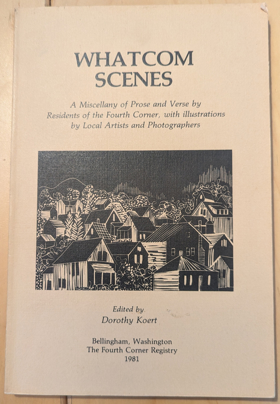
Whatcom Scenes, 1981, edited by Dorothy Koert. A miscellany of prose and verse by residents of the fourth corner, with illustrations by local artists and photographers. Paperback with 134 pages, published by The Fourth Corner Registry. xvi, 134 pages : illustrations ; 23 cm CIRC [ 1 ]
|
1981 |
|
Railroad man a conversation with W.J. Gamble, W.I. & M. Ry. Co by Latah County Historical Society 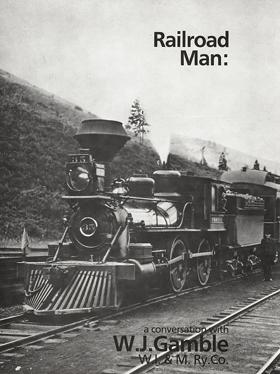
A conversation with W.J. Gamble about his life working for the Washington, Idaho & Montana Railway Company from 1910 until his retirement in 1951, including the origins and development of the railroad and his relationship with it. 16 pages : illustrations, maps, portraits ; 26 cm CIRC [ 0 ]
|
1981 |
|
Overland from Canada to British Columbia by Thomas McMicking, Joanne Leduc 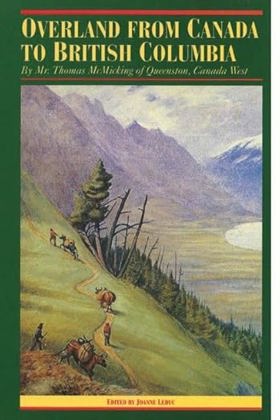
Spurred on by reports of gold in the Cariboo, adventurers from all over the world descended on British Columbia in the mid-1800s. Among them were ambitious easterners who accepted the challenge of the shorter but more arduous overland route across the prairies and the Rockies. One such man determined to find his fortune in the West was Thomas McMicking – destined to lead the largest and best organized group of “Overlanders” into British Columbia. His record of their epic journey is a valuable historical document that possesses the universal appeal of an adventure story. McMicking presents a vivid image of the hardships of the overland route, the dangers, both real and imagined -- like the apparently threatening Plains Indians who turned out to be “our best friends” – facts about important officials and settlements, and scientific observations of the physical environment. But this is also a very human document that describes a journey of self-discovery revealing a sensitive man’s encounter with a bountiful and beautiful yet hostile and alien land. The journal is augmented by a valuable introduction, appendices on the Overlanders’ trail and the McMicking family, and biographical sketches of many of the men who later played prominent roles in British Columbia’s development and whose descendants became some of the province’s best-known leaders and families. It is also enriched by the pictorial records of William Hind, a major Canadian painter who became known as the “expedition artist.” Drawing on much previously unavailable material as well as on traditional sources, the editor has created a comprehensive historical framework for this unique document. xl, 121 pages : illustrations, maps ; 23 cm. CIRC [ 0 ]
|
1981 |
|
Totem poles an illustrated guide by Marjorie M. Halpin, Michael M. Ames 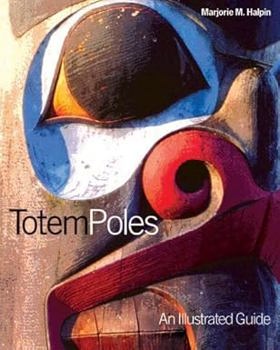
Presents an illustrated history of the totem poles of the Native peoples of the Northwest Coast and examines their form and meaning, origin and cultural significance to those in the Pacific Northwest 58 pages : illustrations (some color) ; 26 cm CIRC [ 0 ]
|
1981 |
|
Walla Walla, a town built to be a city, 1900-1919 by Robert Allen Bennett
|
1982 |
|
South Whidbey and its people Volume 1 by Lorna Cherry, South Whidbey Historical Society 
How it was formed. Indians - the first inhabitants. Early explorers and the arrival of settlers. The giant mammoths that once roamed here. And much, much, more. volumes : illustrations ; 26 cm CIRC [ 1 ]
|
1982 |
|
Green gold for America the life and times of Roderic Marble Olzendam by Roderic Marble Olzendam, Gordon Keith
|
1982 |
|
History of Hood River County, Oregon, 1852-1982 by Hood River County Historical Society
|
1982 |
|
Paths to the Northwest a Jesuit history of the Oregon Province by Wilfred P. Schoenberg 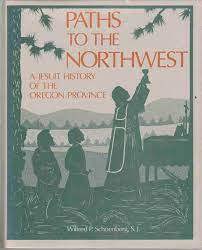
A detailed history of the Oregon Province of the Jesuits from 1831 to 1982. The Oregon Province includes St. Ignatius Mission. Illustrates how the Pacific Northwest Indian missions became a very small part of the Province's business as it grew. The Alaskan Mission and Jesuit educational work occupied most of the Province's resources xiii, 647 pages, 2 unnumbered leaves of plates : illustrations ; 26 cm CIRC [ 1 ]
|
1982 |
|
The Rogue, a river to run (the story of pioneer whitewater river runner Glen Wooldridge and his first eighty years on the Rogue River) by Florence Arman, Glen Wooldridge 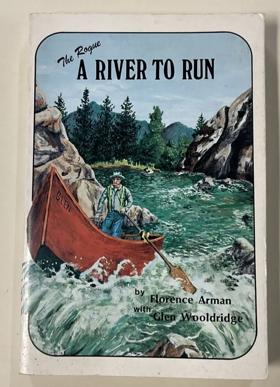
"One day in 1915, I started down the Rogue River in a boat I made. My first trip, I was a wild brainless kid of course, learning the hard way by rambunctious adventure, the needs to explore the unknown, down the plunging rapids. The Rogue is a wild brawling river and you had better respect it. I learned to use the oars, the pikepole, rope line, currents and eddies, and how to read the water. I craved fast white water like a steelhead, and tried lots of rivers like the Klamath, the Salmon River of No Return, Canadian rivers, etc., but for me the Rogue beats them all. Later I hauled dudes... hundreds of them... maybe over a thousand, shooting the rapids and camping out on the beach in the wilds." These stories and many more are in this no-holds-barred book. But more than that, it tells of the Rogue itself, of its development and its people. It gives you a sense of an earlier time - a time whose only remnants are rusting pieces of mining equipment, fiant traces of burned cabins and crumbling bridge piers. It brings alive the grizzled miners always looking to strike it rich tomorrow; hermits toting rifles after the ultimate game, each other; tall-tale tellers; poachers and gamewardens; fueders, gillnetters, sportsmen and unsportsmen. It tells of blasting the channel downriver, of floods and rescues, of depression and river-running highs. xv, 276 pages : illustrations ; 23 cm CIRC [ 1 ]
|
1982 |
|
|
1982 |
|
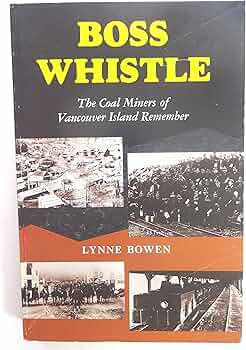
Boss whistle the coal miners of Vancouver Island remember by Lynne Bowen
|
1982 |
|
Digressions of a native son by Emmett Watson 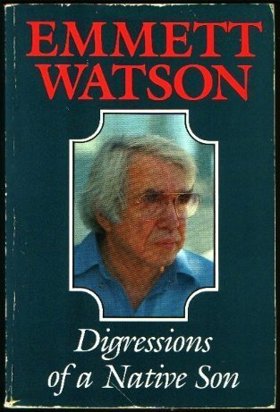
Digressions of a Native Son is a 1982 memoir by Emmett Watson (1918-2001), a Seattle journalist whose columns appeared in Seattle newspapers for more than 50 years. 251 pages ; 21 cm CIRC [ 0 ]
|
1982 |
|
Draft environmental impact statement for Madrona Point, Eastsound, Washington July 1982 by San Juan County (Wash)., Northwest Building Corporation 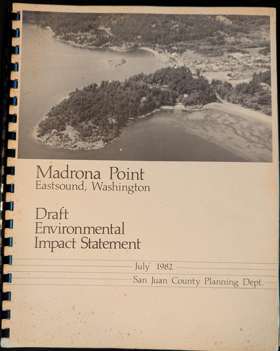
Platting of a 29.67 acre subdivision on Madrona Point, adjacent to the unincorporated town of Eastsound, into eleven single family lots (approx. 9 acres) five tracts for multi-family housing (approx. 3-1/2 acres) to contain 30 dwelling units in four- and five-unit buildings, and two larger tracts for future development subject to binding site plan approval (approx. 10-3/4 acres), intended for 61 multi-family dwellings in two- and four-unit buildings. In addition, four community recreation tracts will be established. On one of the community tracts a small caretaker's residence would be constructed, bringing the total of proposed residential units to 103. 241 pages : illustrations, maps ; 28 cm CIRC [ 1 ]
|
1982 |