Catalog of British Columbiana and Pacific Northwest Americana
Encyclopedia Cascadia Catalog contains book titles of mostly non-fiction Pacific Northwest Coast of North America Titles (primarially British Columbia, Idaho, Oregon and Washington State) in an easy-to-understand title catalog. If you see a link with this badge ONLINE CIRC it means that there is an online institution that provides free access to that title. In some cases there may be more than one institution hosting the title digitally.
| Catalog Title | Published |
|---|---|
|
The Pig War and other experiences of William Peck soldier 1858-1862, U.S. Army Corps of Engineers : the journal of William A. Peck, Jr. by William A. Peck, C. Brewster Coulter, Bert Webber 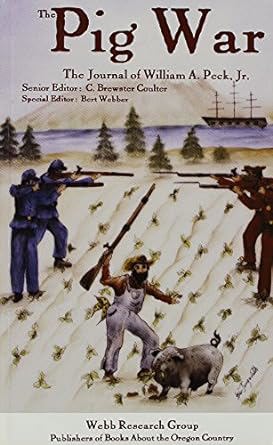
Edited by C. Brewster Coulter and Bert Webber, The Pig War and Other Experiences of William Peck, Soldier 1858-1862 presents the remarkable personal journal of a U.S. Army engineer stationed in the Pacific Northwest during a tense geopolitical standoff. The book chronicles Private William A. Peck's daily life, military duties, and keen observations surrounding the infamous 1859 San Juan Island boundary dispute between the United States and Great Britain. Through these rare primary documents, the text captures the stark isolation, raw camp conditions, and quiet diplomacy that characterized an uneasy international borderlands garrison. A keen insight drawn from the work is how military journals humanize imperial brinkmanship; by filtering an international crisis through the mundane daily chores and reflective musings of an ordinary soldier, the narrative reveals that historical flashpoints are often lived not as grand historical dramas, but as tedious, freezing waits in remote wilderness outposts. x, 236 pages : illustrations, maps ; 21 cm CIRC [ 1 ]
|
1993 |
|
Lights of the inside passage a history of British Columbia's lighthouses and their keepers by Donald Graham 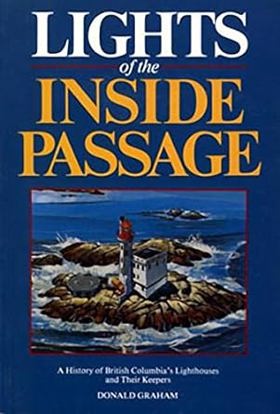
The lighthouses of the inside passage, many of them built to guide prospectors on their way to the Klondike, stretch from sheltered stations on the Gulf Islands to stark, storm-swept Triple Island and Langara, south of Alaska. Feel the fury of destructive North Pacific gales and tidal waves that ravage the coast; ponder the unsolved murder of Addenbrooke's keeper, and the mysterious disappearances on Egg Island; witness the insanity caused by isolation -and enjoy the contentment and peace that many keepers found on their solitary stations. Don Graham, keeper at Vancouver's Point Atkinson light, tells the stories of individual lighthouses, then brings the history of lightkeepers in general into the present. The century-old tradition of service that has insured the safety of West Coast mariners and ships is currently threatened by automation, and Graham presents a persuasive case against unmanning the lights through his account of the dedication and endurance of pioneer keepers. 269 str. : ilustr. ; 25 cm CIRC [ 1 ]
|
1993 |
|
The other side of Oregon by Ralph Friedman 
A collection of history, biographies and tales of what makes the eastern side of Oregon unique. The Other Side of Oregon is filled with stories about people and places that make the state special, spiced with philosophical tidbits from the author. xii, 425 pages : illustrations ; 23 cm CIRC [ 1 ]
|
1993 |
|
Terrible trail the Meek Cutoff, 1845 by Keith Clark, Lowell Tiller, Maverick Publications 
In the winter of 1960, when Keith Clark and Lowell Tiller hit upon the idea of investigating the tragic history of the Meek Cutoff in Oregon, they formulated four goals: To write an investigative if not definitive work on the subject. To lay to rest the mass of misinformation about the route of those lost and wandering pioneers who made up the Meek Train. To narrate the passage of the emigrant train whose tragic experience rivaled - indeed, surpassed, in the number of deaths -that of the Donner Party of California. To help lay the groundwork for the solution of the Blue Bucket mystery. This book offers the results of the achievement of these goals. In 1845, when emigrant parties reached old Fort Boise on the Snake River, they still faced many tortuous miles through the Blue Mountains and down the Columbia to The Dalles. A shortcut which would avoid this fearsome part of the journey seemed to have been discovered by Stephen H. L. Meek, older brother of Joe Meek. Confident that he could lead wagons through territory where he had trapped, and west across the Cascades through country he knew only by description, Meek, an intrepid mountain man, persuaded two hundred families to follow him through the trackless desert country of central Oregon. The emigrants made their way up the Malheur River, building their road as they went; and the story of their suffering, despair, and eventual rescue is presented in the pages of this book. Somewhere along the route to the Willamette Valley a group of these wandering people stumbled onto gold only to lose sight of it again. Subsequent searchers have traced and retraced the trail for more than a hundred years but to no avail. The book throws new light on the possibility of a rediscovery of the long-lost Blue Bucket gold. There are thirty-three illustrations from photographs, three maps and an endsheet map, a bibliography, an index, and a roster of names of pioneers. xx, 279 pages : illustrations, maps ; 22 cm CIRC [ 1 ]
|
1993 |
|
History of the flower bulb industry in Washington State by Charles J. Gould 
Published by the Washington State University Agricultural Experiment Station and authored by plant pathologist Charles J. Gould, History of the Flower Bulb Industry in Washington State details the remarkable mid-20th-century rise of commercial bulb production in the Pacific Northwest. The text chronicles how immigrant growers and agricultural innovators capitalized on the region's mild, maritime-influenced climate—particularly in the Puget Sound and Skagit valleys—to successfully rival traditional European floral markets. Through detailed historical accounts and horticultural data, the book documents the labor-intensive cultivation of daffodils, tulips, and iris that transformed local farmland into vibrant floral landscapes. A keen insight drawn from the work is how regional agricultural booms often rely on imported microclimates; by identifying that Western Washington's cool, damp springs closely mirrored the prized growing conditions of the Netherlands, the industry proved that niche economic success can be engineered by aligning local ecological quirks with international market demands. ix, 309 pages : illustrations, maps ; 23 cm CIRC [ 1 ]
|
1993 |
|
Washington off the beaten path by Todd Litman, Suzanne Kort 
Published as a regional travel guide by Todd Litman and Suzanne Kort, Washington Off the Beaten Path steers travelers away from crowded metropolitan tourist traps and toward the state's hidden roadside gems, quirky local museums, and secluded natural wonders. The book takes readers on a comprehensive journey across Washington's diverse terrain—from the rain-drenched coastal forests of the Olympic Peninsula to the high-desert canyons of the Inland Empire—highlighting lesser-known historical sites and eccentric community landmarks. Through descriptive entries and practical travel tips, the authors champion the curious explorer willing to trade interstate highways for winding rural backroads. A keen insight drawn from the work is how alternative travel guides subvert standard tourism economies; by assigning cultural and recreational value to overlooked rural outposts, the book reframes geographic isolation and quirky local character not as economic liabilities, but as precious antidotes to mass-market commercialization. xii, 180 pages : illustrations, maps ; 21 cm CIRC [ 1 ]
|
1993 |
|
The white tide by Ruth Dunbar 
Published by regional presses, The White Tide by Ruth Dunbar explores the dramatic social and environmental transformations accompanying early settlement and resource exploitation in the Pacific Northwest. The book traces the rapid influx of pioneers, industrial loggers, and speculators whose arrival fundamentally altered indigenous landscapes and traditional ways of life across the region's river valleys and coastal frontiers. Through narrative character studies and historical context, the text highlights the heavy human and ecological costs borne by a rapidly commercialized wilderness. A keen insight drawn from the work is how the metaphor of a "white tide" captures the overwhelming, impersonal force of frontier expansion; settlement was experienced not merely as a gradual migration, but as an encroaching, high-tide wave that permanently submerged native ecosystems and historical land-use patterns under an unyielding tide of industrial modernity. v, 248 pages : illustrations ; 22 cm CIRC [ 1 ]
|
1993 |
|
Pacific graveyard a narrative of shipwrecks where the Columbia River meets the Pacific Ocean by Jim Gibbs 
Man's age-old struggle with the sea comes historically alive in these true stories of shipwrecks off the Oregon and Washington coasts -- all near the mouth of the Columbia River. Dramatic photos of disaster and rescue at sea are placed with the stories they illustrate. Narrative appendix lists all wrecks; pictorial map gives locations. Fourth edition. 5 1/2 x 8 1/2. Highlighted by over 100 superb photos. Index. 304 pages. Companion to "Pacific Graveyard Shipwrecks Chart." 302 pages : illustrations, maps ; 22 cm CIRC [ 1 ]
|
1993 |
|
Railroad signatures across the Pacific Northwest by Carlos A. Schwantes 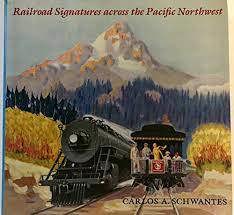
Demonstrates that the railroads profoundly affected the way people lived, how they adjusted to the new opportunities or threats that swift and cheap transportation provided. In short, how they viewed the world.This book is for everyone fascinated by trains and their nineteenth-century opening of the great Northwest. With cases of pictures never before published this book tracks the stories of families lured to settle in the west, revelations about railroad buccaneers, and breathtaking engineering feats of bridges over daunting gorges - Gene Shalit, The Today Show, NBC 359 pages : illustrations (some color) ; 26 x 27 cm CIRC [ 1 ]
|
1993 |
|
Lakelure a tale of Medina, Washington by Junius Rochester 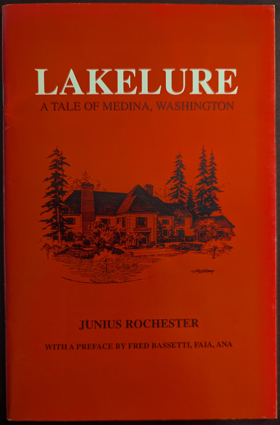
Published by local historian Junius Rochester, Lakelure: A Tale of Medina, Washington chronicles the colorful transformation of an exclusive eastern shore community along Lake Washington. The book traces Medina's evolution from a dense, stump-strewn wilderness and early 20th-century strawberry-farming enclave into one of the most affluent residential suburbs in the Pacific Northwest. Through historical photographs and engaging local archives, the text captures the summer-resort origins of families who fled the urban clamor of Seattle via the historic mosquito fleet ferries long before the floating bridges spanned the lake. A keen insight drawn from the work is how suburban wealth in the Seattle region repurposed geographical sanctuary into exclusivity; the transition of Medina from a quiet agrarian refuge into a fortress of tech barons and elites illustrates how pristine lakeside isolation is ultimately commodified and walled off from the very metropolitan core it once sought to escape. ii, 42 pages : illustrations ; 23 cm CIRC [ 1 ]
|
1993 |
|
The Lone Ranger and Tonto fistfight in heaven by Sherman Alexie 
In this darkly comic short story collection, Sherman Alexie, a Spokane/Coeur d'Alene Indian, brilliantly weaves memory, fantasy, and stark realism to paint a complex, grimly ironic portrait of life in and around the Spokane Indian Reservation. These twenty-two interlinked tales are narrated by characters raised on humiliation and government-issue cheese, and yet are filled with passion and affection, myth and dream. There is Victor, who as a nine-year-old crawled between his unconscious parents hoping that the alcohol seeping through their skins might help him sleep, Thomas Builds-the-Fire, who tells his stories long after people stop listening, and Jimmy Many Horses, dying of cancer, who writes letters on stationary that reads "From the Death Bed of Jimmy Many Horses III," even though he actually writes then on his kitchen table. Against a backdrop of alcohol, car accidents, laughter, and basketball, Alexie depicts the distances between Indians and whites, reservation Indians and urban Indians, men and women, and mostly poetically between modern Indians and the traditions of the past x, [2], 223 pages ; 24 cm CIRC [ 0 ]
|
1993 |
|
New land, new lives Scandinavian immigrants to the Pacific Northwest by Janet Elaine Rasmussen 
"NEW LAND, NEW LIVES tells in their own words the experiences of 45 immigrants (28 of them women) in the early years of the 20th century. Rasmussen's selections capture the textures and tones of ordinary life. They show how the cultures the immigrants had known in the Old World influenced . . . life in the Pacific Northwest".--TACOMA NEWS TRIBUNE. 41 photos xiii, 320 pages : illustrations, 2 maps ; 25 cm CIRC [ 0 ]
|
1993 |
|
Slough of memories recollections of life in Bothell, Kenmore, North Creek, Woodinville, 1920-1990 by Fred Klein, Northshore History Boosters 
Slough of Memories: Recollections of Life in Bothell, Kenmore, North Creek, Woodinville, 1920-1990, compiled by Fred Klein and the Northshore History Boosters, is a detailed historical account of Washington State's Northshore communities. Published in 1992, the book relies on firsthand personal accounts, historical records, and photographs to trace the area's development along the Sammamish River, which was historically referred to locally as a slough. The narrative captures the everyday lives, cultural shifts, and economic growth of the region over a seventy-year span, documenting its gradual transformation from quiet rural agricultural outposts into bustling Seattle suburbs. ix, 211 pages : illustrations, maps ; 28 cm CIRC [ 1 ]
|
1992 |
|
Early Castle Rock and north Cowlitz County, Washington by Leland G. Jackson 
The late Leland Jackson (author), whose ancestors were among the early families to migrate to the area that was to become Castle Rock, Washington, was fortunate enough to appreciate local history and sufficiently skilled to write about it in a style that is both informative and easy to follow. This book provides readers insight into the hardships and joys the settlers experienced. xi, 160 pages : illustrations, maps ; 28 cm CIRC [ 1 ]
|
1992 |
|
Oysterville roads to grandpa's village by Willard R. Espy , Earl Thollander (Illustrator) 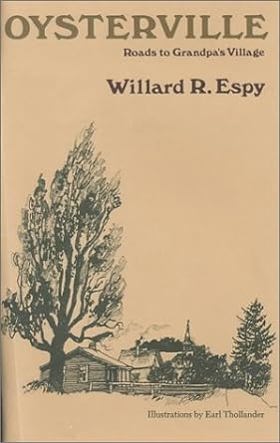
Features tales of four families who settled up and down the East Coast of America three centuries ago and subsequently migrated west, eventually arriving at the tiny settlement of Oysterville on the Pacific coast in the territory of Washington. 300 pages : illustrations ; 26 cm CIRC [ 1 ]
|
1992 |
|
Chief Joseph's allies by Clifford E. Trafzer, Richard D. Scheuerman 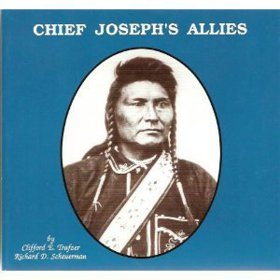
Authored by historians Clifford E. Trafzer and Richard D. Scheuerman, Chief Joseph's Allies chronicles the complex and often overlooked role of the Palus, or Palouse, people during the tragic Nez Perce War of 1877. The book details how these indigenous communities bravely navigated escalating colonial pressures, offered vital sanctuary and alliance to Chief Joseph's band across the Columbia Plateau, and subsequently suffered devastating displacement and military retribution. Through rich archival documentation and tribal oral histories, the text restores the voices of a sovereign people whose historical narrative was long suppressed by dominant frontier myths. A keen insight drawn from the work is how regional military histories deliberately erase peripheral indigenous actors; by centering the strategic sacrifices of the Palouse, the authors reveal that the tragic outcome of 1877 was not just a bilateral conflict between the U.S. Army and the Nez Perce, but a multi-tribal resistance effort against an overwhelming imperial enclosure of the entire Columbia River basin. vii, 112 pages : illustrations ; 21 x 22 cm CIRC [ 1 ]
|
1992 |
|
Battle Rock the hero's story : a true account, Oregon coast Indian attack : an Oregon documentary by Bert Webber, Margie Webber, J. M. Kirkpatrick 
Published by maritime historians Bert Webber, Margie Webber, and J.M. Kirkpatrick, Battle Rock: The Hero's Story chronicles the harrowing 1851 clash between a small party of American gold-seekers led by Captain William Tichenor and the local Quat-a-qtie (Tututni) people on the southern Oregon coast. The book details the group's desperate defense atop a rocky sea stack in present-day Port Orford after an initial exploratory landing provoked fierce Indigenous resistance to protect their ancestral territory. Drawing on historical documents, pioneer journals, and local accounts, the text preserves a violent and foundational episode of frontier expansion. A keen insight drawn from the work is how regional historical documentation often elevates colonial survival narratives while obscuring the broader geopolitical trauma; by framing the skirmish through the heroic lens of isolated pioneers under siege, the account masks the reality that the true assault was an unprovoked imperial intrusion onto sovereign Indigenous land. 75 pages : illustrations, maps, portraits ; 22 cm CIRC [ 1 ]
|
1992 |
|
Vancouver's voyage charting the Northwest Coast, 1791-1795 by Robin Fisher 
Traces the history of Vancouver's expedition to explore and map the west coast of North America xi, 131 p. : ill. (some col.) ; 25 x 26 cm. CIRC [ 1 ]
|
1992 |
|
Art in Seattle's public places an illustrated guide by James M. Rupp, Mary Randlett 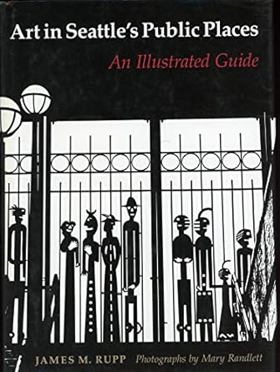
Covers art in Seattle's neighborhoods, including the downtown, Pioneer Square, the University of Washington, Green Lake and north Seattle. Includes sculpture, stained glass and murals 320 pages : illustrations, maps ; 27 cm CIRC [ 1 ]
|
1992 |
|
Hail, Columbia! Robert Gray, John Kendrick, and the Pacific fur trade by John Scofield 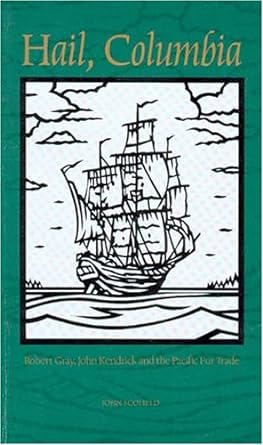
On the first day of October 1787, captains John Kendrick and Robert Gray, along with fifty other men - sailors and tradesmen alike - set sail from Boston, soon to be the first Yankees to lay eyes on the lush and resource-rich Northwest Coast of North America. This journey, and Gray's subsequent voyage in 1790, were trading ventures that would lead to little wealth for anyone involved, but would supply future generations with rich stories of encounters between the Native Americans and the traders, of desperate escapades along the coast, and, eventually, the reward to the United States of the Columbia River. Kendrick, on board the Columbia Rediviva, and Gray, on the Lady Washington, maneuvered around treacherous Cape Horn, then sailed north up the western coasts to present-day Oregon, Washington, and British Columbia. There they traded with the Indians for the prized sea-otter pelts (called by the Russians "soft gold"). Finally, they would sail for the China ports of Macao and Canton, where they traded the skins for tea and fine china. The American ships had joined a contingent of international vessels (mostly British and Spanish) assembled at Nootka Sound, some to trade, others on voyages of exploration. The two captains eventually would switch ships, and Kendrick would remain on the Northwest Coast, while Gray sailed on to China and to Boston - then back once again. These were the first citizens of the new nation to sail into the Pacific, and the repercussion of their voyages would ring loudly for years to come. The dreamer Kendrick would never return to Boston, choosing to remain on the other side of the world until his death in the Sandwich Islands, late in 1794. The more pragmatic Gray would continue his career as a sea captain into the nineteenth century. xx, 378 pages : illustrations, maps ; 26 cm. CIRC [ 1 ]
|
1992 |
|
Gray & Columbia's River by Joean K. Fransen 
Authored by Joean K. Fransen, Gray & Columbia's River chronicles the maritime explorations of Captain Robert Gray and his historic 1792 discovery of the great river of the West. The book traces Gray's momentous voyage aboard the Columbia Rediviva, detailing his navigation of treacherous Pacific Northwest coastal waters and the lucrative sea otter trade that tied the region to global maritime markets. Through engaging historical narrative, the text highlights the sheer tenacity and seamanship required of early American merchants operating along an unmapped and dangerous frontier. A keen insight drawn from the work is how a single geographic discovery altered the geopolitical fate of an entire continent; by successfully crossing the treacherous bar of the Columbia River, Gray secured vital territorial claims for the United States that fundamentally reshaped the destiny of the Pacific Northwest. ii, 143 pages : illustrations, maps ; 22 cm CIRC [ 1 ]
|
1992 |
|
Naval Station Puget Sound at Sand Point by Dennis Stuhaug, United States Department of the Navy Morale, Welfare and Recreation Department 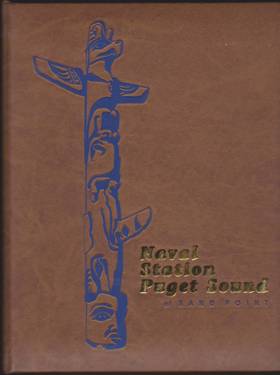
Published by the Department of the Navy alongside local author Dennis Stuhaug, Naval Station Puget Sound at Sand Point chronicles the fascinating military and aviation heritage of Seattle’s historic waterfront base. The book details the facility's evolution from a vital 1920s naval air station—famous as a key stop for the 1924 round-the-world flight—into a crucial World War II training and logistics hub. Through archival photographs and military records, the text captures how the installation served as a dynamic nexus between civilian urban life and naval defense along Lake Washington. A keen insight drawn from the work is how the transformation of military bases into public parks reflects the shifting priorities of modern cities; as Sand Point was decommissioned and turned into Magnuson Park, it demonstrated how post-industrial urban spaces are reclaimed to heal the ecological and social splits left behind by military-industrial expansion. 104 pages : illustrations (1 color), portraits (1 color) ; 29 cm CIRC [ 0 ]
|
1992 |
|
The Boiseans at home by Arthur A. Hart 
To own a fine house is a mark of success, and Boiseans of earlier times were no different from those of today in recognizing this. This volume is a collection of short essays that aim to capture the flavor of the life and times of some of the families that played a significant part in Boise s history. 86 pages : illustrations, portraits ; 20 cm CIRC [ 0 ]
|
1992 |
|
Once upon a time in Seattle by Emmett Watson 
Luckily for him, and for us, Emmett Watson's beat as a columnist for The Seattle Times required him to stay in touch with his beloved native city. In his daily meanderings, usually accompanied by his miniature poodle, Tiger, Watson saw much that is invisible to the rest of us. Of course, he was around longer than most of us, too--over eight decades, five of them as a newspaperman whose happy fate it had been to assay the crooked timber of humanity and reassure us of its worth. As he looked at Seattle, Watson discerned, with a geologist's eye, human fossils buried in layers of history here, there and everywhere. In this volume, a companion to his Digressions of a Native Son, published almost four decades ago, Watson brings to life some of the citizens Seattle should not forget, and, along the way, reminds us that a city is a human habitat whose history can properly be told only in the tale of its people. xxiii, 166 pages ; 23 cm CIRC [ 0 ]
|
1992 |
|
Discover Nanaimo an illustrated history by Charles Lillard, Lynn Welburn, Greater Nanaimo Chamber of Commerce 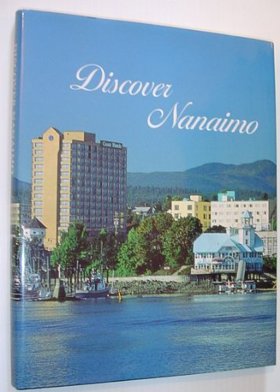
Published in 1992 by the Greater Nanaimo Chamber of Commerce, Discover Nanaimo: An Illustrated History by Charles Lillard and Lynn Welburn provides a richly documented examination of the city's past. The authors skillfully weave together archival photography and narrative text to trace Nanaimo's transformation from a resource-extraction hub into a vibrant coastal community. By balancing civic milestones with everyday social history, the volume offers scholars and regional enthusiasts an engaging window into the Pacific Northwest's economic and cultural development. 149 p. : ill. (some col.), ports. ; 29 cm. CIRC [ 0 ]
|
1992 |