Catalog of British Columbiana and Pacific Northwest Americana
Encyclopedia Cascadia Catalog contains book titles of mostly non-fiction Pacific Northwest Coast of North America Titles (primarially British Columbia, Idaho, Oregon and Washington State) in an easy-to-understand title catalog. If you see a link with this badge ONLINE CIRC it means that there is an online institution that provides free access to that title. In some cases there may be more than one institution hosting the title digitally.
| Catalog Title | Published |
|---|---|
|
In the sea of sterile mountains the Chinese in British Columbia by James W. Morton
|
1974 |
|
In the path of destruction eyewitness chronicles of Mount St. Helens by Richard B. Waitt , Washington State University Press (Publisher) 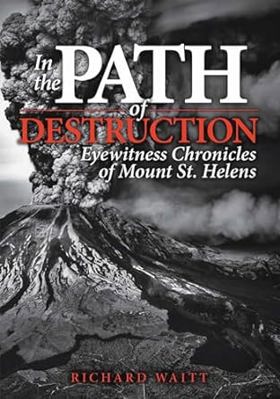
"The air had no oxygen, like being trapped underwater ... I was being cremated, the pain unbearable."--Jim Scymanky. "I was on my knees, my back to the hot wind. It blew me along, lifting my rear so I was up on my hands ... It was hot but I didn't feel burned--until I felt my ears curl."--Mike Hubbard. A napping volcano blinked awake in March 1980. Two months later, the mountain roared. Author Richard Waitt was one of the first to arrive following the mountain's early rumblings. A geologist with intimate knowledge of Mount St. Helens, Waitt delivers a detailed and accurate chronicle of events. His eruption story unfolds through unforgettable, riveting narratives--the heart of a masterful chronology that also delivers engrossing science, history, and journalism x, 413 pages : illustrations ; 26 cm CIRC [ 0 ]
|
2014 |
|
In the middle and on the edge the Twin Falls region of Idaho by James R. Gentry, College of Southern Idaho, Twin Falls Centennial Commission 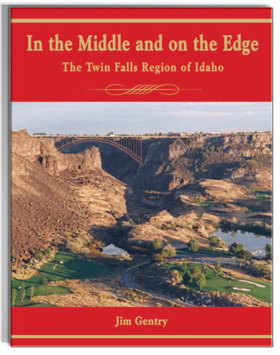
Dr. Jim Gentry arrived in Twin Falls in 1969 at the age of 23 to begin teaching history at the College of Southern Idaho. Having lived in five other states, Jim was glad to have found "his home". That love encouraged historical research and an ongoing fastination with local history. This book illustrates a concept that took shape early in Jim's study; that this region was in the middle and on the edge even before Twin Falls was founded in 1904 xvi, 413 pages : illustrations, maps ; 23 cm CIRC [ 1 ]
|
2003 |
|
In the company of sisters Canada's women in the war zone, 1914-1919 by Dianne Graves 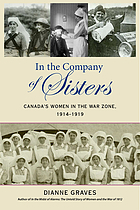
"When Canada entered the First World War in August 1914, it embarked on a major war effort at home and abroad. The nation's women worked tirelessly to help and support the troops fighting overseas, and among them were many who chose to 'do their bit' overseas by serving and volunteering in areas of the war zone from Britain and the European mainland to the Middle East and Russia. In the Company of Sisters chronicles their endeavours and achievements amid the drama of a life-and-death struggle that claimed millions of lives. Spearheaded by the nurses who were sent to various theatres of war, plenty of other determined souls channelled their energy into a wide range of much-needed work and, in so doing, broke new ground. Whether driving ambulances in range of enemy shelling, nursing sick soldiers in the heat and disease of the eastern Mediterranean, clothing destitute Belgian refugees or cheering up the troops with concerts, care packages and a cup of tea, these remarkable women played an important part in a multitude of ways. Canadian nurses at the Anglo-Russian Hospital in St. Petersburg watched the Russian Revolution taking place at their front door and cared for people wounded in the streets. Four remarkable Canadian 'women with a mission' are covered in detail: Julia Drummond, who became 'mother' to the Canadian forces; actress and theatre producer Lena Ashwell, who took concerts and theatre to the troops in the front lines; Julia Grace Wales, pacifist and peace worker, who inspired peace negotiations even as the battles raged; and Mary Riter Hamilton, pioneer among Canadian women artists, who documented the devastated battlefields for posterity. What the Canadian women who went overseas experienced had a marked impact on their own lives, and in some cases acted as a catalyst for what they went on to accomplish in later life. The legacy they bequeathed to future generations was one of selfless and positive action that remains an inspiration to this day. In the Company of Sisters celebrates the 'sisters' - military and civilian - who ventured overseas from 1914 to 1919 and highlights their courageous march along the path towards the equality and self-determination that Canadian women later went on to achieve."-- Provided by publisher xx, 363 pages : illustrations, maps ; 23 cm CIRC [ 0 ]
|
2021 |
|
In the blast zone catastrophe and renewal on Mount St. Helens by Charles Goodrich, Kathleen Dean Moore, Frederick J. Swanson 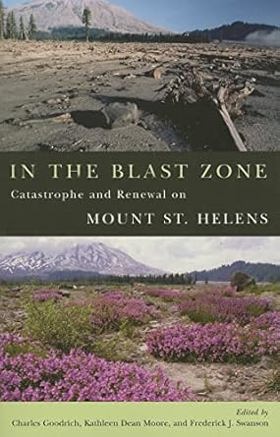
As it erupted in 1980, Mount St. Helens captured the attention of the region, nation, and world, and it continues to fascinate us today: a constant reminder that we live in volcano country. In lucid prose and poetry by some of America's leading writers and scientists, In the Blast Zone explores this story of destruction and renewal in all its human, geological, and ecological dimensions. Most popular accounts of the momentous eruption have focused on the devastation it caused. More recent scientific work on Mount St. Helens tells a story of unexpectedly rapid and varied ecological and geological change. In the Blast Zone is the first book to present a cross-pollination of literary and scientific perspectives on the mountain's history of cataclysm and renewal. Most of the contributors to this volume camped together on Mount St. Helens for four days, hiking, observing, and sharing ideas. They asked the question: What can this radically altered landscape tell us about nature and how to live our lives? In the Blast Zone collects some of their answers. While introducing ecological and geological insights, it also tells compelling stories about how science and literature inform our lives and our relationship to nature. These writings will startle readers with new recognition of the matchless gifts of Mount St. Helens: the gifts of beauty, of illumination, of hope. xix, 124 pages : illustrations, maps ; 22 cm CIRC [ 0 ]
|
2008 |
|
In pursuit of the Nez Perces the Nez Perce War of 1877 by Linwood Laughy, O. O. Howard, Duncan McDonald, Joseph 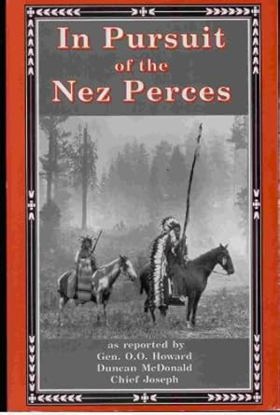
Three contradicting accounts concerning the military campaign of the Nez Perce War of 1877 x, 307 pages : map ; 22 cm CIRC [ 0 ]
|
1993 |
|
In nature's realm early naturalists explore Vancouver Island by Michael Layland 
"A celebration of the richly diverse flora and fauna of Vancouver Island as explored through the records of explorers, settlers, and visitors, and with due respect to the wealth of Indigenous traditional knowledge of the island's ecosystems. In Nature's Realm gathers initial reports, recorded histories, and personal accounts left by Vancouver Island's early naturalists who studied the region's flora and fauna. Many, such as Archibald Menzies, accompanied English and Spanish explorations investigating the coastal geography for colonial expansion. Doctor-naturalists such as John Scouler, David Douglas, and Robert Brown worked with the Hudson's Bay Company and collected specimens. Irish-born John Macoun, a renowned naturalist, brought his expertise to Vancouver Island, as did botanical artists Sarah Lindley (Lady Crease) and Emily Henrietta Woods. In Nature's Realm is a companion volume to Layland's two previous titles: A Perfect Eden: Encounters by Early Explorers of Vancouver Island, shortlisted for a BC Book Prize in two categories; and The Land of Heart's Delight: Early Maps and Charts of Vancouver Island, shortlisted for the Bill Duthie Booksellers' Choice Prize, and for the City of Victoria Butler Book Prize."-- Provided by publisher 282 pages : illustrations (chiefly color) ; 25 x 27 cm CIRC [ 0 ]
|
2019 |
|
In mountain shadows a history of Idaho by Carlos A. Schwantes 
Idaho is now seen as one of the most intriguing and attractive states in the Union. Any view of the Gem State is likely to be broadened and deepened by this superbly written history of it, In Mountain Shadows. Carlos A. Schwantes illustrates the extent to which Idahoans have always been divided by geography, transportation patterns, religion, and history. Although the state motto should have been "Divided We Stand," as he says in affectionate jest, it is also true that Idahoans come together on some basics—on avoiding crowds and maintaining the good life close to scenic mountains and streams. Schwantes reaches back to 1805, when Lewis and Clark were among the first white men to enter present-day Idaho. He describes the Indians then living in the Great Basin and Plateau, and proceeds through layers of history to show how fur traders, missionaries, and overland emigrants defined the land that became a territory in 1863 and, finally, a state in 1890. The vigilantism, Indian wars, mining booms and busts, and an-imosity toward Mormons and Chinese immigrants that marked the territorial years gave way to more troubles in the early years of statehood: an economic downturn, industrial violence, political protest. The arrival of automobiles promised to end isolation, but the formidable terrain slowed the building of north-south highways, just as it had railroads. Nevertheless, future Idaho would be a product of engineering and witness the coming of irrigation systems and hydroelectric plants. Schwantes brings his history through the Great Depression, World War II, and the Cold War, noting everyday life, colorful personalities, political and economic cycles, raging controversies, and current trends. xii, 292 pages, 16 unnumbered pages of plates : illustrations (some color), maps, portraits ; 26 cm CIRC [ 1 ]
|
1991 |
|
In love with a hillside garden by Ann Pytkowicz Streissguth, Daniel Streissguth, Benjamin Streissguth, Arboretum Foundation (Seattle, Wash) 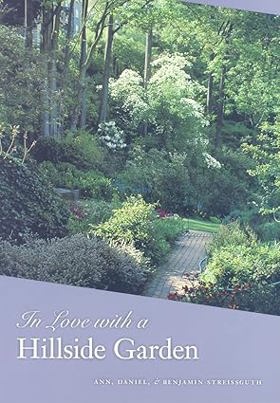
It all began when architect Daniel, then a bachelor, built his own house on a wild hillside lot, developing his garden as next-door-neighbor, Ann, was developing a garden around natural springs in her backyard. We married, and together with our growing son, Benjamin, continued these gardens as we also fought through blackberries, horsetails, and morning glories to push intersecting paths through the adjacent two-lot wilderness we later purchased, creating a little park which we planted and nurtured and ultimately gave to the City of Seattle in 1996, with our promise to maintain it through our lifetimes. This richly illustrated book offers timely inspiration to gardeners in an increasingly urban world. In an engaging narrative, the Streissguths show the emergence of their gardening partnership during forty years of marriage, and their philosophy that developing a site along a public stairway gave them the opportunity to share their garden with neighbors and passersby. They offer practical insight into concepts of linking inside and outside rooms and of combining private and public spaces, and they describe the process through which they transformed a steep forested hillside in the heart of Seattle into a deciduous woodland garden with banks of perennials, a dell, vistas of the city and lake, and a site for ornamental and food-producing plants. Finally, they consider the future stewardship of the Streissguth Gardens, a park linking the wild and tamed sections of a unique greenbelt garden shared with joggers, strollers, fellow gardeners, schoolchildren, and those who call it “a touch of Eden in a big city.” 118 pages : illustrations (chiefly color) ; 26 cm CIRC [ 0 ]
|
2009 |
This book explains the missing month of Lewis and Clark history that occurred when they reached the Pacific Ocean and has completely redefined the expedition's history. Ziak's research - detailed in this book - resulted in the creation of United States newest national park -the Lewis and Clark National Park located in Oregon and Washington states. xviii, 219 pages : color illustrations, color maps ; 26 cm CIRC [ 1 ]
|
2005 |
|
In common with the fish wars, the Boldt Decision, and the fight to save salmon in the Pacific Northwest by Bill Wilkerson , Don Pugnetti 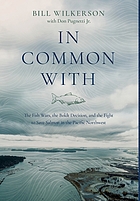
Because of state actions and policies, Washington Tribes had long been denied their fair share of the salmon harvest granted by treaties adopted by the US government and the Tribes in 1854. Tribal members staged "fish-ins" and other demonstrations, and ultimately pursued a federal lawsuit against the state. Decided in 1974 by US district court judge George H. Boldt, the landmark ruling gave Tribes an equal share of fish, meaning yields for non-Native fishermen plummeted. As a result, many non-Native commercial fishing businesses closed, and chaos and legal disputes continued into the 1980s. All the while, the number of salmon available for harvest steadily declined. During this post-Boldt period, a group of Tribal and government leaders collectively decided change was sorely needed. Through collaboration, they forged major, seemingly unattainable agreements to cooperatively manage fisheries, all while protecting and enhancing salmon runs. Author Bill Wilkerson, then fisheries director for the state of Washington, and legendary Tribal leader Billy Frank Jr. were among a select group of courageous visionaries who worked to bring peace to state waters and reverse the steady decline of salmon runs. Without Frank's dedicated participation in these talks, legitimizing the process in the view of local Tribes, it's unlikely these agreements would have ever been made. In Common With is an insider's look at a number of successful negotiations between historic adversaries. They included an international salmon treaty between the US and Canada, a long-term cooperative management agreement between the state and Tribes, and a major accord between the state, Tribes, and forestland managers to protect salmon habitat on privately owned forestlands. This groundbreaking feat of diplomacy and partnership revealed the power of honoring one another?s opinions, needs, and wants. This spirit of cooperation and dedication to common ground serves as a shining example for contemporary leaders in today's polarized political landscape xv, 381 pages ; 23 cm CIRC [ 0 ]
|
2024 |
|
In and around Port Ludlow yesterday and today by Pat Thompson, Port Ludlow Garden Club 
In and Around Port Ludlow: Yesterday and Today by Pat Thompson and the Port Ludlow Garden Club is a 1987 local history and travel guide dedicated to this scenic waterfront community on Washington's Olympic Peninsula. The book chronicles the town's evolution from a bustling 19th-century lumber mill hub into a modern resort and residential enclave. Ultimately, it serves as a charming community-driven tribute that preserves the rich pioneer heritage, local geography, and natural beauty of the Port Ludlow area. 55 pages : illustrations, maps ; 22 cm CIRC [ 1 ]
|
1987 |
|
Imprisoned in Paradise Japanese internee road workers at the World War II Kooskia Internment Camp by Priscilla Wegars, Michiko Midge Ayukawa, University of Idaho Asian American Comparative Collection (Publisher) 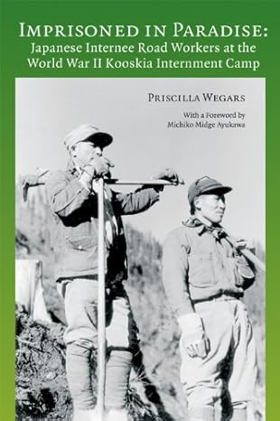
The Kooskia Internment Camp, a unique, virtually forgotten, World War II Detention and road building facility, was located on the remote, wild, and scenic Lochsa River in north central Idaho. Between mid-1943 and mid-1945 the Kooskia camp held an all-male contingent of some 265 so-called "enemy aliens" of Japanese ancestry. Most came from 21 states and 2 territories, but others were from Mexico; some were even kidnapped from Panama and Peru. Two alien internee doctors, an Italian and later a German, provided medical services; 25 Caucasian employees included several women; and a Japanese American man censored the mail. Despite having committed no crimes, but suspected of potential sabotage, these noncitizen U.S. residents of Japanese descent had been interend elsewhere in the U.S. following Japan's attack on Pearl Harbor in December 1941. They volunteered for transfer to the Kooskia Internment Camp and received wages for helping construct the Lewis-Clark Highway, now Highway 12, supervised by U.S. Bureau of Public Roads employees. Knowledge of their rights under the 1929 Geneva Convention empowered the Kooskia internees to successfully challenge administrative mistreatment, thereby regaining much of the self-respect they had lost by being so unjustly interned. Here, finally, is their story. --back cover xxxiv, 323 pages : illustrations, maps, portraits ; 23 cm CIRC [ 0 ]
|
2010 |
|
Illahe the story of settlement in the Rogue River canyon by Kay Atwood
Illahe tells the story of the miners, packers, farmers, and families who settled southern Oregon's rugged Rogue River Canyon in the 1860s. Kay Atwood creates a personal picture of what life was like in the remote canyon, drawing on first-person accounts from diaries, journals, and interviews she conducted with descendants of the families who settled the area, most of whom shared Native American and white ancestry. Their stories recount hardships, dangerous river travel, deadly floods, extreme winters, constant isolation, and the self-sufficiency required to survive in this wild, beautiful place. In addition to presenting the words of the homesteaders and their descendants, Atwood has also gathered a treasure trove of rare historic photographs, supplemented by her own drawings and hand-drawn maps. For anyone who has enjoyed the Rogue River canyon and wondered about the history of this national Wild and Scenic Rivers corridor, as well as for readers interested in pioneer history and the settlement of southern Oregon, Illahe offers a fascinating portrait of a truly unique time and place. --Jacket iii, 251 pages : illustrations ; 23 cm CIRC [ 1 ]
|
1978 |
|
Idaho, its meaning, origin and application by John E. Rees 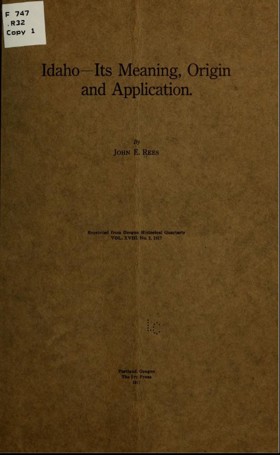
Published in 1917 by pioneer historian and Indian trader John E. Rees, Idaho: Its Meaning, Origin and Application is a focused etymological monograph attempting to definitively trace the linguistic roots of the state's name. The text argues that the word originates from the Shoshone exclamation "Ee-dah-how," romantically translated as "the sun comes down the mountain," drawing heavily upon Rees's personal interactions with local tribes and early frontier lore. By compiling linguistic fragments, regional myths, and legislative records, the booklet served to establish a poetic Indigenous pedigree for the newly minted state, one that was enthusiastically embraced by local civic boosters despite subsequent linguistic disputes. A keen insight drawn from the work is how the pioneer-era appropriation of Native language functioned as a form of cultural trophy-hunting; by cementing a highly romanticized, settler-translated Indigenous phrase as the official state identity, early historians actively co-opted Native heritage to give the colonial government an aura of natural, ancient legitimacy while simultaneously overseeing the systemic marginalization of the very people whose language they claimed to honor. Vol. 18, No. 2 (Jun., 1917), pp. 83-92 (10 pages) ONLINE CIRC [ 1 ]
|
1917 |
|
Authored by S. P. Morgan, Idaho, Facts and Statistics Pertaining to Its Early Settlement and Colonization provides a focused historical account of the state's first permanent white settlement, the Mormon-founded Franklin colony. The text blends demographic data, pioneer chronologies, and agricultural records to document how early religious settlers transformed the arid southeastern frontier into a viable, structured agrarian community. Furthermore, the book details the escalating territorial frictions between the encroaching colonizers and the indigenous Shoshone population, framing these violent clashes solely as "Indian troubles" that threatened pioneer progress. A keen insight drawn from the work is how early statistical histories weaponized civic data to justify indigenous displacement; by pairing seemingly objective agricultural metrics with subjective, one-sided narratives of Native American hostility, the text effectively disguised the brutal realities of colonization behind a veneer of rational economic development and inevitable civilization. 36 pages ; cm. ONLINE CIRC [ 1 ]
|
1910 |
|
Idaho's remarkable women daughters, wives, sisters, and mothers who shaped history by L. E. Bragg 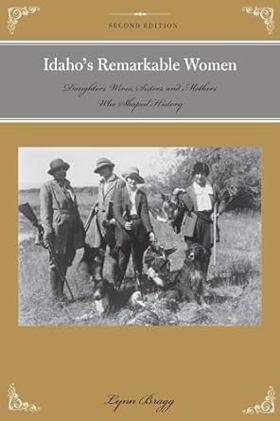
Idaho's Remarkable Women 2 tells the history of the Gem State through the stories of fifteen pioneering women, all born before 1900, who made a profound impact on Idaho. Each woman in her own way displayed remarkable courage, hope, and love during a time when Idaho was still an untamed frontier. xi, 163 pages : illustrations, map ; 23 cm. CIRC [ 0 ]
|
2016 |
|
Idaho's place in the sun by H. M. Newell 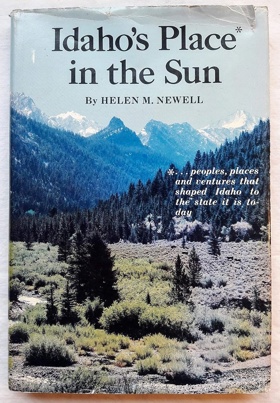
Published in 1975, Helen M. Newell's Idaho's Place in the Sun provides a comprehensive overview of the Gem State's historical development, moving from its early indigenous populations and fur trappers through the territorial days to modern statehood. The book combines detailed historical narratives with rich anecdotal accounts, capturing the rugged spirit of the miners, ranchers, and pioneers who settled the challenging landscape. Illustrated with archival photographs, it serves as both an accessible introduction for general readers and a valuable reference for those interested in Pacific Northwest history. Keen Insight: Newell’s narrative excels by treating Idaho not as a unified whole, but as a patchwork of isolated, geographically distinct micro-regions whose unique local struggles ultimately forged the state's broader cultural identity. vi, 180 pages : illustrations, portraits ; 24 cm CIRC [ 1 ]
|
1977 |
|
Idaho's place a new history of the Gem State by Adam M. Sowards , University of Idaho Program in Pacific Northwest Studies 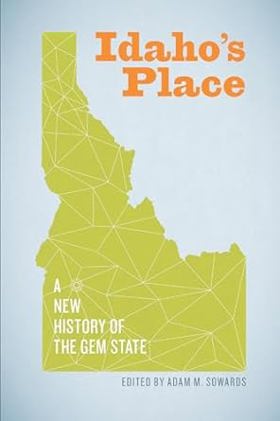
Idaho's Place is an anthology of the most current and original writing on Gem State history. From the state's indigenous roots and early environmental battles to recent political and social events, these essays provide much-needed context for understanding Idaho's important role in the development of the American West. Through a creative approach that combines explorations of concepts such as politics, gender, and race with the oral histories of Idaho residents - the very people who lived and made state history - this unique collection sheds new light on the state's surprisingly contentious past. Readers, whether they are longtime residents or newcomers, tourists or seasonal dwellers, policy makers or historians, will be treated to a rich narrative in which the many threads of Idaho's history entwine to produce a complete tapestry of this beautiful and complex Western state. ix, 310 pages : illustrations, maps ; 24 cm CIRC [ 1 ]
|
2014 |
|
Idaho's Malad Valley a history by Thomas J. McDevitt 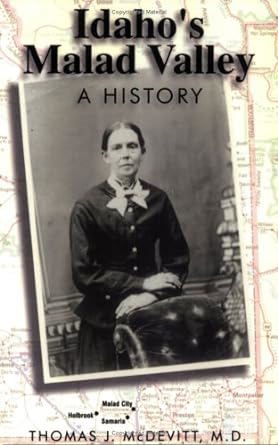
A history of the development of a section of Southeastern Idaho which was one of the main transportation routes from Salt Lake City to the gold fields as well as a rich agricultural area. A good, bad and ugly history of a small Idaho Welsh settlement. The frontier between Mormon and Gentile, Saint and sinner. A place once advertised where a woman could shoot her husband and never spend a day in jail.The Presbyterian tolled for an "innocent" young Michael Murphy, the first man legally hanged in Idaho. Charles Fremont looked from Malad towards Great Salt Lake. They almost drowned exploring from a rubber boat. x, 230 pages : illustrations, portraits ; 23 cm CIRC [ 1 ]
|
2001 |
|
Idaho's historic trails from Lewis & Clark to railroads by Martin Potucek 
This is the story of trails blazed by early explorers, miners, and soldiers and provides travel tips for modern-day explorers. Idaho s Historic Trails includes modern maps of roads and trails and information about interesting side trips. Includes Lewis & Clark's route and the Oregon Trail (and South Alternate.) xx, 166 pages : illustrations, maps ; 23 cm CIRC [ 0 ]
|
2003 |
|
Idaho's Constitution the tie that binds by Dennis C. Colson, Idaho 
Distributed by the University of Nebraska Press for the University of Idaho PressThis revised edition of Dennis Colson's book presents a more accessible view to a new generation of students and legislators, many of whom are unfamiliar with Idaho's tumultuous beginnings. Idaho's Constitution opens a door for the reader into the political struggle and turmoil of a century ago, but also the spirit of compromise and common purpose that conquered the divisions they faced. xi, 288 pages ; 24 cm CIRC [ 0 ]
|
1991 |
|
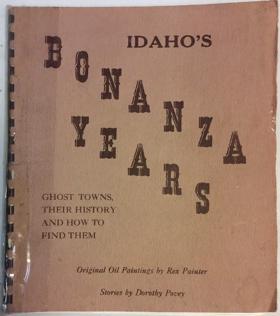
Idaho's bonanza years ghost towns, their history and how to find them by Rex Painter, Dorothy Povey
|
1966 |
|
Idaho wine country by Alan Minskoff, Paul Hosefros 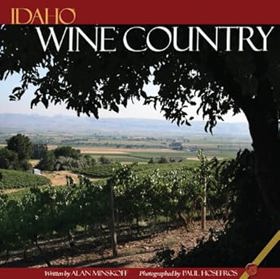
Writer Alan Minskoff and photographer Paul Hosefros took to the back roads of Idaho for fifteen months, interviewing and photographing more than fifty winemakers and grape growers and documenting all stages of grape and wine production. Their book, the first full-length exploration of the state s emerging wine industry, chronicles an enterprise on the verge of discovery. xv, 188 pages : illustrations (chiefly color), color maps ; 26 cm CIRC [ 0 ]
|
2010 |
|
Idaho rocks! a guide to geologic sites in the Gem State by Reed S. Lewis , John Burch , Mark D. McFaddan , Chelsea McRaven Feeney 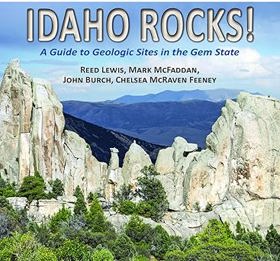
"To discover the unworldly geologic novelties of the Gem State, all that is required is a good map, a sense of adventure, and Idaho Rocks!, a guide to 60 of the most compelling geologic sites in Idaho. The well-chosen destinations span the state's geologic history from the 2.6-billion-year-old gneiss in the Panhandle to 2,000-year-old lava at Craters of the Moon, and from gold and silver deposits hidden in Idaho's mountains to visible scars from recent earthquakes and landslides. With its beautiful photographs and informative figures and maps, this guidebook will get you up to speed on every aspect of Idaho's diverse geology"-- Provided by publisher v, 153 pages : color illustrations, color maps ; 22 cm. CIRC [ 0 ]
|
2020 |