Catalog of British Columbiana and Pacific Northwest Americana
Encyclopedia Cascadia Catalog contains book titles of mostly non-fiction Pacific Northwest Coast of North America Titles (primarially British Columbia, Idaho, Oregon and Washington State) in an easy-to-understand title catalog. If you see a link with this badge ONLINE CIRC it means that there is an online institution that provides free access to that title. In some cases there may be more than one institution hosting the title digitally.
| Catalog Title | Published |
|---|---|
|
Getting to the water's edge on Whidbey & Camano islands by Sarah Schmidt, Dan Pederson, Stacey Neumiller, WSU Beach Watchers, Washington State University Extension 
Published by Washington State University Extension and the WSU Beach Watchers, Getting to the Water’s Edge on Whidbey & Camano Islands serves as an exhaustive field guide to public shoreline access, marine life, and coastal trails across Island County. Compiled through extensive community research, the book details dozens of specific beaches, boat launches, and parks while weaving in rich context on local geology, natural history, and indigenous heritage. It bridges the gap between a practical recreational map and an environmental manual by emphasizing responsible stewardship of the fragile Salish Sea ecosystem. A keen insight drawn from the work is how citizen-science guidebooks function as powerful grassroots conservation tools; by meticulously cataloging public access points and educating visitors on local ecological sensitivities, the text transforms recreational day-trippers into active defenders of the regional shoreline. ix, 166 pages : color illustrations, color maps ; 22 cm CIRC [ 1 ]
|
2006 |
|
Getting elected is the easy part working and winning in the state legislature by Karen Keiser 
Across the nation every two years, first-time lawmakers enter state legislatures--institutions steeped in tradition, arcane procedures, and unwritten rules. Although dozens of publications advise candidates on how to run and win campaigns, for those elected, few resources exist. After more than twenty years in the Washington State Legislature, Senator Karen Keiser realized she could address that knowledge gap. Written for legislative newcomers and others interested in state government, her book blends documented research with her personal experiences and observations about how to succeed and achieve real change. She focuses on the culture adjustment and challenges many newly elected lawmakers face, and offers tips and advice to help them achieve their legislative goals xiv, 155 pages : illustrations ; 23 cm CIRC [ 0 ]
|
2023 |
|
George Washington of Centralia how the pioneering son of a slave crossed the continent, founded a town, and saved it during its darkest hours by Brian Mittge, Kerry MacGregor Serl 
Although George Washington has been in the public eye since facing a racially-charged court case in the 1840s and a quick vote of support by the Missouri Legislature, his full life’s story has never been completely told — until now. Local historians Brian Mittge and Kerry MacGregor Serl have pulled together public documents, little-known archival materials and oral histories into a 200-page story that reads like the full history of the 19th century. From slavery to the frontier, from the Oregon Trail to the Pacific Northwest, this is a story that is sweeping in its scope but human to its core. You’ll read about the ways that George Washington nurtured ties during a time of division, creating unity in the community he created and sustaining his neighbors through the depth of dire economic depression. xviii, 198 pages : illustrations, maps ; 23 cm CIRC [ 1 ]
|
2018 |
|
George Tsutakawa early works on paper by David F. Martin , George Tsutakawa (Artist), Cascadia Art Museum (Organizer, Host institution) 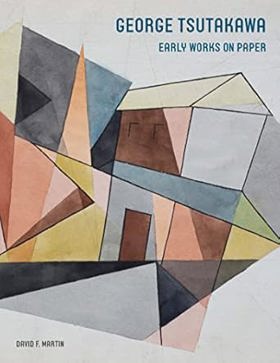
"One of the leading Northwest artists of his generation, George Tsutakawa (1910-97) is internationally known for his sculpture and fountain designs. However, a lesser-known aspect of his career was the production of blockprints, watercolors, and works on paper that began in the 1920s and continued throughout his career. Born in Seattle and educated in Japan, Tsutakawa had early success while still in high school. He attended the University of Washington, where he received an MFA in sculpture in 1950, and became an influential instructor at the university's School of Art from 1947 to 1976. Drawn from the Tsutakawa estate, most of the works shown here have never been seen previously by the public. These early works display concepts and inspirations that would inform Tsutakawa's aesthetic throughout a long and distinguished career. Contextual works by Tsutakawa's instructors and contemporaries provides a broader understanding of his oeuvre."--Provided by distributor 143 pages : illustrations (chiefly color) ; 29 cm CIRC [ 0 ]
|
2022 |
|
George Gibbs northwest array full reports, place names, word list, artifact names, and guide by George Gibbs , Jay Miller 
Essential information for Northwest tribes, traditions, languages, place names, and systematic word study by George Gibbs from the 1850s 266 pages ; 27 cm CIRC [ 1 ]
|
2015 |
|
Geology underfoot in Southern Idaho by Shawn Willsey 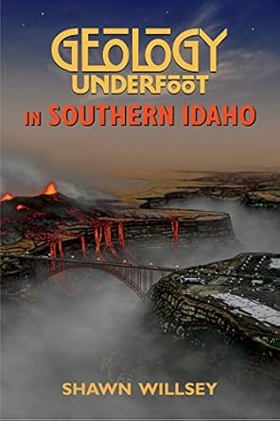
Geology professor Willsey aims to inspire more Idahoans and visitors to take an interest in one of the most compelling and fascinating regions of the earth. He aims to bridge the gap between geologists and the interested public by passing along a collection of fascinating stories told by southern Idaho's rocks and landscapes. Southern Idaho's geologic history spans about 2.5 billion years--more than half that of the Earth. Chapters represent a sampling of the unique geologic features that formed during this immense amount of time. Willsey selects accessible locations that are exceptional in terms of either location or geologic history. --Publisher xi, 290 pages : color illustrations, color maps ; 23 cm. CIRC [ 0 ]
|
2017 |
|
Geology of the San Juan Islands by Edwin H. Brown 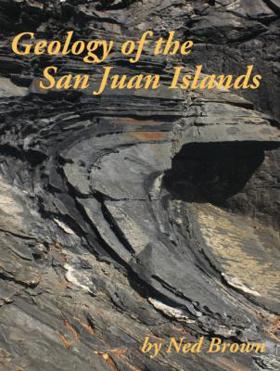
Nestled in the heart of the Salish Sea lie the picturesque San Juan Islands, an archipelago molded by eons of tectonic and glacial activity. Over the course of his nearly five-decade career, WWU geology professor Ned Brown has led countless research teams to decode this complex terrestrial heritage. In Geology of the San Juan Islands, Brown provides detailed, approachable, full color photos and diagrams to illuminate the complexities of these iconic islands. Author Ned Brown is an Emeritus Professor of geology at Western Washington University. He was raised in Minnesota, and went on to receive higher education at Dartmouth College, University of Otago, and U.C. Berkeley. He came to Bellingham in 1966, attracted by the landscape and mountain-building geology. In his nearly five-decade career, Ned, together with students, traversed and sampled much of the bedrock in the Cascades, San Juan Islands, and southern British Columbia Coast Mountains. This lifetime work is the basis for numerous student theses, and professional reports. 99 pages : illustrations (chiefly color), maps ; 28 cm CIRC [ 1 ]
|
2014 |
|
General William S. Harney prince of dragoons by George Rollie Adams 
"Between the War of 1812 and the Civil War, General William S. Harney became one of the best-known military figures in America. In a career aided by Andrew Jackson and the concept of an expansible army, Harney saw duty in virtually every part of the country and participated in most of the key military episodes of his time. He chased remnants of Lafitte pirates in Louisiana, campaigned with Abraham Lincoln and Jefferson Davis during the Black Hawk War, developed Vietnam-style riverine tactics that ended the Second Seminole War, and led Winfield Scott's cavalry in the Mexican War. In the 1850s Harney devised the army's largest and most successful pre-Civil War campaign against Plains Indians, commanded troops charged with upholding federal authority in Kansas and Utah, and almost provoked hostilities with Great Britain in the Pacific Northwest. Removed from command amid false charges of disloyalty during the Missouri secession crisis, he returned as a leading member of the Indian Peace Commission of 1867-68." "Harney was bold, ambitious, and innovative, but also impulsive, vindictive, and violent. His career illustrates the nineteenth oentury army's role in implementing federal policy, highlights its limited resources compared to its responsibilities, and illuminates key aspects of its organizational structure, the behavior of its officers, and its impact on personal lives."--Jacket xix, 389 pages : illustrations ; 24 cm CIRC [ 1 ]
|
2001 |
|
General history of Oregon through early statehood by Charles Henry Carey
|
1971 |
|
Gene Zema architect, craftsman by Grant Hildebrand, Gene Zema 
In the three decades following World War II, a group of architects centered in the Puget Sound region were designing buildings of extraordinary quality, whose most evident commonality was the use of wood in profusion, as exposed, meticulously detailed structure and as interior and exterior surface. Gene Zema, a 1950 graduate of the University of Washington and a student of the legendary Lionel Pries, was one of this group. In a career that spanned twenty years, Zema designed forty-six houses, seven clinics, two architectural offices, a nursery, and a golf clubhouse, and he participated in the design of two University buildings. He built several buildings with his own hands, developing a consummate sense of appropriate design in wood. The luxuriantly crafted details and uniquely dramatic spatial compositions of his work place it at the forefront of that remarkable movement. Zema was also a distinguished collector and retailer of Native American and Japanese antiquities. In 1983, relying on the sale of antiquities for income and limiting his architectural practice, he and his wife, Jane, bought a 70-acre meadow on Whidbey Island. On their property Zema built a workshop, a windmill and pump house, a chicken house, a home, a peacock house, and a kiln, all of which are as remarkable as his earlier masterpieces. Gene Zema is an iconic figure among those who know his work, but the region to which his work is intimately bound is far from the centers of architectural journalism and his story is little known. It is the story of a unique figure in an extraordinary American architectural movement and an exceptional figure in the history of the Pacific Northwest. x, 147 pages : illustrations (chiefly color) ; 26 cm CIRC [ 0 ]
|
2011 |
|
Gem minerals of Idaho by John A. Beckwith, Jane Beckwith 
Gem Minerals of Idaho, designed for beginners and for those collectors visiting Idaho for the first time, it is a guide to some of the countless collecting areas of the state. It is not a textbook of mineralogy and, so far as possible, avoids technical terminology. However, it does contain information of general value on the physical and optical characteristics of minerals, as well as facts concerning history, lore, and fashioning of many of the gems. 129 pages : illustrations, maps ; 23 cm CIRC [ 0 ]
|
1971 |
|
Gay Seattle stories of exile and belonging by Gary Atkins 
In 1893, the Washington State legislature quietly began passing a set of laws that essentially made homosexuality, and eventually even the discussion of homosexuality, a crime. A century later Mike Lowry became the first governor of the state to address the annual lesbian and gay pride rally in Seattle. Gay Seattle traces the evolution of Seattle’s gay community in those 100 turbulent years, telling through a century of stories how gays and lesbians have sought to achieve a sense of belonging in Seattle. Gary Atkins recounts the demonization of gays by social crusaders around the turn of the century, the earliest prosecutions for sodomy, the official harassment and discrimination through most of the twentieth century, and the medical discrimination and commitment to mental hospitals that continued into the 1970s as homosexuality was diagnosed as a disease that could be "cured." Places of refuge from this imposed social exile were created in underground theater and dance clubs: the Gold Rush-era burlesque shows, modern drag theater, and in mid-century the emergence of openly gay bars, from the Casino to Shelley’s Leg. Many of these were subjected to steady exploitation by corrupt police - until bar owner MacIver Wells and two Seattle Times reporters exposed the racket. The increasingly public presence of gays in Seattle was accompanied by the gradual coalescence of social services and self-help organizations such as the Dorian Society, gay businesses and advocacy groups including the Greater Seattle Business Association, and the stormy relationship between the Vatican, Seattle's Catholic hierarchy, and gay worshippers. Atkins’ narrative reveals the complex and often frustrating process of claiming a civic life, showing how gays and lesbians have engaged in a multilayered struggle for social acceptance against the forces of state and city politics, the police, the media, and public opinion. The emergence of mainstream political activism in the 1970s, and ultimately the election of Cal Anderson and other openly gay officials to the state legislature and city council, were momentous events, yet shadowed by the devastating rise of AIDS and its effect on the homosexual community as a whole. These stories of exile and belonging draw on numerous original interviews as well as case studies of individuals and organizations that played important roles in the history of Seattle’s gay and lesbian community. Collectively, they are a powerful testament to the endurance and fortitude of this minority community, revealing the ways a previously hidden sexual minority "comes out" as a people and establishes a public presence in the face of challenges from within and without. xl, 451 pages : illustrations ; 23 cm CIRC [ 0 ]
|
2013 |
|
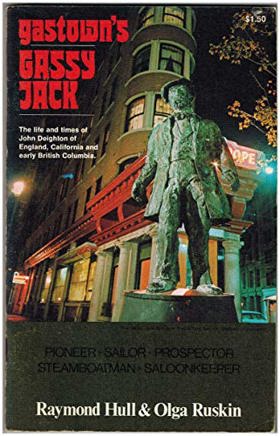
Gastown's Gassy Jack the life and times of John Deighton of England, California and early British Columbia by Raymond Hull, Olga Ruskin
|
1971 |
|
Galena Bay odyssey reflections of a hippie homesteader by Ellen Schwartz 
"A writer and educator reflects on the idealistic, tumultuous, and eye-opening time she spent as a back-to-the-land hippie homesteader in Kootenays in the 1970s. What compelled a nice Jewish girl from the suburbs of New York to spend a decade of her life as a hippie homesteader in the BC wilderness? Galena Bay Odyssey traces Ellen Schwartz's journey from a born-and-raised urbanite who was terrified of the woods to a self-determined logger, cabin-builder, gardener, chicken farmer, apiarist, and woodstove cook living on a communal farm in the Kootenays. Part memoir, part exploration of what motivated the exodus of young hippies--including American expatriates, like Ellen and her husband, Bill--to go "back to the land" in remote parts of North America during the 1960s and '70s, this fascinating book explores the era's naivety, idealism, and sense of adventure. Like most "back to the land" books, Galena Bay Odyssey describes the physical work involved in clearing land, constructing buildings, and living off of what they produced, but it also traces the complicated journey of discovery this experience brought to Ellen and Bill. Now, nearly half a century later, Ellen reflects on what her homesteader experience taught her about living more fully, honestly, and ecologically."-- Provided by publisher 265 pages, 14 unnumbered pages of plates : illustrations ; 23 cm CIRC [ 0 ]
|
2023 |
|
Fusang The discovery of America by Chinese Buddhist priests in the fifth century by Charles G. Leland 
This book, first published in 1875 and reissued in 1973, analyses the limited evidence from the works of early Chinese historians that explorers from China had discovered a country they called Fusang – possibly western America, and in all probability Mexico. The original document on which Chinese historians based their accounts of Fusang was the report of a Buddhist monk called Hoei-shin, who, in the year 499 AD, returned from a long journey to the east. xix, 212 pages ONLINE CIRC [ 1 ]
|
1875 |
|
Fur traders from New England the Boston men in the North Pacific, 1787-1800 : the narratives of William Dane Phelps, William Sturgis, and James Gilchrist Swan by William Dane Phelps, William Sturgis, James G. Swan, Briton Cooper Busch, Barry M. Gough 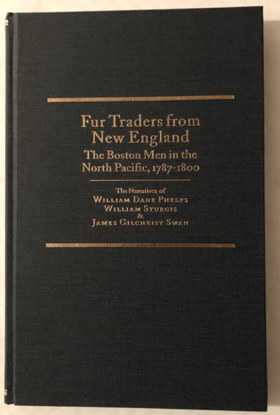
Examines the work of Boston mariners in the fur trade and other trades during the late eighteenth and early nineteenth century 137 pages ; 25 cm. CIRC [ 1 ]
|
1997 |
|
Fur trade and exploration opening the Far Northwest, 1821-1852 by Theodore J. Karamanski 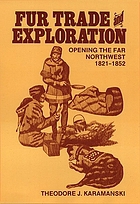
Discusses the role of the Hudson's Bay Company and its fur traders in the exploration of northern B.C., the western NWT, the Yukon and eastern Alaska xxii, 330 pages : illustrations, maps ; 23 cm CIRC [ 0 ]
|
1983 |
|
Fur trade and empire George Simpson's journal entitled Remarks connected with the fur trade in the course of a voyage from York Factory to Fort George and back to York Factory 1824-25, with related documents by George Simpson , Frederick Merk (Editor, Writer of introduction)
Simpson's reorganization of Oregon Territory after amalgamation with the Northwest Company. First published in 1931 lxii, 370 pages : folded map ; 24 cm CIRC [ 1 ]
|
1968 |
|
Frontiers of Vancouver Island by E. Blanche Norcross, Doris Farmer Tonkin
|
1969 |
|
Frontier history along Idaho's Clearwater River pioneers, miners & lumberjacks by John Bradbury 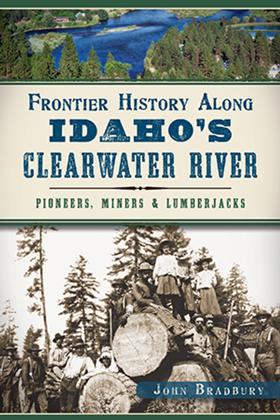
The Clearwater River runs deep through northern Idaho's history. The Nez Perce tribe made its home along the river. Lewis and Clark's journey west took them through the Clearwater. In fact, the Nez Perce made the expedition's voyage from the Clearwater River to the Pacific Ocean possible by teaching them how to make dugout canoes from ponderosa pine logs. Fur traders like John Jacob Astor and William Ashley financed the first American commercial activity on the river, bringing trappers to the area and paving the way for the Oregon Trail. Later came the first gold rush, the Nez Perce war, statehood, homesteaders and the beginning of the logging industry. Join author John Bradbury as he recounts a time when native tribes, explorers, trappers, preachers, miners and lumberjacks made a life along the Clearwater, establishing the area for future generations. 157 pages : illustrations, maps ; 24 cm CIRC [ 0 ]
|
2014 |
|
From wilderness to suburbia an illustrated history of Parkland, Washington by Richard D. Osness
|
1976 |
|
From trails to rails the post offices, stage stops, & wagon roads of Union County, Oregon by Irene Barklow 
From Trails to Rails: The Post Offices, Stage Stops, & Wagon Roads of Union County, Oregon by Irene Barklow is a meticulously researched 1987 local history that chronicles the evolution of pioneer transportation and communication in Eastern Oregon. The book details the region's transformation from rugged frontier trails and early stagecoach routes into a modernized railway hub, specifically cataloging the establishment of local post offices and settlements along the way. Ultimately, it serves as an invaluable resource for regional historians and genealogists tracing the infrastructural growth and pioneer heritage of Union County. ix, 300 pages : illustrations, portraits ; 29 cm CIRC [ 1 ]
|
1987 |
|
From thorns to blossoms a Japanese American family in war and peace by Mitzi Asai Loftus , David Loftus , Oregon State University Press (Publisher) 
"Mitsuko "Mitzi" Asai was not yet ten years old in the spring of 1942 when President Roosevelt's Executive Order 9066 sent 120,000 people of Japanese ancestry--about two-thirds of them US citizens--from their homes on the West Coast to inland prison camps. They included Mitzi and most of her family, who operated a fruit orchard in Hood River, Oregon. The Asais spent much of World War II in the camps while two of the older sons served in the Pacific in the US Army. Three years later, when the camps began to close, the family returned to Hood River to find an altered community. Shop owners refused to serve neighbors they had known for decades; racism and hostility were open and largely unchecked. Humiliation and shame drove teenaged Mitzi to reject her Japanese heritage, including her birth name. More than a decade later, her life took another turn when a Fulbright grant sent her to teach in Japan, where she reconnected with her roots. In From Thorns to Blossoms, Mitzi recounts her rich and varied life, from a childhood surrounded by barbed wire and hatred to a successful career as a high school English teacher and college instructor in English as a Second Language. Today, Asai descendants continue to tend the Hood River farm while the town confronts its shameful history. Originally published in 1990 as Made in Japan and Settled in Oregon, this revised and expanded edition describes the positive influence Mitzi's immigrant parents had on their children, provides additional context for her story, and illuminates the personal side of a dark chapter in US history. It's the remarkable story of a transformation from thorns into blossoms, pain into healing."-- Provided by publisher x, 217 pages : illustrations, portraits ; 23 cm CIRC [ 0 ]
|
2024 |
|
From the Ganges to the Snake River an East Indian in the American West by D. Majumdar 
A collection of essays about various experiences of the author while living in Idaho Falls, Idaho xii, 244 pages : illustrations ; 23 cm CIRC [ 0 ]
|
2000 |
|
From sojourner to citizen Chinese of the Inland Empire by Edith E. Erickson, Eddy Ng
|
1989 |