Catalog of British Columbiana and Pacific Northwest Americana
Encyclopedia Cascadia Catalog contains book titles of mostly non-fiction Pacific Northwest Coast of North America Titles (primarially British Columbia, Idaho, Oregon and Washington State) in an easy-to-understand title catalog. If you see a link with this badge ONLINE CIRC it means that there is an online institution that provides free access to that title. In some cases there may be more than one institution hosting the title digitally.
| Catalog Title | Published |
|---|---|
|
Winter twigs a wintertime key to deciduous trees and shrubs of northwestern Oregon and western Washington by Helen M. Gilkey, Patricia L. Packard 
Winter Twigs has long been respected and widely used as a unique guide for wintertime identification of the deciduous plants of northwestern Oregon and western Washington (many of the species covered are also found in British Columbia and Alaska). The first edition of this book has been used by thousands of botany students and other interested individuals to identify plants during the months that they lack the leaves and flowers that most field guides rely on. Intended for use by teachers, students, scientists, amateur botanists, and outdoor enthusiasts, Winter Twigs brings together in one convenient volume the information necessary to identify all of the native deciduous woody plants likely to be encountered in the region, as well as many of the more common escaped cultivated species, Also included are certain species which are normally evergreen but may be deciduous during severe winters. Covered are 82 species representing 35 genera of 17 plant families likely to be found between the Cascade mountains and Pacific Coast in Washington and Oregon as far south as the Umpqua divide, and keys to all species that can be readily identified by winter characteristics. The glossary of botanical terms and more than 100 line drawings that highlight the identifying features of various plants will be especially valuable to students and beginners. To make this new edition as accurate and up-to-date as possible, the nomenclature for 22 species has been updated to conform to the latest scientific literature, with contributions by the Oregon Vascular Plant Checklist Project. x, 118 pages : illustrations ; 23 cm CIRC [ 0 ]
|
2001 |
|
Wings over Idaho an aviation history by Arthur A. Hart 
Wings Over Idaho began as a modest overview of the history of aviation in Boise, Idaho, and grew into a history embracing the whole state. The wonder of flight made Idaho's thousands of square miles of mountains and wilderness passable by plane in hours rather than weeks. 175 pages : illustrations ; 28 cm CIRC [ 0 ]
|
2008 |
|
Wings of power Boeing and the politics of growth in the Northwest by T. M. Sell 
Through most of its history, the Boeing Company has been one of the biggest providers of jobs and wealth in western Washington State. But in the 1990s, the company found itself a target of local activists and politicians who saw urban sprawl and “growth politics” ruining the region’s quality of life. T. M. Sell grew up in a Boeing family, near Boeing’s Renton plant, and later covered the company as a reporter for the Valley Daily News and the Seattle Post-Intelligencer. He is a first-hand observer of the drama he unfolds--one personally interested in the future of his community, well informed about the details of its history, acquainted with many of the principal players, and conversant with the theoretical and historical literature that bears on the multifaceted questions he seeks to answer. After a lively sketch of the Boeing Company’s history into the last decade of the 20th century, Sell looks at what happened when Boeing tried to expand its facilities in Renton and Everett. It was then that the “paradox of growth” first manifested itself, the point at which the benefits of economic expansion appeared to be outweighed by its costs. Sell examines political power management in Washington State, paying particular attention to Boeing’s successful efforts to be a positive influence in the state, to the strategies it used to influence growth-management legislation in Olympia, and to its negotiations with the communities most affected by its efforts to grow. In each case, Sell gives not just an overview of positions and strategies but also sharply drawn portraits of the lobbyists, analysts, and politicians involved, many of whom explain their views in direct conversation. The balanced and comprehensive approach Sell brings to bear on the story is also his recommendation for dealing with inevitable future growth-related contentions. Fostering the continuing health of our economic and political environment, he concludes, will require just such a broad, evenhanded, and sensible approach to the politics of compromise. xxx, 162 pages ; 24 cm CIRC [ 0 ]
|
2001 |
|
Wind hard from the West the Lewis and Clark expedition on the Snake and Columbia Rivers by Robert Heacock , Kris Townsend (Photographer) 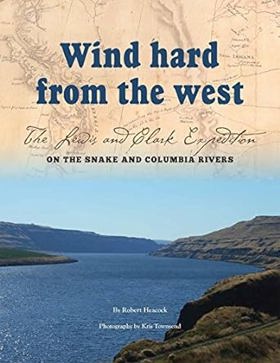
Written by Robert Heacock with photography by Kris Townsend, Wind hard from the west chronicles the daily activities and location descriptions of the Lewis and Clark Expedition on the Snake and Columbia Rivers, complete with maps, plus historic and modern photos. This copy is sold in coil or (spiral) binding. 155 pages : illustrations (some color), maps (some color) ; 28 cm CIRC [ 1 ]
|
2015 |
|
Win-Quatt a brief history of The Dalles, Oregon by Philip Klindt, Linda Klindt, Widge Johnson, Carolyn Wood 
About 80 miles east of Portland, Oregon, in the heart of the majestic Columbia River Gorge, lies a small community with great significance. Surrounded by rolling hills, scenic mountains, abundant orchards and fields, The Dalles is a treasure trove of beauty and home to many recreational activities. However, the less apparent gems are found in its lavish history. Authors Philip and Linda Klindt, teachers and owners of the oldest bookstore in Oregon, trace the fascinating 10,000 year story of this vital trade center. --Cover 128 pages : illustrations, maps ; 23 cm CIRC [ 1 ]
|
2011 |
|
William S. U'ren Oregon father of the initiative, referendum, and recall by Richard W. Etulain , John Thomas 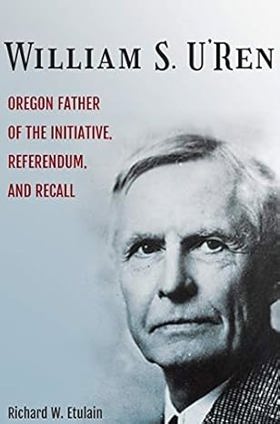
This slim volume collects essays, speeches, and letters written by Oregon political reformer and one-term legislator William S. U'Ren. Historian Richard Etulain's twenty-five-page biographical overview that precedes these primary documents is the most comprehen- sive coverage of U'Ren's life and impact on the state's politics to date. In the overview, Etulain calls U'Ren "one of the state's chief political thinkers and activists," who was known for promoting the Initiative and the Referen- dum, both of which were political reforms that Oregon voters adopted in 1902. Despite his short career as an elected official, U'Ren was Influential in Oregon and well beyond. His writing covers advocacy for the single tax and reflections on the efficacy of political reforms. Also included in the volume are the few photographs of U'Ren that exist, a short historiographic essay by Etulain, and Etulain's call for future research. x, 185 pages : photographs ; 23 cm CIRC [ 0 ]
|
2020 |
|
William Lovell Finley champion of Oregon's wildlife refuges by Joe R. Blakely 
This biography of the pioneer photographer and conservationist, William Finley, not only tells the astonishing story of his efforts to save Oregon wildlife in the early 1900s, but includes the original photographs of birds that made his work so successful. William Finley and Herman Bohlman climbed 150-foot trees, scaled cliffs, crawled through poison oak, and paddled on mosquito-infested lakes carrying heavy camera gear in search of wild birds to photograph. Finley worked for over 25 years to save the Malheur National Wildlife Refuge in Eastern Oregon. Finley fought to clean up the Willamette River. Possibly every wildlife refuge in Oregon -- including the one named in his honor south of Corvallis -- owes its existence to this man's struggle to provide sanctuaries for wild animals 208 pages : illustrations, photographs, maps ; 23 cm. CIRC [ 0 ]
|
2021 |
|
William Hobson (1820-1891) pioneer, minister, and founder of the Evangelical Friends Church (Quakers) in the Pacific Northwest by Julie M. Anderson 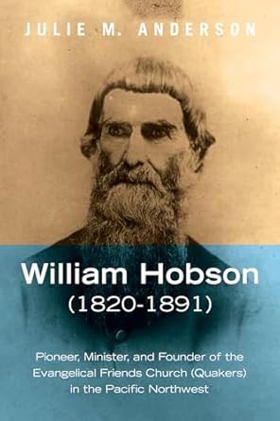
"William Hobson, a staunch nineteenth-century Quaker minister and determined follower of Jesus Christ, was shaped by revival, Quaker history, and his Friends upbringing. As a young adult he left his home state of North Carolina for the Iowa frontier where he honed his God-given leadership skills while shepherding the pioneer congregation at Honey Creek. After two decades in Iowa, Hobson received a mid-life call from God to establish a new missions-focused Quaker community somewhere on the West Coast. Following an extensive search for the perfect location, Hobson eventually chose Newberg, Oregon, and Quaker influence in the region quickly spread, culminating in the organization of the Evangelical Friends Church (Quakers) in the Pacific Northwest. Hobson's lifelong determination to follow God continues to serve as a godly example inspiring us to likewise dedicate our lives to God's kingdom purposes"-- Back cover xvii, 262 pages : illustrations (black and white) ; 23 cm CIRC [ 0 ]
|
2021 |
|
Willamette River greenways navigating the currents of conservation policy and practice by Travis Williams 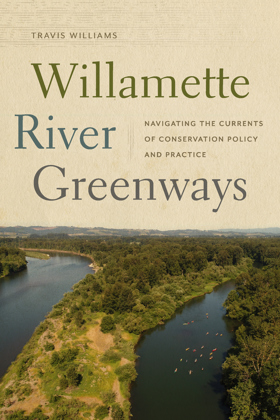
"The Willamette River Greenway Program, first proposed in 1966 by future Oregon governor Bob Straub, envisioned a nearly two-hundred-mile assemblage of public lands along the Willamette River for public use and environmental protection. While the Greenway Program fell far short of Straub's original proposal, today it provides for significant riverside lands with a range of public benefits. The Greenway Program also offers a useful lens through which to view the successes and failures of Oregon's environmental protection policies over the past few decades. Travis Williams, executive director of Willamette Riverkeeper, has spent countless hours paddling the Willamette, becoming familiar with its flora, fauna, and human neighbors. In Willamette River Greenways, he combines personal narrative about his experiences on the river with nuanced consideration of the controversies and challenges of the Greenway Program. Williams sheds light on current land stewardship practices, revealing the institutional and leadership failures that endanger the river's water quality and habitat, and looks to the program's future. He also takes readers with him onto the water, sharing what it's like to travel the river by canoe, paying homage to the river's natural beauty and the host of wildlife species that call it home. Part policy analysis, part advocacy, and all love letter to one of Oregon's great rivers, Willamette River Greenways offers valuable perspective to policymakers, land use managers, and recreational river users alike"-- Provided by publisher x, 196 pages : illustrations, map ; 23 cm CIRC [ 0 ]
|
2022 |
|
Willamette River Basin planning atlas trajectories of environmental and ecological change by David Hulse, Stan Gregory, Joan P. Baker, Pacific Northwest Ecosystem Research Consortium 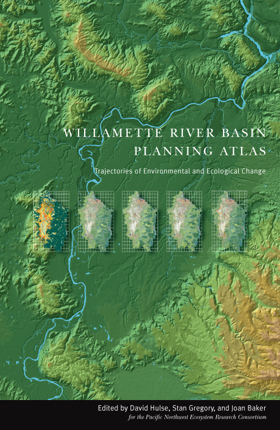
"The Willamette River Basin Planning Atlas offers a valuable resource for anyone interested in the region's past, present, and future. Using a variety of color maps, charts, and photographs, the Atlas presents a vast amount of information intended to provide a long-term, large-scale view of changes in human and natural systems within the Basin." "Five chapters provide information on current conditions and historical changes since 1850, focusing in turn on land forms and geology, water resources, plants and animals, land use, and human population." "Next, there is a detailed examination of how the Basin may change between now and 2050 under three alternative scenarios for future land and water use: one assuming a continuation of current land use and management policies, the second assuming a loosening of current policies to allow freer development, and the third assuming greater emphasis on ecosystem protection and restoration." ix, 178 pages : illustrations (some color), maps (some color) ; 44 cm ONLINE CIRC [ 1 ]
|
2002 |
|
Willamette landings, ghost towns of the river by Howard McKinley Corning, Federal Writers' Project (Or) 
A history of the towns and landings on the Willamette River that were serviced by steamboats prior to the advent of railroads. Includes an index of almost 200 landings, as compiled by Capt. Arthur Riggs in 1940. Howard McKinley Corning (1896-1977) was a poet and historian. During the 1930s he served as an editor and supervisor for the Oregon Writers' Project of the Works Progress Administration, the work for which led to his writing of both this book (1947) and A Dictionary of Oregon History (1956). vi, 224 pages illustrations 23 cm CIRC [ 2 ]
|
1973 |
|
Wildmen, wobblies & whistle punks Stewart Holbrook's lowbrow Northwest by Stewart H. Holbrook, Brian Booth 
Stewart Holbrook was a high school dropout who emerged from logging camps to become the author of three dozen books, the Pacific Northwest’s foremost storyteller, one of the nation’s most popular historians, and a satirical painter known as “Mr. Otis.” Today readers are rediscovering Holbrook’s colorful and irreverent accounts of Pacific Northwest history. Wildmen, Wobblies, and Whistle Punks collects twenty-six of Holbrook’s best writings about the region. Combining solid scholarship with humor and a gift for celebrating the offbeat, Holbrook’s stories record a vibrant, often overlooked side of Northwest history. Here are forgotten scandals and murders; stories of forest fires, floods, and other calamities; tales of loggers and life in the logging camps; and profiles of various lowbrow characters—radicals, do-gooders, dreamers, schemers, and zealots. vi, 313 pages : illustrations, map ; 23 cm. CIRC [ 0 ]
|
1992 |
|
Wildlife-habitat relationships in Oregon and Washington by David H. Johnson , Thomas A. O'Neil 
The biggest challenge facing natural resource conservation efforts today is to maintain biological diversity and viable ecosystems. This requires the best available scientific information on the relationships between individual species and their habitat. Wildlife-Habitat Relationships in Oregon and Washington is the first book to compile and synthesize in a single convenient, comprehensive volume a vast amount of diverse information on 593 wildlife species and their relationships with the 32 terrestrial, freshwater, and marine habitat types of Oregon and Washington. Included are color photographs of each habitat type, as well as hundreds of maps, diagrams, and other illustrations. In addition, a separate CD-ROM (included with the book) contains additional wildlife diata and color maps, and seven matrices that link wildlife species with their respective habitat types. The 88 contributing authors include experts in wildlife, botany, fisheries, conservation biology, vegetation mapping, and the ecology of forest, rangeland, and marine environments, among other fields. Intended for use by natural resource managers and planners, scientists, conservationists, educators, and other individuals with a deep interest in wildlife species and their habitats, this book is sure to be a valuable resource and standard reference for many years to come. xix, 736 pages : illustrations, maps (some color) ; 29 cm + 1 CD-ROM (4 3/4 in.) CIRC [ 0 ]
|
2001 |
|
Wild in the Willamette exploring the Mid-Valley's parks, trails, and natural areas by Lorraine Anderson, Abby P. Metzger 
Located between the population centers of Portland and Eugene, Oregon’s Willamette Valley boasts rich opportunities for outdoor recreation that are too often overlooked. Wild in the Willamette is a guidebook to the natural treasures of the mid-Willamette Valley, extending far beyond the familiar I-5 corridor. Sprinkled with natural history sidebars and infused with essays by notable local authors, it aims to connect residents and visitors with the best hiking, biking, and paddling opportunities the mid-Valley offers. With a special focus on seven watersheds—the Marys, Calapooia, South Santiam, North Santiam, Luckiamute, Yamhill, and Pudding—as well as the middle portion of the main stem Willamette River, the book describes a range of outings at different levels of challenge. Families with young children, day hikers, long-distance backpackers, kayakers, canoeists, bird watchers, and cyclists alike will find ideas for spending a satisfying afternoon or venturing outside for a multiday trip. Whether choosing a wheelchair-accessible trail, a rugged hike in a wilderness area, a dip in a rocky swimming hole, a paddle on the broad Willamette, or a bike ride through farmland—whether lifetime residents or week-long visitors—outdoor enthusiasts will benefit from detailed notes on the history and ecology of this special place. Armchair travelers will also find reward in the book’s literary and natural history offerings. Generously illustrated with maps and keys to the area’s many attractions, Wild in the Willamette, a companion volume to the Portland-Vancouver region’s Wild in the City, is an essential guide to the natural wonders of Oregon’s mid-Willamette Valley. xxi, 306 pages ; 23 cm CIRC [ 0 ]
|
2015 |
|
Wild in the city exploring the intertwine, the Portland-Vancouver region's network of parks, trails, and natural areas by Michael C. Houck, M. J. Cody, Audubon Society of Portland 
The second edition of the highly acclaimed Wild in the City brings more than one hundred of the best parks, trails and natural areas to your fingertips. This comprehensive “must-have” reference will be the go-to field guide for hikers, cyclists, paddlers, bird watchers, and nature enthusiasts. This revised and updated edition contains new maps organized according to watershed and includes twenty-eight unique “rambles” that explore multiple sites for recreation, wildlife viewing, or simply contemplating the joys of nature. New natural history essays by Ursula K. Le Guin, Kim Stafford, Robin Cody, Judy BlueHorse Skelton, Robert Michael Pyle, Jonathan Nicholas, and Richard Louv, author of Last Child in the Woods, offer fresh perspectives on the little pockets and expansive corridors of Portland’s wild environs. The book also examines the innovative strategies that cities, agencies, and nonprofits are using to create an ecologically sustainable metropolitan region. This invaluable resource will be an essential guide for educators and parents who want to explore the region’s natural wonders with their students and children. Included are tips on living with wildlife, as well as a new section that provides essential information on how urban living and green spaces intersect. xx, 427 pages : illustrations, maps ; 23 cm CIRC [ 0 ]
|
2011 |
|
Wild beauty photographs of the Columbia River Gorge, 1867-1957 by Terry Toedtemeier , John Laursen , Northwest Photography Archive (Publisher) 
The inaugural volume in the Northwest Photography Series, Wild Beauty chronicles the rich photographic history of the spectacular Columbia River Gorge. This exquisitely produced large-format book features more than 130 images—most of them previously unpublished and many never before available for public view—by some three dozen photographers, including Carleton Watkins, Benjamin Gifford, Lily White, Sarah Ladd, Fred Kizer, Alfred Monner, and Ray Atkeson. Wild Beauty represents, in the words of one reviewer, “a culmination of decades of research, exhibition, and total immersion in the geology, history, and photography of the Columbia River Gorge.” The Columbia River Gorge exerts a powerful influence on the lives and imaginations of the inhabitants of the Pacific Northwest. For people who live here today, just as for those Native Americans and European settlers who preceded us, this dramatic natural landform is a source of awe. Since the 1860s it has inspired superb photographers who have framed and interpreted the way we see the Gorge, and who have in turn had their artistic vision shaped by this compelling landscape. The ninety-year period covered in Wild Beauty was a critical period in the river’s history. Over thousands of years the wild, free-flowing torrent of the Columbia River carved a passage – the Columbia River Gorge – through the Cascade Mountain Range. In the 1860s, when the first photographers arrived, the Gorge still looked much the same as it had when Lewis and Clark made their way down the river in 1805, and indeed as it had for centuries before that, when the native peoples’ culture of fishing and trade thrived along the river’s banks. In the mid twentieth century, the character of the river was fundamentally altered by the construction of hydroelectric dams. Wild Beauty begins in 1867 with images by the legendary Carleton Watkins, creator of some of the greatest landscape photographs of the nineteenth century. The volume ends in 1957 with the completion of The Dalles Dam, which drowned Celilo Falls and with it the historic site where Indians had fished for millennia. The images in this beautifully designed volume are presented one to a spread, with captions on the facing pages. The book is organized into five chronological sections, each with a brief introduction; a map shows the locations where the photographs were made. The photographs have been meticulously restored and are exquisitely reproduced in four-color process to capture the subtle coloration and nuanced tonal values of albumen prints, gelatin silver prints, platinum prints, hand-colored photographs, and early Kodachromes. The photography of Watkins and his successors is a significant piece of the cultural heritage of the Pacific Northwest. Readers interested in the history of the Columbia River and the photography of the developing American West will be enthralled by the book’s scope and artistry. And those who love the Gorge’s stunning beauty will welcome how this volume has captured its grandeur. Wild Beauty is the inaugural volume in a new series initiated by the Northwest Photography Archive. For 150 years, photographers have chronicled the landscape, people, and events of the Pacific Northwest. The Archive’s mission is to gather the finest and most significant of these images, from both private and public collections, and publish them in book form to make them widely available. All volumes in the series will be printed and bound in Oregon. 345 pages : illustrations (some color), color maps ; 32 cm. CIRC [ 1 ]
|
2008 |
|
Why that name? place names of Kamloops district by Mary Balf
|
1978 |
|
Whitman County from Abbieville to Zion by Edith E. Erickson 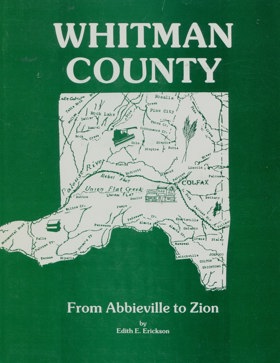
The authors interest spread to Whitman County as she uncovered information and felt others might be intrigued by the number of places that had at one time been named and have since disappeared. In order to make this book accurate, she used a variety of sources ranging from postal records to interviews with people who at tented some of the small and now consolidated schools. Contains bibliography and maps [2], xxiii, 140 pages : illustrations, maps ; 28 cm CIRC [ 1 ]
|
1985 |
|
Whitewater mailmen the story of the Rogue River mail boats by Gary Meier, Gloria Meier 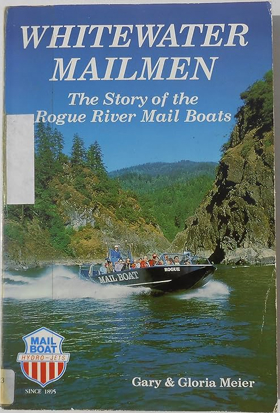
Authored by regional historians Gary Meier and Gloria Meier, Whitewater Mailmen: The Story of the Rogue River Mail Boats chronicles the perilous and essential maritime service that kept Oregon's remote canyon settlements connected to the outside world. The book details the history of the daring pilots who navigated the treacherous rapids, submerged boulders, and churning white water of the lower Rogue River to deliver mail, supplies, and passengers to isolated homesteaders. Drawing on archival photographs and firsthand interviews, the text captures the mechanical evolution from wooden skiffs to specialized jet boats that conquered an unforgiving aquatic highway. A keen insight drawn from the work is how postal delivery infrastructure served as the true lifeblood of geographic integration in the American West; by transforming a dangerous wilderness river into a dependable federal mail route, these boatmen proved that modern state control and community survival in the rugged backcountry depended entirely on mastering wild, untamed waters. xii, [187] pages : illustrations ; 23 cm CIRC [ 1 ]
|
1991 |
|
White riot the 1907 anti-Asian riots in Vancouver by Henry Tsang 
"Essays and photographs that document the anti-Asian riots of 1907 in the context of contemporary anti-Asian sentiment. White Riot: The 1907 Anti-Asian Riots in Vancouver explores the conditions leading up to and the impact of a demonstration and parade in Vancouver, Canada, organized by the Asiatic Exclusion League and the ensuing mob attack on the city's Chinese Canadian and Japanese Canadian communities. Emblematic of a systemically racist era, White Riot reveals the social and political environment of the time, when racialized communities were targeted through legislated as well as physical acts of exclusion and violence. Based on 360 Riot Walk, a 360-degree video walking tour by artist and author Henry Tsang, White Riot offers an intersectional approach to this pivotal moment in the history of racialized communities and a cultural and social context for understanding for the current wave of anti-Asian sentiment. It features photographs of the riots colourized by Tsang as well as those of contemporary Vancouver where the riots took place. Essays by Tsang and others speak to the colonial times that preceded and followed the 1907 riots, as well as issues that Chinese and Japanese communities (and other racialized communities) in North America are facing today. White Riot poses the question: in the current ethos of anti-racism and decolonization, what does it take to reconcile our collective histories within the legacy of white supremacy? Includes essays by the Asian Canadian Labour Alliance, Paul Englesberg, Melody Ma, Angela May and Nicole Yakashiro, Jeffery R. Masuda, Aaron Franks, Audrey Kobayashi and Trevor Wideman, and Andy Yan, with an introduction by Patricia E. Roy."-- Provided by publisher 191 pages : illustrations (chiefly color), color maps ; 21 x 26 cm CIRC [ 0 ]
|
2023 |
|
White poplar, black locust by Louise Wagenknecht 
"Growing up in one of the West's last company lumber towns, a small community called Hilt on the California-Oregon border, Louise Wagenknecht witnessed the dying years of a unique way of life. The tail-end of the 1950s lumber boom would devastate the ancient old-growth forests of the Klamath Mountains as well as the people of Hilt, whose lives were inextricably tied to the company lumber mill. White Poplar, Black Locust is the story of that transformation, but it is also something more-a noteworthy addition to the literature of place, and a sensitive and richly textured family memoir. As Wagenknecht unravels the threads that still bind her to both Hilt's history and her own, unforgettable characters emerge, and what should have been the happy ending to this story, the marriage of her divorced mother to a forester working for the Fruit Growers Supply Company, becomes instead the end of childhood innocence, foretelling the demise of the mill and the end of Hilt itself. Originally published by the University of Nebraska Press in 2003, this first book in Louise Wagenknecht's trilogy about life in the Klamath Mountains is now available through Oregon State University Press, together with Light on the Devils (2011) and Shadows on the Klamath (2021)"-- Provided by publisher viii, 238 pages : illustrations ; 23 cm CIRC [ 0 ]
|
2021 |
|
White Grizzly Bear's legacy learning to be Indian by Lawney L. Reyes 
"I walked across the highway and stood on the bank overlooking Lake Roosevelt. My attention was directed to the area where Kettle Falls once flowed. As I stood there the wind came. As I listened I imagined that it talked to me. It seemed that it was telling me of how things once were. I began to think of friends and relatives who were no longer living. They began to appear before me, perched on the large rocks, fishing for the great salmon." In his distinctive voice, Lawney Reyes, grandson of Pic Ah Kelowna or White Grizzly Bear of the Sin Aikst, relates the history of his family and his people. The Sin Aikst are now known as the Lakes tribe, absorbed into the Colville Confederated Tribes of eastern Washington. And where Kettle Falls once flowed and the Sin Aikst once fished are places that exist now only in memory, flooded when the Grand Coulee Dam was completed in 1942. Reyes uses personal and family history to explore the larger forces that have confronted all Native Americans: displacement, acculturation, and the potent force of self-renewal. The son of a Filipino immigrant and a mother who traced her ancestry to the earliest known leaders of the Sin Aikst, Reyes paints a vivid picture of his early life in the Indian village of Inchelium, destroyed by the building of the dam. Reyes describes the loss of homeland and traditional ways of life, the scarcities that followed, and the experiences of a court-ordered Indian boarding school in Oregon. These well-known facts of loss and injustice take on a compelling dimension in Reyes’s blend of history and autobiography, brought to life by the vivid images and personalities he describes. Despite the loss of heritage beneath the waters of the Columbia River and the flood of white acculturation, Reyes and his younger brother, the late Native American leader Bernie Whitebear, were able to fashion rich lives in a changed world, lives that honor the past while engaging with the present. xviii, 197 pages : illustrations, maps ; 23 cm CIRC [ 0 ]
|
2013 |
|
Whistle stops along the Columbia River narrows a history of Burton and surrounding area by Burton New Horizons Book Committee
|
1982 |
|
Whispers from "Old Genesee," and echoes of the Salmon River by John A. Platt 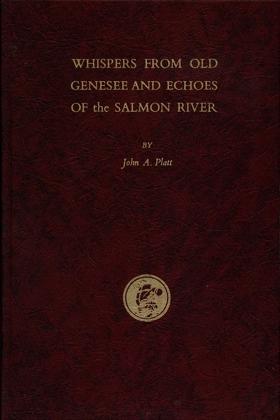
Early day history and folklore of the Idaho Panhandle, including Latah, Nez Perce, Idaho and Lewis counties. Preface by the author: "In writing the following pages I have been influenced by a desire to record for our sons and daughters, and their descendants, a written chronicle of the happenings of our lives, together with a mention of certain interesting events which occurred in the vicinity of Genesee during the pioneer days. As these events happened from sixty to seventy-five years ago, there may be some lapse of memory or wrong interpretations. I was only a small boy at the time the earlier events transpired, but they made such a deep impression on my mind that I have never forgotten them. This will not be a complete history – nor a literary masterpiece. It will contain some history, some biography, and perhaps a sprinkling of “blarney.” If the reader, as he peruses these pages, finds amusement, information or entertainment from my efforts, I will feel amply rewarded.” [7], 75, [6],46, [1] pages : illustrations, map, portraits ; 23 cm CIRC [ 1 ]
|
1959 |
|
Whidbey Island's special places and the people who love them by Dan Pedersen 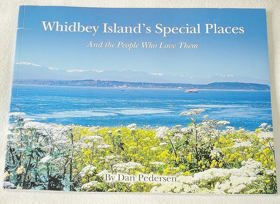
Through ten people, Pedersen tells the stories of 10 different places. The names are recognizable to many: Ranger Rick Blank at Deception Pass State Park, Roger Sherman on Central Whidbey, and Elliott Menasche, an authority on South Whidbey State Park, for example. In simple feature stories he smoothly describes the places and the people who treasure them. It’s an easy read, but surprisingly informative even for long-time islanders. You may not have known, for example, that the oldest tree on the island, located in Deception Pass State Park, recently celebrated its 860th birthday. 63 pages : color illustrations, color map ; 22 x 28 cm CIRC [ 1 ]
|
2009 |