Catalog of British Columbiana and Pacific Northwest Americana
Encyclopedia Cascadia Catalog contains book titles of mostly non-fiction Pacific Northwest Coast of North America Titles (primarially British Columbia, Idaho, Oregon and Washington State) in an easy-to-understand title catalog. If you see a link with this badge ONLINE CIRC it means that there is an online institution that provides free access to that title. In some cases there may be more than one institution hosting the title digitally.
| Catalog Title | Published |
|---|---|
|
Pendleton a short history of a real western town by Keith F. May, Christina Rae May 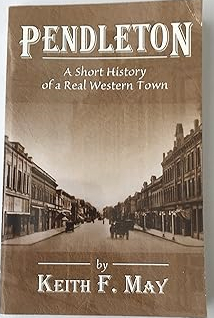
Published by Keith F. May and Christina Rae May, Pendleton: A Short History of a Real Western Town explores the dynamic evolution of this iconic Oregon community from its origins as a frontier trading post into a bustling agricultural and cultural hub. The book chronicles the town's rich heritage, highlighting the impact of the Oregon Trail, the arrival of the railroad, and the establishment of its famous woolen mills and annual Round-Up celebration. Through local anecdotes and historical highlights, the authors capture the rugged spirit and enduring character that distinguish Pendleton from standard suburban settlements. A keen insight drawn from the text is how communities like Pendleton leverage theatrical traditions like the rodeo not just for entertainment, but as vital cultural anchors that allow a changing rural economy to publicly perform and preserve its foundational mythos. 124 pages : illustrations, maps, portrait ; 22 cm CIRC [ 1 ]
|
2005 |
|
The Wenatchee Valley and its first peoples thrilling grandeur, unfulfilled promise by Richard D. Scheuerman, John Clement, Clifford E. Trafzer, Wenatchee Valley Museum and Cultural Center 
Published by the Wenatchee Valley Museum and Cultural Center, The Wenatchee Valley and its First Peoples: Thrilling Grandeur, Unfulfilled Promise by Richard D. Scheuerman, John Clement, and Clifford E. Trafzer examines the complex cultural history of Washington's mid-Columbia region. The book juxtaposes the awe-inspiring geography of the high-desert river valley with the tragic history of displacement experienced by its original indigenous inhabitants, particularly the Wenatchi people. Through historical accounts, archival photographs, and cultural analysis, the authors trace how rapid Euro-American settlement and irrigation projects transformed the landscape while frequently breaking solemn treaties. A keen insight drawn from the text is how the subtitle's reference to "unfulfilled promise" operates as a poignant critique of manifest destiny; it highlights how the modern agricultural bounty of the Wenatchee apple capital was built directly upon the unfulfilled legal and moral guarantees made to the valley's original stewards. xxii, 145 pages : color illustrations, map, portraits ; 23 x 29 cm CIRC [ 1 ]
|
2005 |
|
The sandal & the cave the Indians of Oregon by Luther S. Cressman 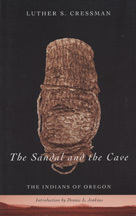
Luther Cressman's 1938 discovery of a 9,000-year-old sandal in Fort Rock Cave revolutionized accepted theories of western prehistory. The recovery of the woven sagebrush-bark sandal, found buried under a layer of volcanic ash from the eruption of Mount Mazama, established a human presence in the Oregon Country much earlier than previously thought. Through six decades of scientific investigation, Cressman worked to uncover the history of the first Oregonians. In The Sandal and the Cave, he offers a brief, lucid introduction to the prehistory of Oregon Indians. Cressman describes their diverse cultures, highlighting similarities and differences between the peoples of various regions: the Oregon Coast, the Klamath Highland, the Northern Great Basin, and the Columbia Plateau. In a new introduction to Cressman's classic work, Dennis Jenkins provides a short biographical profile of the "father of Oregon archaeology" and discusses the importance of Cressman's excavation results and interpretations. Jenkins also offers a concise summary of recent archaeological research in the Northern Great Basin, bringing readers the most up-to-date information about the oldest known sites in Oregon. About the author: Luther S. Cressman (1897-1994) joined the University of Oregon faculty in 1929 and, in addition to his pioneering work as a field archaeologist, was instrumental in establishing the Department of Anthropology and the UO Museum of Natural History. His other books are Prehistory of the Far West: Homes of Vanished Peoples and A Golden Journey: Memoirs of an Archaeologist. xxxiii, 142 pages : illustrations, maps ; 22 cm. CIRC [ 0 ]
|
2005 |
|
Good wood growth, loss, and renewal by Steven R. Radosevich 
Good Wood is a clear-eyed, finely hewed collection of personal essays on farming, forestry, and family in the Pacific Northwest. As a young man, Steve Radosevich learned to prune trees by watching his grandfather. Working in the apple orchards of the struggling family farm, he saw that "every cut was a decision, conscious and deliberate, about the health of the trees and their coming crops." In Good Wood, Radosevich examines the choices we make in life and how those choices affect the health of people and places. Radosevich draws on his experiences on two farms-the "homeplace," a family farm in Washington's Yakima Valley, and Kla-kla-nee, his small vineyard in Oregon's Willamette Valley. Radosevich is also a professor of forestry, and his commitment to sustainable forestry informs his writings. His book seamlessly combines recollections of tending smudge pots on freezing spring nights east of the Cascades with discussions about the flooding of Native fishing grounds at Celilo Falls and clearcuts in the Oregon Coast Range. "All these losses," writes Radosevich, "have been decisions too, made consciously I think, but with less deliberation than the forethought of a farmer pruning his orchard." As keeper of the old family orchard and tender of a new family farm, Radosevich reveals in these stories his deliberate choices and his hopes for the world of his children and grandchildren. xii, 136 pages ; 22 cm CIRC [ 0 ]
|
2005 |
|
Jumptown the golden years of Portland jazz, 1942-1957 by Robert Dietsche 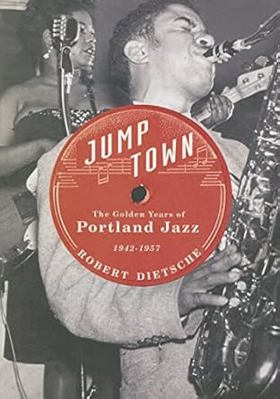
A fascinating blend of music, politics, and social history, Jumptown sheds light on a time and place overlooked by histories of Portland and jazz. For a golden decade following World War II, a thriving African American neighborhood—that would soon be bulldozed for urban renewal—spawned a jazz heyday rarely rivaled on the West Coast. Such luminaries as Duke Ellington, Charlie Parker, Oscar Peterson, Dave Brubeck, and Wardell Gray headlined Portland clubs and traded chops with the up-and-coming local talent. The Dude Ranch. Lil' Sandy's. McClendon's Rhythm Room. The Frat Hall. The Chicken Coop. The Uptown Ballroom. Jazz historian Bob Dietsche leads a guided tour of the main jazz spots—from supper club to dance hall—capturing the emotion, excitement, and energy of an evening on the town. His book for the first time collects hundreds of pieces of local jazz history—photographs, personal recollections, reviews, handbills—to create "an anatomy of a jazz village." Dietsche's compendium of stories and moments brings to life the citizens of this jazz village—the musicians and dancers, the disc jockeys and promoters, the critics and music teachers, the club owners and patrons. Jumptown celebrates and preserves this rich cultural past and showcases its continuing influence. In an afterword, Lynn Darroch recaps the highlights in Portland jazz during the past 40 years and shows how “Portland's 21st century jazz scene reflects the city's original golden age, and the spirit of the Avenue remains in the sounds of today.” xiii, 229 pages : illustrations, 1 map ; 26 cm CIRC [ 0 ]
|
2005 |
|
Frank Okada the shape of elegance by Kazuko Nakane, Frank S. Okada, Museum of Northwest Art 
"Artist Frank Okada played a significant role in the modern art history of the Pacific Northwest. Born a Nisei in 1931, he was raised in Seattle's International District. Throughout his life he retained its influences and expressed his vivid memories in his art. From his first painting award - received at the Washington State fair - until his death in 2000 at the age of sixty-nine, he worked at the confluence of regional art, Asian culture, and national art movements." "At the beginning of his career, Okada received a series of prominent fellowships - John Hay Whitney in 1957, Fulbright in 1959, and Guggenheim in 1966-67. He was greatly influenced by the artists he met and was a close observer of the art scenes in New York, Paris, and Kyoto in an effort to find his own style of painting and how to be a painter. He began teaching painting at the University of Oregon in 1969, a tenure that lasted thirty years. His work from the seventies, eighties, and nineties balanced forms and colors in intensely worked surfaces. The color blocks gradually became more intellectually structured and his compositions more expressive as he made his colors more powerful. As Nakane notes, without recognizable reference to nature or his own personality, he created a texture that brought light to a field of color. The build-up of color dots underneath and extensive small textural stories across large canvases made progress slow. In order to appreciate his paintings, one needs to spend time observing how the colors respond to the charges of light throughout the day."--Jacket 80 pages : color illustrations ; 23 cm CIRC [ 0 ]
|
2005 |
|
Keeping it living traditions of plant use and cultivation on the Northwest Coast of North America by Douglas Deur, Nancy J. Turner 
The European explorers who first visited the Northwest Coast of North America assumed that the entire region was virtually untouched wilderness whose occupants used the land only minimally, hunting and gathering shoots, roots, and berries that were peripheral to a diet and culture focused on salmon. Colonizers who followed the explorers used these claims to justify the displacement of Native groups from their lands. Scholars now understand, however, that Northwest Coast peoples were actively cultivating plants well before their first contact with Europeans. This book is the first comprehensive overview of how Northwest Coast Native Americans managed the landscape and cared for the plant communities on which they depended. Bringing together some of the world's most prominent specialists on Northwest Coast cultures, Keeping It Living tells the story of traditional plant cultivation practices found from the Oregon coast to Southeast Alaska. It explores tobacco gardens among the Haida and Tlingit, managed camas plots among the Coast Salish of Puget Sound and the Strait of Georgia, estuarine root gardens along the central coast of British Columbia, wapato maintenance on the Columbia and Fraser Rivers, and tended berry plots up and down the entire coast. With contributions from ethnobotanists, archaeologists, anthropologists, geographers, ecologists, and Native American scholars and elders, Keeping It Living documents practices, many unknown to European peoples, that involve manipulating plants as well as their environments in ways that enhanced culturally preferred plants and plant communities. It describes how indigenous peoples of this region used and cared for over 300 different species of plants, from the lofty red cedar to diminutive plants of backwater bogs. xi, 404 pages : illustrations, 1 map ; 25 cm CIRC [ 0 ]
|
2005 |
|
When the river ran wild! Indian traditions on the Mid-Columbia and the Warm Springs Reservation by George Aguilar 
"Nearly seventy-five years of my lifetime have come and gone since hearing of the sparse historical events from the old-timers," American Indian elder George Aguilar tells us. "It’s my turn now." When the River Ran Wild! is Aguilar's recounting of events he heard about while watching his grandmother make moccasins by the light of a coal-oil lamp and while strapped to the back of his aunt's horse on the way to the huckleberry grounds. He learned them at Coyote's Fishing Place, where his uncles built scaffolds and taught him how to use traditional technologies to catch salmon as they made their seasonal runs up the river. In this remarkable personal memoir and tribal history, we learn about Aguilar's people, the Kiksht-speaking Eastern Chinookans, who lived and worked for centuries connected to the rhythms and resources of the great fishing grounds of the Columbia River at Five Mile Rapids. When the River Ran Wild! is the story of a culture and a community that has undergone tremendous change since 1805, when the River People encountered Meriwether Lewis and William Clark as they traveled down the Columbia River on their way to the Pacific Ocean. To find the stories of that change, Aguilar draws on the journals and diaries of early White missionaries and settlers, such as Gabriel Franchere, Rev. Henry Perkins of Wascopum Mission, and A. B. Meacham. He found other stories in anthropological papers and historical studies that recorded the voices of people who practiced and remembered ceremonies and traditions that were lost or changed during the difficult years of removal to the Warm Springs Reservation in north-central Oregon. He heard yet others from tribal elders who have kept the history and stories of the River People in their memories. When the River Ran Wild! is the history of names and naming, of deep family connections, and of traditional customs. It is a descriptive catalogue of the plants the River People used for sustenance and medical purposes, and it is a detailed guide on how to pack out an elk and how to tan a hide. Aguilar retells the stories and myths of the river, the stories that "are now infrequent and told from books in the English language," the stories whose "body language, animal mimicry, and facial expressions are gone." Aguilar has written this book to help us know what the River People have lost on the Columbia River over the decades, but he also gives testimony to what has been conserved and enlivened by a people who love the land and who honor tradition and those who came before. He takes us, perhaps better than anyone else can, back to a time when the river ran wild. xviii, 252 pages : illustrations ; 23 cm CIRC [ 0 ]
|
2005 |
|
Raincoast chronicles 20 lilies and fireweed : frontier women of British Columbia by Stephen Hume 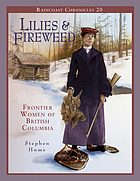
Lilies and Fireweed is packed with unforgettable stories of women surviving in the unforgiving, sometimes hostile environment of pioneer and aboriginal British Columbia. Based on award-winning journalist Stephen Hume's popular series "Frontier Women of BC" that appeared in the Vancouver Sun in 2002, this collection of essays contains stories, photographs and other materials that have never before been published. From hospitals to dance halls, and from the classroom to the cannery floor, this insightful pictorial history examines indigenous and immigrant women's positions in the workplace, home and wilderness. Hume delves into the lives of aboriginal and pioneer women who had an important and multifaceted influence on the development of British Columbia. We meet women such as 17-year-old Frances Barkley, who insisted on accompanying her husband on a merchant voyage to British Columbia in 1786 and subsequently twice circumnavigated the world; Lady Amelia Douglas - a Cree woman and wife of Governor James Douglas - who had her own important but often overlooked role in the forging of British Columbia; Mrs. Washiji Oya, the first Japanese woman to settle in Canada in 1887; and Maria Pollard Grant, who, in 1895, became the first woman elected to public office in BC. Brimming with fascinating historical photographs, Lilies and Fireweed brings to light the forgotten stories of mothers, dance-hall girls, artists, teachers and adventurers that are as enthralling and diverse as BC itself. 80 p. : ill., ports. ; 28 cm. CIRC [ 0 ]
|
2004 |
|
Madison Park remembered by Jane Powell Thomas 
Published in local editions by Jane Powell Thomas, Madison Park Remembered captures the intimate neighborhood history and evolution of one of Seattle’s most historic lakeside communities. The book traces the area's transformation from a native transit route and late 19th-century recreational resort accessible by cable car into a vibrant residential enclave nestled along the shores of Lake Washington. Through a rich collection of archival photographs and personal reminiscences, the text preserves the vanishing daily rhythms of neighborhood cottages, local parks, and lakeside streetcar culture. A keen insight drawn from the work is how urban lakeside neighborhoods function as historical micro-ecosystems; by tracking how a recreational getaway morphed into an affluent urban suburb, the narrative reveals how Seattle's rapid geographic expansion was fundamentally propelled by the public desire to escape industrial city life while still retaining metropolitan proximity. 170 pages : illustrations, maps ; 23 cm CIRC [ 1 ]
|
2004 |
|
Conquest and catastrophe the triumph and tragedy of the Great Northern Railway through Stevens Pass by T. Gary Sherman, Washington State Library Rare Publications Collection 
Published by the Washington State Library Rare Publications Collection, Conquest and Catastrophe: The Triumph and Tragedy of the Great Northern Railway Through Stevens Pass by T. Gary Sherman details the epic, perilous engineering feat of pushing a transcontinental railroad through the rugged Cascade Mountains. The book chronicles James J. Hill's ambitious drive to conquer the treacherous terrain of Stevens Pass, balancing the immense economic triumph of connecting the Midwest to Puget Sound against the staggering human and environmental toll. Through archival records and striking photographs, the text recounts deadly avalanches—such as the infamous 1910 Wellington disaster—and the relentless labor required to tame an unforgiving alpine landscape. A keen insight drawn from the work is how corporate hubris on the industrial frontier often blinded railway leaders to ecological realities, demonstrating that treating raw mountain passes as mere engineering obstacles carried a devastating human cost. xiii, 243 pages : illustrations, maps ; 23 cm CIRC [ 1 ]
|
2004 |
|
Nanaimo the harbour city by Goody Niosi, Terry Patterson 
Published in 2004, Nanaimo: The Harbour City is an engaging travel guide and visual keepsake written by Goody Niosi with photography by Terry Patterson. The book chronicles the history and cultural evolution of this Vancouver Island community, tracing its growth from an early Aboriginal settlement into a thriving, modern port city. Alongside Patterson's vibrant images of the bustling harbour and local seascape, Niosi provides readers with detailed walking tours of historic neighborhoods and insights into the area's natural beauty. It serves as both a practical resource for travelers and a colorful celebration of Nanaimo's unique coastal heritage. 112 pages : illustrations (chiefly color), 1 color map, portraits ; 28 cm CIRC [ 1 ]
|
2004 |
|
Sailing with Vancouver a modern sea dog, antique charts and a voyage through time by Sam McKinney 
As Sam McKinney retraced the explorations of Captain George Vancouver and his men from Puget Sound to Queen Charlotte Sound he wondered, "Could I have been one of them?" In the 1790s, Vancouver's crew rowed for long hours day after day, and camped on rocky beaches in all weathers to chart the intricate coastline for European colonial exploits. Two hundred years later, McKinney followed their ancient path in his 25-foot sailboat, anchoring where they did, meeting the same winds and waves, and sharing "the link of vulnerability that is the ever-present condition of all people who go to sea." McKinney offers insightful comparisons of what sailors saw and experienced, in the 18th century and today, around the Inland Sea. At the end of his trip he, like Vancouver, claimed the area he had explored, "not by deed of ownership but out of love for the place, its staggering beauty [and] the memories of the people and cultures who have found homes along its shores." McKinney invites readers along on a perceptive voyage through time and along the magnificent, storied west coast.-- Provided by publisher 1 online resource (xiii, 209 pages) : illustrations, maps CIRC [ 1 ]
|
2004 |
|
The Boise Massacre on the Oregon Trail attack on the Ward party in 1854 and massacres of 1859 by Donald H. Shannon 
Only some half-dozen of the adverse encounters between Indians and emigrants on the Oregon and California Trails can be termed "massacre". The Ward Party Massacre that occurred on the Boise river is one of those unfortunate, and often overlooked events. Author Donald H. Shannon explores the relations between the peoples of the "Snake Country" of Southern Idaho, Shoshoni, Northern Paiutes, Bannocks and Emigrants, in a attempt to describe the environment that led to several of the most violent conflicts that occurred along the Oregon and California trails. xi, 287 pages : illustrations, maps ; 23 cm. CIRC [ 1 ]
|
2004 |
|
Sacajawea's people the Lemhi Shoshones and the Salmon River country by John W. W. Mann 
"John W.W. Mann offers an absorbing and richly detailed look at the life of Sacajawea's people before their first contact with non-Natives, their encounter with the Lewis and Clark Expedition in the early nineteenth century, and their subsequent confinement to a reservation in northern Idaho near the town of Salmon. He follows the Lemhis from the liquidation of their reservation in 1907 to their forced union with the Shoshone-Bannock tribes of the Fort Hall Reservation to the south. He describes how for the past century, surrounded by more populous and powerful Native tribes, the Lemhis have fought to preserve their political, economic, and cultural integrity. His compelling and informative account should help to bring Sacajawea's people out of the long shadow of history and restore them to their rightful place in the American story."--Jacket 1 online resource (xxiii, 258 pages) : illustrations, maps CIRC [ 1 ]
|
2004 |
|
The Long Beach Peninsula where the Columbia meets the Pacific by Donella J. Lucero, Nancy L. Hobbs 
Jutting northward from the mouth of the Columbia River, the Long Beach Peninsula defines Washington's southwestern coastal geography. The picturesque blend of beach and forest along the river, Willapa Bay, and the Pacific Ocean was home to the Chinook Indians who first settled this region. European and American trade came to this area in the 18th century, opening the way for Lewis and Clark to explore and establish a land route to the Pacific. The region prospered because of its diverse natural resources and thriving fur trade. Today, a vibrant tourist industry fuels the Peninsula's continuing development. 159 pages : illustrations, map ; 25 cm. CIRC [ 1 ]
|
2004 |
|
The early exploration of inland Washington waters journals and logs from six expeditions, 1786-1792 by Richard W. Blumenthal 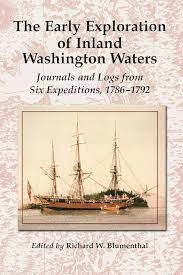
"For those armchair historians interested in the initial nautical exploration of inland Washington waters, this text is an addition to Northwest maritime history. Beginning in 1786 and continuing through 1792, The Early Exploration of Inland Washington Waters includes annotated transcriptions of all the logs and journals of the area's earliest explorers. This text follows the initial journey of John Meares, four intervening expeditions by the Spanish, and culminates with George Vancouver's voyage in 1792." vii, 214 pages ; 23 cm CIRC [ 1 ]
|
2004 |
|
Enduring threads ecclesiastical textiles of St. John the Divine Church, Yale, British Columbia, Canada by Jennifer Iredale, Irene Bjerky, Fraser Heritage Society 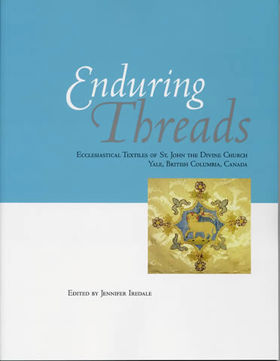
This project focused on researching approximately 100 liturgical textiles in the collection of St. John the Divine Anglican Church in Yale, BC. St. John the Divine is one of the oldest churches in the province, and many of the handmade textiles appear to date back to the time of its origins in the 1860s. The Church is now de-sanctified and designated as a Provincial Heritage Site. The Church was associated with the All Hallows Anglican girls school, which operated in Yale from 1884 to 1920. Part of the research concentrated on the production of textiles for the Church by the faculty and students of the school. Research included an analysis of the technical construction of the textiles to help determine their origins. The study of the St. John the Divine collection was contextualized within a broader history of the production of Anglican liturgical textiles, particularly in Western Canada. Comparisons were made between the Yale pieces and those from other sites. Oral history interviews with members of Anglican textile guilds, sanctuary committees, and descendants of students from All Hallows School helped fill out the research. 52 p. : ill., port. (some col.) ; 28 cm. CIRC [ 0 ]
|
2004 |
|
Steamboats on Northwest rivers by Bill Gulick 
Before the Northwest sported trains and roads alongside its rivers, steamboats took the curious and the settlers as far inland as the water could take them. Gulick describes the boats and the people who plied the rivers from Idaho to Alaska in the early days of white settlement, focusing on the career of the irascible William Polk Gray, who turned from his aspirations to be a missionary medical man to become a skilled fresh-water mariner. Gray and only a few dozen others like him managed xviii, 248 pages : illustrations, map ; 23 cm CIRC [ 0 ]
|
2004 |
|
A Voyage to the Northwest Side of America The Journals of James Colnett, 1786-89 by James Colnett, Robert Galois 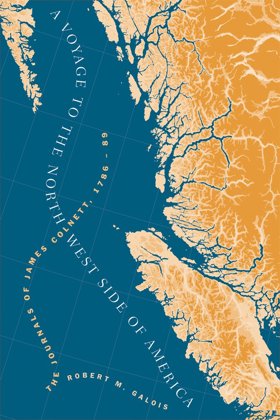
The journal of James Colnett is the last unpublished account of the early maritime fur trade on the Northwest Coast. Between 1786 and 1789, Colnett's expedition traversed the coast from Prince William Sound to the Strait of Juan de Fuca. Its members were the first Europeans to encounter the Tsimshian and the southern Heiltsuk, and the first to land on the southern Queen Charlotte Islands. The journal is reproduced with full scholarly apparatus, as well as extracts from a second journal by Andrew Bracey Taylor, 3rd mate on one of the ships in Colnett's command. Focusing on the expedition's remarkable encounters with the Native peoples of the Northwest Coast, Galois' introductory essay also addresses the geopolitical context of the voyage and the intellectual background that shaped the writing of the journals. This fascinating account gives us a new understanding of early European presence in the Northwest and of Native responses to these developments. It will interest historians, geographers, and ethnographers of the Northwest Coast and beyond. xiii, 441 pages : illustrations, maps ; 24 cm CIRC [ 1 ]
|
2004 |
|
The Lewis and Clark trail yesterday and today by William E. Hill 
Veteran author William Hill commemorates the 200th anniversary of the Lewis and Clark expedition with this guide to the history and the route of the Corps of Discovery. Journals, maps, paintings and photographs serve to vividly contrast the U.S. that Lewis and Clark ventured through to the land that the modern adventurere will pass through when following this guidebook. xxiii, 288 pages : illustrations, maps ; 23 cm CIRC [ 0 ]
|
2004 |
|
Lewis and Clark's bittersweet crossing by Carol Lynn MacGregor, Gaye Hoopes (Illustrator) 
Describes the Lewis and Clark Expedition to explore the American West in the early 1800s, focusing particularly on the time the group spent with the Shoshoni and Nez Perce Indians in Idaho 32 pages : color illustrations, color maps ; 23 x 28 cm CIRC [ 0 ]
|
2004 |
|
Six decades back early days on the Snake River Plain by Charles S. Walgamott 
Charles Shirley Walgamott arrived by stage at Rock Creek Station, Idaho Territory in 1875. In an untamed land, far from his native Iowa, he survived illness, hardship, and lawlessness. Walgamott mined, trapped, ranched and hunted, while living with settlers, Indians and outlaws. xxv, 357 pages : illustrations ; 21 cm. CIRC [ 0 ]
|
2004 |
|
Dining car to the Pacific the "famously good" food of the Northern Pacific Railway by William A. McKenzie 
"William A. McKenzie offers an illustrated and detailed account of hospitality on the Northern Pacific - a service that many considered the best in the industry - drawing on sources ranging from railroad records of the 1860s to anecdotal accounts from the people who were there. In addition, McKenzie includes more than 150 authentic recipes used on the line, such as the Great Big Baked Potato, Washington Apple Pan Cake, and Northern Pacific Fruit Cake. Dining Car to the Pacific will be a treasured addition to the libraries of historians, cooks, and any one with nostalgia for the dinning car experience."--Jacket xi, 164 pages : illustrations ; 22 x 28 cm. CIRC [ 0 ]
|
2004 |
|
Outpost of empire the Royal Marines and the joint occupation of San Juan Island by Mike Vouri 
A history of the British Royal Marines twelve-year occupation of San Juan Island. 105 pages : illustrations, maps ; 18 x 23 cm CIRC [ 1 ]
|
2004 |