Catalog of British Columbiana and Pacific Northwest Americana
Encyclopedia Cascadia Catalog contains book titles of mostly non-fiction Pacific Northwest Coast of North America Titles (primarially British Columbia, Idaho, Oregon and Washington State) in an easy-to-understand title catalog. If you see a link with this badge ONLINE CIRC it means that there is an online institution that provides free access to that title. In some cases there may be more than one institution hosting the title digitally.
| Catalog Title | Published |
|---|---|
|
General William S. Harney prince of dragoons by George Rollie Adams 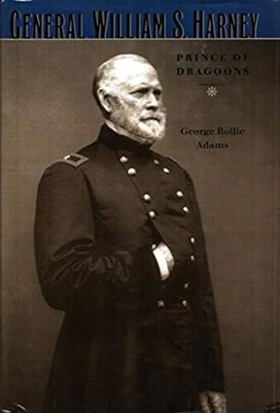
"Between the War of 1812 and the Civil War, General William S. Harney became one of the best-known military figures in America. In a career aided by Andrew Jackson and the concept of an expansible army, Harney saw duty in virtually every part of the country and participated in most of the key military episodes of his time. He chased remnants of Lafitte pirates in Louisiana, campaigned with Abraham Lincoln and Jefferson Davis during the Black Hawk War, developed Vietnam-style riverine tactics that ended the Second Seminole War, and led Winfield Scott's cavalry in the Mexican War. In the 1850s Harney devised the army's largest and most successful pre-Civil War campaign against Plains Indians, commanded troops charged with upholding federal authority in Kansas and Utah, and almost provoked hostilities with Great Britain in the Pacific Northwest. Removed from command amid false charges of disloyalty during the Missouri secession crisis, he returned as a leading member of the Indian Peace Commission of 1867-68." "Harney was bold, ambitious, and innovative, but also impulsive, vindictive, and violent. His career illustrates the nineteenth oentury army's role in implementing federal policy, highlights its limited resources compared to its responsibilities, and illuminates key aspects of its organizational structure, the behavior of its officers, and its impact on personal lives."--Jacket xix, 389 pages : illustrations ; 24 cm CIRC [ 1 ]
|
2001 |
|
This blessed wilderness Archibald McDonald's letters from the Columbia, 1822-44 by Archibald McDonald, Jean Murray Cole 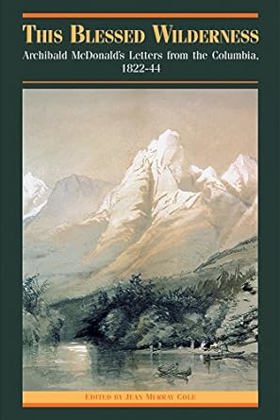
"The twenty-five years between 1821 and 1846 were turbulent but important years in the history of the fur trade in the Pacific Northwest: 1821 saw the merger of the Hudson's Bay Company and the North West Company, and 1846 saw the signing of the Oregon Treaty, which established the Canada-US border." "Archibald McDonald was a man who experienced these changes first-hand. As a senior HBC officer, he was sent to the Columbia District headquarters at Fort George in 1821 to oversee the recently absorbed NWC posts and assets. After the merger, McDonald went on to direct operations at Thompson River (1826-28), Fort Langley (1829-33), and Fort Colvile (1834-44)." "During his tenure in the Pacific Northwest, letters were McDonald's only link with the outside world. Collected here for the first time by Jean Murray Cole, these public and private letters to friends, business colleagues, missionaries, botanists, and many others provide a fascinating narrative of the expansion of the fur trade at a critical time in its history."--Jacket ix, 297 pages : illustrations, map ; 24 cm CIRC [ 1 ]
|
2001 |
|
Portland, then & now by Linda Dodds, Carolyn M. Buan 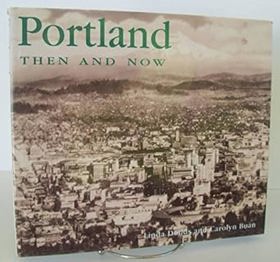
Celebrating America's favorite cityscapes, this series combines historic interest and contemporary beauty. Then and Now features fascinating archival photographs contrasted with specially commissioned, full-color images of the same scene today. A visual lesson in the historic changes of our greatest urban landscapes 144 pages : chiefly illustrations (some color) ; 26 x 29 cm CIRC [ 1 ]
|
2001 |
|
The great Northwest the search for regional identity by William G. Robbins 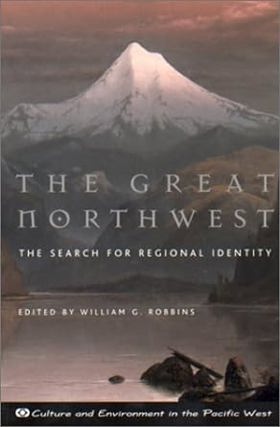
For more than 150 years, Pacific Northwest writers have sought out the region's shared stories and traditions in an attempt to explain the common features of its places and people. A key element in the study of place and region is the relationship between human experience and the natural world. This newest volume in the acclaimed Culture and Environment in the Pacific West series offers a compelling blend of ideas and perspectives on region identity in the Pacific Northwest. In The Great Northwest, historian William G. Robbins gathers writings that explore the idea and reality of the Pacific Northwest from a surprising variety of viewpoints. Descriptions of and stories about such distinct places as Celilo Falls on the Columbia river, Alaska, interior British Columbia, and the reforested Tillamook Burn in Oregon show why the search for regional identity is a complex but ultimately rewarding endeavor. "The business of understanding the Pacific Northwest is messy but important," writes series editor William Lang. "Knowing what we think about our place and our region offers opportunities to understand ourselves our communities, and our relationships to the larger world." x, 190 pages : illustrations ; 23 cm. CIRC [ 1 ]
|
2001 |
|
Puget Sound ferries from canoe to catamaran, an illustrated history by Carolyn Neal, Thomas Kilday Janus 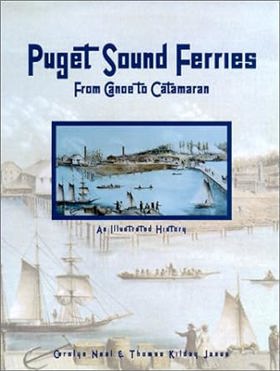
Authored by Carolyn Neal and Thomas Kilday Janus, Puget Sound Ferries: From Canoe to Catamaran, an Illustrated History presents a visual and narrative chronicle of the vessels that have spanned Washington’s inland sea across generations. The book traces the technological evolution of water transit from indigenous dugout canoes and early steam-powered "mosquito fleet" boats to modern automobile ferries and high-speed catamarans. Richly illustrated with historical photographs and detailed vessel logs, the text highlights how changing ship designs directly reflected the growing mobility needs of a decentralized coastal population. A keen insight drawn from the work is how the ferry system functioned as the original democratic equalizer of the region; by stitching together disparate islands and mainland shorelines before bridges were feasible, these vessels created a unified regional community out of a fragmented marine geography. 224 pages : illustrations ; 29 cm CIRC [ 1 ]
|
2001 |
|
Oregon burial site guide by Dean H. Byrd, Stanley R. Clarke, Janice M. Healy 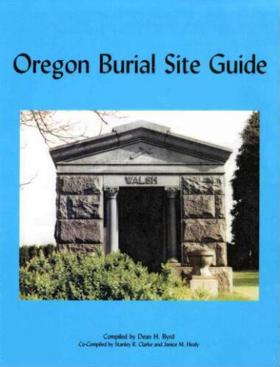
Published by Binford & Mort and compiled by researchers Dean H. Byrd, Stanley R. Clarke, and Janice M. Healy, Oregon Burial Site Guide serves as a comprehensive genealogical and historical inventory of cemeteries across the state. The volume documents thousands of burial locations ranging from pioneer family plots and historic urban graveyards to remote rural resting places, providing precise geographic coordinates and historical context for each site. By systematically cataloging these final resting places, the text rescues forgotten local figures and early settlers from historical obscurity while mapping the shifting human settlement patterns of the Pacific Northwest. A keen insight drawn from the work is how regional cemeteries function as open-air archives of frontier demographics; the layout, marker materials, and clustering of these graves physically map out the waves of migration, epidemic diseases, and harsh environmental realities that shaped early Oregon communities long before modern municipal records were established. xxxvi, 1180 pages : illustrations, maps ; 29 cm CIRC [ 1 ]
|
2001 |
|
An identification guide to the larval marine invertebrates of the Pacific Northwest by Alan L. Shanks 
The study of larval invertebrates is a vital and growing field in contemporary marine science. The key ecological role of larvae in determining adult population sizes has been recognized for decades and has inspired extensive research. This volume, the first of its kind, is an identification guide to the planktonic larvae of shallow subtidal and intertidal invertebrates common to the Pacific Northwest coast. Each chapter provides a brief background to the larval biology of an invertebrate group; keys, line drawings, and descriptions for the identification of larvae; a list of the species present in the Pacific Northwest; and a reference section. The geographic range covered is roughly from southeast Alaska to northern California; however many of the species are found along the entire coast of California, as far south as Baja California. An essential reference for anyone attempting to identify larval invertebrates from zooplankton samples, this working manual is intended for students as well as scientists and researchers. It offers an important new resource for marine biologists, biological oceanographers, marine and intertidal ecologists, and especially larval biologists. 314 pages : illustrations ; 27 cm CIRC [ 0 ]
|
2001 |
|
Landscape traveled by coyote and crane the world of the Schi̲tsuʼumsh : Coeur d'Alene Indians by Rodney Frey, Coeur D'Alene Tribe of the Coeur D'Alene Reservation, Idaho 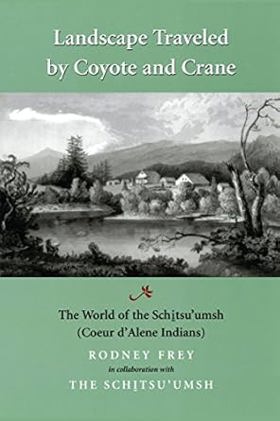
Anthropologist Rodney Frey culminates a decade of work with the Schitsu’umsh (the Coeur d’Alene Indians of Idaho) in this portrait of the unique bonds between a people and the landscape of their traditional homeland. The result of an intensive collaboration between investigator and Native people, the book includes many traditional stories that invite the reader’s participation in the world of the Schitsu’umsh. The Schitsu’umsh landscape of lake and mountains is described with a richness that emphasizes its essential material and spiritual qualities. The historical trauma of the Schitsu’umsh, stemming from their nineteenth-century contacts with Euro-American culture, is given dramatic weight. Nonetheless, examples of adaptation and continuity in traditional cultural expression, rather than destruction and discontinuity, are the most conspicuous features of this vivid ethnographic portrait. Drawing on pivotal oral traditions, Frey mirrors the Schitsu’umsh world view in his organization and presentation of ethnographic material. He uses first-person accounts by his Native consultants to convey crucial cultural perspectives and practices. Because of its unusual methodology, Landscape Traveled by Coyote and Crane is likely to become a model for future work with Native American peoples, within the Plateau region and beyond. xi, 329 pages : illustrations ; 24 cm CIRC [ 0 ]
|
2001 |
|
The boys of Boise furor, vice & folly in an American city by John Gerassi, Peter Boag 
A classic account of a 1950s sex scandal that depicts middle America's traditional response to homosexuality. Written in 1965 about a same-sex sexual scandal that occurred in 1955 in Boise, Idaho, John Gerassi’s classic study depicts both middle America’s traditional response to homosexuality and an era in the country’s history before the modern gay rights movement really got underway. Because much of what Gerassi wrote about persists in today’s struggles over gay and lesbian issues, his book still has much to tell us about how contemporary society reacts to, and misunderstands, homosexuality. On the morning of November 2, 1955, the people of Boise, Idaho, were stunned by a screaming headline in the Idaho Daily Statesman, THREE BOISE MEN ADMIT SEX CHARGES. Time magazine picked up the story, reporting that a "homosexual underworld" had long operated in Idaho’s staid capital city. The Statesman led the hysteria that resulted in dozens of arrests—including some highly placed members of the community—and sentences ranging from probation to life imprisonment. Peter Boag’s Foreword places the book in historical perspective, summarizing the popular psychological theories and legal conceptions that helped to shape Gerassi’s research. He discusses advances in Idaho’s public approach to homosexuality and ways in which the provincialism chronicled by Gerassi persists to this day. xxxii, 328 pages ; 22 cm. CIRC [ 0 ]
|
2001 |
|
Saving the reservation Joe Garry and the battle to be Indian by John Fahey 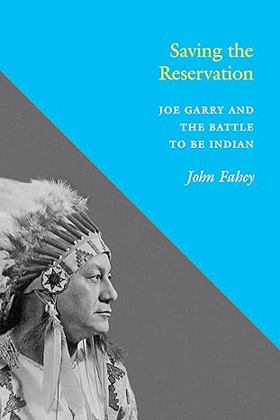
Joseph R. Garry (1910–1975), a Coeur d’Alene Indian, served six terms as president of the National Congress of American Indians in the 1950s. He led the battles to compel the federal government to honor treaties and landownership and dominated an era in government-Indian relations little attended by historians. Firmly believing that forced assimilation of Indians and termination of federal trusteeship over Native Americans and their reservations would doom Indian cultures, Garry had his greatest success as a leader in uniting American Indian tribes to fend off Congress’s plan to abandon Indian citizens. Born into a chief’s family and raised on the Coeur d’Alene reservation in northern Idaho, Garry rose to chairmanship of his tribal council, president of the Affiliated Tribes of the Northwest Indians, and leadership of NCAI. He was the first Native American elected to the Idaho House and Senate. Handsome, personable, and articulate, Garry traveled constantly to urge Indian tribes to hold onto their land, develop economic resources, and educate their young. In a turbulent decade, Garry elevated Indians to political and social participation in American life, and set in motion forces that underlie Indian relations today. xi, 220 pages : illustrations ; 24 cm CIRC [ 0 ]
|
2001 |
|
Exploring Coast Salish prehistory the archaeology of San Juan Island by Julie K. Stein 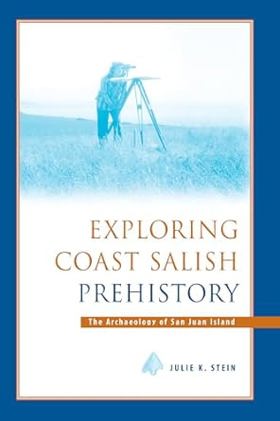
Every year thousands of people visit the San Juan Islands off the coast of Washington State. With a copy of Exploring Coast Salish Prehistory in hand, they will enjoy an introduction both to archaeology in general and to sites within San Juan Island National Historic Park. The Coast Salish people inhabited the San Juans for 5,000 years. One important site on San Juan Island, Cattle Point, was a summer camp where residents engaged in fishing and shellfish harvesting. Native peoples' recollections of activities there have been confirmed by physical evidence in the form of shell middens, fish bones, and other artifacts. Another San Juan site, English Camp, was a winter village site for 2,000 years. Structure remains provide insight into how people's lives and activities changed over time. Tools found at the site have allowed archaeologists to deduce that early residents ate camas bulbs and other plants, engaged in woodworking, weaving, fishing, and carving, and manufactured and used stone tools. Stein's discussions of the sites and archaeological practices are enhanced by numerous illustrations. Clear photos of different types of artifacts, topographical maps, and other images help the reader to understand how people lived in the San Juans thousands of years ago ix, 126 pages : illustrations CIRC [ 1 ]
|
2000 |
|
Nuu-chah-nulth voices, histories, objects & journeys by Alan L. Hoover, Royal British Columbia Museum 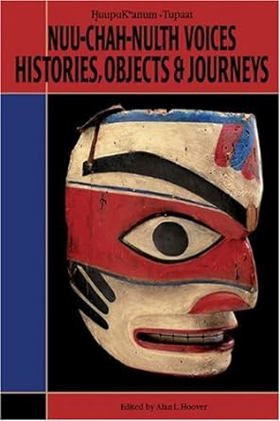
"This is the first collection of essays, articles and interviews about the Nuu-chah-nulth people, who live along the west coast of Vancouver Island (Canada) and the Olympic Peninsula (U.S.A.). Alan L. Hoover has assembled a balance of views from inside and outside Nuu-chah-nulth history, culture and art. He presents the collection in four parts." "In "Voices", the Mowachaht-Muchalaht and Huu-ay-aht nations recount their own histories, and describe who and where they are today. "Histories" offers fascinating accounts of recent history from outside the Nuu-chah-nulth culture, and ancient histories and legends from inside. "Objects" highlights the different interests of those who create objects and those who collect them: are these objects art? Finally, 'Journeys' relates the personal and spiritual growth of three Nuu-chah-nulth artists, and how their creations speak about where they came from and where they are now."--Jacket vii, 389 pages : illustrations (some color), maps ; 24 cm CIRC [ 1 ]
|
2000 |
|
A whale hunt by Robert Sullivan 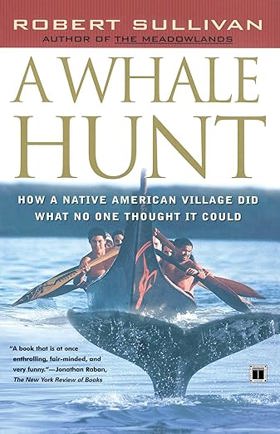
For centuries the hunting of the whale was what defined the Makah, a Native American tribe in Neah Bay, but when commercial whaling drove the gray whale to near extinction in the 1920s, the Makah voluntarily discontinued their tradition and hung up their harpoons. In 1994, after the gray whale was taken off the endangered species list, the Makah decided to hunt again. The problem was that all the old whalers were dead—no one knew how to go about hunting a whale. A Whale Hunt chronicles the two years Robert Sullivan spends with the Makah as they prepare for and stage the first hunt. Combating tribal infighting and inexperience, they must also face passionate, furious animal rights activists and swarming reporters. Before the ragtag group of hunters even pursues a whale, there are clashes, disappointments, and defeats, small triumphs and unexpected heroes. A book of many layers and revelations, A Whale Hunt is the story of the demise and attempted resurrection of a Native American nation and of the individuals on the reservation whose lives are forever changed. 285 p. ; 24 cm. CIRC [ 1 ]
|
2000 |
|
History of Idaho's Silver Valley 1878-2000 by Ray Chapman 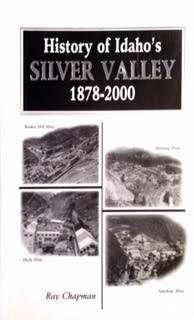
Authored by Ray Chapman, History of Idaho's Silver Valley 1878-2000 chronicles the dramatic economic boom, labor struggles, and environmental transformations of northern Idaho's mineral-rich Coeur d'Alene mining district. The book traces the region's trajectory from the late 19th-century gold and silver rushes through the explosive rise of hard-rock industrial mining, bitter union-management conflicts, and the eventual twentieth-century transition toward environmental cleanup and post-industrial reinvention. Drawing on local archives, mining records, and community lore, the text captures how rugged mountain canyons shaped a fierce, insular culture forged by subterranean labor. A keen insight drawn from the work is how the boom-and-bust cycle of extraction creates a profound psychological duality in mining towns; while the constant threat of economic collapse fosters intense, radical solidarity among workers, it simultaneously leaves the community perpetually tethered to the physical and financial scars of an exhausted landscape. 116 pages : illustrations, map ; 22 cm CIRC [ 1 ]
|
2000 |
|
The Lemhi Sacajawea's people by Brigham D. Madsen 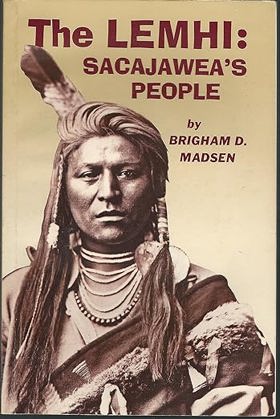
Native American historian Brigham D. Madsen tells the story of the Mountain Shoshoni culture from the fateful day in 1805 when Chief Ca-me-ah-wait met Lewis and Clark to 1907 when the Lemhi moved to the Fort Hall Reservation. 214 pages : illustrations, maps ; 23 cm CIRC [ 1 ]
|
2000 |
|
Cataclysms on the Columbia a layman's guide to the features produced by the catastrophic Bretz floods in the Pacific Northwest by John Eliot Allen, Marjorie Burns, Sam C. Sargent 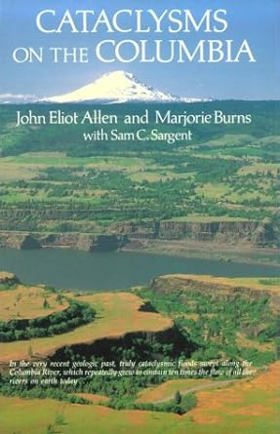
The formation of the Grand Coulee remained a mystery for many years until J Harlen Bretz proved that the Columbia River basin was the site of huge floods 15,000 years ago that created the landscape we see today. 213 pages : illustrations ; 24 cm CIRC [ 1 ]
|
2000 |
|
This & that. Part II by Irene Kellar Mueller 
A collection of Irene Mueller's first 80 columns published in the Coupeville examiner 173 pages ; 21 cm CIRC [ 1 ]
|
2000 |
|
Pioneers of Peshastin the son : growing up in the Wenatchee Valley by Carl J. Bergren 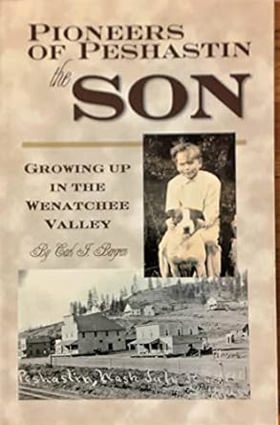
Authored by Carl J. Bergren, Pioneers of Peshastin the Son: Growing Up in the Wenatchee Valley provides a deeply personal memoir of growing up amidst the apple orchards and rugged hills of north-central Washington during the mid-20th century. The book captures the rhythm of rural agricultural life in the Peshastin and Leavenworth areas, detailing the grueling seasonal labor of fruit farming, local school days, and the tight-knit bonds of a valley community dependent on the land. Through nostalgic recollections and family history, the text contrasts the idyllic pastoral imagery of orchard country with the demanding economic realities faced by generational farming families. A keen insight drawn from the work is how second-generation pioneers experienced a complex burden of inheritance; rather than discovering an untamed wilderness, children of the original homesteaders were tasked with maintaining and monetizing an already-carved-out agricultural landscape, transforming the raw grit of frontier survival into a rigid, generational corporate farming routine. 152 pages : illustrations ; 22 cm CIRC [ 1 ]
|
2000 |
|
Tales of Hood Canal by Ethel M. Dalby, Valerie Abrams Johnson, Mason County Historical Society (Wash) 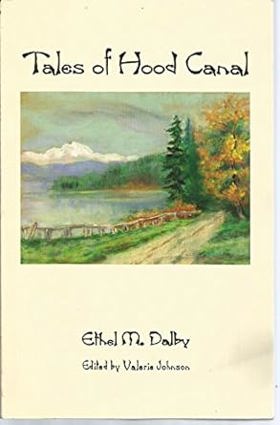
Published by the Mason County Historical Society and co-authored by Ethel M. Dalby and Valerie Abrams Johnson, Tales of Hood Canal compiles rich local lore, vintage photographs, and personal recollections documenting the historic communities along Washington's dramatic fjord. The book chronicles the lives of early loggers, oyster growers, homesteaders, and maritime traders who navigated the deep, glacier-carved waters of the canal before the arrival of modern highways. Through collected anecdotes and archival records, the text preserves the distinct character of isolated waterfront settlements shaped by the rhythms of the tides and dense surrounding forests. A keen insight drawn from the work is how a winding marine waterway served simultaneously as a barrier and a highway; while the steep topography of the Hood Canal kept communities geographically sequestered from inland urban centers, the water itself provided the vital commercial and social umbilical cord that tied them to the broader Puget Sound economy. ix, 137 pages : illustrations ; 22 cm CIRC [ 1 ]
|
2000 |
|
Encyclopedia of British Columbia by Daniel Francis, Harbour Publishing 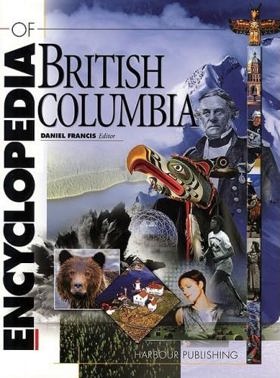
For the first time, everything you always wanted to know about BC is gathered together in one place! The Encyclopedia of British Columbia is the definitive reference work on BC. With more than 4,000 entries and hundreds of photos, maps, tables and charts, the EBC is the source of readable and authoritative information on all the significant BC people, places and things that you would currently have to search a vast library to find. What makes the EBC even better is the wealth of special local information and BC lore - all those details that make BC the weird and wonderful place it is. The EBC was conceived and compiled by Harbour Publishing, an award-winning, independent, 100% BC-owned company, with advice and assistance from more than 200 British Columbians. It is indispensable at home, at school, in the office - everywhere comprehensive, authoritative, concise information about BC is needed. xviii, 806 pages : illustrations (some color), maps (some color) ; 29 cm + 1 computer optical disc (4 3/4 in.) CIRC [ 1 ]
|
2000 |
|
Outlaws of the Pacific Northwest by Bill Gulick 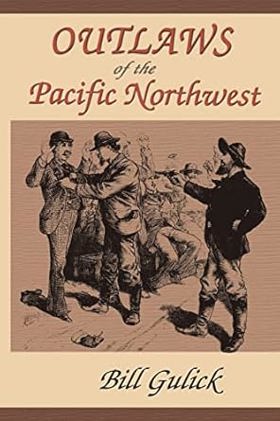
The lawlessness of the frontier towns of the plains states is well documented. However, as silver and gold deposits were found in the Pacific Northwest, the rush of miners and speculators that brought to the region brought with it its own share of crime and criminals. Author Bill Gulick sticks to the facts in telling the stories of this region but does so in swift conversational prose that entertains and educates. xiv, 199 pages : illustrations, map ; 23 cm CIRC [ 0 ]
|
2000 |
|
From the Ganges to the Snake River an East Indian in the American West by D. Majumdar 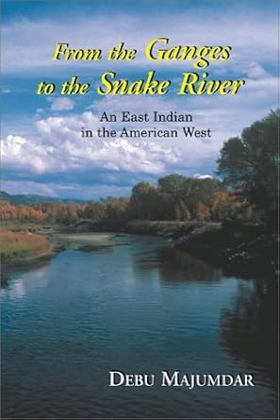
A collection of essays about various experiences of the author while living in Idaho Falls, Idaho xii, 244 pages : illustrations ; 23 cm CIRC [ 0 ]
|
2000 |
|
J.R. Simplot a billion the hard way by Louie W. Attebery 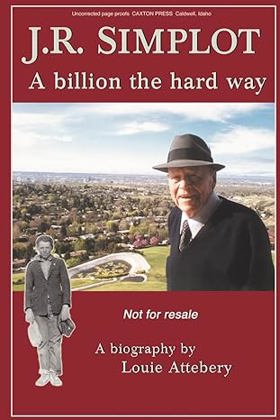
This is the story of a kid from Declo, Idaho who parlayed a few "bum" lambs into one of the largest privately held companies in America. J.R. Simplot is one of the last of the classic Horatio Alger success stories - a man who spent seventy-five years building an international empire. xxxii, 251 pages : illustrations ; 24 cm CIRC [ 0 ]
|
2000 |
|
Elder tales spirited women over sixty tell their stories by Ruth Garrison, Lorry Roberts, Soroptimist International of Boise 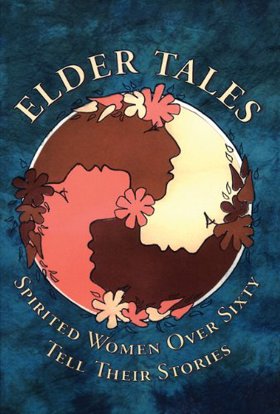
These are stories about an extraordinary array of women of different ethnicities and regions of Idaho, whose lives span six decades and more. With gusto and hard work they created their lives in their own ways and challenged the social mores of their times, intent on living meaningful and purposeful lives. ix, 268 pages : illustrations ; 23 cm CIRC [ 0 ]
|
2000 |
|
Rediscovering Vardis Fisher centennial essays by Joseph M. Flora 
Vardis Fisher was one of Idaho's most accomplished writers. His attention to western landscape and rural culture left a lasting, albeit controversial, legacy. These twelve evocative essays explore the impact and achievement of Fisher s work and life. xiii, 254 pages : illustrations ; 24 cm CIRC [ 0 ]
|
2000 |