Catalog of British Columbiana and Pacific Northwest Americana
The Encyclopedia Cascadia Catalog indexes mostly non-fiction literature covering the Pacific Northwest coast of North America, with an emphasis on British Columbia, Idaho, Oregon, and Washington State.
| Catalog Title | Published |
|---|---|
|
Squamish the shining valley by Kevin McLane 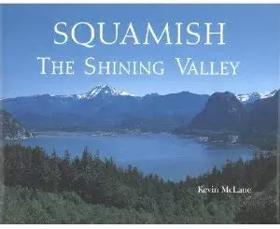
Published by mountaineer and author Kevin McLane, Squamish: The Shining Valley chronicles the dramatic geographic, cultural, and recreational evolution of British Columbia's famous fjord-side corridor. The book traces the region's transformation from an ancestral indigenous territory and a rugged 19th-century logging outpost into a world-renowned mecca for rock climbing, mountaineering, and outdoor recreation. Through striking photography and detailed historical accounts, the text captures the tenacity of the working-class communities who first carved railways and mills out of the imposing granite wilderness. A keen insight drawn from the work is how modern outdoor recreation alters the meaning of peripheral landscapes; the transition of Squamish from an extractive mill town into an elite adventure capital demonstrates that post-industrial mountain valleys are increasingly valued not for the timber they yield, but for the untamed verticality that allows modern seekers to escape urban containment. 96 pages : illustrations (some color), portraits ; 23 x 28 cm Non-circulating [ 1 ]
|
1994 |
|
Dr. John McLoughlin master of Fort Vancouver, father of Oregon by Nancy Wilson, Bert Webber 
Curator Nancy Wilson of the McLoughlin House National Historic Site in Oregon City, has labored for years to bring together the details of the life of Dr. John McLoughlin. She has written about this Hudson's Bay Company Chief Factor, who also founded Oregon City, in a gracious yet telling way. This book covers, and a singular popular volume, everything that could be discovered about Mr. McLoughlin from his earliest years until the day he died. McLoughlin got into trouble with this British employers because he was a compassionate man who did his best to help sick, hungry and broke American pioneers freshly arrived over the Oregon Trail. But he insisted that Americans settled south of the Columbia River as he believed when the International boundary was settled the Columbia River would be the dividing line. To protect the interests of the Hudson's Bay Company, McLoughlin put up the first building at Wilmette Falls (Oregon City) then platted the city. On his retirement he moved permanently to Oregon City and became an American citizen. Here is the story recorded with library reference quality but is narrated in a easy-to-read language. The Editor, Bert Weber, Master Librarian (retired) and research photojournalist, is author of many books about Oregon. --- from book's back cover 205 pages : illustrations, maps ; 22 cm Non-circulating [ 1 ]
|
1994 |
|
This bloody deed the Magruder incident by Ladd Hamilton 
The infamous murder and robbery of Lewiston merchant Lloyd Magruder and his companions during the 1860s gold rush is legendary in Idaho, Montana, and Washington. Ladd Hamilton constructs a compelling account of the destruction of Magruder’s pack train while traveling on the Southern Nez Perce Trail in the Bitterroot Mountains, and the subsequent quest by Magruder’s friend Hill Beachey to track his killers to San Francisco, escort them back to Lewiston, and then protect them from mob justice until they could be tried in court. By appraising written evidence and community lore, Hamilton has created an intriguing account based on fact and documentation. But he also blends in historical fiction when required to complement the narrative in those places where events are known to have occurred but the historical sources are sparse or virtually nonexistent. Underlying Hamilton’s work is his exact and familiar knowledge of early Idaho Territory, which in 1863 stretched hundreds of miles from Lewiston at the Snake-Clearwater confluence to the gold camps of Virginia City, Bannack, and beyond in what is now Montana. Hamilton’s imaginative characterizations of Magruder, Beachey, outlaw sheriff Henry Plummer, and large cast of other historical figures in Idaho, Montana, and California is based on his years of knowing the many and varied peoples of the West. Also underlying Hamilton's work is his insightful knowledge of the early gold camps in Idaho and Montana territories. xviii, 253 pages, 8 unnumbered pages of plates : illustrations, portrait ; 23 cm Desiderata
|
1994 |
|
A history of Moscow First United Methodist Church a century on the Palouse by Moscow First United Methodist Church (Moscow, Idaho) 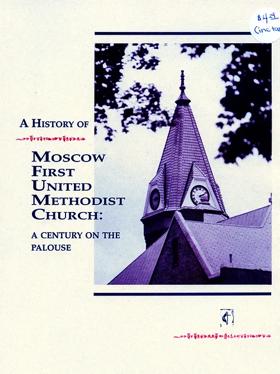
Perhaps one of the most recognizable buildings in Moscow, the United Methodist Church was added to the National Register of Historic Places in 1978. This book explores the life and evolution of the church from its very beginning in 1876. i, 97 pages : illustrations ; 28 cm Desiderata
|
1994 |
|
Pocket girdles and other confessions of a Northwest farm girl by Marianne Love 
Marianne Love’s Pocket girdles and other confessions of a Northwest farm girl explores the intimate, everyday agrarian resilience and evolving community identity within the timbered valleys of the Idaho Panhandle during the mid-twentieth century. The narrative illustrates how the demanding environmental realities of this inland topography—defined by dense northern forests, rugged mountain terrain, and the rigorous seasonal rhythms of small-scale family farming—required immense physical labor and constant, shared adaptation from rural residents. By detailing personal recollections of the gradual transition from the isolated, grueling routines of traditional farm life to the cooperative engagement in mid-century civic and social institutions, the text highlights how shared daily experiences and rural community networks served as vital threads connecting the region. Ultimately, the memoir demonstrates that patiently fostering these everyday neighborly bonds and collaboratively adapting to the geographic and cultural isolation of the inland frontier were essential steps in cultivating a deeply rooted, vibrant rural heritage in the modern Pacific Northwest. What's a pocket girdle? Find out in this hilarious collection of stories about rural childhood. "Marianne's writings catch the true and comic flavor of what it's like to grow up in rural Idaho". -- Patrick McManus 213 pages : illustrations ; 23 cm Desiderata
|
1994 |
|
Talking on paper an anthology of Oregon letters and diaries by Shannon Applegate , Terence O'Donnell 
Contributors to this anthology of Oregon letters and diaries include a missionary and a gambler, a prisoner and a judge, a clown and a civil servant, a housewife and a homesteader, a cowboy, a schoolgirl, a nun, and many others. Few would consider themselves writers. Yet all took the time to commit words to paper, providing us today with a unique sense of their lives and times. Letters and diaries are among the most intimate of literary expressions. Seldom written for an intended audience of more than one (if that), they provide a private forum for feelings, concerns, and interests. Yet letters and diaries also benefit a wider audience. They afford us a special knowledge of the past, for they are commonly filled with the concrete details of everyday life, details which biography and history tend to disregard. A summer holiday, fur trapping, a sea voyage, courtship and war, travel and homesteading, the Depression, the Japanese internment, hope despair, and joy--the writings collected in Talking on Paper bring an impressive immediacy to these experiences. In gathering material for this book, the editors traveled thousands of miles and researched thousands of documents. Selections span a period of a century and a half and reflect the wide cultural and ethnic diversity of Oregon. From the lyric-laced diaries of Greek emigrant and itinerant railroad worker Haralambos Kambouris to the poignant letter by 10-year-old Julia Wilson of Mitchell describing the loss of her family in a flash flood, these private expressions of literacy and imagination reveal an intimate aspect of Oregon literature. xviii, 324 pages : illustrations ; 28 cm. Desiderata
|
1994 |
|
The Biology and management of red alder by David E. Hibbs, Dean S. DeBell, Robert F. Tarrant 
Only a few years ago, red alder, the major hardwood species in the Northwest, was regarded as a weed to be eradicated with herbicides. Today, red alder provides the raw material for a thriving industry, producing fine furniture, specialized veneers and plywoods, and paper products. In addition to its economic values, red alder has unique biological values that are proving vital in efforts to improve forest management. This timely study presents a synthesis of current knowledge about the biology and management of red alder. The first section covers topics in the basic biology of alder, while the second section offers principles and practices of alder management. The book's 34 contributors provide current and comprehensive information that will allow forest managers to weave red alder into the improved forest management systems demanded by an increasingly well-informed public. xi, 256 pages : illustrations ; 29 cm Desiderata
|
1994 |
|
Haida monumental art villages of the Queen Charlotte Islands by George F. MacDonald, Richard J. Huyda 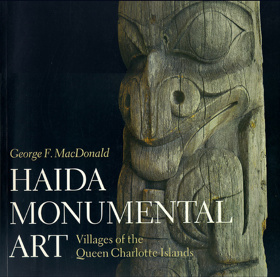
"The Haida of the Queen Charlotte Islands in British Columbia constructed some of the most magnificent houses and erected some of the most beautifully carved totem poles on the Northwest Coast. During the last quarter of the nineteenth century, images of the Haida's immense cedar houses and soaring totem poles were captured, first on glass plates and later on film, by photographers who travelled to then-remote villages such as Masset and Skidegate to marvel at, and record, what they saw there." "Haida Monumental Art ... includes a large number of these remarkable photographs, selected from a collection of over 10,000 original prints and photographic plates. They depict the Haida villages at the height of their glory and record their tragic deterioration only a few decades later. ... By combining archaeology and ethnohistory, George MacDonald presents an integrated framework for understanding the physical structure of a Haida village. He explains how the houses and poles are part of a fascinating web of myth, family history, and Haida cosmology, which provides a unique insight into Haida culture."--Back cover 218 pages : illustrations (some color), maps ; 31 cm Desiderata
|
1994 |
|
Native American wives of San Juan settlers by Karen Jones Lamb 
Karen Jones Lamb’s biographical and genealogical chronicle, Native American Wives of San Juan Settlers, recovers the foundational domestic, familial, and cross-cultural relationships that anchored mid-to-late nineteenth-century non-Indigenous settlement across the San Juan Archipelago. The work documents how early homestead claims, sheep stations, and lime-quarrying ventures across San Juan, Orcas, and Lopez islands were established directly within the ancestral marine territories, reef net locations, and seasonal harvesting sites of Northern Straits Salish peoples, including the Lummi, Samish, Songhees, and Saanich. Lamb details how settler survival on isolated island homesteads depended profoundly on the labor, ecological knowledge, and extensive kinship networks of Indigenous women, whose open-water canoe navigation and foraging skills maintained isolated households long before the advent of regular steamship service. Ultimately, these biographical accounts illustrate how cross-cultural marriages bridged the turbulent transition from the joint military occupation of the Pig War to formalized American civilian governance, highlighting the central role of Native women in sustaining the archipelago's early civic and maritime communities. 94 pages : illustrations ; 27 cm Desiderata
|
1994 |
|
The road runs west a century along the Bella Coola trail by Diana French 
Diana French’s The Road Runs West: A Century Along the Bella Coola Trail examines the historic transportation corridor linking the central interior plateau from the Fraser River across the Chilcotin to the Pacific tidal inlets at Bella Coola. French documents how nineteenth-century surveyor routes and settler wagon trails were superimposed onto ancient grease trails long traded and defended by the Nuxalk, Tsilhqot'in, and Dakelh nations. The narrative traces the establishment of early river ferries, stage stops, and farming communities along the Fraser River benches, detailing pioneer agriculture and civic development at Alexandria, Australian, Marguerite, Kersley, Macalister, and Soda Creek. Through detailed interviews, archival correspondence, and property records, the text chronicles how rural homesteaders and freight teamsters maintained vital supply lines across an unforgiving and isolated interior landscape. 276 pages : illustrations, maps, portraits ; 23 cm Desiderata
|
1994 |
|
Cariboo trail communities from 70 Mile House to 100 Mile House and Williams Lake by Irene Stangoe
Irene Stangoe’s Cariboo Trail Communities: From 70 Mile House to 100 Mile House and Williams Lake provides a localized historical survey tracing the evolution of civic settlements along the primary interior highway corridor. Stangoe documents how early stagecoach stops and cattle ranches expanded into organized rural municipalities, focusing on the development of Williams Lake from an agricultural crossroads and Pacific Great Eastern Railway stock shipping point into the primary commercial centre of the Cariboo-Chilcotin. The text chronicles prominent ranching families, early civic leaders, and the establishment of community institutions such as the Williams Lake Stampede. Stangoe also details the histories of neighboring settlements throughout the San Jose valley and surrounding plateaus, including 150 Mile House, Lac la Hache, 108 Mile Ranch, Glendale, and Enterprise. 128 pages : illustrations, maps, portraits ; 22 cm Desiderata
|
1994 |
|
North Coast odyssey the Inside Passage from Port Hardy to Prince Rupert by Kenneth Campbell 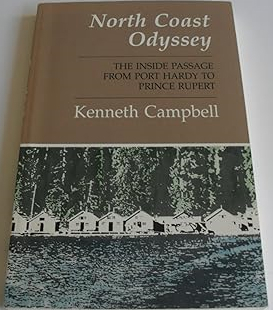
Published by Kenneth Campbell, North Coast Odyssey: The Inside Passage from Port Hardy to Prince Rupert captures the dramatic geography and rich maritime heritage of British Columbia's isolated northern marine highway. The book chronicles a coastal voyage through labyrinthine fjords, treacherous narrows, and wind-swept archipelagos, blending nautical adventure with local history, Indigenous lore, and observations of the region's abundant marine wildlife. Through vivid descriptive prose, the author details the weathered cannery towns, lighthouses, and remote settlements that cling to a magnificent yet unforgiving coastline. A keen insight drawn from the work is how the Inside Passage functions as a liquid highway that simultaneously isolates and connects; by relying entirely on maritime transit through a maze of stone and water, coastal inhabitants experience a profound sense of remoteness that can only be bridged by a deep, respectful attunement to the fickle rhythms of the Pacific tides. 202 pages : illustrations, maps, portrait ; 23 cm Non-circulating [ 1 ]
|
1993 |
|
Queen Anne, community on the hill by Kay Frances Reinartz 
Published in local editions by Kay Frances Reinartz, Queen Anne: Community on the Hill chronicles the rich neighborhood history and architectural evolution of one of Seattle’s most prominent geographic landmarks. The book traces the area's transformation from a dense evergreen forest and native camp into an affluent residential streetcar suburb offering sweeping vistas of Elliott Bay and the Cascade Mountains. Through archival photographs, diaries, and municipal records, the text captures the daily lives of early residents who shaped the hill's distinct community identity amidst rapid urban growth below. A keen insight drawn from the work is how topographical isolation can preserve a distinct community consciousness within an expanding metropolis; by literally rising above the industrial grit and commercial clamor of downtown Seattle, Queen Anne Hill allowed its residents to curate an architectural enclave that visually and socially equated geographic elevation with civic prestige. viii, 231 pages : illustrations, maps ; 28 cm Non-circulating [ 1 ]
|
1993 |
|
Seabeck tide's out, table's set by Fredi Perry, Michael Jay Mjelde, Larry Hill, Victoria Rowe 
History of Seabeck, Washington (state) covers the early Native American history, exploration by British and American navigators, and continues on to the development of the harbor as the site of a lumber mill and shipbuilding center. Topics include water transportation, hotels, saloons, store, post office, schools, cemetery, Seabeck Christian Conference Center, and surrounding communities. Included are census and cemetery records, maps, legends, and an extensive index. This is the second printing.-- 242 pages : illustrations, maps ; 28 cm Non-circulating [ 1 ]
|
1993 |
|
Chiefs & chief traders Indian relations at Fort Nez Percés, 1818-1855 by Theodore Stern 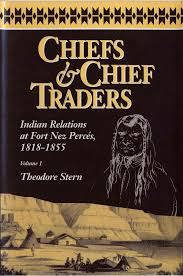
A ground-breaking study of the relations between the fur traders of Fort Nez Perce's and the Indians of the region, primarily Cayuse, Wallawalla, Umatilla, and Nez Perce. Existing literature on this region has focused on the white explorers, the fur traders, and the settlers; Chiefs and Chief Traders offers a new perspective, exploring both white and Indian cultures and their interactions. Chiefs and Chief Taders represents the culmination of 25 years of research, utilizing an extensive variety of primary sources - some used here for the first time - as well as oral interviews conducted in the course of ethnographic research on the Umatilla Indian Reservation. Stern weaves together anthropology and history in a way that few are qualified to do. He brings important new information to the story of the relations between Indians and whites in the Pacific Northwest xii, 272 pages : illustrations, maps ; 24 cm Non-circulating [ 1 ]
|
1993 |
|
Land in common an illustrated history of Jackson County, Oregon by Joy B. Dunn, Southern Oregon Historical Society 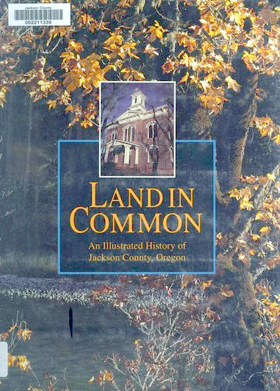
Published by the Southern Oregon Historical Society and authored by Joy B. Dunn, Land in Common: An Illustrated History of Jackson County, Oregon chronicles the complex and vibrant heritage of the Rogue River Valley. The book traces the region's transformation from ancestral indigenous homelands and a turbulent 1850s gold rush frontier into a thriving agricultural and timber-producing community. Through an extensive collection of historical photographs and archival records, the text highlights the diverse waves of settlers, miners, and entrepreneurs who shaped the physical and social landscape of southern Oregon. A keen insight drawn from the work is how the book's title operates as a poignant irony; by documenting how a land once held in common by native nations was rapidly parceled out into private claims, the history reveals that the foundational wealth of the frontier was built entirely upon the systematic legal enclosure of indigenous geography. xiv, 178 pages : illustrations (some color) ; 29 cm Non-circulating [ 1 ]
|
1993 |
|
Sails, steamships & sea captains settlement, trade, and transportation of Island County between 1850-1900 by Island County Historical Society 
Published by the Island County Historical Society, Sails, Steamships & Sea Captains: Settlement, Trade, and Transportation of Island County Between 1850-1900 chronicles the maritime foundation of Washington’s Whidbey and Camano islands during the late nineteenth century. The book details the pivotal role played by mosquito fleet steamers, schooners, and daring sea captains in binding together isolated homesteads, timber camps, and agricultural outposts across Puget Sound long before the era of bridges and highways. Through archival photographs and pioneer accounts, the text captures a watery frontier where daily commerce, mail delivery, and social survival depended entirely on wind, tide, and vessel navigation. A keen insight drawn from the work is how insular geography in the Pacific Northwest inverted modern transportation logic; rather than land acting as the primary territory and water as the barrier, the interconnected waterways of Puget Sound served as the region's true main street, dictating the economic rise and fall of early island communities based entirely on their access to passing steamship docks. vii, 137 pages : illustrations, maps ; 21 cm Non-circulating [ 1 ]
|
1993 |
|
Arch Cape chronicles a bit of Oregon coast's past by David English, Alma English 
Published by local historians David and Alma English, Arch Cape Chronicles: A Bit of Oregon Coast's Past explores the intimate, isolated history of a windswept coastal community nestled between Cannon Beach and Nehalem. The book traces Arch Cape’s evolution from an untamed wilderness of dense old-growth timber and rocky headlands into a quiet haven for pioneering homesteaders, loggers, and vacationers. Drawing on historical documents, oral histories, and vintage photographs, the authors document how early travelers navigated the treacherous coastline before the construction of modern highways and tunnels carved open the rugged terrain. A keen insight drawn from the work is how the very geographic barriers that delayed Arch Cape's development—such as towering sea cliffs and impassable tides—ultimately preserved its secluded character, transforming what was once an existential travel hazard into an exclusive sanctuary for those seeking refuge from the modern world. 357 pages : illustrations ; 26 cm Non-circulating [ 1 ]
|
1993 |
|
Calabash a guide to the history, culture, and art of African Americans in Seattle and King County, Washington by Esther Hall Mumford 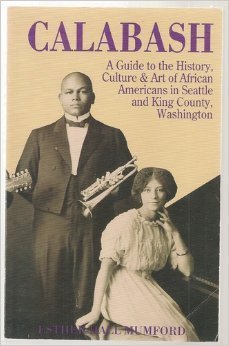
"This guide is intended to acquaint county residents and visitors with some of the more easily accessible landmarks of African-American history. These include works of art and cultural and historical sites which have been passed or driven by, for years while their existence, significance or association with African Americans in King County over the past century and a half has gone unnoted. This book provides information to give the user a sense of the creators and participants, the places and the activities associated with them ... Except for private homes and corporations most of the art and sites included here are accessible to public viewers. They are marked on the maps accompanying each section." from author's preface xii, 158 pages : illustrations, maps ; 22 cm Non-circulating [ 1 ]
|
1993 |
|
Tracks, trails, and tales in Clallam County, state of Washington by Harriet U. Fish 
Published by local historian Harriet U. Fish, Tracks, Trails, and Tales in Clallam County, State of Washington chronicles the rugged pioneering history and frontier development of the Olympic Peninsula's northernmost reaches. The book captures the arduous experiences of early homesteaders, loggers, and native communities who navigated dense rain forests, uncharted coastal waters, and punishing mountain passes to build isolated settlements. Through first-person accounts, archival records, and local folklore, the text preserves the vanishing daily rhythms of a remote region shaped by timber extraction and maritime trade. A keen insight drawn from the work is how the geographic isolation of the Olympic Peninsula inverted standard settlement patterns; because dense wilderness and fierce coastal weather made overland travel nearly impossible, early Clallam County communities were often more closely tethered by steamship routes to distant Seattle and Victoria than to the rest of their own state. 214 pages : illustrations ; 22 x 28 cm Non-circulating [ 1 ]
|
1993 |
|
The Washington story a history of our State by Ruth Pelz, Seattle Public Schools 
Published by Seattle Public Schools and authored by educator Ruth Pelz, The Washington Story: A History of Our State provides an engaging regional overview designed to introduce students to the complex political, economic, and social heritage of the Pacific Northwest. The book traces the region's trajectory from ancestral Indigenous stewardship and the maritime fur trade through the eras of industrial logging, hydroelectric dam construction, and the rise of modern aerospace and technology hubs. By centering diverse voices and grassroots perspectives, the text moves beyond traditional pioneer narratives to examine how ordinary workers, immigrants, and native nations shaped local communities. A keen insight drawn from the work is how civic education textbooks function as blueprints for regional identity; by intentionally highlighting labor strikes, environmental struggles, and social justice milestones alongside economic triumphs, the book teaches young citizens that Washington's modern prosperity is inextricably tied to an ongoing, contentious negotiation between corporate ambition and grassroots resistance. 303 pages : illustrations, maps ; 27 cm Non-circulating [ 1 ]
|
1993 |
|
Haboo native American stories from Puget Sound by Vi Hilbert, Ron Hilbert 
The stories and legends of the Lushootseed-speaking people of Puget Sound represent an important part of the oral tradition by which one generation hands down beliefs, values, and customs to another. Vi Hilbert grew up when many of the old social patterns survived and everyone spoke the ancestral language. Haboo, Hilbert's collection of thirty-three stories, features tales mostly set in the Myth Age, before the world transformed. Animals, plants, trees, and even rocks had human attributes. Prominent characters like Wolf, Salmon, and Changer and tricksters like Mink, Raven, and Coyote populate humorous, earthy stories that reflect foibles of human nature, convey serious moral instruction, and comically detail the unfortunate, even disastrous consequences of breaking taboos. Beautifully redesigned and with a new foreword by Jill La Pointe, Haboo offers a vivid and invaluable resource for linguists, anthropologists, folklorists, future generations of Lushootseed-speaking people, and others interested in Native languages and cultures. XXIII, 204 Seiten : Illustrationen ; 28 cm Non-circulating [ 1 ]
|
1993 |
|
The Vancouver Natural History Society, 1918-1993 by Jim Peacock, Vancouver Natural History Society 
Published by the Vancouver Natural History Society and authored by Jim Peacock, The Vancouver Natural History Society, 1918–1993 chronicles seventy-five years of grassroots ecological stewardship, amateur scientific research, and outdoor exploration in southwestern British Columbia. The book details the organization's instrumental role in advocating for provincial parks, documenting regional flora and fauna, and fostering a community-wide appreciation for the natural landscapes surrounding a rapidly expanding urban center. Through archival logs, club newsletters, and biographical sketches, the text highlights how dedicated citizen scientists successfully pushed back against unbridled resource extraction to protect local wilderness. A keen insight drawn from the work is how amateur natural history societies functioned as the vanguard of early environmentalism; by mobilizing urban citizens into weekend field trips and systematic species observation, the society turned ordinary nature enthusiasts into passionate political defenders of British Columbia's imperiled ecosystems. 104 pages : illustrations ; 22 cm Desiderata
|
1993 |
|
The Utter disaster on the Oregon Trail the Utter and Van Ornum massacres of 1860 by Donald H. Shannon 
"In 1860 on the South Alternate Route of the Oregon Trail in the Snake River Country of present day Idaho and Oregon. A rare instance when Indians not only attempted but maintained a successful attack on encircled emigrant wagons. Attacks on the Utter wagon train and then on the survivors resulted in the greatest loss of life to an emigrant train and to the attacking Indians, of any such encounters. Survivors' starvation camp on the Owyhee River and eventual rescue by an army expedition commanded by Captain Frederick T. Dent (his sister married U.S. Grant). Discovery of the Van Ornum massacre -- the bodies "gleaming in the moonlight"--By a fast-moving dragoon force led by Lieutenant Marcus A. Reno (later with Custer at the Little Big Horn). Two-year attempt to rescue children held captive by the Shoshoni as the US Army disintegrated at the onset of the Civil War."--Cover xvii, 218 pages : illustrations, maps ; 23 cm. Desiderata
|
1993 |
|
Mining engineers and the American West the lace-boot brigade, 1849-1933 by Clark C. Spence 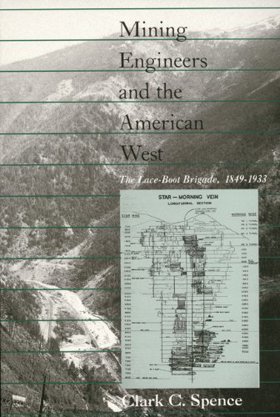
Even though they were key figures in the development of western mining, mining engineers have received little attention until publication of Dr. Clark Spence's volume. At once a technological and social history, Dr. Spence examines the professional mining engineer in terms of his education, lifestyle, actual work, and impact on the environment beyond the Mississippi. xii, 407 pages : illustrations, maps ; 23 cm Desiderata
|
1993 |