Catalog of British Columbiana and Pacific Northwest Americana
Encyclopedia Cascadia Catalog contains book titles of mostly non-fiction Pacific Northwest Coast of North America Titles (primarially British Columbia, Idaho, Oregon and Washington State) in an easy-to-understand title catalog. If you see a link with this badge ONLINE CIRC it means that there is an online institution that provides free access to that title. In some cases there may be more than one institution hosting the title digitally.
| Catalog Title | Published |
|---|---|
|
Beauty of the city A.E. Doyle, Portland's architect by Philip Niles 
The Central Library, Benson Hotel, Reed College, the Meier & Frank building, the U.S. National Bank—these are just a few of the grand Portland icons designed by Albert E. Doyle. During a period of rapid growth in Portland, Oregon, after the Lewis & Clark Centennial Exposition and before the Great Depression, Doyle (1877-1928) was the city’s most important architect. Beauty of the City is the first biography of this celebrated architect. Doyle’s career was short, just twenty-one years. Yet everywhere Portland retains his imprint. Many of Doyle’s classical, often white terra-cotta buildings became venerable city landmarks. He also designed Portland residences, Neahkahnie beach cottages, and houses and banks in Oregon and Washington. Using A. E. Doyle’s own diaries and letters and his firm’s records, historian Philip Niles traces the architect’s life and times in the context of the burgeoning cityscape. As Portland expanded beyond its frontier origins and provincialism, Doyle helped introduce Eastern and European sophistication. Indeed, his refined sensibility influenced the development of the Northwest Regional Style by Pietro Belluschi and John Yeon, among others. Doyle set the standard for elegance and proportion that later architects adapted to more modern styles—his standard defines Portland’s vibrant core and contributes to the city’s beauty as much today as it did 80 years ago. Readers interested in Northwest history and culture will appreciate this compelling and richly illustrated biography of “Portland’s architect.” Likewise, architectural historians and those seeking to better understand Portland’s architectural heritage will enjoy reading of Doyle’s contributions to this celebrated cityscape. “All new things built with the idea of preserving the beauty of the city and adding to it." -A. E. Doyle xvi, 278 pages : illustrations, map ; 26 cm CIRC [ 0 ]
|
2008 |
|
Beacon for mountain and plain story of the University of Idaho by Rafe Gibbs 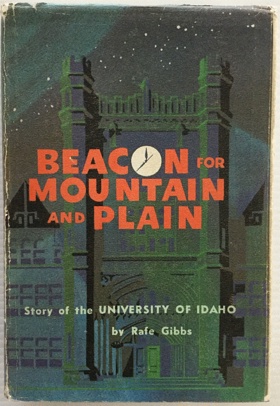
Book commemorates the proud heritage and spirit of all who were involved in shaping the history of the University of Idaho. x, 420 pages illustrations, portraits, facsimiles 24 cm CIRC [ 0 ]
|
1962 |
|
Beach of heaven a history of Wahkiakum County by Irene Martin 
Beach of Heaven is a history of the earliest settled areas in Washington. As the birthplace of both the state's canned salmon industry and the cooperative extension movement, as well as Congresswoman Julia Butler Hansen, Wahkiakum County has a historical significance far beyond its borders. Today it stands at the cusp of major change as the rural occupations of fishing, farming, and logging, upon which the country has traditionally depended, suffer from outside influences and demographic shifts. Beach of Heaven documents these changes and looks ahead to future possibilities. This book is much more than a county history. It is a story of the development of a place, of the settlement of ethnic groups, of the establishment of social and transportation networks that made life livable in a wild and forested country. As Irene Martin writes, Beach of Heaven is "an emotional engagement with the place we call home." It will resonate for all who have a passion for the little places, the rural areas, the community values that are gradually passing into history. xiii, [1], 178 pages, 32 unnumbered pages of plates : illustrations, maps, portraits ; 23 cm CIRC [ 1 ]
|
1997 |
|
Be brave, Tah-hy! the journey of Chief Joseph's daughter by Jack R. Williams, Jo Proferes (Illustrator) 
On June 17, 1877, gunshots marked the start of war—one that swept twelve-year-old Tah-hy (Chief Joseph’s daughter) and her people into a harrowing journey across the American West. Relentlessly pursued, they endured multiple battles, cold, hunger, and death. Eventually, after months of exile and heartbreak, they began their path to a new way of life. Based on actual events and narrated by Tah-hy’s youthful voice, this biographical novel is intended for young adults, but will also interest older readers. The story presents many aspects of the Nez Perce Dreamer culture and reminds us of what was lost when they were overpowered and displaced. 134 pages : color illustrations ; 21 x 26 cm CIRC [ 0 ]
|
2012 |
|
Bayocean the Oregon town that fell into the sea by Bert Webber, Margie Webber 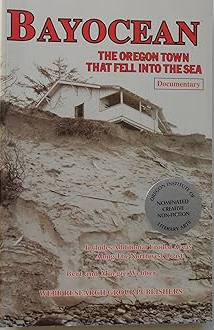
This documentary shows the erosion that took place in Bayocean, Oregon with dozens of historic and current photographs, maps, unique cartoons, bibliography, index. The book also Salishan, Nestucca, Cape Lookout State Park, Newport and Jump-Off Joe, the Southern Oregon Coast, Washington's "wash-away" beach, the total destruction of Cape Showalter, and other places. vi, 206 pages ; 22 cm CIRC [ 1 ]
|
1989 |
|
Bayocean Atlantis of Oregon by Jerry Sutherland 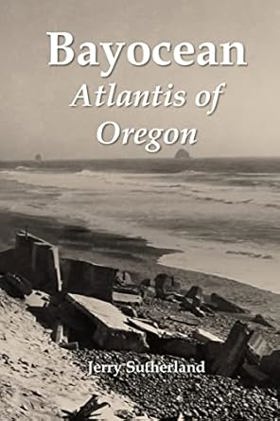
Like Plato's fictional island kingdom, most of Bayocean sank below the sea long ago. The rest lies buried beneath the shore pine, salal, and beach grass covering the four-mile-long spit that protects Tillamook Bay from the Pacific Ocean. This book chronicles the half-century this Oregon resort town existed, tells the stories of people who lived there, and explains its demise. Starting in 1907, urbanites in Oregon's Willamette Valley and across the Pacific Northwest were promised a grand resort where they could enjoy cool, ocean breezes during hot summers. Lots sold quickly at first, especially those along Bayocean's one-hundred-foot-high ridgeline where bay and ocean views were breathtaking. But Tillamook's remote location, an economic downturn, and insufficient financial reserves led to delays, litigation, and receivership. Though never grand, at one point or another Bayocean featured a massive natatorium, three hotels, forty-two rental cabins, a two-story mercantile, two restaurants, three dance halls, an amusement pavilion, and fifty-nine homes. Reed College students ran the resort one summer; a military academy for boys tried but failed another. A commune invigorated the town for a couple of years during the Great Depression, as did Coast Guard war dogs during World War II. These and other episodes in Bayocean's history make it more interesting than most, but the fact that nothing remains makes it matter. Erosion began pulling homes into the sea in the late 1920s and undercut the oceanside natatorium in 1932. As the spit's foredune continued to recede, more homes fell. In November 1952 a storm surge blew its narrow southern section into Tillamook Bay. Four years later, the Army Corps of Engineers built a breakwater to reconnect the island to Cape Meares, destroying what remained of the town in the process. It took geologists, geographers, and oceanographers two decades to figure out that the erosion had been caused by faulty jetty planning rather than natural forces. Their work prevented similar environmental disasters from occurring elsewhere. When Jerry Sutherland heard about Bayocean in 2014, he first read everything written about it. He then searched for additional information, traveling across the United States to look through personal and institutional archives. Along the way, he shared some of his discoveries with the public at www.bayocean.net and with the producers of television documentaries. But in his book, Sutherland shares it all.--Publisher 282 pages : illustration, maps, portraits ; 23 cm CIRC [ 0 ]
|
2023 |
|
Battle Rock the hero's story : a true account, Oregon coast Indian attack : an Oregon documentary by Bert Webber, Margie Webber, J. M. Kirkpatrick 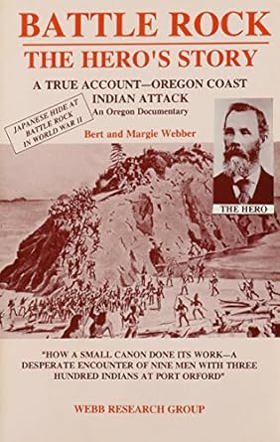
Published by maritime historians Bert Webber, Margie Webber, and J.M. Kirkpatrick, Battle Rock: The Hero's Story chronicles the harrowing 1851 clash between a small party of American gold-seekers led by Captain William Tichenor and the local Quat-a-qtie (Tututni) people on the southern Oregon coast. The book details the group's desperate defense atop a rocky sea stack in present-day Port Orford after an initial exploratory landing provoked fierce Indigenous resistance to protect their ancestral territory. Drawing on historical documents, pioneer journals, and local accounts, the text preserves a violent and foundational episode of frontier expansion. A keen insight drawn from the work is how regional historical documentation often elevates colonial survival narratives while obscuring the broader geopolitical trauma; by framing the skirmish through the heroic lens of isolated pioneers under siege, the account masks the reality that the true assault was an unprovoked imperial intrusion onto sovereign Indigenous land. 75 pages : illustrations, maps, portraits ; 22 cm CIRC [ 1 ]
|
1992 |
|
Barns of the West a vanishing legacy by Arthur A. Hart 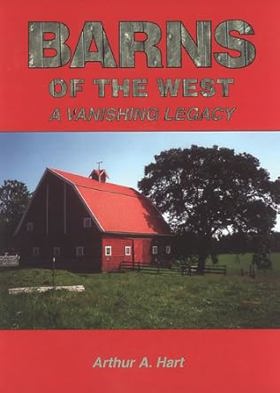
Text and photos illustrate a variety of barn structures and styles, including hops drying barns. Barns photographed are in Montana, Idaho, Oregon, Washington, and Alaska 112 pages : chiefly illustrations (some color) ; 29 cm CIRC [ 0 ]
|
1996 |
|
Barlow Road by Wasco County Historical Society, Clackamas County Historical Society 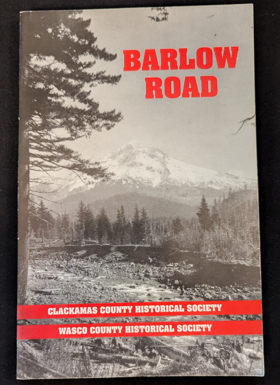
Authored collaboratively by the Wasco County Historical Society and the Clackamas County Historical Society, Barlow Road chronicles the construction and historical legacy of the final, grueling overland leg of the historic Oregon Trail. The book traces how Sam Barlow’s 1845 toll road carved a hazardous wagon route around the treacherous southern flank of Mount Hood, offering exhausted pioneers a perilous alternative to navigating the dangerous rapids of the Columbia River. Through archival maps, journals, and photographs, the text details the monumental physical labor required to hack a wagon track through dense old-growth forests and volcanic terrain. A keen insight drawn from the work is how the creation of the Barlow Road transformed a humanitarian struggle into a capitalist enterprise; by privatizing the final mountain obstacle of the migration route, the toll road proved that the westward movement was driven as much by entrepreneurial toll-gate economics as it was by Manifest Destiny. vii, 97 pages : illustrations, maps ; 21 cm CIRC [ 1 ]
|
1998 |
|
Barkley Sound a history of the Pacific Rim National Park area by R. Bruce Scott
|
1972 |
|
Bandon tales stories of country life by Granny Abbott 
Authored by longtime southern Oregon resident Granny Abbott, Bandon Tales: Stories of Country Life offers a charming, homespun collection of reminiscences documenting early homesteading, farming, and coastal community life near Bandon during the late 19th and early 20th centuries. The book captures the unvarnished realities of rural survival, neighborly mutual aid, and domestic routines against the backdrop of raw wilderness and sweeping Pacific shores. Through affectionate and straightforward prose, the text preserves the colloquial voice and everyday folklore of pioneers who carved out an existence on a windswept frontier. A keen insight drawn from the work is how domestic humor and storytelling served as vital psychological currency for frontier women; by framing crushing physical hardships through the lens of wry local comedy, homesteaders built emotional resilience and forged unbreakable social ties that kept isolation at bay. 111 pages : illustrations ; 21 cm CIRC [ 1 ]
|
1997 |
|
Bamberton from dust to bust and back by Maureen Alexander, Andrew S. Brown
|
2012 |
|
Balancing Bountiful what I learned about feminism from my polygamist grandmothers by Mary Jayne Blackmore 
"As the daughter of Mormon leader Winston Blackmore, Mary Jayne Blackmore grew up within the closed-off polygamist community of Bountiful, BC. She spent her younger years riding ponies, raising pet lambs and playing in the hay in the Old Barn, under the constant shadow of religious fanaticism, doomsday preparation and an instilled fear of the world outside of Mormonism. In 2017 her father was charged and convicted of practicing polygamy, splitting the community in two and further inciting the media sensationalism and worldwide criticism that had always surrounded Bountiful. As the world she had always known imploded, Mary Jayne was forced to redefine her faith, family and womanhood for herself. Today, through her work and her personal exploration of feminism, Mary Jayne is helping to heal a broken community, one that she watched turn from safe and loving to angry, arrogant and resentful. She is also building her own place in the world--as a teacher, mother, writer and educated woman--and she has managed to retain loving bonds with her family, including her father. From a childhood in an idyllic but sheltered community to early adulthood in an arranged marriage, ensuing divorce, and eventual return to Bountiful, Bridging Bountiful is Mary Jayne's journey of coming of age and coming to terms with her background as she strives to answer the question: What is the right kind of family, the right kind of woman and the right kind of feminist?"-- Provided by publisher 319 pages : back and white illustration ; 23 cm CIRC [ 0 ]
|
2020 |
|
Baker County sketch book by Gordon Stewart, Patricia Stewart
|
1956 |
|
Bainbridge landings by Allen Beach
|
1965 |
|
Badger and Coyote were neighbors Melville Jacobs on Northwest Indian myths and tales by William R. Seaburg, Pamela Amoss 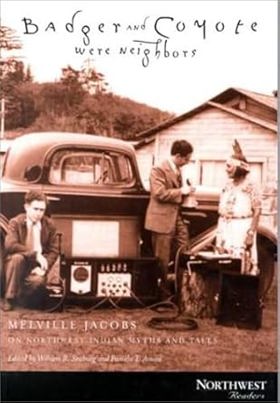
For the Clackamas Chinook Indians, these words signaled the end of a myth recital. Melville Jacobs spent a lifetime recording traditional stories and studying the life ways of those who told them. An anthropologist and folklorist, Jacobs (1902-1971) made it his life's work to preserve and interpret the fast-disappearing languages and traditions of the Indian peoples of Oregon and Washington. This volume presents an introduction to Jacobs's seminal research and provides an engaging selection of the myths and tales that he painstakingly collected. In their introduction, the editors provide an overview of Jacobs's remarkable life and career. A professor at the University of Washington, Jacobs, like his mentor Franz Boas, spent months in the field, seeking out and interviewing Native people. A selection of Jacobs's articles and essays on Northwest Indian oral traditions introduce his theory and method of folklore research. In addition to his own original writings, this volume gathers eighteen stories collected and translated by Jacobs. Eight of the stories include his extensive interpretations, several of which are published here for the first time. The stories represent the range of genres that Jacobs collected and are drawn from many of the Native groups with which he worked, including Chinook, Kalapuya, Sahaptin, and Coos. All the stories were originally collected in the Native languages and translated into English with help from Jacobs's Indian consultants. Making possible the scholarly understanding and appreciation of Native folk literature was Melville Jacobs's greatest challenge. This volume in the Northwest Readers series is evidence of his success. It offers a valuable introduction to Jacobs's work for anyone interested in the rich folklore of Northwest Indians, as well as for students and scholars of American Indian oral traditions and their interpretation. x, 310 pages : illustrations ; 23 cm. CIRC [ 0 ]
|
2000 |
|
Backroad adventures through interior British Columbia by Donovan Clemson 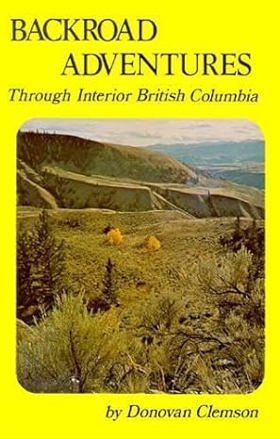
BACKROAD ADVENTURE takes us through the great stretch of country lying between the Coast range and the Rockies, south of Prince George. It is about the quiet remote places and the people one finds sheepherders in alpine pastures, ranchers in secluded valleys, fire watchers on isolated mountain tops, and the lonely ferrymen. The byways straggle and wander through the interior, leading to dry valleys where fantastic rock formations surprise the stranger; or to remote jack pine plateaux where back woods ranchers count many miles between neighbors. Threading the timbered Kootenay valleys, quiet and friendly roads trail past the fast fading relics of ghostly mining towns and rustic settlements which time has passed by. 192 pages : illustrations ; 21 cm CIRC [ 1 ]
|
1981 |
|
Backcountry roads--Idaho by Lynna Howard, Leland Howard 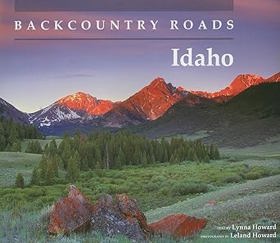
Backcountry Roads- Idaho is a beautiful, informative and practical guide to the Gem State's hidden treasure of roadways. Enhanced by 140 photos from award-winning photographer Leland Howard, Backcountry Roads-Idaho is a rarity, a guidebook that is also a work of art. Award-winning outdoor writer Lynna Howard provides GPS coordinates, expedition maps, and detailed descriptions for would be explorers. Her creative flair brings backcountry travel to life with an immediacy that engages all the senses. This is an indispensable tool for anyone who wishes to experience firsthand the rugged beauty of scenic Idaho 240 pages : color illustrations, color maps ; 22 x 28 cm CIRC [ 0 ]
|
2009 |
|
Back roads of Washington 74 trips on Washington's scenic byways by Earl Thollander 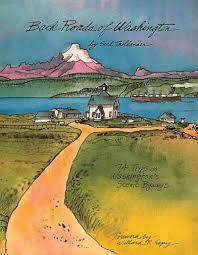
Wander off the beaten path with artist Earl Thollander and discover some of the most picturesque areas of the state. In hand-written text and vivid illustrations, Back Roads of Washington guides readers through 6,000 miles of scenic beauty. This regional classic captures the memorable details of back roads that can be enjoyed on the way to a destination, on a Sunday drive, or sitting in a comfortable armchair. -- Amazon 200 pages : illustrations, maps ; 28 cm CIRC [ 1 ]
|
1992 |
|
Autobiography of Rear Admiral Charles Wilkes, U.S. Navy, 1798-1877 by Charles Wilkes, William James Morgan, United States Naval History Division
|
1978 |
|
Auburn--a look down Main Street by Josephine Emmons Vine
|
1990 |
|
Atomic frontier days Hanford and the American West by John M. Findlay, Bruce William Hevly 
On the banks of the Pacific Northwest’s greatest river lies the Hanford nuclear reservation, an industrial site that appears to be at odds with the surrounding vineyards and desert. The 586-square-mile compound on the Columbia River is known both for its origins as part of the Manhattan Project, which made the first atomic bombs, and for the monumental effort now under way to clean up forty-five years of waste from manufacturing plutonium for nuclear weapons. Hanford routinely makes the news, as scientists, litigants, administrators, and politicians argue over its past and its future. It is easy to think about Hanford as an expression of federal power, a place apart from humanity and nature, but that view distorts its history. Atomic Frontier Days looks through a wider lens, telling a complex story of production, community building, politics, and environmental sensibilities. In brilliantly structured parallel stories, the authors bridge the divisions that accompany Hanford’s headlines and offer perspective on today’s controversies. Influenced as much by regional culture, economics, and politics as by war, diplomacy, and environmentalism, Hanford and the Tri-Cities of Richland, Pasco, and Kennewick illuminate the history of the modern American West. xv, 368 pages : illustrations, maps ; 23 cm. CIRC [ 0 ]
|
2011 |
|
Atlas of the Pacific Northwest resources and development by Richard M. Highsmith , Jon M. Leverenz (Cartographer), Oregon State University
|
1962 |
|
Atlas of Oregon wilderness by William L. Sullivan 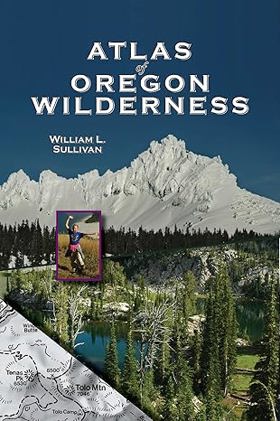
With the addition of 200,000 more acres designated by Congress as Oregon wilderness in 2009, use this as a planning guide to explore new areas and old favorites from The Three Sisters and Mount Hood to Eagle Cap and Steens Mountain. This is a complete guide to Oregon's backcountry. This complete guide to Oregon's backcountry includes the new wilderness areas designated by Congress in March 2009 as well as old favorites from Mt. Hood and the Three Sisters to Steens Mountain and the Wallowas. The atlas features 70 pages of detailed, shaded-relief maps, 40 pages of color photographs, 146 recommended backpacking trips, 500 featured hikes, and tips for mountain climbers, whitewater rafters, kayakers, Nordic skiers, and snowshoers. 384 pages : illustrations (some color), maps, plates ; 23 cm CIRC [ 0 ]
|
2010 |
|
Atlas of Oregon by William G. Loy, Stuart Allan, Aileen R. Buckley, James E. Meacham 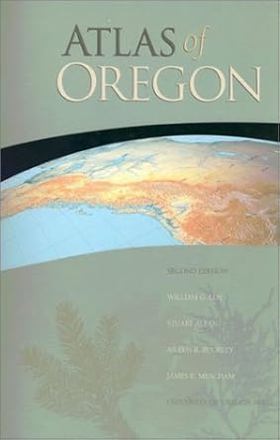
This beautiful and authoritative volume offers a detailed look at the history, geography, and people of Oregon. Stunning full-color maps are complemented by informative text exploring everything from the earliest settlers to the growth of Oregon vineyards to Portland's traffic jams. The Atlas maps a world of information, from native cultures, exploration, politics, religion, and economic growth to landforms, volcanoes, lakes, place names, vegetation, and wildlife habitat. Created by an award-winning team of geographers and cartographers, it is both a work of art and a fascinating reference. 1 atlas (xvii, 301 pages) : color illustrations, color maps ; 34 cm CIRC [ 0 ]
|
2001 |