Catalog of British Columbiana and Pacific Northwest Americana
The Encyclopedia Cascadia Catalog indexes mostly non-fiction literature covering the Pacific Northwest coast of North America, with an emphasis on British Columbia, Idaho, Oregon, and Washington State.
| Catalog Title | Published |
|---|---|
|
A history of Moscow First United Methodist Church a century on the Palouse by Moscow First United Methodist Church (Moscow, Idaho) 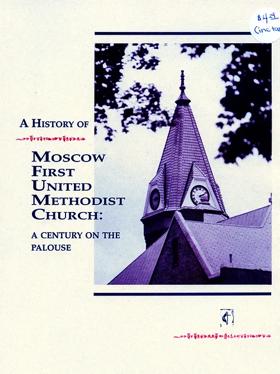
Perhaps one of the most recognizable buildings in Moscow, the United Methodist Church was added to the National Register of Historic Places in 1978. This book explores the life and evolution of the church from its very beginning in 1876. i, 97 pages : illustrations ; 28 cm Desiderata
|
1994 |
|
A history of Laurelhurst by Christine Barrett, Laurelhurst Community Club (Seattle, Wash) 
Christine Barrett and the Laurelhurst Community Club's A history of Laurelhurst chronicles the suburban transformation of a densely wooded peninsula extending into the deep waters of Lake Washington and Union Bay in northeast Seattle. Set against these defining shorelines and the distant backdrop of the Cascade Range, the narrative details how early developers and pioneering families transitioned a rugged, logged-over landscape into a highly structured residential enclave. By tracing the active civic engagement of the neighborhood's foundational kinship networks, the text reveals how residents cooperatively built robust local institutions and shared social traditions to anchor their new lakeside homesteads. Ultimately, this local history documents how the deliberate planning and tight-knit family bonds of these early settlers successfully transformed an isolated waterfront frontier into one of the city's most enduring and cohesive communities. 75 pages : illustrations ; 21 x 28 cm Non-circulating [ 1 ]
|
1989 |
|
A history of Latah County to 1900 by Lawrence Ray Harker 
Lawrence Ray Harker’s A history of Latah County to 1900 explores the gradual pioneer settlement and enduring agricultural development of the uniquely fertile, rolling topography of the Palouse region in northern Idaho. The narrative illustrates how the specific environmental realities of this landscape—defined by vast expanses of deep, wind-blown loess soils, the dense white pine timberlands of the eastern foothills, and the seasonal rhythms of the inland climate—required immense resilience and thoughtful cultivation from early homesteaders. By detailing the steady transition from isolated mining camps and early subsistence claims to the collaborative establishment of robust dry-land farming networks and the eventual integration of vital rail corridors, the text highlights how the county's prosperity relied on community-driven adaptation to its rich natural resources. Ultimately, the account demonstrates that cooperatively harnessing the immense agricultural potential of the Palouse hills and patiently building cohesive civic and educational institutions, such as those in early Moscow, were essential steps in transforming a remote frontier into a thriving, deeply rooted agrarian and cultural heartland of the inland Pacific Northwest. 83 leaves ; 28 cm Desiderata
|
1941 |
|
A History of Coquitlam and Fraser Mills, 1858-1958 by H. A. J. Monk, John Stewart 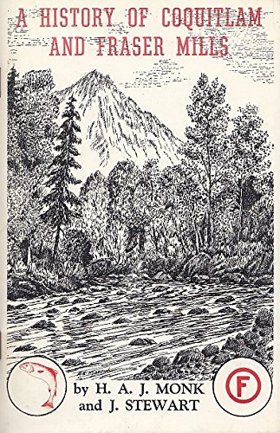
H. A. J. Monk and John Stewart’s A History of Coquitlam and Fraser Mills, 1858-1958 chronicles the explosive industrial colonization of a sprawling, heavily timbered riverine expanse located at the strategic confluence of the Coquitlam and Fraser rivers. The narrative maps how the impenetrable biological mass of the ancient coastal rainforest and the volatile, flood-prone hydrology of the lower Fraser delta initially choked overland movement, forcing early settlers and timber barons to rely exclusively on this massive aquatic highway to transport raw logs and export milled lumber. By detailing the monumental industrial effort required to construct Fraser Mills—which evolved into the largest lumber processing facility in the British Empire—and the grueling pioneer labor needed to clear the dense alluvial floodplains for viable agriculture, the text illustrates how large-scale economic expansion was strictly governed by the severe physical realities of this riparian topography. Ultimately, the account demonstrates that systematically harvesting these colossal timber stands and engineering robust mechanized milling infrastructure directly upon the riverbanks were the absolute prerequisites for transforming a rain-soaked, isolated wilderness into a globally dominant epicenter of Pacific seaboard timber manufacturing. 76 pages : illustrations, maps ; 23 cm Desiderata
|
1958 |
|
A history of central Washington including the famous Wenatchee, Entiat, Chelan and the Columbia Valleys with an index and eighty scenic-historical illustrations by Lindley M. Hull
Published in 1929 and compiled by Lindley M. Hull for the Pioneer Association of Central Washington, A History of Central Washington is a massive, 624-page regional chronicle detailing the settlement of the Wenatchee, Entiat, Chelan, and Columbia valleys. Divided into two primary sections—"The Story of Pioneer Settlements" and "The Development Period"—the volume combines eighty scenic-historical illustrations with exhaustive biographical sketches of early white homesteaders. The text meticulously documents the physical transformation of the region, emphasizing the construction of irrigation ditches, the establishment of commercial orchards, and the founding of local civic institutions. Like many pioneer-driven histories of the era, the book operates as a triumphalist civic monument celebrating the rugged endurance and capitalist successes of the region's Anglo-American founders. A keen insight drawn from the work is how the narrative conceptually weaponizes agricultural "development" to morally legitimize colonial displacement. By framing the region's history fundamentally around the engineering of irrigation canals and the cultivation of profitable cash crops, Hull’s compilation equates valid land ownership exclusively with industrial-scale agrarian capitalism. This historiographical maneuver effectively reduces the original Indigenous inhabitants and their complex, pre-existing territorial claims to mere background frontier trivia, occasionally noting them only as transient obstacles or linguistic curiosities. Consequently, the aggressive ecological enclosure and demographic replacement of the region is structurally sanitized, demanding that readers view the settlement of central Washington not as an act of territorial conquest, but as the righteous, inevitable unlocking of a previously "wasted" landscape's true economic destiny. 624 pages : illustrations ; 23 cm Non-circulating [ 1 ]
|
1929 |
|
A historical, descriptive and commercial directory of Owyhee County, Idaho, January 1898 Silver City, De Lamar, and Guffey by Press of The Owyhee Avalanche 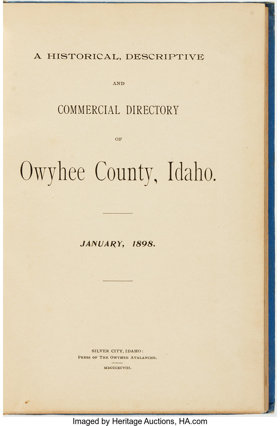
Published in 1898 by the Press of The Owyhee Avalanche, this volume serves as both a foundational historical record and a practical commercial guide to Owyhee County, Idaho, during its late 19th-century resource boom. The text provides detailed accounts of the region's geography, emerging rail infrastructure, and lucrative mining operations, while also cataloging the local businesses, civic leaders, and pioneer residents who populated towns like Silver City, De Lamar, and Guffey. A keen insight drawn from the publication is how frontier newspapers actively functioned as regional boosters, utilizing these exhaustively detailed directories to legitimize rugged, isolated mining camps into permanent, investment-worthy municipalities by projecting a highly organized image of commerce and rapid modernization. 154 pages : illustrations, portraits ; 24 cm ONLINE Circulation [ 1 ]
|
1898 |
|
A Haida wedding by Terri-Lynn Williams-Davidson , Robert Davidson 
"A visual and cultural celebration of a traditional Haida wedding ceremony, exploring its roots, rituals, symbolism, joyfulness, and contemporary significance for a thriving Indigenous Nation. In 1996, Terri-Lynn Williams and Robert Davidson celebrated their wedding with a traditional ceremony, the first in over a century that was legalized under Haida law. This book provides an intimate photographic window into that momentous day and marks the resurgence of a tradition that was nearly lost to colonial forces. Relying on recorded knowledge their ancestors had shared with ethnographers and anthropologists, and the few details living Elders could recall about the tradition of guud 'iina Gihl ("becoming married") in the time before the arrival of Christian missionaries, the couple carefully planned out a seven-part celebration. It involved a canoe procession, ceremony, feast, dancing, and dowry payment, signifying the coming together of two people, two families, and two clans. The occasion is lovingly and painstakingly recounted through imagery and text in this fascinating tribute to a resilient culture and the unbreakable bonds of love and family."-- Provided by publisher ix, 86 pages : illustrations ; 27 cm Desiderata
|
2023 |
|
A Gulf Islands patchwork some early events on the islands of Galiano, Mayne, Saturma, North and South Pender by British Columbia Historical Association Gulf Islands Branch 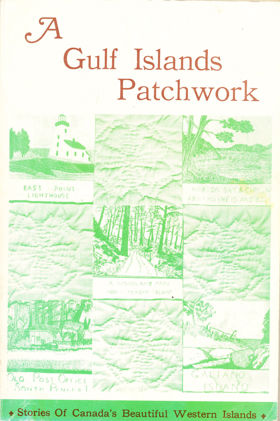
The British Columbia Historical Association’s A Gulf Islands Patchwork provides a fragmented but intimate pioneer chronicle of the sprawling Southern Gulf Islands archipelago, specifically detailing early settlement on Galiano, Mayne, Saturna, and the Penders. The narrative maps the defining, water-bound topography of these rugged landmasses, scattered across the treacherous tidal currents of the Strait of Georgia. By detailing the early establishment of remote lighthouses, coastal homesteads, and vital ferry landings, the book illustrates how the sheer physical isolation of this marine environment dictated every aspect of daily survival and community integration. The text highlights how early indigenous populations and subsequent pioneer settlers were forced to rely entirely on volatile aquatic highways—most notably navigating the violent, rip-tide currents of Active Pass—as dense, rocky interiors severely restricted overland transit and large-scale agriculture. Ultimately, the collection captures the profound environmental constraints of this coastal frontier, demonstrating how mastering complex maritime navigation and adapting to the unyielding isolation of a fractured island geography were the absolute prerequisites for establishing a viable, interconnected pioneer society along the remote Pacific seaboard. 192 pages : illustrations ; 23 cm Non-circulating [ 1 ]
|
1961 |
|
A guide to the Indian tribes of the Pacific Northwest by Robert H. Ruby, John A. Brown, Cary C. Collins, M. Dale Kinkade, Sean O'Neill 
This third edition includes the recent economic, political, and cultural developments that affect the native communities, as well as other contemporary issues such as Indian gaming and the Native American Graves Protection and Repatriation Act. All entries include information on tribal history, location, demographics, and cultural traditions xliv, 415 pages : illustrations, maps ; 24 cm. Non-circulating [ 1 ]
|
2010 |
|
A guide to the Indian tribes of the Pacific Northwest by Robert H. Ruby, John A. Brown
Historical information concerning Indian tribes located in the Pacific Northwest. Major tribes described include the Cathlamet, Cowlitz, Klamath, Lummi, Nez Percé, Paiute, Puyallup, Shoshoni, Spokane, (Spokan), Suquamish, Tillamook xx, 289 pages : illustrations ; 27 cm. Non-circulating [ 1 ]
|
1986 |
|
A guide to shipwrecks along the West Coast Trail by R. E. Wells
|
1981 |
|
A guide to Oregon south coast history traveling the Jedediah Smith Trail by Nathan Douthit 
One of the state's most spectacular scenic regions, Oregon's southern coast is also rich in history. Fur trade explorer Jedediah Smith, Coos Indian Annie Miner Peterson, lumber baron Louis Simpson, and writer Zane Grey are just a few of the fascinating individuals who helped shape South Coast history. This indispensable guide and reference work opens with an overview of South Coast history, from prehistory to the present. This first section features in-depth looks at the region's native peoples, early exploration, white settlement, Indian-white warfare, the forest industry, transportation, and town development. The second section follows the route taken along the South Coast in 1828 by Jedediah Smith, one of the foremost explorers of the American West. It describes key historic sites from the California/Oregon border to Heceta Head. Drawing on journal entries, the author traces the Jedediah Smith Expedition's advance, and recounts its troubled relations with coastal Indians and its tragic ending. Along the expedition's route, the book profiles the region's many historic places: its archaeological sites, historic buildings, towns, museums, state parks, historic roads, natural areas, shipwrecks, and lighthouses. Nathan Douthit is professor emeritus of history and political science at Southwestern Oregon Community College in Coos Bay, where he taught from 1969 to 1997. He is author of The Coos Bay Region, 1890-1944: Life on a Coastal Frontier and articles on Indian-White relations in southern Oregon. For recreation on the South Coast, he likes to bike from Coquille to Arago, hike the coast trail from Sunset Bay to Shore Acres, and drive historic back roads. xii, 208 pages : illustrations, maps ; 26 cm Non-circulating [ 1 ]
|
1999 |
|
A guide to Oregon south coast history including an account of the Jedediah Smith Exploring Expedition of 1828 and its relations with the Indians by Nathan Douthit 
A Guide to Oregon South Coast History: Including an Account of the Jedediah Smith Exploring Expedition of 1828 and Its Relations with the Indians by Nathan Douthit is a 1986 regional history published by River West Books in Coos Bay. The book provides a detailed historical overview of the rugged southern Oregon coastal frontier, centering heavily on the pivotal 1828 overland expedition led by the renowned fur trapper and mountain man Jedediah Smith. Douthit meticulously examines the expedition's grueling journey north from California, culminating in the violent and tragic clash with the Kalawatset (Lower Umpqua) Native Americans. Ultimately, it serves as an essential and highly focused scholarly resource for understanding the complex dynamics of early Euro-American exploration, cultural misunderstandings, and the devastating impact of frontier contact on the Indigenous populations of the Pacific Northwest. xvii, 157 pages : illustrations ; 28 cm Desiderata
|
1986 |
|
A guide to freshwater fishes of Oregon by Douglas F. Markle, Joseph R. Tomelleri (Illustrator) 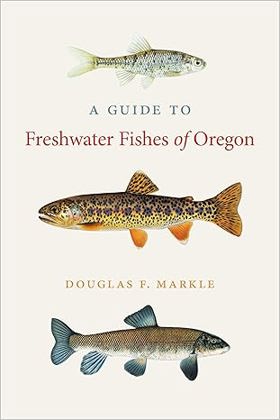
A Guide to Freshwater Fishes of Oregon is the first authoritative guide to the native and non-native freshwater fishes found in Oregon. It provides identification aids and images for most of the 137 known species and subspecies. Larval and juvenile stages and hybrids are also illustrated for some groups. Many groups of Oregon fishes are difficult to identify because of their size, diversity of forms, or lack of comprehensive study. In addition, ongoing debate remains about the number of species or subspecies in Oregon. This guide makes use of established naming conventions while highlighting apparent biological diversity. This compromise between accepted nomenclature and a system that reflects the true biodiversity of Oregon’s fishes reflects the delicate balance between scientific communication and the organism’s place in nature. Written by a scientist who has studied diversity in marine and freshwater fishes for decades, and beautifully illustrated with the author’s photographs and full-color drawings by renowned “fish artist” Joseph R. Tomelleri, A Guide to Freshwater Fishes of Oregon is as visually pleasing as it is scientifically rigorous. With annotated keys and detailed color illustrations, it will be useful to professional biologists, sportsmen and anglers, and anyone curious about the diversity of freshwater fishes of Oregon 140 pages : color illustrations, color maps ; 23 cm Desiderata
|
2016 |
|
A great revolutionary wave women and the vote in British Columbia by Lara Campbell 
"British Columbia is often overlooked in the national story of women's struggle for political equality. This book rights that wrong. A Great Revolutionary Wave follows the propaganda campaigns undertaken by suffrage organizations and traces the role of working-class women in the fight for political equality. It demonstrates the connections between provincial and British suffragists, and examines how racial exclusion and Indigenous dispossession shaped arguments and tactics for enfranchisement. Lara Campbell rethinks the complex legacy of suffrage and traces the successes and limitations of women's historical fight for political equality. That legacy remains relevant today as Canadians continue to grapple with the meaning of justice, inclusion, and equality."-- Provided by publisher 310 pages : illustrations ; 23 cm. Desiderata
|
2020 |
|
A great good country a guide to historic Moscow and Latah County, Idaho by Lillian Woodworth Otness, Latah County Historical Society (Publisher)
|
1983 |
|
A glance at British Columbia and Vancouver's Island in 1861 by Alfred J. Langley
Published in London in 1862, Alfred J. Langley’s pamphlet A Glance at British Columbia and Vancouver's Island in 1861 serves as a classic piece of colonial booster literature explicitly designed to attract British emigrants and investment to the Pacific Northwest. The text outlines the region's physical geography, favorable climate, and abundant natural resources, with a particular emphasis on the explosive wealth generated by the Cariboo Gold Rush and the availability of agricultural land. It captures a pivotal moment of transition as the British administration actively sought to shift the region away from the monopolistic fur-trade economy of the Hudson's Bay Company toward a permanent, settler-driven society. A keen insight drawn from the publication is how Langley’s promotional rhetoric conceptually maps the rugged frontier strictly through the lens of capitalist extraction, systematically minimizing the existing Indigenous presence in order to aggressively market the region as an "empty" wilderness ripe for immediate white settlement and industrial exploitation. 44 pages ; 19 cm ONLINE Circulation [ 1 ]
|
1862 |
|
A geographical sketch of that part of North America called Oregon by Hall J Kelley
Containing an account of the Indian title, the nature of a right of sovereignty, The first Discoveries, Climate and Seasons, Face of the Country and Mountains, Natural Divisions, Physical Appearance and Soil of Each, Forests and Vegtable prouductions, rivers, bays. 80 pages frontispiece (folded map) 22 cm ONLINE Circulation [ 1 ]
|
1833 |
|
A geographic dictionary of Washington by Henry Landes
Compiled in 1917 by State Geologist Henry Landes, A Geographic Dictionary of Washington served as an exhaustive, state-sponsored gazetteer meticulously cataloging the topography, towns, and waterways of the region. Published as an official bulletin of the Washington Geological Survey, the reference work standardized the elevations, physical locations, and nomenclatures of thousands of natural features and nascent pioneer settlements. By transforming the vast, rugged landscape into an organized, alphabetical ledger of geographic data, the text provided the essential bureaucratic infrastructure required for industrial resource extraction, railroad expansion, and systemic territorial administration. A keen insight drawn from the work is how supposedly objective geological catalogs functioned as absolute instruments of imperial consolidation; by codifying a standardized map that permanently overwrote traditional Indigenous spatial networks with federal and pioneer names, Landes's scientific inventory effectively cemented American administrative ownership over the physical landscape. 346, [3] pages, 1 unnumbered leaf of plates : charts, maps (1 folded) ; 23 cm. Non-circulating [ 1 ]
|
1917 |
|
A generous nature lives transformed by Oregon by Marcy Cottrell Houle 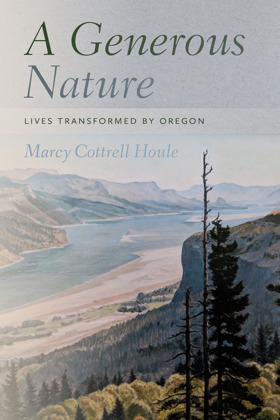
"A Generous Nature: Lives Transformed by Oregon offers profiles of twenty-one conservationists and activists who have made enduring contributions to the preservation of Oregon's wild and natural places and its high quality of life. These stories speak to their courage, foresight, and actions-at times against great odds-to save places, enact legislation, and motivate others to cherish and protect the places that make Oregon unique. Taken from personal interviews conducted by the author over a decade, these stories will help readers understand the histories of Oregon's exceptional places, innovative planning efforts, and laws. They provide insight into the principles and values that motivated individuals to preserve the beauty and natural resources of Oregon, craft legislation to further protect them, and educate others about their value. Places as diverse as the Columbia River Gorge Natural Scenic Area, the wild and scenic Sandy River, and Tryon Creek State Park are featured, along with background on critical laws such as the Beach Bill, Diack Act, and Senate Bill 100, and organizations such as SOLVE and the High Desert Partnership. A Generous Nature is a testament to the vision and hard work of people who loved Oregon and fought to protect its ecosystems and habitats for the benefit of all. These stories do more than educate. They will inspire readers and demonstrate that individually we can make a difference. They underscore that the natural wonders of our state should be guarded and not taken for granted. In these times of unsettled political polarization and divisiveness, A Generous Nature is a crucial reminder of our individual and collective responsibility to stand for and defend the places, ideals, and laws that make Oregon a progressive model for the rest of the nation"-- Provided by publisher 237 pages ; 23 cm Desiderata
|
2019 |
|
A forest of your own the Pacific Northwest handbook of ecological forestry by Kirk Hanson , Seth Zuckerman 
"A Forest of Your Own is based on the principle of ecological forestry-recognizing that a forest is not a "wood factory," but rather a whole system that has been entrusted to human stewards. In this comprehensive how-to manual, authors Kirk Hanson and Seth Zuckerman explore all aspects of forest ownership-everything from how to evaluate a piece of land before you buy it through creating-and implementing--long-term management plans that may include establishing and protecting new stands of trees, harvesting mushrooms and medicinal plants as well as wood, and protecting your forests far into the future"-- Provided by publisher 270 pages : illustrations (chiefly color) ; 23 cm Desiderata
|
2024 |
|
A force for nature Nancy Russell's fight to save the Columbia River Gorge by Bowen Blair , Oregon State University Press (Publisher) 
"By 1980, the Columbia Gorge's world-class vistas were on the brink of destruction. Every generation since 1907 had tried to protect the Gorge from development but had failed. A Force for Nature describes how Nancy Russell, a mother of four with no political, fundraising, or organizing experience, built a successful grassroots campaign to save the Gorge despite furious opposition, slashed tires, and threats to her life. Bowen Blair, former executive director of Friends of the Columbia Gorge and senior vice president of the Trust for Public Land, provides a behind-the-scenes account of how Russell thwarted factories and subdivisions proposed for the Gorge's most spectacular lands while overcoming intense resistance to federal legislation from both Oregon and Washington Governors, five of the six Gorge counties, 41,000 Gorge residents, and the Reagan administration. Blair provides previously unknown details on Russell's use of litigation, land acquisition, and legislation to achieve last-second, dramatic victories. He describes how Russell drove the purchase of the Gorge's most important land for public parks, and provided loans and bought property herself when the Trust for Public Land's strategy faltered. Blair recounts the National Scenic Area Act's fraught Congressional passage on the session's last day, and why President Reagan reversed his decision to veto the Act just hours before it would die. A Force for Nature should be read by anyone who cares about the Gorge or protecting nationally significant landscapes, or who will enjoy a suspenseful account of a woman overcoming daunting odds to save the place that she loved"-- Provided by publisher x, 306 pages, 8 unnumbered pages of plates : illustrations (some color), maps (some color), portraits (some color) ; 23 cm Desiderata
|
2022 |
|
A force for change Beatrice Morrow Cannady & the struggle for civil rights in Oregon, 1912-1936 by Kimberley Mangun 
"A Force for Change is the first full-length study of the life and work of one of Oregon's most dynamic civil rights activists, Beatrice Morrow Cannady." "Between 1912 and 1936, Cannady tirelessly promoted interracial goodwill and fought segregation and discrimination. She gave hundreds of lectures to high school and college students and shared her message with radio listeners across the Pacific Northwest. She was assistant editor, and later publisher, of The Advocate, Oregon's largest African American newspaper. Cannady was the first black woman to graduate from law school in Oregon, and the first to run for state representative. She held interracial teas in her home in Northeast Portland and protested repeated showings of the racist film The Birth of a Nation. And when the Ku Klux Klan swept into Oregon, she urged the governor to act quickly to protect black Oregonians' right to live and work without fear. Despite these accomplishments, Beatrice Cannady fell into obscurity when she left Oregon in the late 1930s." "A Force for Change illuminates Cannady's key role in advocating for better race relations in Oregon in the early decades of the twentieth century. It describes her encounters with the period's leading black artists, editors, politicians, and intellectuals, including W. E. B. Du Bois, Langston Hughes, Oscar De Priest, Roland Hayes, and James Weldon Johnson. It dispels the myth that African Americans played little part in Oregon's history and it enriches our understanding of the black experience in Oregon and the civil rights movement across the country."--BOOK JACKET [vii], 344 pages : illustrations, portraits ; 23 cm Desiderata
|
2010 |
|
A father and an island reflections on loss by O. Alan Weltzien 
As author Ann Ronald notes, "Simultaneously a paean to his father and a personal memoir about a changing landscape caught by a ‘rising tide of affluence,’ Alan Weltzein’s A Father and an Island:Reflections on Loss, echoes my own Pacific Northwest youth—the endless saltwater summers, the quirky behavior of a bookworm, the sweet sharp tang of blackberry cobbler, the fierce games of badminton, the beachcombing days of discovery, the blessedness of parents well loved. Anyone who’s grown up in and around Puget Sound will find familiar memories triggered on every delicious page. Some sweet,some nostalgic, some downright sad, they’re all here in this poignant remembrance of things past." Northwest author Mary Clearman Blew writes, "In this moving tribute to his father and his family’s home on a Puget Sound island,Alan Weltzein returns us to a time when summers were glorious and children played all day long on beaches that were still unexploited and unrestricted—a pleasure to read." Weltzien's memoir is an essential book for Northwest Letters. 288 pages ; 22 cm Non-circulating [ 1 ]
|
2008 |
|
A failed vision of empire the collapse of Manifest Destiny, 1845-1872 by Daniel J. Burge 
Since the early twentieth century, historians have traditionally defined manifest destiny as the belief that the United States was destined to expand from coast to coast. This generation of historians has posed manifest destiny as a unifying ideology of the nineteenth century, one that was popular and pervasive and ultimately fulfilled in the late 1840s when the United States acquired the Pacific Coast. However, the story of manifest destiny was never quite that simple. In A Failed Vision of Empire Daniel J. Burge examines the belief in manifest destiny over the nineteenth century by analyzing contested moments in the continental expansion of the United States, arguing that the ideology was ultimately unsuccessful. By examining speeches, plays, letters, diaries, newspapers, and other sources, Burge reveals how Americans debated the wisdom of expansion, challenged expansionists, and disagreed over what the boundaries of the United States should look like. A Failed Vision of Empire is the first work to capture the messy, complicated, and yet far more compelling story of manifest destiny’s failure, debunking in the process one of the most pervasive myths of modern American history. xvii, 246 pages : illustrations ; 24 cm Desiderata
|
2022 |