Catalog of British Columbiana and Pacific Northwest Americana
Encyclopedia Cascadia Catalog contains book titles of mostly non-fiction Pacific Northwest Coast of North America Titles (primarially British Columbia, Idaho, Oregon and Washington State) in an easy-to-understand title catalog. If you see a link with this badge ONLINE CIRC it means that there is an online institution that provides free access to that title. In some cases there may be more than one institution hosting the title digitally.
| Catalog Title | Published |
|---|---|
|
The man who ate too much the life of James Beard by John Birdsall 
"The definitive biography of America's best-known and least understood food personality, and the modern culinary landscape he shaped. After World War II, a newly affluent United States reached for its own gourmet culture, one at ease with the French international style of Escoffier, but also distinctly American. Enter James Beard, authority on cooking and eating, his larger-than-life presence and collection of whimsical bow ties synonymous with the nation's food for decades, even after his death in 1985. In the first biography of Beard in twenty-five years, acclaimed writer John Birdsall argues that Beard's struggles as a closeted gay man directly influenced his creation of an American cuisine. Starting in the 1920s, Beard escaped loneliness and banishment by traveling abroad to places where people ate for pleasure, not utility, and found acceptance at home by crafting an American ethos of food likewise built on passion and delight. Informed by never-before-tapped correspondence and lush with details of a golden age of home cooking, The Man Who Ate Too Much is a commanding portrait of a towering figure who still represents the best in food"-- Provided by publisher xiv, 449 pages, 16 unnumbered pages of plates : illustrations ; 25 cm CIRC [ 0 ]
|
2020 |
|
The making of the Northwest Forest Plan the wild science of saving old growth ecosystems by K. Norman Johnson , Jerry F. Franklin , Gordon H. Reeves , Debora L. Johnson (Contributor), Susan Jane M. Brown 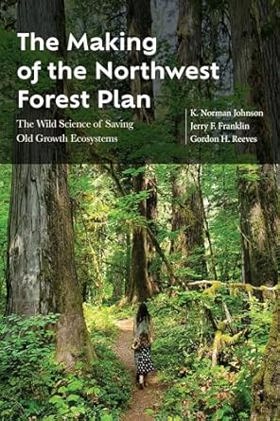
"Tree sitters. Logger protests. Dying timber towns. An iconic species on the brink. The Timber Wars consumed the Pacific Northwest in the late 1980s and early1990s and led political leaders to ask scientists for a solution. The Northwest Forest Plan was the result. For most of the twentieth century, the central theme of federal forest management in the Pacific Northwest had been logging old-growth forests to provide a sustained yield of timber. During the 1970s and 1980s, however, a series of studies by young scientists highlighted the destructive impact of that logging on northern spotted owls, salmon, and the old-growth ecosystem itself. Combining this new science with newly minted environmental laws like the Endangered Species Act, environmental activists obtained court injunctions to stop old-growth logging on federal land, setting off a titanic struggle in the Pacific Northwest to find a way to accommodate conservation imperatives as well as the logging that provided employment for tens of thousands of people. That effort involved years of controversy and debate, federal courts, five science assessments, Congress, and eventually the president of the United States. It led to creation of the Northwest Forest Plan, which sharply and abruptly shifted the primary goal of federal forestry toward conserving the species and ecosystems of old-growth forests. Scientists went from spectators to planners and guides, employing their latest scientific findings and expertise to create a forest plan for 20 million acres that would satisfy the courts. The largest upheaval in federal forest management in history had occurred, along with a precipitous decline in timber harvest, and there was no going back. In this book, three of the scientists who helped craft that change tell the story as they know it: the causes, development, adoption, and implementation of the Northwest Forest Plan. The book also incorporates personal reflections from the authors, short commentaries and histories from key figures- including spotted owl expert Eric Forsman-and experiences from managers who implemented the plan as best they could. Legal expert Susan Jane M. Brown helped interpret court cases and Debora Johnson turned spatial data into maps. The final chapters cover the plan's ongoing significance and recommendations for conserving forest and aquatic ecosystems in an era of megafires and climate change."-- Provided by publisher xv, 457 pages, 16 unnumbered pages of plates : illustrations (some color), maps (some color) ; 23 cm CIRC [ 0 ]
|
2023 |
|
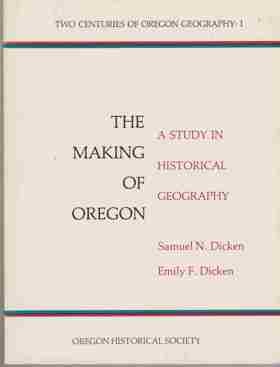
The making of Oregon a study in historical geography by Samuel N. Dicken, Emily F. Dicken
|
1979 |
|
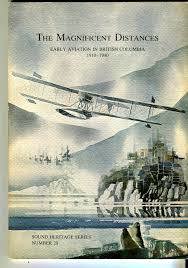
The Magnificent distances early aviation in British Columbia, 1910-1940 by Dennis Duffy, Carol Crane, David N. Parker, Paul Stoddart
|
1980 |
|
The Lummi Indians of northwest Washington by Bernhard J. Stern 
BASED ON THE AUTHOR'S ETHNOLOGICAL RESEARCH IN 1928-1929. INTERVIEWS WERE CONDUCTED WITH JOSEPH HILLAIRE, FRANK HILLAIRE, AUGUST MARTIN, WILLIAM McCLUSKEY AND MR. AND MRS. MATT PAUL 127, [1] p. front., plates, map. 26 cm. CIRC [ 1 ]
|
1934 |
|
The lumberman's frontier three centuries of land use, society, and change in America's forests by Thomas R. Cox 
With The Lumberman’s Frontier, Thomas Cox has reconstructed a groundbreaking history that stands apart from all previous studies of American forests. Forests were ubiquitous in early America, but it was only in selected areas that trees, rather than farming, ranching, or mining, attracted settlement. These areas constitute the lumberman’s frontier, which appeared first in northern New England in the seventeenth century, followed by upstate New York, the Allegheny Plateau, the upper Great Lakes states, the Gulf South, and the Far West. The forest frontiers generated capital and building materials important in the nation’s development, but they also left a legacy of environmental problems, class and urban-rural divisions, and economic frictions. The 1930s marked the end of the lumberman’s frontier, but these consequences continue to shape attitudes and policies toward forests, most notably the questions “Whose forests are they?” and “How and by whom should forests be used?” Drawing upon recent work in social and economic history, as well as a wealth of historical data on forest industries and individuals, The Lumberman’s Frontier neither glorifies economic development nor falls into the maw of ecological gloom-and-doom. It puts individual actors at center stage, allowing the points of view of the workers and lumbermen to emerge. xi, 531 pages : illustrations, maps ; 23 cm CIRC [ 0 ]
|
2010 |
|
The lost rescue parallel diaries of the advance party from the Lost Wagon Train of 1853 with a history of the lost wagon trains of 1845 and 1853 by Daniel Owen, Andrew S. McClure, Benjamin Franklin Owen 
In 1853, a wagon train camped in the Eastern Oregon desert, 130 miles from the Oregon Trail. Uncertain of their whereabouts and in desperate need of supplies, they sent a scouting party over the mountains for help. This is the true story of Elijah Elliott’s “Advance Party.” Becoming lost in the Three Sisters Wilderness, they tell their own story of starvation and loyalty through two parallel diaries. Known as the Lost Rescue, the scouting party was the first known group of Euro-Americans to cross the Cascade Mountains through the Three Sisters Wilderness Area.The Lost Rescue contains a complete history of the Meek Cutoff. In 1845, while facing threats from the Walla Walla and Cayuse Nations, Stephen Meek led 1,050 men, women and children into the wilderness, seeking a short-cut across the Eastern Oregon desert. Poorly supplied and facing a mysterious illness, they forged a new path through the desert. In 1853, Elijah Elliott attempted to lead a large group on the same cutoff. After a costly wrong turn, Elliott found himself at the mercy of an angry mob. As they journeyed west, the starving train made their own way across the desert, facing hunger and intense thirst. In an act of desperation, the emigrants set their animals free, and followed them to the distant waters of the Deschutes River. xiii, 236 pages : illustrated, maps, portraits ; 23 cm CIRC [ 0 ]
|
2015 |
|
The long journey of the Nez Perce a battle history from Cottonwood to the Bear Paw by Kevin Carson 
"In 1877, the U.S. Government opened the Nez Perce lands in Oregon to settlers and ordered the tribe to move to a reservation in Idaho Territory. Although reluctant to leave their homeland, the Nez Perce began the long trek eastward. A small band of young warriors vented their frustration, however, in two days of deadly attacks on settlements along the Salmon River. Realizing that the U.S. response would be overwhelming--particularly in light of Custer's defeat the year before--the Nez Perce leaders, including Chiefs Joseph, Looking Glass, and White Bird, prepared their people for war. A U.S. Army battalion led by Civil War general Oliver O. Howard along with several other coordinated army units began pursuit in an effort to subdue the Nez Perce and forceably move them to the reservation. The Nez Perce resolved to escape to freedom in Canada. Using their intimate knowledge of the land and their native Appaloosa horses skillfully, the Nez Perce were able to successfully check and elude the much larger American force for more than three months as they wound their way across the Rocky Mountains, through the newly established Yellowstone National Park, and into Montana. The war finally ended when the exhausted Indian--men, women, and children--were surrounded in the Bear Paw Mountains. Looking Glass was shot dead, and at this point, Chief Joseph relinquished and gave his famous address of surrender to General Howard. While most of the Nez Perce ended up on a reservation, the band led by White Bird was able to make their way to Canada and freedom. The Nez Perce War is one of the most important and emotional campaigns of the Indian Wars. It essentially closed an era in American history, and the amount of time, money, and troops required to subdue the Nez Perce brought the plight of American Indians and the reservation system to the front pages of newspapers around the world. In The Long Journey of the Nez Perce: A Battle History from Cottonwood to Bear Paw, former U.S. Army engineering officer Kevin Carson brings his intimate knowledge of the territory crossed by the Nez Perce along with his skill as a cartographer to reconstruct in detail the battles and skirmishes along the entire route of the conflict"--Publisher's website xvii, [1], 293 pages : illustrations, maps, portraits ; 25 cm CIRC [ 0 ]
|
2011 |
|
The Long Beach Peninsula where the Columbia meets the Pacific by Donella J. Lucero, Nancy L. Hobbs 
Jutting northward from the mouth of the Columbia River, the Long Beach Peninsula defines Washington's southwestern coastal geography. The picturesque blend of beach and forest along the river, Willapa Bay, and the Pacific Ocean was home to the Chinook Indians who first settled this region. European and American trade came to this area in the 18th century, opening the way for Lewis and Clark to explore and establish a land route to the Pacific. The region prospered because of its diverse natural resources and thriving fur trade. Today, a vibrant tourist industry fuels the Peninsula's continuing development. 159 pages : illustrations, map ; 25 cm. CIRC [ 1 ]
|
2004 |
|
The Lone Ranger and Tonto fistfight in heaven by Sherman Alexie 
In this darkly comic short story collection, Sherman Alexie, a Spokane/Coeur d'Alene Indian, brilliantly weaves memory, fantasy, and stark realism to paint a complex, grimly ironic portrait of life in and around the Spokane Indian Reservation. These twenty-two interlinked tales are narrated by characters raised on humiliation and government-issue cheese, and yet are filled with passion and affection, myth and dream. There is Victor, who as a nine-year-old crawled between his unconscious parents hoping that the alcohol seeping through their skins might help him sleep, Thomas Builds-the-Fire, who tells his stories long after people stop listening, and Jimmy Many Horses, dying of cancer, who writes letters on stationary that reads "From the Death Bed of Jimmy Many Horses III," even though he actually writes then on his kitchen table. Against a backdrop of alcohol, car accidents, laughter, and basketball, Alexie depicts the distances between Indians and whites, reservation Indians and urban Indians, men and women, and mostly poetically between modern Indians and the traditions of the past x, [2], 223 pages ; 24 cm CIRC [ 0 ]
|
1993 |
|
The log school-house on the Columbia a tale of the pioneers of the great Northwest by Hezekiah Butterworth
|
1890 |
|
The Little Lucky a family geography by Gail Wells 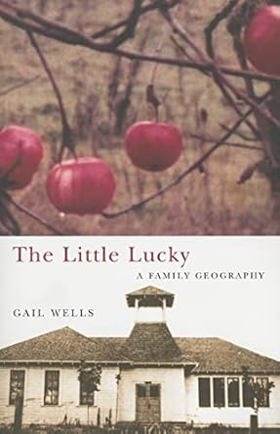
"When you live in an old house, the remodeling and rehabilitating never end. I guess the same is true when you belong to a family." A tumble-down schoolhouse and a loving, troubled family are at the heart of The Little Lucky, a reflection of the many ways in which a place can shape and be shaped by family. In discerning and nimble prose, Gail Wells tells the story of how she and her husband moved from their tiny Seattle apartment to her grandfather’s house, formerly an abandoned schoolhouse, near the Little Luckiamute River of western Oregon. They work earnestly to transform the slantwise structure into a home and discover both joy and frustration along the way. With wry clarity, Wells reveals the tangled dream of living in rural Oregon — a chronically flooded basement, mouse skeletons inside the bathroom walls, and the relentless struggle to fix the unfixable — all while raising a family and salvaging a place alive with memories. Amid the angst of tearing down and building up, Wells discovers something unexpected: a sense of honorable struggle and the grace of getting what you need rather than what you want. These stories reveal an intimate geography and the dynamic between family and a homeplace. And these are also stories of acceptance, "of doing what you can and letting the rest go; of learning what is precious and what is expendable; of the surprising solace of surrendering to the possible; and of gratitude for incredible good luck." 143 pages ; 22 cm CIRC [ 0 ]
|
2007 |
|
The light on the island by Helene Glidden
|
1951 |
|
The lifeline of the Oregon Country the Fraser-Columbia brigade system, 1811-47 by James R. Gibson 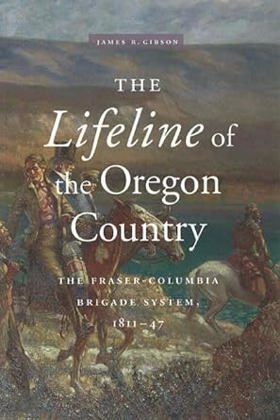
"Furs is what brings us," remarked an early trader in the Oregon Country. He added, however, that "the difficulty of getting the necessary supplies will continue to operate against it," located as it was "on the worst side of the Rocky Mountains." Fortunately, the discovery in 1805 by Lewis and Clark that the Columbia River was navigable by canoe or boat to the Pacific led to the logistical linking of the New Caledonia and Columbia Districts by means of the Fraser-Columbia brigade system xi, 292 pages : maps ; 24 cm CIRC [ 1 ]
|
1997 |
|
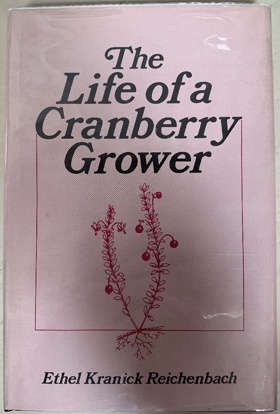
The life of a cranberry grower by Ethel Kranick Reichenbach
|
1981 |
|
The Library of Oregon State University its origins, management, and growth : a centennial history by William Hugh Carlson, Oregon State University
This history is, as will be evident throughout, a labor of love. While the treatment is obviously sympathetic, I believe and hope that it is nevertheless objective. -Author 94 pages ; 28 cm ONLINE CIRC [ 1 ]
|
1966 |
|
The Lewis and Clark trail yesterday and today by William E. Hill 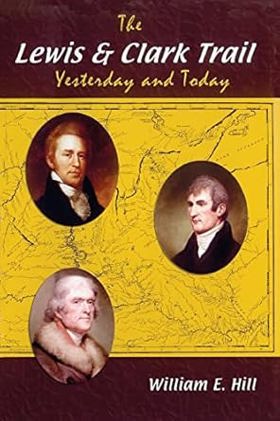
Veteran author William Hill commemorates the 200th anniversary of the Lewis and Clark expedition with this guide to the history and the route of the Corps of Discovery. Journals, maps, paintings and photographs serve to vividly contrast the U.S. that Lewis and Clark ventured through to the land that the modern adventurere will pass through when following this guidebook. xxiii, 288 pages : illustrations, maps ; 23 cm CIRC [ 0 ]
|
2004 |
|
The letters of Narcissa Whitman by Narcissa Prentiss Whitman 
Authored by pioneer missionary Narcissa Prentiss Whitman, The Letters of Narcissa Whitman compiles her poignant, firsthand correspondence sent to family and friends in New York while living among the Cayuse people at the Waiilatpu Mission in southeastern Washington from 1836 until her tragic death in 1847. The letters document the staggering physical isolation, cultural clashes, and domestic struggles of being among the first white American women to cross the Rocky Mountains and settle in the Pacific Northwest. Through her eloquent and deeply personal accounts, the text offers an unvarnished window into the mindset of evangelical expansionism and the heavy psychological toll of frontier life. A keen insight drawn from the work is how domestic correspondence functioned as an ideological tether for women on the religious frontier; by meticulously chronicling her daily efforts to transplant Victorian domesticity into an Indigenous landscape, Whitman's letters reveal how female missionaries attempted to domesticate foreign geopolitical spaces through the sheer force of written narrative and cultural replication. 266 pages, 1 unnumbered leaf of plates : illustrations, portrait ; 24 cm CIRC [ 0 ]
|
1996 |
|
The letters and journals of Simon Fraser, 1806-1808 by W. Kaye Lamb
|
1966 |
|
The Lemhi Sacajawea's people by Brigham D. Madsen 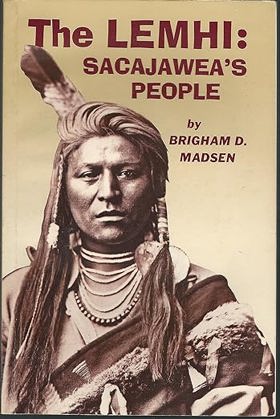
Native American historian Brigham D. Madsen tells the story of the Mountain Shoshoni culture from the fateful day in 1805 when Chief Ca-me-ah-wait met Lewis and Clark to 1907 when the Lemhi moved to the Fort Hall Reservation. 214 pages : illustrations, maps ; 23 cm CIRC [ 1 ]
|
2000 |
|
The left hand of Eden meditations on nature and human nature by William Ashworth 
The Left Hand of Eden contributes to the growing, often contentious debate on wilderness and forest practices, but does so from an unusual perspective - that of an environmentalist advocating abandonment of wilderness preservation. Ashworth argues that wilderness preservation is a form of separation from the land and, as such, is as harmful to nature as logging or mining. Treating nature as something "other"--Whether to preserve it or destroy it - creates a false dichotomy, from which all modern environmental battles arise: use versus preservation, civilization versus wilderness. Ashworth presents his ideas in a series of linked nature essays. In these writings he shows that proper care for the land requires not just use or reverence, but use with reverence xiv, 194 pages ; 22 cm CIRC [ 0 ]
|
1999 |
|
The last wilderness by Murray Morgan 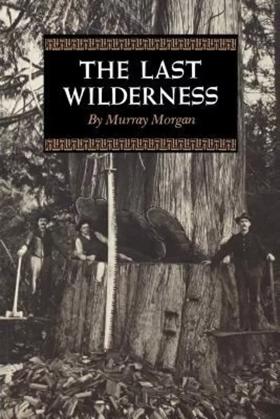
First published in 1955, this book tells the lively and entertaining story of the Olympic Peninsula, "the fist of land thrust north between Puget Sound and the Pacific Ocean, a wilderness area of six thousand square miles, as large as the state of Massachusetts, more rugged than the Rockies, its lowlands blanketed by a cool jungle of fir and pine and cedar, its peaks bearing hundreds of miles of living ice that gave rise to swift rivers alive with giant salmon; the first land in the Pacific Northwest to be reported by explorers, the last to be mapped--the last wilderness." Murray Morgan has recorded the epic adventures of the pioneers of this remote region in this rousing and humor-filled saga, one that should capture the imagination of Americans everywhere.--Publisher's description xi, 275 pages ; 20 cm. CIRC [ 1 ]
|
1976 |
|
The last lookout on Dunn Peak fire spotting in Idaho's St. Joe National Forest by Nancy Sule Hammond 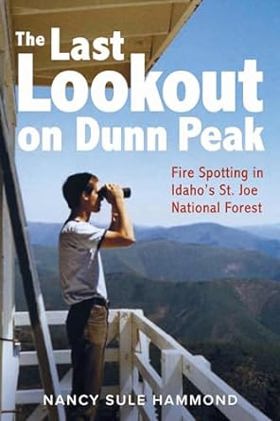
"Don and Nancy Hammond spent two seasons spotting fires in Idaho's St. Joe National Forest. Interspersing personal stories, history, and details of the work, Nancy journeys back to that exciting time"-- Provided by publisher xi, 271 pages illustrations (some color), maps ; 23 cm CIRC [ 0 ]
|
2023 |
|
The last logging show a forestry family at the end of an era by Aaron Williams 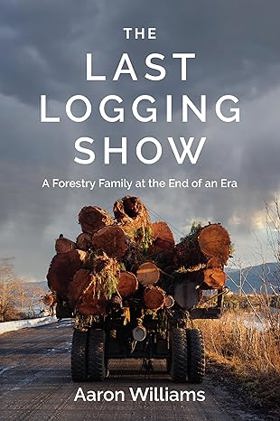
A third-generation Pacific Northwest logger returns to the forests of Haida Gwaii, to witness a way of life in the grip of change. By the time Aaron Williams began learning how to fall a tree, his family had been making clear cuts on BC hillsides for nearly a century. During his father’s generation, the industry started to crumble, and by the time Williams arrived, he knew his future lay elsewhere. But his father continued in the trade, his work taking him into the forests of Haida Gwaii. There, Williams follows him into a season at Collison Point, where the loggers are increasingly unwelcome visitors to the ancient forests. The Last Logging Show captures the spectacular setting of Haida Gwaii and the people who call it home. It unravels the lives and dreams of those who log the forests for a living, who have coexisted with the Haida for generations—but while one way of life is in the twilight of existence, the other is being reborn. Thoughtful and compelling, this is a story of connection, community, and the force of fundamental change. 1 online resource (xv, 207 pages) : illustrations, map CIRC [ 0 ]
|
2024 |
|
The last house at Bridge River the archaeology of an aboriginal household in British Columbia during the fur trade period by Anna Marie Prentiss 
Offers a comprehensive archaeological study of a single-house floor and roof deposit dated to approximately 1835-1858 C.E. Although the Fur Trade period of the nineteenth century was a time of significant change for aboriginal peoples in the Pacific Northwest, it is a period that is poorly understood. These studies offer new insights. xiv, 267 pages : illustrations, maps ; 27 cm CIRC [ 0 ]
|
2017 |