Catalog of British Columbiana and Pacific Northwest Americana
Encyclopedia Cascadia Catalog contains book titles of mostly non-fiction Pacific Northwest Coast of North America Titles (primarially British Columbia, Idaho, Oregon and Washington State) in an easy-to-understand title catalog. If you see a link with this badge ONLINE CIRC it means that there is an online institution that provides free access to that title. In some cases there may be more than one institution hosting the title digitally.
| Catalog Title | Published |
|---|---|
|
A historical, descriptive and commercial directory of Owyhee County, Idaho, January 1898 Silver City, De Lamar, and Guffey by Press of The Owyhee Avalanche 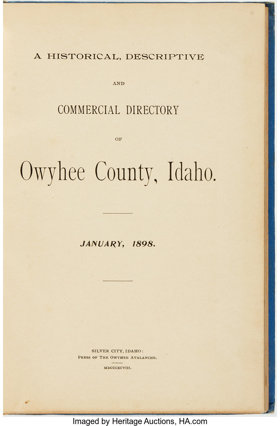
Published in 1898 by the Press of The Owyhee Avalanche, this volume serves as both a foundational historical record and a practical commercial guide to Owyhee County, Idaho, during its late 19th-century resource boom. The text provides detailed accounts of the region's geography, emerging rail infrastructure, and lucrative mining operations, while also cataloging the local businesses, civic leaders, and pioneer residents who populated towns like Silver City, De Lamar, and Guffey. A keen insight drawn from the publication is how frontier newspapers actively functioned as regional boosters, utilizing these exhaustively detailed directories to legitimize rugged, isolated mining camps into permanent, investment-worthy municipalities by projecting a highly organized image of commerce and rapid modernization. 154 pages : illustrations, portraits ; 24 cm ONLINE CIRC [ 1 ]
|
1898 |
|
Pioneer history of Coos and Curry Counties, Or. heroic deeds and thrilling adventures of the early settlers by Orvil Ovando Dodge, Pioneer and Historical Association of Coos County, Or (Issuing body) 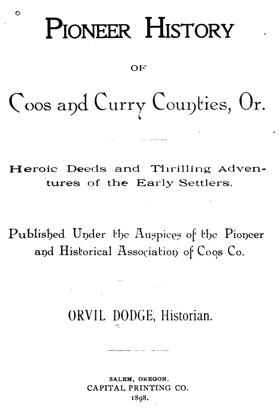
Published in 1898 by Orvil Ovando Dodge, this historical volume chronicles the early white settlement, resource extraction, and violent conflicts that defined the foundational pioneer era of Oregon's rugged southern coast. A keen insight drawn from the text is how its highly romanticized framing of the brutal Rogue River Wars as "heroic deeds" demonstrates the active mythmaking required by early settlers to morally justify the violent displacement of indigenous populations in pursuit of timber and coastal gold. The narrative details the region's extreme geographic isolation, explaining how the impenetrable Coast Range forced these early communities to develop fiercely independent maritime and logging economies rather than relying on overland trails. Furthermore, the book serves as a vital genealogical archive by preserving extensive biographical sketches and firsthand accounts of the resilient prospectors, sailors, and civic leaders who built Coos and Curry counties. 4 preliminary leaves, 5-468, 103 pages, 27 unnumbered leaves of plates : frontispiece, illustrations, portraits ; 22 cm CIRC [ 0 ]
|
1898 |
|
The correspondence and journals of Captain Nathaniel J. Wyeth, 1831-6 a record of two expeditions for the occupation of the Oregon Country, with maps, introduction and index by F.G. Young, Nathaniel J. Wyeth 
Describes the famous Battle of Pierre's Hole of that year between the Blackfeet and the trappers and their Indian allies (including the Flatheads). The second section covers Wyeth's observations camping with a Flathead camp during April and May 1833 xix, 262 pages, 3 unnumbered leaves of plates (2 folded) : maps ; 25 cm ONLINE CIRC [ 1 ]
|
1899 |
|
An illustrated history of the state of Idaho containing a history of the state of Idaho from the earliest period of its discovery to the present time, together with glimpses of its auspicious future ; illustrations ... and biographical mention of many pioneers and prominent citizens of to-day .. by Lewis Publishing Company (Publisher)
Published in 1899 by the Lewis Publishing Company, this expansive volume offers a comprehensive chronicle of Idaho’s evolution from its earliest European exploration and volatile territorial days through its first crucial decade of statehood. A keen insight drawn from the text is how its enthusiastic, progress-driven narrative actively attempts to rebrand Idaho—deliberately transitioning its public reputation from a transient, lawless mining frontier into a stable, unified agricultural and civic powerhouse ready for outside investment. To reinforce this vision of civilized permanence, the text devotes substantial space to extensive biographical sketches of the prominent pioneers, merchants, and ranchers who built the state's foundational institutions. Ultimately, the work stands as both a vital genealogical archive and a fascinating artifact of Gilded Age boosterism designed to cement a cohesive identity for the newly formed state. xv, 726 pages, 105 unnumbered leaves of plates : frontispiece (portrait) illustrations, portraits ; 30 cm ONLINE CIRC [ 1 ]
|
1899 |
|
A history of the state of Washington by Lancaster Pollard
Published in 1937, Lancaster Pollard's A History of the State of Washington is a comprehensive, multi-volume chronicle that documents the Pacific Northwest's rapid transformation from an isolated frontier territory into an established, industrialized state. The text meticulously details the economic and political forces that shaped the region, covering the early fur trade, pioneer settlements, complex Native American relations, and explosive urban growth. A keen insight drawn from the work is how the state's extreme geographic isolation from the eastern United States forged a distinct, self-reliant "area-kinship" among early settlers, driving them to rapidly develop robust, localized economies centered on timber and agriculture. Additionally, the latter half of the work serves as an invaluable genealogical archive by preserving hundreds of detailed biographical sketches of the prominent pioneers and civic leaders who built Washington's foundational communities. ONLINE CIRC [ 1 ]
|
1900 |
|
History of Custer County, Idaho .. by Jesse R. Black
Published in 1900, Jesse R. Black's History of Custer County, Idaho provides a concise chronicle of the region's establishment in 1880 and its rapid transition from untamed wilderness to a bustling frontier hub. The narrative details the volatile boom-and-bust cycles of the gold and silver rushes that birthed high-altitude mining towns like Bonanza and Custer, while also documenting the severe challenges faced by early settlers. A keen insight drawn from the text is how the area's violent early history—marked by profound geographic isolation, harsh mountain elements, and bloody conflicts with Native American tribes—forged a fiercely resilient pioneer culture built entirely around rapid resource extraction. Ultimately, this brief volume serves as a vital historical snapshot of the fleeting but transformative mining boom that defined central Idaho's rugged pioneer era. 1 preliminary leaf, 21 pages, 1 leaf 20 cm ONLINE CIRC [ 1 ]
|
1900 |
|
The Thompson Indians of British Columbia by James Alexander Teit, Franz Boas 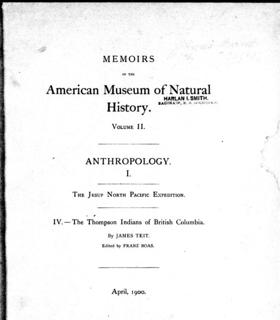
The following description of the Thompson Indians is based on two manuscripts prepared by Mr. James Teit, - the one a description of the Upper Thompson Indians, written in 1895; the other a description of the Lower Thompson Indians, written in 1897 as a result of work done by Mr. Teit for the Jesup North Pacific Expedition. pages 163-392. illustrations (including map) plates XIV-XX. 36 cm ONLINE CIRC [ 1 ]
|
1900 |
|
Life of General Isaac I. Stevens by Hazard Stevens
Written by his son Hazard Stevens, this extensive biography chronicles the life of General Isaac I. Stevens, focusing on his tenure as the first governor of Washington Territory and his subsequent military service during the Civil War. The narrative details his ambitious efforts to survey the northern transcontinental railroad route, his aggressive treaty negotiations with Pacific Northwest Native American tribes, and his eventual death at the Battle of Chantilly. A keen insight drawn from the text is how its deeply defensive, hagiographic tone—particularly regarding Stevens's highly controversial use of martial law during the Puget Sound War—demonstrates how 19th-century biographers actively sanitized the harsh realities of Manifest Destiny to cement a heroic family legacy. Ultimately, the work remains a vital, albeit heavily biased, historical record of the political and military foundations of the Pacific Northwest. Isaac Ingalls Stevens (March 25, 1818 - September 1, 1862) was the first governor of Washington Territory, a United States Congressman, and a major general in the Union Army during the American Civil War until his death at the Battle of Chantilly. 2 volumes (xix., 480, [13] leaves of plates; xx, 530 pages, [44] leaves of plates) : illustrations, maps, plans, portraits ; 24 cm ONLINE CIRC [ 2 ] CIRC [ 2 ]
|
1901 |
|
An illustrated history of Walla Walla County, state of Washington by W. D. Lyman
Published in 1901, W. D. Lyman’s comprehensive volume chronicles the pioneer settlement, agricultural expansion, and civic maturation of Walla Walla County in southeastern Washington. A keen insight drawn from the text is how Walla Walla's strategic evolution from a chaotic gold-rush supply post into a highly stable, wheat-producing powerhouse allowed it to economically and politically dominate the early Washington Territory long before the rise of the Puget Sound cities. The narrative meticulously details this transformation alongside the complex pioneer interactions with Native American tribes, including the profound regional impact of the Whitman Massacre. Like similar historical works of its era, the book ultimately serves as a vital genealogical archive by preserving hundreds of detailed biographical sketches of the resilient farmers, merchants, and civic leaders who built the region. ONLINE CIRC [ 1 ]
|
1901 |
|
Kathlamet texts by Franz Boas
Published in 1901 by pioneering anthropologist Franz Boas, Kathlamet Texts is a foundational ethnographic compilation of the myths, legends, and cultural narratives of the Kathlamet Chinookan people of the lower Columbia River. Working closely with Charles Cultee, one of the final fluent speakers of the nearly extinct language, Boas meticulously recorded these oral traditions using rigorous phonetic transcriptions alongside literal English translations. A keen insight drawn from the work is how the complex syntax and untranslatable idioms preserved in these bilingual texts vividly demonstrate Boas's foundational theory of linguistic relativity, proving that the nuanced Kathlamet worldview was inextricably bound to the specific structure of their language. Consequently, the book stands not merely as a collection of folklore, but as a critical act of linguistic salvage that permanently secured the grammatical and cultural heritage of a vanishing Pacific Northwest civilization. 261 pages : portraits ; 30 cm ONLINE CIRC [ 1 ]
|
1901 |
|
History and folklore of the Cowichan Indians by Martha Douglas Harris, Margaret C. Maclure (Illustrator) 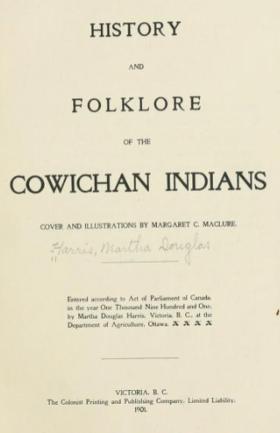
In the late 1800s, Martha Douglas Harris, the daughter of the former governor of British Columbia, observed that "civilization" was destroying the "native dignity and wholesome life" of the Cowichan tribe of Vancouver, "substituting much evil for the real good found in their former customs and character." She herself was part Cree Indian-a fact that her father was none too eager to make public. But he and her mother had long since passed away, and so she wrote this book of 20 folktales in 1901, partly to honor her Native American heritage 89, [1] pages frontispiece, illustrations 21 cm ONLINE CIRC [ 1 ]
|
1901 |
|
The Formation and Administration of the Provisional Government of Oregon by H. W. Scott
Harvey W. Scott's historical account details the 1843 establishment of Oregon's Provisional Government, chronicling how American pioneers in the Willamette Valley organically created their own civil authority prior to formal United States jurisdiction. A keen insight drawn from the text is that this localized governance was not born of political rebellion against the British Hudson's Bay Company, but rather out of the pragmatic necessity to manage land disputes, probate laws, and frontier security in a stateless vacuum. The narrative meticulously outlines the legislative and administrative milestones of this temporary state, highlighting the early settlers' inherent capacity for democratic organization. Ultimately, Scott demonstrates how this impromptu legal framework effectively secured American civilian control over the disputed Pacific Northwest, seamlessly paving the way for eventual territorial status without descending into frontier anarchy. 25 pages ONLINE CIRC [ 1 ]
|
1901 |
|
An Illustrated history of Baker, Grant, Malheur and Harney counties, with a brief outline of the early history of the state of Oregon by Western Historical Publishing Company
Published in 1902 by the Western Historical Publishing Company, this comprehensive volume documents the early settlement and economic foundation of eastern Oregon's vast frontier. Following a brief overview of the state's early years, the text provides detailed local histories and extensive biographical sketches of the pioneers who built communities across Baker, Grant, Malheur, and Harney counties. A keen insight drawn from the narrative is how the region's harsh, arid geography necessitated an economy based heavily on cattle ranching and mining, forging a rugged cultural identity that sharply contrasted with the agrarian settlements of the Willamette Valley. Ultimately, the book serves as both a valuable genealogical resource for these four counties and a historical testament to the sheer endurance required to establish industry in the high desert. 788 pages, 70 unnumbered leaves of plates : illustrations, portraits ONLINE CIRC [ 1 ]
|
1902 |
|
Oregon literature by John B. Horner
Oregon has produced more genuine literature during the short period of her history, extending back only fifty years, than all the thirteen American colonies wrote in a century and half. Notwithstanding this fact, she is the oldest state in the Union that has not collated the best things written by her sons and daughters. This task has been delayed merely for want of time and inclination. No one did it, so I undertook it 253, [2] pages, 36 unnumbered leaves of plates : illustrations, portraits ; 21 cm ONLINE CIRC [ 1 ]
|
1902 |
|
An illustrated history of north Idaho : embracing Nez Perces, Idaho, Latah, Kootenai and Shoshone counties, state of Idaho by Western Historical Publishing Company
Published in 1903, this extensive volume chronicles the pioneer settlement, Native American history, and rapid industrial development across the rugged panhandle region of northern Idaho. A keen insight drawn from the text is how the area's extreme geographic isolation from southern Idaho forced these northern counties to develop a distinct, fiercely independent culture driven by the volatile boom-and-bust cycles of the Coeur d'Alene mining districts and vast timber operations. The book details the civic and economic growth within Nez Perces, Idaho, Latah, Kootenai, and Shoshone counties, documenting their transition from frontier wilderness to established industrial hubs. Like similar regional histories of its era, the narrative ultimately serves as a vital genealogical resource by preserving hundreds of biographical sketches of the prospectors, farmers, and civic leaders who built the region. xxviii, 1238 pages, [113] leaves of plates : illustrations, portraits ; 31 cm ONLINE CIRC [ 1 ]
|
1903 |
|
History vs. the Whitman saved Oregon story : three essays towards a true history of the acquisition of the old Oregon Territory by William Isaac Marshall
Published in the early 20th century, William Isaac Marshall’s collection of essays meticulously dismantles the highly romanticized myth that missionary Marcus Whitman single-handedly saved the Oregon Territory from British control through a heroic cross-country winter ride in 1842. Relying heavily on primary source documents, Marshall proves that the United States government was already fully committed to retaining Oregon, and that Whitman’s arduous journey was actually undertaken to prevent the closure of his own struggling mission by its governing board. A keen insight drawn from the text is how the enduring popularity of the "Whitman saved Oregon" legend exposes the vulnerability of historical narratives to religious and nationalist propaganda, demonstrating how early writers eagerly embraced a fabricated, providential savior figure to retroactively justify America's westward expansion. By prioritizing rigorous archival evidence over emotional storytelling, Marshall's work fundamentally corrected the historical record and set a new standard for historiography regarding the acquisition of the Pacific Northwest. 236 pages ; 24 cm ONLINE CIRC [ 1 ]
|
1904 |
|
An illustrated history of Stevens, Ferry, Okanogan and Chelan counties, state of Washington by Western Historical Publishing Company
Published in 1904 by the Western Historical Publishing Company, this comprehensive volume chronicles the pioneer settlement, civic foundation, and industrial emergence of four rugged counties in northern Washington state. A keen insight drawn from the text is how the sudden, controversial opening of former Native American reservation lands (such as the Colville Reservation) to white prospectors triggered explosive mining booms, acting as the primary catalyst that rapidly transformed this isolated northern frontier into permanent communities. The narrative details the distinct economic drivers across the region, from the rich mineral districts of Ferry and Stevens to the vast cattle ranges and early orchard irrigation projects of Okanogan and Chelan counties. Furthermore, the book preserves the area's pioneer legacy by featuring hundreds of detailed biographical sketches of the resilient prospectors, ranchers, and civic leaders who built these foundational settlements. xxii, 867 pages, 43 unnumbered leaves of plates : illustrations, portraits ; 31 cm ONLINE CIRC [ 1 ]
|
1904 |
|
An illustrated history of the Big Bend country, embracing Lincoln, Douglas, Adams, and Franklin counties, state of Washington by Richard F. Steele , Arthur P. Rose 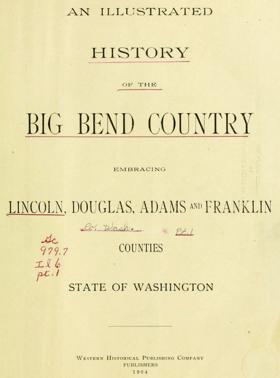
Published in 1904, this comprehensive volume documents the pioneer settlement, agricultural development, and civic formation of the Columbia River's Big Bend region in eastern Washington. A keen insight drawn from the text is how the seemingly barren, arid landscape was rapidly transformed into a highly lucrative wheat-producing powerhouse through the advent of dry farming techniques and the critical expansion of railroad infrastructure. The authors chronicle this dramatic economic and cultural shift across Lincoln, Douglas, Adams, and Franklin counties, detailing their transition from harsh frontier to thriving agricultural communities. Furthermore, the book serves as an invaluable genealogical archive by providing extensive biographical sketches of the resilient early settlers who drove this remarkable regional transformation. xxiv, 1024 pages : plates, portraits ; 31 cm ONLINE CIRC [ 2 ]
|
1904 |
|
Pioneer reminiscences of Puget Sound : the tragedy of Leschi by Ezra Meeker
"Pioneer Reminiscences of Puget Sound: The Tragedy of Leschi" is a historical account written by Ezra Meeker, an American pioneer who settled in the Puget Sound region of Washington state in the mid-1800s. The book focuses on the tragic story of Chief Leschi, a prominent leader of the Nisqually tribe who was accused of murder and subsequently executed by the territorial government in 1858. Meeker provides a firsthand account of the events leading up to Leschi's trial and execution, as well as his own personal experiences living among the Native American tribes of the region. The book offers a unique perspective on the early history of the Pacific Northwest, shedding light on the complex relationships between settlers and Native Americans during a tumultuous period of American expansion. xx, 554 pages, 26 unnumbered leaves of plates (2 folded) illustrations 24 cm ONLINE CIRC [ 1 ]
|
1905 |
|
Early Oregon : jottings of personal recollections of a pioneer of 1850 by George E. Cole
Authored by early pioneer and future territorial governor George E. Cole, Early Oregon: Jottings of Personal Recollections of a Pioneer of 1850 provides a firsthand memoir of the grueling overland migration and the nascent civic formation of the Pacific Northwest. The book chronicles Cole's arduous journey across the plains and his subsequent immersion into the turbulent economic, social, and political landscape of the early Oregon Territory. Through unvarnished personal anecdotes and biographical sketches of prominent fellow settlers, the text offers a valuable primary source lens detailing the region's rapid transition from a rugged frontier to an organized society. A keen insight drawn from the work is how the shared trauma and logistical hurdles of overland migration forged enduring, tight-knit political networks; by relying on personal alliances cemented during the grueling 1850 crossing, early pioneers successfully translated their trail-forged bonds directly into the foundational legislative and economic power structures of the new territory. 95 pages : frontispiece (portrait) ; 20 cm ONLINE CIRC [ 1 ]
|
1905 |
|
An illustrated history of central Oregon, embracing Wasco, Sherman, Gilliam, Wheeler, Crook, Lake and Klamath counties, state of Oregon by F. A. Shaver, Arthur P. Rose,Richard F. Steele,A. E. Adams, Western historical publishing company
Published in 1905 by the Western Historical Publishing Company, this extensive volume chronicles the early pioneer settlement and economic development of central and south-central Oregon. A keen insight drawn from the text is how the region's severe geographic isolation—cut off from the coast by the Cascade Mountains and defined by an expansive, arid high desert—forced early settlers to build an exceptionally self-reliant culture that depended heavily on massive livestock operations and fierce competition for scarce water rights. The authors provide comprehensive local histories for Wasco, Sherman, Gilliam, Wheeler, Crook, Lake, and Klamath counties, documenting their gradual transition from rugged frontier outposts into established civic and agricultural centers. Like other regional histories of its era, the narrative ultimately serves as a vital genealogical archive by preserving hundreds of detailed biographical sketches of the resilient ranchers, merchants, and civic leaders who built these foundational communities. xxx, 1097 pages : plates, portraits ; 31 cm ONLINE CIRC [ 1 ]
|
1905 |
|
The Selkirk Range by A. O. Wheeler, Canada Department of the Interior
An "account of a topographical survey of a portion of the Selkirk Mountains adjacent to the line of the Canadian Pacific Railway ... accompanied by a brief review of travel and exploration, of previous surveys and of mountaineering in these regions." xvii, 459 pages, 92 unnumbered leaves of plates : illustrations ; 25 cm + 1 case ([14] folded leaves of plates : illustrations, maps ; 25 cm) ONLINE CIRC [ 1 ]
|
1905 |
|
Cathlamet on the Columbia Recollections of the indian people and short stories of early pioneer days in the valley of the lower Columbia river. by Thomas Nelson Strong 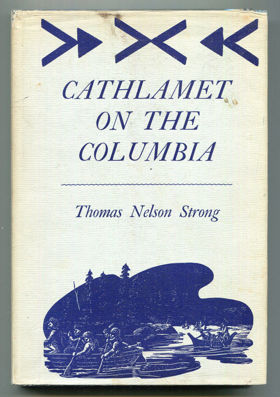
Published in 1906, Thomas Nelson Strong’s Cathlamet on the Columbia provides a vivid historical account of early pioneer life along the lower Columbia River during the mid-to-late 19th century. The book chronicles the foundational days of the Cathlamet settlement in Washington State, highlighting the complex interactions between incoming settlers and the indigenous Chinookan tribes. Through personal recollections and short stories, Strong documents the region's cultural shifts, the tragic decline of local Native American populations due to disease, and the rugged realities of frontier survival. It remains a valuable primary source for understanding the social and environmental transformation of the Pacific Northwest prior to heavy industrialization. xv, 170 pages, 1 unnumbered leaf of plates : colour, mounted illustration ; 21 cm ONLINE CIRC [ 1 ] CIRC [ 1 ]
|
1906 |
|
An Illustrated history of southeastern Washington, including Walla Walla, Columbia, Garfield and Asotin counties, Washington by Frederic Ambrose Shaver, Richard F. Steele, Arthur P. Rose, Western Historical Publishing Company, Spokane, Wash
Published by the Western Historical Publishing Company and compiled by regional historians, An Illustrated History of Southeastern Washington provides an exhaustive, county-by-county chronicle of early pioneer settlement across Walla Walla, Columbia, Garfield, and Asotin counties. The massive volume details the region's transformation from indigenous territories and early missionary outposts into a dominant agricultural empire driven by dryland wheat farming and regional railroad expansion. Through detailed biographical sketches of prominent citizens and extensive civic records, the text serves as a foundational archive for understanding the economic ambitions and social structures of the inland Pacific Northwest. A keen insight drawn from the work is how subscription-based county histories operated as early forms of civic boosterism; by heavily emphasizing the successes of local patriarchs and agricultural wealth while marginalizing the indigenous displacement that made it possible, the volume illustrates how frontier communities intentionally curated their own historical memory to attract further investment and institutional legitimacy. xxii, 874 p. illus., plates, ports. 31 x 25 cm. ONLINE CIRC [ 1 ]
|
1906 |
|
An Illustrated history of Skagit and Snohomish Counties, their people, their commerce and their resources with an outline of the early history of the State of Washington, endorsed as authentic by local committees of pioneers by The Interstate Publishing Company
Published by the Interstate Publishing Company, An Illustrated History of Skagit and Snohomish Counties offers a sweeping, encyclopedia-style chronicle of early pioneer settlement and economic development in northwestern Washington. The extensive volume traces the rapid transformation of the region's dense primeval forests and fertile river valleys into thriving hubs of the timber, agricultural, and maritime industries. Through exhaustive biographical sketches of prominent families—explicitly endorsed as "authentic" by local pioneer committees—the text serves as a monumental archive documenting the civic ambition and commercial resource extraction that defined the Puget Sound hinterlands. A keen insight drawn from the work is how the overt endorsement by pioneer committees reveals the manufactured nature of early frontier historiography; by tightly controlling the published narrative to validate their own commercial successes, the region's founding elite actively engineered a sanitized, triumphant origin story designed to cement their social authority and attract future investment. 1117 pages : portraits ; 29 cm ONLINE CIRC [ 1 ]
|
1906 |