Catalog of British Columbiana and Pacific Northwest Americana
Encyclopedia Cascadia Catalog contains book titles of mostly non-fiction Pacific Northwest Coast of North America Titles (primarially British Columbia, Idaho, Oregon and Washington State) in an easy-to-understand title catalog. If you see a link with this badge ONLINE CIRC it means that there is an online institution that provides free access to that title. In some cases there may be more than one institution hosting the title digitally.
| Catalog Title | Published |
|---|---|
|
Edward Sheriff Curtis visions of the first Americans by Don Gulbrandsen, Edward S. Curtis 
Contains over 300 photographs by Edward Sheriff Curtis from his inspirational work on the North American Indian. The book includes many regions, tribes and ages of people, and in some ways even some of the more negative aspects of his photographs are invaluable because they informed much of the mainstream American (worldwide, really) mythology that surrounds First Nations peoples of North America. The photos are somewhere between documentary and romanticism. Where he could have taken straight documentary photos of poverty and tattered Western/white clothing, he instead staged warrior meetings on horseback and the like. 256 pages : chiefly illustrations, color map, portraits ; 25 x 36 cm CIRC [ 1 ]
|
2010 |
|
Edward Feuz Jr a story of enchantment by D. L. Stephen 
"An intimate look at the life and climbs of Swiss alpine guide Edward Feuz Jr., patriarch of Canadian alpinism and genuine lover of mountains." --Bookmanager 318 pages : illustrations ; 22 cm CIRC [ 0 ]
|
2021 |
|
Edmonds, the gem of Puget Sound a history of the city of Edmonds by Ray V. Cloud
|
1953 |
|
Edible and medicinal flora of the West Coast the Pacific Northwest and British Columbia by Collin Varner 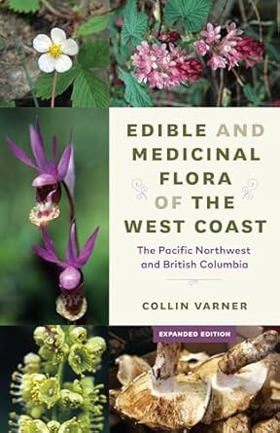
"The coastal Pacific Northwest of North America is home to a multitude of edible and medicinal plant species, edible mushrooms, and marine plants--from Black Gooseberry to Western Tea-Berry, from Golden Chanterelle to Yellow Morel Mushroom, and from Sea Asparagus to Winged Kelp. Now revised and updated with additional species and recipes, this compact, full-color forager's guide offers clear photography, descriptions, safety tips, and warnings, as well as culinary and medicinal uses from Indigenous Peoples and settlers, for more than 150 wild-growing flora species in the region. Practical, user-friendly, and safe, Edible and Medicinal Flora of the West Coast is an indispensable guide for beginner and experienced foragers alike"-- Provided by publisher 264 pages : color illustrations, color maps ; 22 cm CIRC [ 0 ]
|
2023 |
|
Edge of awe experiences of the Malheur-Steens country by Alan Contreras , William Kittredge, Ursula K. Le Guin (Illustrator) 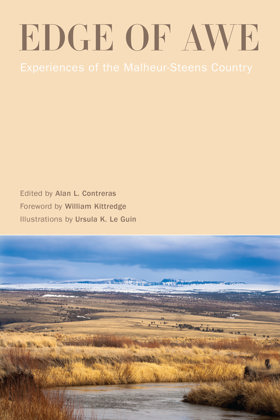
This compelling anthology gathers together personal impressions of the Malheur-Steens country of southeastern Oregon, known for its birding opportunities, its natural beauty and remoteness, and, more recently, for the 2016 armed takeover of the Malheur National Wildlife Refuge. Contributors of poetry and narrative nonfiction include biologists, students, tourists, birders, and local residents, thus reflecting the perspectives of both visitors and residents. Edge of Awe celebrates the immense variety of human experience in the Malheur-Steens region. This high-desert marsh country has long been a place of human habitation, work, and recreation, but this compendium is weighted toward the writing of visitors over the past one hundred years. It encompasses a wide range of experiences, such as fishing the Blitzen River, attending the Steens Running Camp, leading a mule train on Steens mountain, looking for rare migrant birds, boating on the great marshes, and much more. Anyone who has visited the awe-inspiring Malheur-Steens country or plans to do so, and anyone with an interest in the region, will find inspiration in this literary companion. xxxi, 190 pages ; 23 cm CIRC [ 0 ]
|
2019 |
|
Eden within Eden Oregon's utopian heritage by James J. Kopp 
Oregon has long been a destination for those seeking new beginnings. Since the establishment of the Aurora Colony in 1856, the state has been the home of nearly three hundred communal experiments. Eden Within Eden is the first book to survey this utopian history, from religious and Socialist groups of the nineteenth century to ecologically conscious communities of the twenty-first century. James Kopp examines Oregon’s communal history in the framework of utopian and communal experiences across America. Eden Within Eden provides rich detail about utopian communities – some realized, some only planned – many of which reflect broader social, political, economic, and cultural aspects of Oregon’s history. From the dawn of communal groups in Oregon – the German Christian colony at Aurora – to Oregon’s most infamous communal experiment – Rajneeshpuram – Kopp describes the range of attempts to establish ideal communities in the state. These include the Jewish agrarian colony of New Odessa in the 1880s as well as the “new pioneers” of the 1960s who captured the spirit of the counterculture and gave voice to growing concerns about the environment. Kopp explores other areas of Oregon’s utopian heritage as well, including literary works and idealistic city planning. The book’s appendix is a rich compilation that will guide students, scholars, and other interested readers to additional information on the profiled – and many other – communities. xiii, 370 pages : illustrations ; 23 cm CIRC [ 0 ]
|
2009 |
|
Echoes of the Grande Ronde by Bert Huffman, Eldridge Huffman (Compiler) 
Published in 1934 in La Grande, Oregon, and compiled by Eldridge Huffman, Echoes of the Grande Ronde is a collection of regional poetry and prose by Bert Huffman, a prominent newspaperman widely celebrated by his contemporaries as the "Poet Laureate of Eastern Oregon". The volume operates as a literary tribute to the landscapes and pioneer heritage of the Grande Ronde Valley and the broader Inland Empire. Through highly romanticized verse, Huffman mythologizes the overland migrations, the rugged endurance of early homesteaders, and the region's sweeping transition from "untamed" wilderness to a productive agricultural basin. Frequently appropriating Indigenous mythology and historical figures—such as his framing of Sacagawea as a "patron saint" of American empire—the collection weaves the narrative of westward expansion into a grand, almost biblical epic of Manifest Destiny. A keen insight drawn from the work is how regional poetry and romantic literature functioned as a profound emotional mechanism to naturalize colonial displacement. By heavily utilizing the "Vanishing Indian" trope—most notably in wistful verses lamenting the fading presence of the Umatilla, Cayuse, and Nez Perce peoples—Huffman's poetry effectively aestheticizes the violence of settler colonialism. This literary maneuver transforms active, systemic territorial dispossession into a tragic, natural, and inevitable melancholic fading, akin to the passing of the seasons. Consequently, the text allows the descendants of white settlers to indulge in a sentimental, guiltless nostalgia for the region's original inhabitants, all while morally validating the permanent agricultural enclosure of the Grande Ronde Valley as the glorious, divinely ordained triumph of American civilization. 87 pages illustrations (portrait) 24 cm CIRC [ 1 ]
|
1934 |
|
Echoes of Puget Sound fifty years of logging and steamboating by Torger Birkeland
|
1960 |
|
Echoes of exclusion and resistance voices from the Hanford Region by Robert Bauman , Robert Franklin 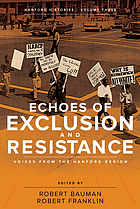
"Four scholars draw from oral histories to focus on experiences of non-white groups such as the Wanapum, Chinese immigrants, interned Japanese Americans, and African American migrant workers, whose lives were deeply impacted by the Hanford Site. Each group resisted segregation and discrimination, and in the process, challenged the region's dominant racial norms"-- Provided by publisher x, 261 pages : illustrations, maps ; 23 cm. CIRC [ 0 ]
|
2020 |
|
Eastern Oregon shortline railroads by Jeff Moore 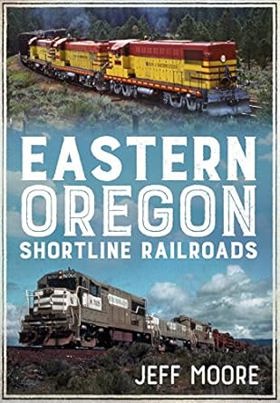
"Most of Oregon east of the Cascade Mountains is a raw and inhospitable land, largely the product of recent volcanic activity. Railroad builders constructed a couple mainlines skirting the edges of the regioni and some branchlines into agricultural communities, but found very little else to attract their interest. Over time, however, a small collection of interesting shortline railroads built or bought rail lines, either in conjunction with the developing timber industry in the Blue, Ochoco, and Wallowa mountains or to connect a few existing communities with the mainline that bypassed the town. This book tells the stories of these small railroads and the roles they played in the development and economies of the region ..."--Cover 176 pages : illustrations ; 25 cm. CIRC [ 0 ]
|
2016 |
|
Eastern Oregon books and print. Volume II an annotated and historical bibliography (with some emphasis on maps) by Wayne Kee 
Published in local editions by bibliographer Wayne Kee, Eastern Oregon Books and Print, Volume II serves as an annotated historical bibliography and cartographic guide dedicated to the literary and geographic records of the state's vast interior. The volume catalogs rare books, manuscripts, regional pamphlets, and historical maps, providing concise publication histories and contextual notes for collectors and researchers alike. By capturing the paper trail of eastern Oregon's settlement, resource extraction, and exploration, the text preserves the foundational documentation of a sparsely populated landscape. A keen insight drawn from the work is how comprehensive regional bibliographies reveal the ideological biases of early print culture; by highlighting which frontier narratives were preserved in print and which were omitted, the bibliography exposes how historical archives actively constructed a romanticized mythos of the high desert while erasing marginalized voices. xi, 206 pages : illustrations, facsimiles, maps ; 23 cm CIRC [ 1 ]
|
2005 |
|
Eastern Oregon books and print an annotated and historical bibliography by Wayne Kee 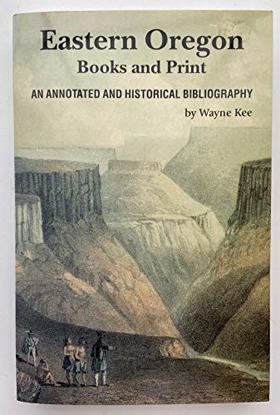
Published as an annotated historical bibliography by Wayne Kee, Eastern Oregon Books and Print catalogs the diverse literary output, regional imprints, and historical texts documenting the high desert and mountain landscapes of eastern Oregon. The work compiles comprehensive descriptions of rare books, pamphlets, and promotional literature ranging from early exploration journals and settlement guides to local histories and indigenous accounts. By structuring these bibliographic entries chronologically and topically, the text maps how print culture mirrored the region's economic and social transformation from an isolated frontier into an organized agrarian and resource-based society. A keen insight drawn from the work is how regional bibliographies function as meta-histories of ideological expansion; the catalog reveals that the printed word was not merely a passive record of eastern Oregon's development, but an active promotional tool deliberately used to tame an intimidating arid landscape into a welcoming destination for homesteaders and investors. xxi, 286 pages : illustrations ; 23 cm CIRC [ 1 ]
|
2001 |
|
Eastern Oregon portrait of the land and its people by Alan D. St John
|
1988 |
|
East Side story growing up at the PNE by Nick Marino 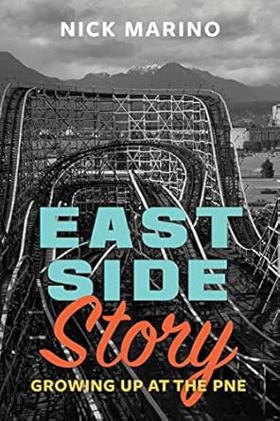
"A sly, sentimental, and wickedly funny memoir about growing up at the local fair. The PNE (Pacific National Exhibition) is a Vancouver tradition, an annual fair started in 1910 that is famous for its farm animals, dog trick shows, and amusement park - highlighted by Canada's oldest wooden roller coaster still in existence. In 1980, when Nick Marino was twelve years old, he started working at the PNE and quickly learned that there was more to the fair than winning stuffed animals and eating mini donuts. He had to contend with belligerent bosses, unhinged carnies, and teenage hustlers. In this funny, charming memoir of fair life, Marino revisits the "Wild West" of the city's East Side, home to the PNE, sharing stories from his six summers working at the fair, where arcade bouncers went on midnight roller coaster rides, riots broke out at concerts, and local kids helped themselves to everything. With beguiling and at times poignant humour, he pulls back the curtain on the culture of carnivals and fairs, an unpredictable and eternally young world of players, scammers, and dreamers."-- Provided by publisher 235 pages : illustrations ; 23 cm CIRC [ 0 ]
|
2023 |
|
East of the Cascades by Phil F. Brogan
|
1964 |
|
|
1981 |
|
Early voyages in the North Pacific, 1813-1818 by Peter Corney
|
1965 |
|
Early Vancouver narratives of pioneers of Vancouver, B.C. by James Skitt Matthews
|
1959 |
|
Early transportation on Klamath waterways by Harry J. Drew, Klamath County Museum
|
1974 |
|
Early Portland stump-town triumphant; rival towns on the Willamette, 1831-1854 by Eugene E. Snyder
|
1970 |
|
Early Oregon days by Edwin D. Culp 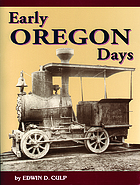
How did people travel in the good old days? Ed Culp traces the history of transportation in the West, particularly into Oregon. Old photos, maps, drawings, advertisements, and transporation schedules illustrate how improvements were made, with emphasis on the development of the railroads. The large majority of the photos were acquired during Culp's forty years in public relations work for one of the large railroads. viii, 185 pages : illustrations, map ; 28 cm CIRC [ 0 ]
|
1987 |
|
Early Oregon atlas early forts, old mines, old town sites by Ralph N. Preston
|
1978 |
|
Early Oregon : jottings of personal recollections of a pioneer of 1850 by George E. Cole
Authored by early pioneer and future territorial governor George E. Cole, Early Oregon: Jottings of Personal Recollections of a Pioneer of 1850 provides a firsthand memoir of the grueling overland migration and the nascent civic formation of the Pacific Northwest. The book chronicles Cole's arduous journey across the plains and his subsequent immersion into the turbulent economic, social, and political landscape of the early Oregon Territory. Through unvarnished personal anecdotes and biographical sketches of prominent fellow settlers, the text offers a valuable primary source lens detailing the region's rapid transition from a rugged frontier to an organized society. A keen insight drawn from the work is how the shared trauma and logistical hurdles of overland migration forged enduring, tight-knit political networks; by relying on personal alliances cemented during the grueling 1850 crossing, early pioneers successfully translated their trail-forged bonds directly into the foundational legislative and economic power structures of the new territory. 95 pages : frontispiece (portrait) ; 20 cm ONLINE CIRC [ 1 ]
|
1905 |
|
Early Okanogan history by William C. Brown 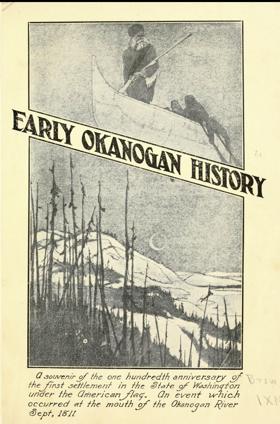
A souvenir of the one hundredth anniversary of the first settlement in the State of Washington under the American flag. An event which occurred at the mouth of the Okanogan River in Sept 1811. 27 pages : illustrations, portraits ; 23 cm ONLINE CIRC [ 1 ]
|
1911 |
|
Early Indian village churches wooden frontier architecture in British Columbia by John Veillette , Gary White 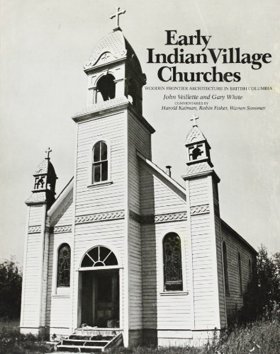
Photographs and descriptions of wood churches in native settlements of B.C xx, 195 pages : illustrations (black and white) ; 29 cm CIRC [ 1 ]
|
1977 |