Catalog of British Columbiana and Pacific Northwest Americana
Encyclopedia Cascadia Catalog contains book titles of mostly non-fiction Pacific Northwest Coast of North America Titles (primarially British Columbia, Idaho, Oregon and Washington State) in an easy-to-understand title catalog. If you see a link with this badge ONLINE CIRC it means that there is an online institution that provides free access to that title. In some cases there may be more than one institution hosting the title digitally.
| Catalog Title | Published |
|---|---|
|
The Lake Washington story a pictorial history by Lucile Saunders McDonald 
A physical and social history of Lake Washington, the 20 mile long body of water that forms the greater part of the eastern boundary of Seattle 160 pages : illustrations ; 28 cm CIRC [ 1 ]
|
1979 |
|
Moscow at the turn of the century by Homer David
|
1979 |
|
Looking at Indian art of the Northwest Coast by Hilary Stewart 
Bold, inventive and highly graphic, the indigenous art of the Northwest Coast is distinguished by its sophistication and complexity. It is also composed of basically simple elements, which, guided by a rich mythology, create images of striking power. This indispensable and beautifully illustrated book is the first to introduce everyone, from the casual observer to the serious collector of Northwest Coast prints, to the forms, cultural background and structures of this highly imaginative art. The elements of style are introduced; the myths and legends which shape the motifs are interpreted; the stylistic differences between the major cultural groupings are defined and illustrated. Raven, Thunderbird, Killer Whale, Bear: all the traditional forms are here, deftly analyzed by a professional writer and artist who has a deep understanding of this powerful culture. 111 pages : illustrations ; 23 cm CIRC [ 1 ]
|
1979 |
|
The colonial postal systems and postage stamps of Vancouver Island and British Columbia, 1849-1871 by Alfred Stanley Deaville 
A sketch of the origin and early development of the postal service on the Pacific seaboard of British North America 210 pages, 8 unnumbered leaves of plates : illustrations ; 24 cm CIRC [ 1 ]
|
1979 |
|
Ralph Edwards of Lonesome Lake by Ralph A. Edwards, Ed Gould 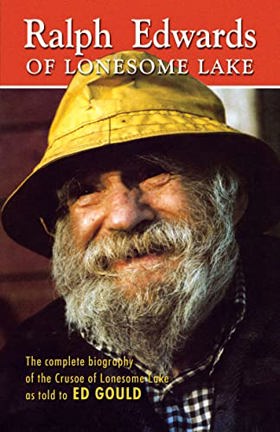
Often called The Crusoe of Lonesome Lake, because of a best-selling book written by the American journalist Leland Stowe, Edwards has gone on to live at least one more life and reveals himself to be a pioneer of a breed that no longer exists. Best known for his almost single-handed rescue of the trumpeter swans from extinction in North America, Edwards now related in his own words other aspects of his long, varied life, including experience with his missionary parents in India, as a telegraph operator under fire in World War I and his eventual return to Lonesome Lake. 293 pages, 20 unnumbered leaves of plates : illustrations (some color) ; 23 cm CIRC [ 1 ]
|
1979 |
|
Tales of Richland, White Bluffs & Hanford, 1805-1943, before the atomic reserve by Martha Berry Parker 
From back This book, Tales of Richland, White Bluffs and Hanford, tells the story of these three towns before there was an atomic project. They were farming communities, rich in a wide variety of early bearing fruit, and with a long growing season for vegetables, feed grains and alfalfa hay. The author lived in Richland from 1932 to 1941. Her mother's family, the Charles Sawyers, came to the Fruitvale District in 1909. The Sawyers had a 19-acre farm just upriver from where the Graduate Center is at present (1986), north of Richland's Hanford School. Mrs Parker has a deep interest in Northwest history and has written two other books, Kin-i-wak, Kenewick, Tehe, Kennewick, and Washington, Oregon; a Map History of the Oregon Country. She is also an amateur archaeologist and is actively interested in Geology and Genealogy. 407 pages : illustrations ; 29 cm CIRC [ 1 ]
|
1979 |
|
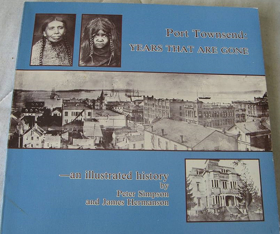
Port Townsend--years that are gone an illustrated history by Peter Simpson, James Hermanson
|
1979 |
|
Indian tribes of Washington, Oregon & Idaho by John Reed Swanton
|
1979 |
|
Salmon fishers of the Columbia by Courtland L. Smith 
A comprehensive historical, social, and economic picture of the Columbia River salmon industry which noted environmental historian Richard White has described as "the best introduction to Columbia River salmon fishing." ix, 117 pages : illustrations, charts, maps, portraits ; 29 cm CIRC [ 1 ]
|
1979 |
|
Cottardi Station, Wahkiakum County, Washington by Carlton E. Appelo 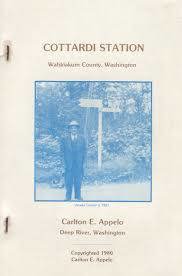
By Carlton Appelo: Whenever the local phone book was printed there was always a wonderful historical book in the back. This one is about Cottardi Station, Washington located on the north side of the Columbia River near Altoona. Now just a memory not even a Ghost Town. 80 pages : illustrations ; 24 cm CIRC [ 1 ]
|
1980 |
|
Summer of promise Victoria 1864-1914 by Derek Pethick 
In 1864 Governor James Douglas handed over his office to Arthur Edward Kennedy, closing an era in Vancouver Island's history and ushering in a period of growth and development. The optimism felt by its people was to a large extent justified; the ensuing years were to bring stability, prosperity and many changes. In Summer of Promise, a sequel to Victoria: The Fort, the author chronicles the years from 1864 to the outbreak of World War One in 1914, seeing them through the eyes of the inhabitants of the city which was the capital of the colony and later of the province. Despite its geographical isolation, its population remained well aware of world events: the Boer War, the death of Queen Victoria, the ascension of Edward VII to the throne and the rising threat of the German navy were as much talked about as the waning of many traditional religious beliefs and the enfranchisement of women. Nearer home, these were important years for Victoria as the colony voted to join the Dominion of Canada, the railroad connected the new province with the rest of the country, and the "All Red Route" linked it by steamship to Australia and the Orient. Motorcars, aeroplanes, telephones, the telegraph and electricity brought British Columbia into the twentieth century. From the momentous to the mundane, and sometimes even to the ridiculous, Derek Pethick documents an era in Victoria's history. Summer of Promise is enlightening, fascinating and enjoyable reading. 191 pages, 8 unnumbered leaves of plates : illustrations ; 23 cm CIRC [ 1 ]
|
1980 |
|
Follow the pathfinders through the Okanogan and Ogopogoland to the Shuswap by George Bechtold
|
1980 |
|
Heritage of the Wallowas life as it was by Ethel Halsey Scott 
Ethel Halsey, daughter of Bill Halsey (born 1873) and Vergie Bell Pinkley (born 1886), was born in the early 1900s. She tells of her life with her husband, Noel Scott, and her children and extended family and friends and neighbors, weaving these with the history of the Wallowa, Oregon area iii, 153 pages : illustrations ; 23 cm CIRC [ 1 ]
|
1980 |
|
Oregon Coast Range wilderness by Sherry Wellborn
|
1980 |
|
Early churches of Washington State by Arnold Pearson, Esther Pearson 
Author is an alumnus of Evanston Township High School, class of 1932 ix, 182 pages : illustrations, map ; 27 cm CIRC [ 1 ]
|
1980 |
|
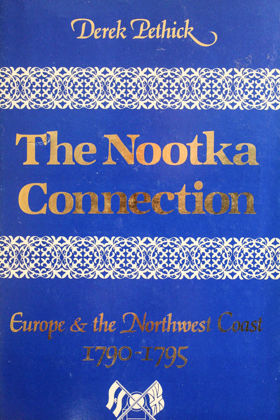
The Nootka connection Europe and the Northwest coast, 1790-1795 by Derek Pethick
|
1980 |
|
Pioneers of North Central Washington by Eva Greenslit Anderson
|
1980 |
|
The history of the Northern Pacific Railroad by Louis T. Renz
|
1980 |
|
So they called the town "Concrete" a story of life and times in unique Concrete, Washington by Charles M. Dwelley 
Concrete, as a town, had a colorful and interesting history and those who took part even briefly never forgot "those old days in Concrete." Some of the itinerant workers who arrived with the building of the railroad in 1900 - Italians, Swedes, Norwegians, Greeks from the old country; plus Northerners, Southerners, Easterners of all nationalities remained to become accorded an unusual acceptance and welcome that made them feel at home. Many who came for a short employment stayed on to marry and settle in, and lived to be buried here as old-timers. It was that kind of town. If you want to know the rest of the story, read on. 134 pages : illustrations ; 21 cm CIRC [ 1 ]
|
1980 |
|
Seattle's black Victorians, 1852-1901 by Esther Hall Mumford 
"...looks at black life in 19th century Seattle from many angles. The combination of newspaper files, county records, and oral history gives a density to the historical picture." John Berry, Seattle Sun -- Back cover 235 pages : illustrations, facsimiles, map, portraits ; 22 cm CIRC [ 0 ]
|
1980 |
|
San Juan Island coastal place names and cartographic nomenclature by Bryce Wood, Washington State Historical Society
|
1980 |
|
Strangers in blood fur trade company families in Indian country by Jennifer S. H. Brown 
Describes the social world of the traders in the 18th and 19th centuries. Examines differences between the North West Company and the Hudson's Bay Company and their effects on Indian-white relations xxiii, 255 pages, 6 unnumbered leaves of plates : illustrations (some color) ; 24 cm CIRC [ 0 ]
|
1980 |
|
The Northern Shoshoni by Brigham D. Madsen 
Brigham D. Madsen examines four distinct groups which comprise the Northern Shoshoni, focusing on the tribe since the arrival of the first white settlers. He describes the early days on the reservation and the tribe’s struggle to adapt to massive cultural changes. 259 pages : illustrations ; 29 cm CIRC [ 0 ]
|
1980 |
|
Coyote was going there Indian literature of the Oregon country by Jarold Ramsey (Compiler, Editor) 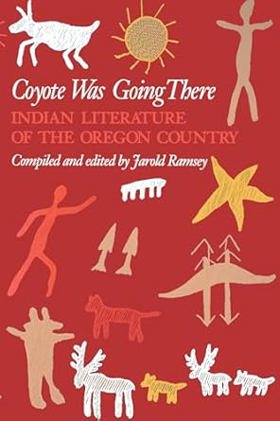
The vivid imagination, robust humor, and profound sense of place of the Indians of Oregon are revealed in this anthology, which gathers together hitherto scattered and often inaccessible legends originally transcribed and translated by scholars such as Archie Phinney, Melville Jacobs, and Franz Boas. xxxvii, 295 pages : illustrations ; 24 cm CIRC [ 0 ]
|
1980 |
|
Point Roberts, U.S.A. the history of a Canadian enclave by Richard Eugene Clark , Runa Thordarson (Photographer), Robert B. Lindquist (Contributor) 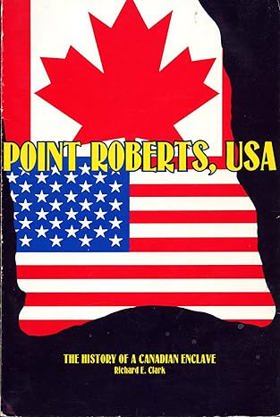
When the June 15, 1846 Treaty of Washington was signed by representatives of the United States and Great Britain, it established the forty-ninth parallel of north latitude as the boundary to the middle of the channel which separates the North American continent from Vancouver Island. That decision, probably unknowingly, left a small piece of real estate below the line but isolated by marine waters from the rest of United States / Washington land. That promontory subsequently became known as Point Roberts, a unique and interesting community, greatly influenced by Canada but fiercely American. Point Roberts is a story of political and geographic accident; it is also a story of the people who settled there, who fished and farmed, who lived under difficult circumstances and isolation. It is a chronicle of good times and bad, rising expectations and tragic events. It includes the efforts of people to create social and cultural institutions to solve their problems and to pass their culture on from one generation to the next — governmental units, churches, schools, water districts, even a cemetery. Point Roberts is also a study of two nations and their people facing off, sharing, trying to learn how to live together. That chapter still is not complete, nor is the history of Point Roberts. But its history has begun, and we are indebted to Richard Clark for gathering the existing bits and pieces to date together in this book. It teaches some valuable lessons — that human perseverance can overcome adversity, that human institutions and social inventions do advance a people, and that Point Roberts is an extremely interesting and valuable part of Washington State and the United States of America. viii, 137 pages : illustrations ; 23 cm CIRC [ 0 ]
|
1980 |