Catalog of British Columbiana and Pacific Northwest Americana
Encyclopedia Cascadia Catalog contains book titles of mostly non-fiction Pacific Northwest Coast of North America Titles (primarially British Columbia, Idaho, Oregon and Washington State) in an easy-to-understand title catalog. If you see a link with this badge ONLINE CIRC it means that there is an online institution that provides free access to that title. In some cases there may be more than one institution hosting the title digitally.
| Catalog Title | Published |
|---|---|
|
History of Pend Oreille County by Tony Bamonte, Suzanne Bamonte 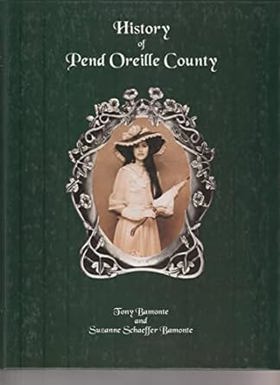
Authored by regional historians Tony and Suzanne Bamonte, History of Pend Oreille County chronicles the rugged development of northeastern Washington through an extensive compilation of historic photographs and archival narratives. The book details the arduous transition of the remote river valley from an indigenous seasonal hunting ground and fur-trading route into a bustling hub of timber harvesting, hardrock mining, and steam-boat navigation. Through its detailed local chronicle, the text captures the tenacity of the pioneer families and industrial workers who carved out permanent settlements along the treacherous banks of the Pend Oreille River. A keen insight drawn from the work is how river systems in the Inland Northwest served simultaneously as lifelines and barriers; while the waterway provided the only viable transportation corridor for hauling timber and supplies out of the dense mountainous terrain, its unpredictable rapids and waterfalls also enforced an intense geographic isolation that kept the county's communities tethered to boom-and-bust resource economies for generations. xv, 271 pages : illustrations, maps, portraits ; 29 cm CIRC [ 1 ]
|
1996 |
|
The Sunshine Coast from Gibsons to Powell River by Howard White 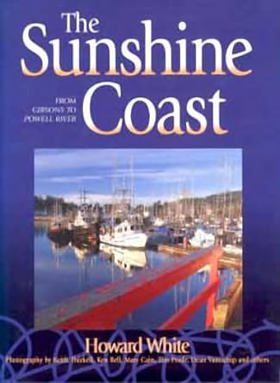
British Columbia's Sunshine Coast is a sublimely scenic 160-kilometre stretch of waterfront between Howe Sound and Desolation Sound, reached by a 40-minute ferry ride from West Vancouver. Join Howard White, award-winning humorist and lifelong coast denizen, on a guided tour from Gibsons, where the long-running TV series The Beachcombers was filmed, to Powell River, the largest community in the region. Along the way, sojourn in Roberts Creek, whose patron saint, the irrepressible Harry Roberts, invented the name "Sunshine Coast." Stop over in Sechelt, named for the Shi'sha'lh or Sechelt Nation who once occupied the bulk of the Sunshine Coast territory. Follow the seriously twisty highway to visit Pender Harbour, where some local fishing folk still do their Saturday shopping in kicker boats. Drop anchor in Princess Louisa Inlet, and discover why the likes of John Barrymore and Andrew Carnegie once came to marvel at its canyon-like splendour. With paintings by local artists, poems by local poets, tall tales by local characters, miracles by Sechelt medicine men, tips on predicting the weather, a fair share of risqué gossip about historical figures, a good mix of bold opinions and hard facts and over 150 beautiful colour photographs, The Sunshine Coast is a book to be treasured, not just by residents and visitors, but by anyone with an eye for fascinating places. First published in 1996, this fully revised edition contains updated text and all new photographs of coast life from the area's most talented photographers including Dean van't Schip and Keith Thirkell. 127 pages : illustrations (some color), color maps ; 29 cm CIRC [ 1 ]
|
1996 |
|
Early human occupation in British Columbia by Roy L. Carlson, Luke R. Dalla Bona 
This book presents the archaeological evidence for the first 5,500 years of prehistory in British Columbia, from about 10,500 to 5,000 years ago. As this period is poorly known even to specialists, Early Human Occupation in British Columbia is a vital contribution to current knowledge about an enigmatic time in a crucially important area of western North America. New data and syntheses have been integrated with previous data about the period, making this the most comprehensive and up-to-date book on the subject. Chapters cover the evidence for the earliest human occupation in all areas of the province: the Subarctic, the Columbia-Fraser Plateau, and the Northwest Coast 261 pages : illustrations, maps ; 29 cm CIRC [ 1 ]
|
1996 |
|
Exploring the south coast of British Columbia Gulf Islands and Desolation Sound to Port Hardy and Blunden Harbour by Don Douglass, Réanne Hemingway-Douglass 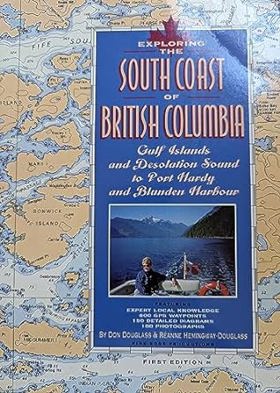
Nowhere does the tourist motto Super, National British Columbia! come more alive than on Vancouver Island's West Coast. With five great sounds, sixteen major inlets, and an abundance of spectacular wildlife, the largest island on the west coast of North America is a cruising paradise. The Douglasses consider their voyages along this coast to be among their most satisfying adventures. In this guide they give small craft skippers the kind of local knowledge they need to circumnavigate the island and drop hook in an abundance of intimate coves. 303 pages : illustrations, maps ; 26 cm CIRC [ 1 ]
|
1996 |
|
A most unusual colony Vancouver Island 1849-1860 by Maureen Duffus 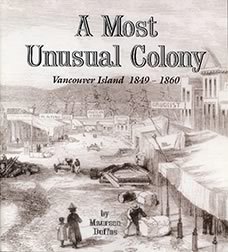
To travel back in time to the Colony of Vancouver Island, read the story of the Hudson's Bay years as told through recollections of a colonial childhood by the fictional Kate Murray and the letters of the real Mary Yates. The letters are inventions, but the real Mary lived through the events of the early years. Their stories combine to give an authentic glimpse of the extraordinary life inside the palisades of Fort Victoria, the world of children at Chaplain Staines's school, the settlers who rebelled against the HBC's autocratic rule, and the growing sophistication of colonial social life before and after BC's gold rush of 1858. viii, 156 pages : illustrations, maps, portraits ; 24 cm CIRC [ 1 ]
|
1996 |
|
Nanaimo retrospective the first century by E. Blanche Norcross, Nanaimo Historical Society 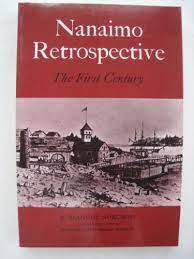
Edited by E. Blanche Norcross and published by the Nanaimo Historical Society, Nanaimo Retrospective: The First Century offers a scholarly yet accessible chronicle of the region's formative hundred years. The volume carefully examines the area's early industrial development, including coal mining and logging, alongside the intricate social dynamics between Indigenous communities and diverse waves of immigrants. Drawing upon archival materials and historical photographs, the text provides researchers and local history enthusiasts with a comprehensive foundational study of the municipality's evolution. xxi, 169 p., [28] p. of plates : ill., map, ports. ; 23 cm. CIRC [ 1 ]
|
1996 |
|
Cannon Beach a place by the sea by Terence O'Donnell, Cannon Beach Historical Society 
Cannon Beach: A Place by the Sea was published in 1996 by the Oregon Historical Society Press. The book chronicles the colorful heritage of this iconic Oregon coastal community. The book weaves together historical accounts and local lore to trace the area's evolution from a remote wilderness into a beloved seaside destination. O'Donnell highlights key figures, early homesteaders, and the enduring natural landscapes that defined the character of the northern Oregon coast. It stands as an informative and engaging chronicle for anyone interested in Pacific Northwest coastal history. xxiii, 164 pages : illustrations, maps ; 23 cm CIRC [ 1 ]
|
1996 |
|
Koom of the Tillamooks by Margaret Watt Edwards, Roger Cooke (Illustrator) 
Koom of the Tillamooks, written by Margaret Watt Edwards and illustrated by Roger Cooke, is a historical fiction story aimed at middle-grade readers. The narrative centers on the title character, Koom, who finds himself unable to remain with the last few surviving Tillamook Native Americans living along Oregon's Tillamook Bay. Feeling equally alienated and uncomfortable in the encroaching white man's world, Koom makes the difficult decision to forge his own path. The plot follows his journey as he prepares to isolate himself and spend the upcoming winter surviving entirely off the land. 178 pages : illustrations ; 24 cm CIRC [ 1 ]
|
1996 |
|
Chiefs & change in the Oregon country Indian relations at Fort Nez Percés, 1818-1855 by Theodore Stern 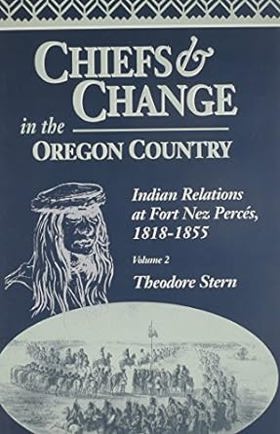
Theodore Stern's critically acclaimed 1993 book Chiefs and Chief Traders explored early encounters between the fur traders of Fort Nez Perces and the Indians of the eastern Columbia Plateau, principally the Cayuse, Nez Perces, Wallawalla, and Umatilla. Drawing on 25 years of research, Stern recreated the dynamic relationships between Indians and whites at the small but strategic trading post near the confluence of the Columbia and Snake rivers. He offered a new perspective on interactions at the fort, one that encompassed the voices and lives of Indians as well as whites. In a remarkable new companion volume, Chiefs and Change in the Oregon Country, Stern again focuses on the Plateau Indians, and particularly on the changes they underwent as first the Hudson's Bay Company traders, then missionaries, and later settlers, Indian agents, and the military entered their world. Stern traces these forces of change as they swept through to the Willamette Valley and details their tremendous impact on the Indians tied by residency and trade to Fort Nez Perces. He concludes his history with the fall of the fort during the Indian wars of the 1850s and the end, shortly thereafter, of independent tribal government. Like its predecessor Chiefs and Change in the Oregon Country is a skillful weaving of history and anthropology. This major work brings important new topics and insights to the story of Indian-white relations in the Pacific Northwest. xx, 428 pages : maps, portraits ; 24 cm CIRC [ 1 ]
|
1996 |
|
The Duwamish diary, 1849-1949 by Grover Cleveland High School (Seattle, Wash) 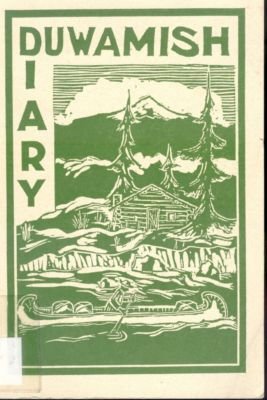
This book compiles a project originally started by a laboratory writing class of Cleveland High School in 1947. It collects an amazing amount of history from books, pamphlets, newspapers, and word-of-mouth stories about Seattle's earliest pioneers: John Holgate, Luther Collins, Henry Van Asselt, and Jacob and Samuel Maple, as well a lot of other history. If you supersize the contents pages, you should be able to read all of the entries. Generously illustrated with b/w photos and a fold-out map of the Duwamish River before and after straightening in the rear xiv, 119 pages : illustrations, maps (1 folded) ; 23 cm CIRC [ 1 ]
|
1996 |
|
Raise hell and sell newspapers Alden J. Blethen & the Seattle Times by Sharon A. Boswell, Lorraine McConaghy 
Raise Hell and Sell Newspapers, the lively biography of Alden J. Blethen, traces the newspaperman's life from his birth in 1845 to his death in 1915. Longtime editor-in-chief of The Seattle Times, Blethen became the most powerful and influential publisher in the Northwest and one of the foremost newspapermen of his generation. Authors Sharon A. Boswell and Lorraine McConaghy tell the compelling story of this self-made man during a period of dramatic change in American life. Alden Blethen arrived in Seattle broke in 1896, after making and losing fortunes as a newspaper owner and publisher in Kansas City and Minneapolis. One year later, the Klondike gold rush transformed the muddy Puget Sound seaport into a magnificent boomtown. Using a loan from his brother-in-law, Blethen purchased a share in The Seattle Times. During the next two decades, as Seattle grew into the queen city of the Northwest, Blethen transformed The Times into the region's largest paper and reclaimed his family's fortune. x, 291 pages : illustrations (some color), portraits ; 27 cm CIRC [ 1 ]
|
1996 |
|
Olga 125 years : memories and potlucks by Irene Barfoot O'Neill 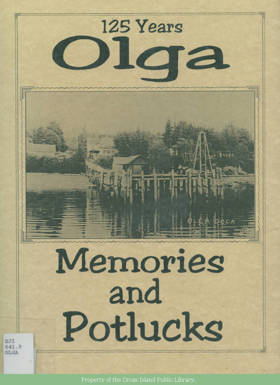
Authored by Irene Barfoot O'Neill, Olga 125 Years: Memories and Potlucks celebrates more than a century of community history in the historic waterfront settlement on Orcas Island, Washington. The book weaves together family recollections, archival records, and community traditions to trace how a pioneer farming and canning outpost evolved into a close-knit, enduring residential hamlet. Through these shared narratives and local recipes, the text highlights the social glue that has sustained generations of residents through changing economic tides. A keen insight drawn from the work is how communal food traditions and shared gatherings function as vital infrastructure in isolated island enclaves; by anchoring local history around the community potluck, the narrative reveals that shared meals served as the primary mechanism for bridging generational divides, welcoming newcomers, and preserving collective memory when formal institutions were scarce. 144 pages : illustrations ; 28 cm CIRC [ 1 ]
|
1996 |
|
Seattle's totem poles by Viola E. Garfield 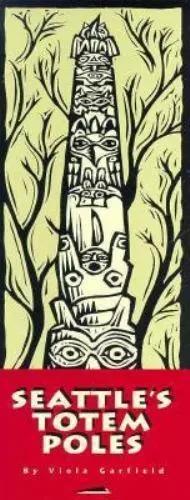
This book tells the history of the Seattle Totem Pole, located in Pioneer Square, including its abduction from its Tlinglit village by Seattle businessmen. The present cedar pole is a duplicate of the original, which was taken down after suffering damage from age and vandals. The book's second section explains Northwest Indian symbols used in poles and carvings seen around the area. Descriptions and photos of several area totem poles are included along with maps showing where other totem poles are located in the Greater Seattle area. 64 pages : illustrations, maps ; 28 x 11 cm CIRC [ 1 ]
|
1996 |
|
Nootka Sound and the surrounding waters of Maquinna by Heather Harbord 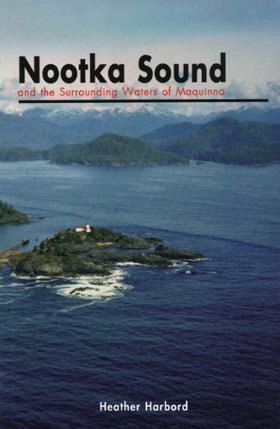
Nootka was the home base of avarice and slaughter as the sea otter was rendered extinct by traders. It gained further infamy with the enslavement of John Jewitt in 1803. Since the author's discovery of Nootka Sound some 15 years ago she has lived off the local waters and been fortunate to witness the return of the sea otter. She shares her experiences with the reader and describes the routes and sights that new visitors can enjoy.-- Backroad jaunts in pristine wilderness 122 pages : illustrations, maps, portraits ; 22 cm CIRC [ 1 ]
|
1996 |
|
James J. Hill empire builder of the Northwest by Michael P. Malone 
In this volume, Michael P. Malone provides a succinct interpretive biography of James J. Hill, the "Empire Builder" - so called for his work in developing the region of the United States between the Great Lakes and the Pacific Northwest. Hill was born near Rockwood, Ontario, in 1838. At age sixteen, following his father's death, he left home for St. Paul, Minnesota Territory. There he found work in the steam boating trade along the Mississippi River. By 1865 he was a freight agent, by 1877 a major coal dealer, and soon thereafter he owned a lucrative steamboat service along the Red River. From these beginnings in transportation, Hill eventually realized his dream of building a transcontinental railroad to the Pacific Ocean. Taking over the bankrupt Saint Paul and Pacific Railroad, which ran between St. Paul and Winnipeg, Hill spent fifteen years constructing what would become the Great Northern Railway. Nor did he stop then. Until his death, in 1916, he continued building and directing his ever-growing business empire. Like most other leaders in the history of American industry, Hill gained loyal partners and avid critics. He was a man of remarkable abilities, determination, and drive, but he could be equally ruthless, overbearing, and politically domineering. The Hill story touches every aspect of the regional economy: transportation, agriculture, mining, lumbering, maritime trade, and town building. Malone explores Hill's complex life and personality, his activities and interests, and recreates both the story of the railroad race to the Pacific and the complex interactions involved in the development of the region xiv, 306 pages : illustrations ; 23 cm. CIRC [ 0 ]
|
1996 |
|
The letters of Narcissa Whitman by Narcissa Prentiss Whitman 
Authored by pioneer missionary Narcissa Prentiss Whitman, The Letters of Narcissa Whitman compiles her poignant, firsthand correspondence sent to family and friends in New York while living among the Cayuse people at the Waiilatpu Mission in southeastern Washington from 1836 until her tragic death in 1847. The letters document the staggering physical isolation, cultural clashes, and domestic struggles of being among the first white American women to cross the Rocky Mountains and settle in the Pacific Northwest. Through her eloquent and deeply personal accounts, the text offers an unvarnished window into the mindset of evangelical expansionism and the heavy psychological toll of frontier life. A keen insight drawn from the work is how domestic correspondence functioned as an ideological tether for women on the religious frontier; by meticulously chronicling her daily efforts to transplant Victorian domesticity into an Indigenous landscape, Whitman's letters reveal how female missionaries attempted to domesticate foreign geopolitical spaces through the sheer force of written narrative and cultural replication. 266 pages, 1 unnumbered leaf of plates : illustrations, portrait ; 24 cm CIRC [ 0 ]
|
1996 |
|
The way we ate Pacific Northwest cooking, 1843-1900 by Jacqueline B. Williams, Ruth Kirk 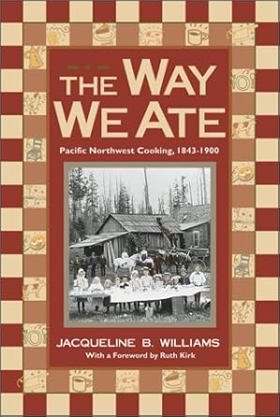
Probing diaries, letters, business journals, and newspapers for morsels of information, food historian Jackie Williams here follows pioneers from the earliest years of settlement in the Northwest to the time when railroads brought Pacific Northwest cooks the latest ingredients and implements. Like she did in her earlier acclaimed volume, Wagon Wheel Kitchens: Food on the Oregon Trail, Williams sheds important new light on a little-understood aspect of our past xix pages, 1 leaf, 215 pages, 8 unnumbered pages of plates : illustrations, map ; 24 cm CIRC [ 0 ]
|
1996 |
|
Very close to trouble the Johnny Grant memoir by Johnny Grant, Lyndel Meikle 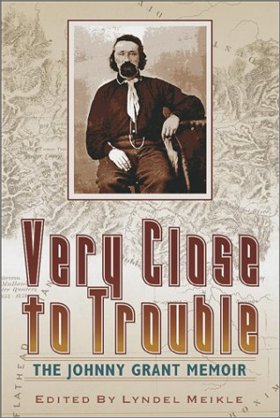
Grant was 76 when he dictated his memoirs to Clothild Bruneau Grant, the last in his fairly long line of wives. Meikle has ably edited the manuscript down to focus on his life in the 1850s and '60s, when Grant galloped across the western Montana frontier, making a name for himself as an early pioneer and trader. Grant's eyewitness accounts of frontier life, from a stage overturning to the hanging of highwaymen, the Mormon rising of 1857 and the discovery of gold, give readers an absorbing glimpse into his rough-and-ready times. --Copyright 1996 Cahners Business Information, Inc xii, 223 pages, 8 unnumbered pages of plates : illustrations, maps, portraits ; 24 cm CIRC [ 0 ]
|
1996 |
|
Thompson River Salish dictionary nł̳e?̳kepmxcín by Laurence C. Thompson, M. Terry Thompson 
Authored by linguists Laurence C. Thompson and M. Terry Thompson, the Thompson River Salish Dictionary (nł̳e?̳kepmxcín) stands as a comprehensive lexical documentation of the Interior Salish language spoken by the Nlaka'pamux people of British Columbia. The volume meticulously records thousands of word stems, grammatical structures, and cultural terms, preserving the intricate phonetic nuances of a language deeply rooted in the river valleys and plateaus of the Pacific Northwest. Through decades of rigorous fieldwork and collaboration with native speakers, the text provides an invaluable linguistic archive designed to rescue an endangered indigenous tongue from colonial erasure. A keen insight drawn from the work is how comprehensive dictionary-making transcends academic compilation to become an act of political and cultural reclamation; by encoding the hyper-specific ecological, botanical, and spiritual vocabulary of the Nlaka'pamux into a permanent written record, the lexicon arms future generations with the native linguistic tools required to fully reclaim their ancestral sovereignty and relationship to the land. xxvii, 1412 pages ; 29 cm. CIRC [ 0 ]
|
1996 |
|
The Northwest salmon crisis a documentary history by Joseph Cone , Sandy Ridlington 
This acclaimed volume offers a key to understanding the historic roots of one of today's most closely watched environmental issues, the fate of salmon in the Pacific Northwest. The history of the current salmon crisis is long and disturbingly consistent, with concern over declining salmon runs beginning in the 1800s. This book focuses on the human actions--and failures to act--that have helped drive many wild salmon stocks in the Pacific Northwest to the brink of extinction. For this first documentary history of the salmon crisis, knowledgeable observers of salmon history have chosen and commented upon the documents that they feel most clearly reveal the causes and implications of today's crisis. The eighty documents span a period of 140 years and address such issues as habitat, hatcheries, dams, fisheries, Indian fishing rights, and watershed management. Together, these mileposts in the sorry journey of the salmon provide a compelling perspective on an environmental crisis of growing national concern. v, 374 pages : illustrations, maps ; 24 cm. CIRC [ 0 ]
|
1996 |
|
Pacific Northwest lighthouses Oregon to the Aleutians by Bruce Roberts, Ray Jones 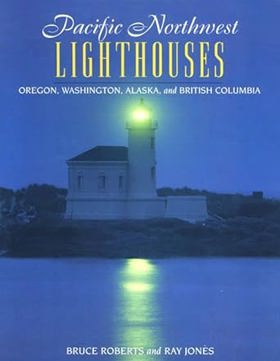
Pacific Northwest Lighthouses pays tribute to the forty-five lifesaving beacons From Coos Bay, Oregon, to Unimark Island in the Aleutians. The lighthouses on the harrowing northwestern coastline of the United States and Canada are memorialized in dramatic tales and glorious photos that evoke the continuing battle between men and sea. Profiles include complete details on directions and visiting hours 88 pages : illustrations (some color) ; 28 cm. CIRC [ 1 ]
|
1997 |
|
She who watches by Willa Holmes, Anderson Benally 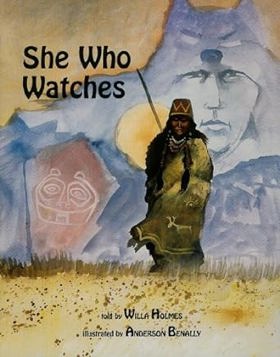
Stories of the Wishram chief Tsagaglalal and Coyote. Authored by Willa Holmes and Anderson Benally, She Who Watches explores the rich history, spiritual significance, and cultural legacy surrounding the famous Columbia River petroglyph known as Tsagaglalal, located near the Dalles. The book weaves together Native oral traditions, historical documentation, and Indigenous perspectives to illuminate the sacred rock art site that has overlooked the river valley for centuries. Through these collected narratives, the text honors the profound spiritual connection regional tribes maintain with ancestral sacred places despite the inundation of the landscape by modern dams. A keen insight drawn from the work is how ancient rock art functions as an eternal sentinel of tribal sovereignty; by enduring through eras of profound ecological and political displacement, figures like Tsagaglalal serve as silent legal and spiritual witnesses asserting an unbroken Indigenous title to the land that industrial modernization could never submerge. ix, 37 pages : color illustrations ; 28 cm CIRC [ 1 ]
|
1997 |
|
Fur traders from New England the Boston men in the North Pacific, 1787-1800 : the narratives of William Dane Phelps, William Sturgis, and James Gilchrist Swan by William Dane Phelps, William Sturgis, James G. Swan, Briton Cooper Busch, Barry M. Gough 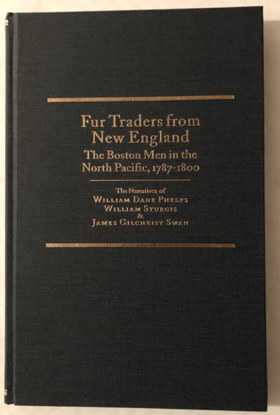
Examines the work of Boston mariners in the fur trade and other trades during the late eighteenth and early nineteenth century 137 pages ; 25 cm. CIRC [ 1 ]
|
1997 |
|
Northwest women an annotated bibliography of sources on the history of Oregon and Washington women, 1787-1970 by Karen J. Blair 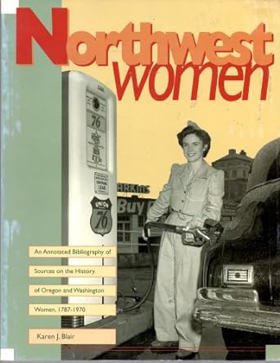
Northwest Women features concise descriptions of more than 700 books and articles that examine the contributions of Washington and Oregon women -- bringing to light generations of scholarship about celebrated and anonymous women, from Native American basket makers to Japanese-Americans interned during World War II x, 134 pages : illustrations ; 28 cm CIRC [ 1 ]
|
1997 |
|
Bandon tales stories of country life by Granny Abbott 
Authored by longtime southern Oregon resident Granny Abbott, Bandon Tales: Stories of Country Life offers a charming, homespun collection of reminiscences documenting early homesteading, farming, and coastal community life near Bandon during the late 19th and early 20th centuries. The book captures the unvarnished realities of rural survival, neighborly mutual aid, and domestic routines against the backdrop of raw wilderness and sweeping Pacific shores. Through affectionate and straightforward prose, the text preserves the colloquial voice and everyday folklore of pioneers who carved out an existence on a windswept frontier. A keen insight drawn from the work is how domestic humor and storytelling served as vital psychological currency for frontier women; by framing crushing physical hardships through the lens of wry local comedy, homesteaders built emotional resilience and forged unbreakable social ties that kept isolation at bay. 111 pages : illustrations ; 21 cm CIRC [ 1 ]
|
1997 |