Catalog of British Columbiana and Pacific Northwest Americana
The Encyclopedia Cascadia Catalog indexes mostly non-fiction literature covering the Pacific Northwest coast of North America, with an emphasis on British Columbia, Idaho, Oregon, and Washington State.
| Catalog Title | Published |
|---|---|
|
A history of Oregon by Robert Carlton Clark, Robert Horace Down, George Verne Blue 
Published in 1925 as an officially sanctioned textbook for the state's public school system, A History of Oregon by Robert Carlton Clark, Robert Horace Down, and George Verne Blue is a foundational educational narrative designed to institutionalize the pioneer origin story for the next generation of citizens. The book comprehensively traces the region's trajectory from early European maritime exploration and the fur trade era through the mass overland migrations, ultimately culminating in the triumphant establishment of the 1843 Provisional Government and formal statehood. Authored by academic historians aiming to elevate regional history to the level of rigorous civic education, the text meticulously details legislative milestones, international boundary treaties, and the systematic agricultural development of the Willamette Valley. A keen insight drawn from the work is how the authors weaponized the rhetoric of legal and bureaucratic evolution to sanitize the inherent violence of territorial conquest; by disproportionately emphasizing the legislative triumphs of early settlers—specifically framing the creation of the Provisional Government as the definitive, miraculous birth of civilization in the region—the textbook actively taught generations of students to view the American occupation of the Pacific Northwest not as an aggressive colonial displacement of Indigenous nations, but as a peaceful, legally ordained transition from an empty wilderness to an organized democracy. xii, 356 pages : illustrations ; 19 cm Non-circulating [ 1 ]
|
1925 |
|
Mount Multnomah, ancient ancestor of the Three Sisters by Edwin T. Hodge, University of Oregon (Publisher)
Mount Multnomah is an invalidated hypothetical ancient volcano postulated in a 1925 publication by geologist Edwin T. Hodge. It was proposed to exist in central Oregon at the present day location of the Three Sisters region. It was estimated to have been around 16,000-foot (4,900 m) tall, and was believed destroyed in a fashion similar to Mount Mazama's eruption resulting in what is now Crater Lake in southern Oregon. 1 preliminary leaf, v, [1], 158, [2] pages, 1 unnumbered leaf of plates : illustrations, folded color map (in pocket) ; 26 cm Non-circulating [ 1 ]
|
1925 |
|
A pioneer's search for an ideal home a book of personal memoirs by Phoebe Goodell Judson, Washington State Library Classics in Washington History
|
1925 |
|
History of Teton Valley, Idaho by B.W. Driggs 
Published in 1926 by local attorney and pioneer descendant Benjamin Woodbury Driggs, History of Teton Valley, Idaho chronicles the transformation of the high-altitude Teton Basin—historically known as Pierre's Hole—from a seasonal Indigenous gathering ground and legendary fur-trade rendezvous into a settled agricultural community. The narrative explicitly bridges two distinct eras: the romanticized, lawless epoch of early mountain men and the subsequent, highly organized colonization of the valley by Mormon (LDS) pioneers. Driggs meticulously records the foundational efforts of these early agrarian settlers, emphasizing their communal resilience in taming a harsh, isolated environment and establishing permanent civic and religious institutions on the eastern edge of Idaho. A keen insight drawn from the work is how the narrative strategically bifurcates the frontier experience to legitimize permanent settler occupation; by romanticizing the early fur trade era as a chaotic, adventurous prelude dominated by transient white trappers and shifting Native American tribes, Driggs effectively frames the subsequent arrival of Mormon pioneers not as an invasion, but as the valley's inevitable maturation into civil order. This historiographical maneuver subtly consigns Indigenous peoples to a closed chapter of frontier antiquity, ensuring that the eventual agricultural enclosure of the Teton Valley is celebrated as the righteous, divinely ordained culmination of American progress rather than an ongoing act of territorial dispossession. 227 pages, 9 unnumbered leaves of plates ONLINE Circulation [ 1 ]
|
1926 |
|
The Oregon constitution and proceedings and debates of the Constitutional Convention of 1857 by Oregon, Charles Henry Carey , Oregon Historical Society (Issuing body), Oregon Constitutional Convention (1857)
Edited by prominent jurist and historian Charles Henry Carey and published by the Oregon Historical Society in 1926, The Oregon Constitution and Proceedings and Debates of the Constitutional Convention of 1857 serves as the definitive legal archive of the state's founding legislative assembly. The massive volume meticulously compiles the daily transcripts, committee reports, and fierce political arguments that culminated in Oregon's 1857 constitution, capturing the territory's transition to formal statehood. The detailed records highlight the pressing political concerns of the pioneer delegates: state finance, the regulation of corporations, and, most prominently, the deeply contested issues of slavery, suffrage, and racial exclusion in the looming shadow of the Civil War. A keen insight drawn from the work is how the archive explicitly exposes the foundational legal architecture of the state as a meticulously engineered white supremacist project. By preserving the raw, unvarnished debates of the delegates, the text inadvertently shatters the myth of the pioneer as a purveyor of universal democratic liberty; instead, it reveals how the architects of Oregon statehood utilized the highest form of democratic bureaucracy to systematically codify racial exclusion—most notably through the infamous constitutional clause banning free Black people from the state, alongside strict prohibitions denying suffrage and property rights to Native Americans and Chinese immigrants. The preservation and publication of these proceedings in the 1920s subtly institutionalized this exclusionary heritage, framing the calculated legal construction of a white utopia not as a profound moral failure, but as a sober, deliberate act of frontier statesmanship. 543 pages : facsimile ; 24 cm Non-circulating [ 1 ]
|
1926 |
|
Early history of the province of British Columbia by Bruce Alistair McKelvie
Published in 1926 by prominent Canadian journalist and popular historian Bruce Alistair McKelvie, Early History of the Province of British Columbia serves as a sweeping, romanticized narrative of the region's colonial formation. The text traces the province's origins from early maritime expeditions and the grueling overland treks of fur trade explorers to the highly structured corporate administration of the Hudson’s Bay Company. McKelvie meticulously chronicles the era of Governor James Douglas, the frantic influx of the gold rushes, and the political maneuvering that ultimately secured British Columbia's entry into the Canadian Confederation, framing the entire era as a triumphant defense of British sovereignty against both an untamed wilderness and the looming threat of American expansionism. A keen insight drawn from the work is how the narrative weaponizes the specter of American Manifest Destiny to morally launder British imperialism; by framing the colonization of the Pacific Northwest primarily as a heroic, defensive geopolitical chess match to save the territory from aggressive United States annexation, McKelvie effectively casts the British Crown and the Hudson's Bay Company not as invading conquerors, but as benevolent, stabilizing protectors. This historiographical strategy successfully sanitizes the devastating impacts of colonial settlement, transforming the systemic displacement and economic subjugation of First Nations peoples into a mere background condition of a noble, state-building enterprise designed to preserve "civilized" British order on the Pacific coast. 118 pages : illustrations ONLINE Circulation [ 1 ] Non-circulating [ 1 ]
|
1926 |
|
Program of Columbia River Historical Expedition, July 15-27, 1926. Itinerary of Columbia River special via Great Northern Railway by Columbia River Historical Expedition 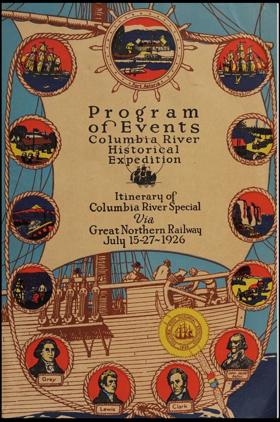
The Program of Columbia River Historical Expedition, July 15-27, 1926 serves as an official itinerary for a monumental commemorative rail tour sponsored by the Great Northern Railway, retracing the vital pioneer, fur trade, and indigenous routes connecting the Midwest to the Pacific Coast. Rather than a traditional historical narrative, the publication catalogs a twelve-day mobile symposium of historians, civic leaders, and students traveling aboard a specialized train to dedicate permanent regional landmarks—such as the Astoria Column in Oregon and the Pathfinder Monument at Bonners Ferry—while participating in commemorative congresses and ceremonies with regional indigenous nations. By documenting the specific route stops, historical addresses, and curated traveling exhibits of frontier artifacts, the text reveals how early twentieth-century corporate and civic alliances worked cooperatively to memorialize the region's complex pioneer history. Ultimately, this itinerary functions as a unique historical artifact in itself, demonstrating how the modernizing Pacific Northwest deliberately curated and physically mapped the legacy of its early pathfinders onto its expanding industrial rail infrastructure. Dedication of the Astoria Column 1926 [34] pages : maps ; 26 cm ONLINE Circulation [ 1 ]
|
1926 |
|
Pacific steamers by Will Lawson
Detailed history and listing of steam ships in the Pacific, changes in technology, with ships mainly from Australia, New Zealand, United States, and Canada xx, 244 pages, 72 unnumbered leaves of plates : illustrations ; 22 cm Non-circulating [ 1 ]
|
1927 |
|
The Pacific Northwest a syllabus by Edmond S. Meany 
Compiled in the early twentieth century by University of Washington professor Edmond S. Meany—the premier institutional architect of the state's historical canon—The Pacific Northwest: A Syllabus operated as a formal pedagogical framework designed to standardize the teaching of regional history in higher education. Functioning as a strict curriculum guide, the text organized the region’s past into a rigid, highly structured taxonomy of chronological eras: maritime discovery, the fur trade, missionary settlement, the pioneer migrations, and the triumphant march to statehood. By dictating the precise historical milestones, key figures, and required readings for university students, Meany’s syllabus built the foundational academic infrastructure that determined exactly how the next generation of teachers, politicians, and civic leaders would learn and transmit their region's origins. A keen insight drawn from the work is how the seemingly neutral, objective format of a university syllabus functioned as a profound instrument of epistemological erasure; by plotting the region’s history strictly along a timeline of Anglo-American achievements, treaties, and legal milestones, Meany conceptually banished millennia of Indigenous civilization to the static realm of "pre-history" or mere environmental obstacles to be overcome. The syllabus weaponized the authority of the university to institutionalize a teleological narrative of colonial progress, ensuring that the violent displacement of Native peoples was academically processed by future civic leaders not as an ongoing injustice, but as a concluded, natural phase in the inevitable maturation of the American state. 18 unnumbered pages ; 22 cm ONLINE Circulation [ 1 ]
|
1927 |
|
History of Pierce County, Washington by W. P. Bonney 
Published in 1927 by William P. Bonney, the long-serving secretary of the Washington State Historical Society, History of Pierce County, Washington is an exhaustive, multi-volume civic chronicle detailing the rapid industrial and demographic transformation of the southern Puget Sound. The text traces the region's development from the early commercial operations of the Hudson's Bay Company at Fort Nisqually and the contentious Medicine Creek Treaty, through the violent Puget Sound War of 1855–1856, culminating in the massive economic boom sparked by Tacoma securing the terminus of the Northern Pacific Railroad. Following the established model of commercial pioneer literature, the primary historical narrative is heavily subsidized by subsequent volumes of flattering biographical sketches of local merchants, politicians, and industrialists, effectively functioning as a sprawling monument to the capitalist triumph of the local elite. A keen insight drawn from the work is how the institutionalization of local history was utilized to posthumously litigate and justify the most controversial acts of frontier violence; by framing the Puget Sound War and the deeply contested execution of Nisqually Chief Leschi as tragic but necessary assertions of territorial law, Bonney's narrative effectively absolves the pioneer government of its aggressive, fraudulent land seizures. By anchoring the legal origins of Pierce County in the triumph of martial and judicial order over Indigenous resistance, the text actively sanitizes the violent foundations of Tacoma's industrial prosperity, demanding that readers accept the systemic dispossession of the Nisqually and Puyallup peoples not as a localized atrocity, but as the unavoidable, legally sanctioned price of modern civic civilization. 3 volumes : illustrations, portraits ; 28 cm Non-circulating [ 2 ]
|
1927 |
|
Some tales of the southern Puget Sound Salish by Arthur C. Ballard
Arthur C. Ballard’s 1927 monograph, Some tales of the southern Puget Sound Salish, serves as a crucial ethnographic and spatial record of the Southern Lushootseed-speaking communities inhabiting the White, Green, Puyallup, and Nisqually river valleys. Working closely with respected culture-bearers, Ballard recorded oral accounts that function as precise, localized geographic catalogs, encoding vital environmental knowledge regarding seasonal salmon migrations, prairie root-digging grounds, and foot trails linking the saltwater estuaries of Puget Sound to the high Cascade mountain passes. These narratives illuminate the complex kinship ties and interdependent alliances through which extended Salish families communally managed resource access, river weirs, and overland portages. For historians of the region, the collection documents an established indigenous geography just as it was being permanently reconfigured by Euro-American settlement—offering an irreplaceable record of the sacred landmarks, river meanders, and marshlands that were systematically diked, channeled, and built over by late nineteenth-century hop farms, timber mills, and the rail corridors of the White River Valley. 3 preliminary leaves, pages 63-81 ; 26 cm Desiderata
|
1927 |
|
Place names of the delta of the Fraser Valley by Denys Nelson
|
1927 |
|
Place Names Around Port Coquitlam by Denys Nelson
|
1927 |
|
Fort Langley, 1827-1927 a century of settlement in the valley of the lower Fraser River by Denys Nelson, Art, Historical and Scientific Association of Vancouver, B.C. 
Denys Nelson’s 1927 centennial monograph, Fort Langley, 1827–1927: A Century of Settlement in the Valley of the Lower Fraser River, documents the strategic transformation of the Hudson’s Bay Company’s primary coastal river post into the administrative cradle of mainland British Columbia. Sited along the tidal reaches of the lower Fraser, the fort’s stockades, agricultural tracts, and river landings were superimposed squarely upon the ancestral territories, seasonal salmon-harvesting grounds, and canoe corridors of the Stó:lō—most notably the Kwantlen and Katzie nations. Nelson’s chronicle details how early fur trade survival and commercial viability hinged entirely on complex interdependent alliances with local Coast Salish communities, who not only provided the thousands of salmon that anchored the fort’s pioneering salted-fish export trade to Hawaii and California, but also commanded the aquatic navigation essential for provisioning the interior brigade trails. By tracing the outpost's evolution from a defensive trading station through the frantic influx of the 1858 Fraser Canyon Gold Rush—culminating in Sir James Douglas’s proclamation of the Crown Colony of British Columbia—to an established agrarian valley, the work illustrates how colonial civic authority and riverine commerce were physically anchored to an enduring Indigenous waterway. 31 pages : illustrations, portraits ; 24 cm ONLINE Circulation [ 1 ]
|
1927 |
|
History of the Columbia River Valley from the Dalles to the sea by Fred Lockley
Authored in 1928 by prominent Oregon journalist and historian Fred Lockley, History of the Columbia River Valley from the Dalles to the Sea is an exhaustive, multi-volume subscription history detailing the commercial and civic maturation of the region's most vital geographic artery. Tracing the lower Columbia corridor's evolution from the era of maritime exploration and the fur trade to the booming industrialization of Portland and Astoria, Lockley leverages his extensive career interviewing early settlers to weave personal pioneer reminiscences into a broader narrative of regional development. Like many commercial histories of its era, the primary historical account is heavily subsidized by subsequent volumes of flattering biographical sketches profiling local merchants, industrialists, and pioneer descendants, serving as a sprawling civic monument to the capitalist triumph of the local elite. A keen insight drawn from the work is how Lockley’s narrative structurally redefines the Columbia River itself, conceptually transforming it from an ancient, highly complex network of Indigenous civilization and sustenance into a mere logistical conduit for Anglo-American capitalism. By framing the "history" of the river valley almost exclusively around the establishment of trading posts, the advent of steamboat navigation, and the extraction of timber and salmon for global markets, the text actively erases millennia of Chinookan and other Native sovereignties. This historiographical maneuver successfully commodifies the landscape, validating the colonial project by teaching readers that the true destiny of the great river was not to sustain the Indigenous societies that had managed it for centuries, but to serve as a passive, exploitable highway for modern industrial empire. 3 volumes : frontispiece, illustrations, plates, portraits ; 27 cm ONLINE Circulation [ 1 ]
|
1928 |
|
Bella Bella texts by Franz Boas 
Published in 1928 by Franz Boas, the foundational architect of modern American anthropology, Bella Bella Texts is a dense, bilingual ethnographic repository preserving the oral literature of the Heiltsuk (historically referred to by colonists as the Bella Bella) people of the central coast of British Columbia. Relying on Indigenous informants, Boas systematically transcribed creation histories, family crest narratives, and shamanistic lore into rigorous phonetic notation alongside literal English translations. The volume reflects Boas’s massive, career-long mandate of "salvage anthropology"—a scientifically urgent rush to document the complex Indigenous societies of the Pacific Northwest Coast before their anticipated erasure under the intense pressures of Canadian assimilation policies, residential schools, and the strict federal prohibition of the potlatch. A keen insight drawn from the work is how the supposedly objective methodology of anthropological transcription actively divorced Indigenous oral traditions from their inherent legal and territorial authority. In Heiltsuk society, these narratives were not mere "folklore" or public entertainment; they were highly guarded intellectual property that codified family lineages, governed resource rights, and asserted territorial sovereignty. By extracting these sacred histories, stripping them of their performative and ceremonial contexts, and flattening them into standardized, bilingual data points for Western academic consumption, Boas’s project subtly disarmed them. The text inadvertently functioned as a mechanism of colonial containment, transforming active, legally binding Indigenous constitutional frameworks into static, depoliticized scientific specimens housed safely within the American academic archive. ix, 291 ; 24 cm ONLINE Circulation [ 1 ]
|
1928 |
|
John Meares' approach to Oregon by John Meares
|
1928 |
|
A history of central Washington including the famous Wenatchee, Entiat, Chelan and the Columbia Valleys with an index and eighty scenic-historical illustrations by Lindley M. Hull
Published in 1929 and compiled by Lindley M. Hull for the Pioneer Association of Central Washington, A History of Central Washington is a massive, 624-page regional chronicle detailing the settlement of the Wenatchee, Entiat, Chelan, and Columbia valleys. Divided into two primary sections—"The Story of Pioneer Settlements" and "The Development Period"—the volume combines eighty scenic-historical illustrations with exhaustive biographical sketches of early white homesteaders. The text meticulously documents the physical transformation of the region, emphasizing the construction of irrigation ditches, the establishment of commercial orchards, and the founding of local civic institutions. Like many pioneer-driven histories of the era, the book operates as a triumphalist civic monument celebrating the rugged endurance and capitalist successes of the region's Anglo-American founders. A keen insight drawn from the work is how the narrative conceptually weaponizes agricultural "development" to morally legitimize colonial displacement. By framing the region's history fundamentally around the engineering of irrigation canals and the cultivation of profitable cash crops, Hull’s compilation equates valid land ownership exclusively with industrial-scale agrarian capitalism. This historiographical maneuver effectively reduces the original Indigenous inhabitants and their complex, pre-existing territorial claims to mere background frontier trivia, occasionally noting them only as transient obstacles or linguistic curiosities. Consequently, the aggressive ecological enclosure and demographic replacement of the region is structurally sanitized, demanding that readers view the settlement of central Washington not as an act of territorial conquest, but as the righteous, inevitable unlocking of a previously "wasted" landscape's true economic destiny. 624 pages : illustrations ; 23 cm Non-circulating [ 1 ]
|
1929 |
|
Mythology of southern Puget Sound by Arthur C. Ballard 
Arthur C. Ballard’s 1929 ethnographic collection, Mythology of southern Puget Sound, serves as an indispensable oral-geographic ledger of the Southern Coast Salish peoples, particularly the Puyallup, Nisqually, Snoqualmie, and Duwamish communities. Transcribed directly from regional culture-bearers—including respected elders such as Snuqualmie Charlie—the narratives function far beyond folklore, recording precise ecological, hydrological, and topographic knowledge of the southern Sound’s river basins, oak prairies, and Cascade foothill corridors. These transformer stories and place-based oral traditions systematically mapped the vital arteries of the Green, White, Puyallup, and Cedar river systems, delineating ancient salmon weirs, seasonal harvesting grounds, and portage routes that sustained dense intertribal trade and family alliances. For historians of Pacific Northwest settlement, Ballard’s compilation provides a vital baseline documenting an intricately managed indigenous domain just before late nineteenth- and early twentieth-century industrialization radically transformed the landscape—diverting rivers, logging alluvial bottomlands, and superimposing railroads, agricultural dikes, and factory towns directly over ancestral Salish villages and maritime crossroads. 1 preliminary leaf, pages 33-150 ; 26 cm ONLINE Circulation [ 1 ]
|
1929 |
|
Our Pacific County by Lewis R. Williams 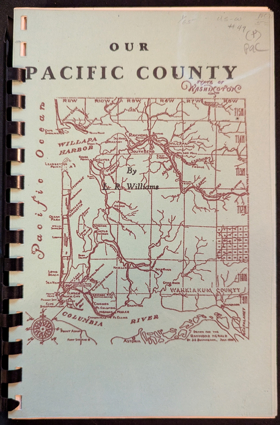
Published in 1930 by local historian Lewis R. Williams, Our Pacific County is a localized civic history detailing the American settlement and economic development of Washington State’s southwestern coast, centered primarily around the resource-rich waters of Willapa Bay (formerly Shoalwater Bay) and the Columbia River estuary. The text chronicles the region's rapid transformation from the domain of early maritime explorers to a bustling hub of pioneer commerce, focusing heavily on the highly lucrative early oyster trade that supplied Gold Rush-era San Francisco, as well as the subsequent rise of massive industrial logging and commercial salmon canning. Compiling local lore, civic milestones, and nostalgic pioneer reminiscences, the book operates as a celebratory tribute to the establishment of frontier towns like Oysterville, South Bend, and Raymond. A keen insight drawn from the work is how the narrative utilizes the romance of frontier resource extraction to morally launder the dispossession of the region's Indigenous maritime societies. By framing the aggressive, often ecologically devastating harvesting of Willapa Bay's native oysters and old-growth timber purely as a heroic tale of pioneer grit and capitalist enterprise, Williams conceptually redefines a complex, sustainably managed Indigenous homeland—historically governed by the Chinook and Chehalis peoples—into a wild, unclaimed repository of raw capital. This historiographical maneuver structurally sanitizes the colonial project, demanding that the systemic displacement of Native populations and the outright monopolization of their traditional marine resources be remembered not as an act of territorial and economic conquest, but as the spirited, inevitable triumph of American industrial progress. 104 pages : illustrations, map ; 22 cm Non-circulating [ 1 ]
|
1930 |
|
Sir James Douglas and British Columbia by W. N. Sage 
Authored in 1930 by University of British Columbia historian Walter Noble Sage, Sir James Douglas and British Columbia is a foundational academic biography chronicling the life of the man widely heralded as the "Father of British Columbia." The text meticulously traces the geopolitical transition of the Pacific coast from the sprawling, resource-extracting corporate fiefdom of the Hudson’s Bay Company into a formal, legally structured British Crown colony. Sage emphasizes Douglas’s autocratic but stabilizing governance during the chaotic influx of tens of thousands of American miners during the 1858 Fraser River Gold Rush, framing his tenure as the critical administrative bulwark that successfully secured British sovereignty in the Pacific Northwest against the aggressive tide of American Manifest Destiny. A keen insight drawn from the work is how the academic reliance on the "Great Man" theory of history functions to morally validate the mechanics of imperial state formation. By framing Douglas as a pragmatic, enlightened patriarch who single-handedly imposed civilized British law upon an unruly frontier of rowdy prospectors and "untamed" Native populations, Sage effectively sanitizes the inherent violence of colonization. This historiographical maneuver subtly recasts the systemic dispossession of First Nations peoples—including Douglas's own highly contested, paternalistic land policies and inadequate reserve allocations—not as acts of territorial theft, but as necessary, sober administrative burdens managed by a benevolent British bureaucracy. Consequently, the establishment of the modern province is memorialized as a triumph of dignified imperial order over wilderness, structurally obscuring the profound colonial trauma embedded in its legal foundation. 398 pages folded map 25 cm. ONLINE Circulation [ 1 ]
|
1930 |
|
A union list of manuscripts in libraries of the Pacific Northwest by Charles W. Smith, Pacific Northwest Library Association
Compiled in 1931 by University of Washington librarian Charles W. Smith and published under the auspices of the Pacific Northwest Library Association, A Union List of Manuscripts in Libraries of the Pacific Northwest serves as a foundational archival inventory designed to formalize and professionalize regional historical research. Building on his earlier bibliographies of published works, Smith meticulously aggregated and mapped the locations of unpublished primary sources—such as pioneer diaries, missionary letters, fur trade ledgers, and territorial government correspondence—scattered across various regional institutions. The catalog effectively centralized the disparate, raw textual artifacts of early Anglo-American settlement, transforming them into a cohesive, searchable database for academic historians. A keen insight drawn from the work is how the bureaucratic cataloging of unpublished archival material functioned as a profound mechanism of epistemological enclosure; by strictly defining authentic historical "manuscripts" as the written, paper artifacts generated exclusively by white settlers, bureaucrats, and missionaries, Smith’s inventory institutionalized the absolute supremacy of the colonial written word. This seemingly neutral archival project structurally barred Indigenous oral histories, material records, and active cultural memory from the realm of legitimate, academically recognized "primary sources." Consequently, it guaranteed that the definitive history of the Pacific Northwest would be researched, written, and validated almost entirely through the literal handwriting of the very people who engineered its colonization. 57 pages 23 cm. Desiderata
|
1931 |
|
Men of Champoeg a record of the lives of the pioneers who founded the Oregon government by Caroline C. Dobbs 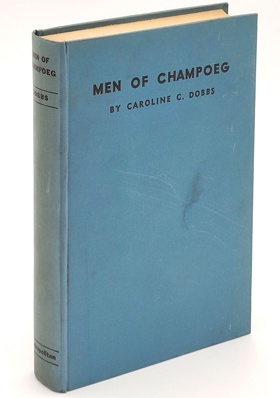
Published in 1932 by Caroline C. Dobbs, Men of Champoeg: A Record of the Lives of the Pioneers Who Founded the Oregon Government is a highly romanticized biographical encyclopedia dedicated to the region's Anglo-American founding fathers. The text meticulously catalogs the lives of the fifty-two men who famously voted on May 2, 1843, at the Champoeg meetings to establish the Provisional Government of Oregon, a critical political maneuver that helped secure the territory for the United States against the interests of the British Hudson's Bay Company. Through glowing pioneer hagiography, Dobbs compiles their genealogies, overland migration struggles, and civic achievements, deliberately elevating a makeshift, ad-hoc frontier assembly into a sacred, foundational moment of democratic destiny on par with the American Revolution. A keen insight drawn from the work is how the meticulous cultivation of a localized founding myth functioned to legally and morally erase pre-existing Indigenous sovereignty. By hyper-focusing the narrative of Oregon's political genesis exclusively on a singular, dramatic legislative vote between white American settlers and French-Canadian trappers, Dobbs conceptually redefines the Willamette Valley as a vacant geopolitical chessboard contested only by European powers. This historiographical maneuver successfully transforms the establishment of the Provisional Government into the miraculous birth of civilization out of an imagined wilderness, actively demanding that readers revere the architects of the pioneer state while completely obscuring the systemic dispossession of the Kalapuya people, whose ancestral lands served as the very stage for this celebrated frontier democracy. 6 preliminary leaves, 218 pages, 1 leaf, 9 unnumbered pages of plates : frontispiece, illustrations, portraits ; 21 cm Non-circulating [ 1 ]
|
1932 |
|
Four wagons west the story of seattle by Roberta Frye Watt 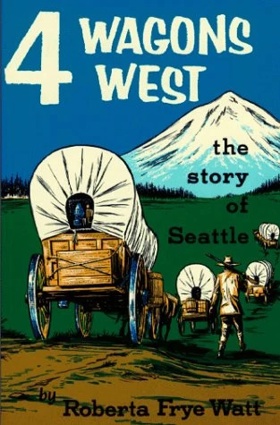
Published in 1931 by Roberta Frye Watt—the granddaughter of city founder Arthur A. Denny—Four Wagons West: The Story of Seattle is a deeply nostalgic, familial hagiography chronicling the pioneer origins of the Pacific Northwest’s largest metropolis. The text traces the Denny Party’s grueling overland migration, their iconic 1851 landing at Alki Point, and the subsequent establishment of the first sawmills and civic institutions on Elliott Bay. Writing the city’s history as a cherished family heirloom, Watt relies heavily on pioneer diaries and ancestral lore, detailing the pioneers' paternalistic relationship with Chief Seattle and their defense of the settlement during the Puget Sound War of 1856. The book ultimately functions to cement the original white founding families as the undisputed moral and civic aristocracy of the region. A keen insight drawn from the work is how the narrative weaponizes maternal pioneer nostalgia and domestic intimacy to sanitize the aggressive mechanics of urban colonial expansion. By framing the establishment of Seattle not as a calculated, capitalist enterprise of land speculation, but as a cozy, inevitable, and divinely guided family triumph, Watt successfully domesticates the violent dispossession of the Duwamish people. This historiographical maneuver effectively reduces Indigenous sovereignty to a romanticized backdrop, transforming figures like Chief Seattle into tragic, benevolent props who seemingly exist only to willingly bequeath the landscape to its "destined" white inheritors. Consequently, the text allows the city's pioneer elite to legally and morally absolve themselves of the ongoing, systemic erasure of the region's original inhabitants. Non-circulating [ 1 ]
|
1933 |
|
Spanish explorations in the Strait of Juan de Fuca by Henry R. Wagner, Fine Arts Press (Santa Ana, Calif) (Publisher)
Thorough, scholarly study of this important aspect of the exploration of the Pacific Coast of North America. The Quimper Expedition, the Eliza Expedition, and the Galiano-Valdes Expedition are among the Spanish Expeditions presented here v, 323, [1] pages : maps (some folded) ; 28 cm Non-circulating [ 1 ]
|
1933 |