Catalog of British Columbiana and Pacific Northwest Americana
Encyclopedia Cascadia Catalog contains book titles of mostly non-fiction Pacific Northwest Coast of North America Titles (primarially British Columbia, Idaho, Oregon and Washington State) in an easy-to-understand title catalog. If you see a link with this badge ONLINE CIRC it means that there is an online institution that provides free access to that title. In some cases there may be more than one institution hosting the title digitally.
| Catalog Title | Published |
|---|---|
|
Green commonwealth a narrative of the past and a look at the future of one forest products community by Stewart H. Holbrook, Phyllis Heady (Illustrator), Dogwood Press, Simpson Logging Company
|
1950 |
|
Green afternoons Oregon gardens to visit by Amy Houchen 
With Green Afternoons in hand, travelers, gardeners, and plant enthusiasts now have an exciting new guide to more than six dozen gardens throughout western and central Oregon and southwestern Washington. In her tour of the region, Amy Houchen uses the word "garden" broadly to include not only traditional gardens but also plantings of interest in such places as parks, college campuses, farms, and community gardens. Along with providing detailed descriptions of Oregon's best known and best loved gardens, Green Afternoons introduces readers to such unlikely but rewarding spots as an arboretum at a freeway rest area and climbing roses dressing up the cyclone fence around a ballfield. Arranged geographically, the garden listings include seasons of interest, directions, whether plants are labeled, a section on background and history, and a description of what to see. Indexes by plant name and topic allow for ease in locating plant specialties and such features as gardens for the blind and composting exhibits. Also included is information on holding weddings and listings of special events. From the Hulda Klager Lilac Gardens in Woodland and the International Rose Test Garden in Portland's Washington Park to Shore Acres in Coos Bay and the Sunriver Botanical Garden, Green Afternoons offers an informative and easy-to-use guide for locating and learning about the region's most beautiful gardens. iv, 250 pages : illustrations, maps ; 22 cm CIRC [ 0 ]
|
1998 |
|
Great and minor moments in Oregon history an illustrated anthology of illuminating glimpses into Oregon's past from prehistory to the present by Dick Pintarich 
Published by Dick Pintarich, Great and Minor Moments in Oregon History: An Illustrated Anthology of Illuminating Glimpses into Oregon's Past from Prehistory to the Present offers a compelling mosaic of state history that deliberately bypasses standard dry chronology in favor of vivid, overlooked vignettes. The book compiles short essays and rare illustrations spanning geological prehistory, early indigenous life, eccentric frontier characters, and twentieth-century turning points. By interspersing major milestones with quirky historical footnotes, the text paints a remarkably human portrait of how the state's distinct cultural landscape actually evolved. A keen insight drawn from the work is how regional history is best understood through its narrative friction; by giving equal weight to forgotten local anomalies and grand political events, the anthology demonstrates that a state's true character is forged not just by its headline heroes, but by the myriad eccentricities of everyday people colliding with an untamed environment. xix, 527 pages : illustrations, maps ; 22 cm CIRC [ 1 ]
|
2003 |
|
Grays Harbor, 1885-1913 by Robert A. Weinstein
|
1978 |
|
Gray & Columbia's River by Joean K. Fransen 
Authored by Joean K. Fransen, Gray & Columbia's River chronicles the maritime explorations of Captain Robert Gray and his historic 1792 discovery of the great river of the West. The book traces Gray's momentous voyage aboard the Columbia Rediviva, detailing his navigation of treacherous Pacific Northwest coastal waters and the lucrative sea otter trade that tied the region to global maritime markets. Through engaging historical narrative, the text highlights the sheer tenacity and seamanship required of early American merchants operating along an unmapped and dangerous frontier. A keen insight drawn from the work is how a single geographic discovery altered the geopolitical fate of an entire continent; by successfully crossing the treacherous bar of the Columbia River, Gray secured vital territorial claims for the United States that fundamentally reshaped the destiny of the Pacific Northwest. ii, 143 pages : illustrations, maps ; 22 cm CIRC [ 1 ]
|
1992 |
|
Granite and gold the story of Oregon's smallest city by James Waucop Tabor
|
1988 |
|
Grammar and dictionary of the Yakama language by Charles Marie Pandosy, John Gilmary Shea, George Gibbs
Published in 1862, Grammar and Dictionary of the Yakama Language originated from the field notes of Catholic Oblate missionary Charles Marie Pandosy, whose French manuscript was subsequently translated and edited by federal ethnologist George Gibbs and historian John Gilmary Shea. The volume stands as the first formal linguistic documentation of the Sahaptin language spoken by the Yakama people of eastern Washington, detailing its intricate grammatical syntax alongside a comprehensive bilingual lexicon. A keen insight drawn from the publication is how the collaboration between a proselytizing missionary and a government ethnologist illustrates the profound entanglement of religion and colonial statecraft, demonstrating how linguistic reference materials originally designed to facilitate spiritual assimilation were systematically repurposed by officials like Gibbs to execute federal treaty negotiations and accelerate indigenous displacement. 59 pages ; 26 cm. ONLINE CIRC [ 1 ]
|
1862 |
|
Governor Smylie remembers by Robert E. Smylie 
"Robert E. Smylie was born in Marcus, Iowa, in 1914 and first came to Idaho as a student at what was then the College of Idaho in Caldwell. Subsequently he worked his way through law school at George Washington University in Washington, D.C., served in the Coast Guard during World War II, married, and came back to Idaho in 1947 first as Assistant Attorney General and then Attorney General."--BOOK JACKET. "In 1954 Robert E. Smylie decided to run for governor, was elected, and served in that office until 1967. During his three terms in office, Governor Smylie could count among his many achievements an increase in the minimum wage, a five-day work week for state employees, creation of the Department of Commerce, a massive state highway construction program, promotion of the interests of business, land, and water within Idaho, serving as chair of the Western Governor's Association, the establishment of the state park system, and the introduction of a state sales tax to fund education."--BOOK JACKET xv, 234 pages : illustrations ; 24 cm CIRC [ 0 ]
|
1998 |
|
Governing Oregon continuity and change by Richard A. Clucas , Mark Henkels , Priscilla L. Southwell , Edward P. Weber 
At the end of the twentieth century, the state government of Oregon was routinely entangled in intense partisan conflict, with opposing sides waging bitter battles in elections, the legislature, and the courts. Many of the most important state laws—such as Measure 5, which capped property taxes—were decided through the initiative process rather than by lawmakers in Salem. As the twenty-first century began, this political dynamic began to shift. Partisan conflict in the capitol grew less rancorous, legislative gridlock eased, and ballot initiatives lost their central role in defining Oregon politics. Less visible changes reshaped issues from agricultural policy to tribal government. This shifting dynamic coincided with significant transformations in Oregon’s economy and cultural life. The state’s economy sustained severe blows twice in the early 2000s, but by 2014, Oregon boasted one of the fastest-growing economies in the nation. Along with economic expansion, Oregon’s population grew in both size and diversity. Despite these powerful forces of change, other aspects of Oregon political life remained entrenched, including the deep urban-rural divide and the state’s problematic fiscal system. With contributions from twenty-seven leading experts and political insiders, Governing Oregon: Continuity and Change offers insight into the people, political practices, governing institutions, and public policies of Oregon. It will be of tremendous value to political scientists, public servants, and engaged citizens alike. xii, 372 pages : illustrations, maps ; 23 cm CIRC [ 0 ]
|
2018 |
|
Governing Idaho politics, people, and power by James B. Weatherby, Randy Stapilus 
Idaho is a state with many varied interests vying for political control. Whether it be in the politically liberal north, the staunchly conservative southeast, or the rapidly changing southwest of the state, the social and political factors that determine who gains power in the Gem State often flies in the face of logic and makes for an interesting study in contrasts. xi, 237 pages : illustrations, map ; 23 cm CIRC [ 0 ]
|
2005 |
|
Goodbye, White Bluffs by Mary Powell Harris
|
1972 |
|
Good wood growth, loss, and renewal by Steven R. Radosevich 
Good Wood is a clear-eyed, finely hewed collection of personal essays on farming, forestry, and family in the Pacific Northwest. As a young man, Steve Radosevich learned to prune trees by watching his grandfather. Working in the apple orchards of the struggling family farm, he saw that "every cut was a decision, conscious and deliberate, about the health of the trees and their coming crops." In Good Wood, Radosevich examines the choices we make in life and how those choices affect the health of people and places. Radosevich draws on his experiences on two farms-the "homeplace," a family farm in Washington's Yakima Valley, and Kla-kla-nee, his small vineyard in Oregon's Willamette Valley. Radosevich is also a professor of forestry, and his commitment to sustainable forestry informs his writings. His book seamlessly combines recollections of tending smudge pots on freezing spring nights east of the Cascades with discussions about the flooding of Native fishing grounds at Celilo Falls and clearcuts in the Oregon Coast Range. "All these losses," writes Radosevich, "have been decisions too, made consciously I think, but with less deliberation than the forethought of a farmer pruning his orchard." As keeper of the old family orchard and tender of a new family farm, Radosevich reveals in these stories his deliberate choices and his hopes for the world of his children and grandchildren. xii, 136 pages ; 22 cm CIRC [ 0 ]
|
2005 |
|
Good times in old Genesee a tale of two families by Gerald Hickman , Tea Joe Hickman 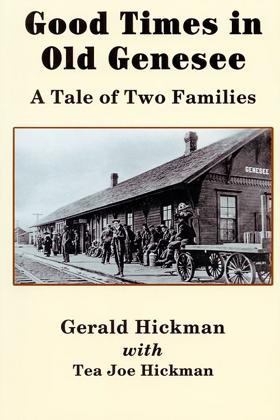
It's a personal and historical recollection of Genesee, Idaho from a former resident, a trip in time to his childhood ranch and beyond, back to the pioneers, in the Genesee valley of North-Central Idaho. It's a visit to Old Genesee, a small community deep in the winter snows and summer grains where his family found a place for themselves. The book covers the period from the first settlers of the 1870s to World War II. It describes the natural history of the area, the early town, and the farming and country life of the early pioneers and those who followed, as engines replaced horses out in the fields. With help from his granddaughter Tea Joe, Gerald Hickman shares his love of Western U.S. history in Good Times in Old Genesee. It's a trip in time to his childhood ranch and beyond, back to the pioneers, in the Genesee valley of North-Central Idaho. It's a visit to Old Genesee, a small community deep in the winter snows and summer grains where his family found a place for themselves. The book covers the period from the first settlers of the 1870s to World War II. It describes the natural history of the area, the early town, and the farming and country life of the early pioneers and those who followed, as engines replaced horses out in the fields. Gerald lives in Eastern Washington near the rolling Palouse hills that stretch out southward to Genesee, with Micky, his childhood bride of 47 years. They have three grown daughters, a dog named Spot, and a cat named Lilly. He is preparing another book on the Indian Wars 1850 through 1865. 107 pages : illustrations, map ; 20 cm CIRC [ 0 ]
|
2015 |
|
Good time girls of the Pacific Northwest a red-light history of Washington, Oregon, and Alaska by Jan MacKell Collins 
As more and more pioneers braved the harsh, unforgiving conditions of moving West, prostitution grew and flourished within the mining camps, small towns, and cities of the nineteenth-century Pacific Northwest. Oregon, Alaska, and Washington State had their share of working girls and madams like Nellie Curtis and Klondike Kate who remain notorious celebrities in the annals of history, but Collins also includes the stories of lesser-known women whose roles in this illicit trade help shape our understanding of the American West xiv, 257 pages : illustrations ; 23 cm CIRC [ 0 ]
|
2020 |
|
Golden days and pioneer ways by Ruth Pfefferle 
Published in 1934 by Ruth Pfefferle, Golden Days and Pioneer Ways is a localized chronicle of early settlement and domestic life in the Pacific Northwest, heavily focused on the intimate, day-to-day realities of homesteading. Drawing from family lore, pioneer letters, and community reminiscences, the text shifts away from grand geopolitical maneuvering to spotlight the domestic labor, social bonds, and domestic resilience of early families. Through a collection of homespun anecdotes and localized histories, the book paints an idyllic portrait of frontier community-building, celebrating the endurance and adaptability required to establish permanent roots in an isolated and demanding environment. vi, 128 pages : illustrations, portraits ; 28 cm CIRC [ 1 ]
|
1977 |
|
Gold along the Fraser by Lorraine Harris 
The cry of "gold along the Fraser!" Hured men from around the world. By 1858, 25000 had swarmed into the new colony of British Columbia. Some were experienced prospectors, some dreamers; all were hoping for instant wealth. Gold Along the Fraser details the experiences-the successes and failures-of these adventurers. 64 pages : illustrations ; 22 cm CIRC [ 1 ]
|
1984 |
|
Gods & goblins a field guide to place names of Olympic National Park by Smitty Parratt 
181, [20] pages, [40], 18 pages of plates (some folded) : illustrations, maps (some color), portraits ; 18 cm CIRC [ 1 ]
|
1984 |
|
Go west, young man a father and son rediscover America on the Oregon Trail by B. J. Hollars 
"B.J. Hollars and his son strike out on a two-week, 2,500-mile road trip to retrace the Oregon Trail. Their mission: to rediscover America--and Americans--along the way"-- Provided by publisher xiv, 232 pages : illustrations, map ; 22 cm CIRC [ 0 ]
|
2021 |
|
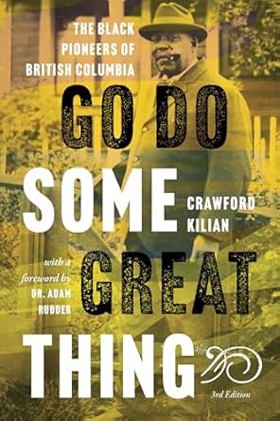
Go do some great thing the black pioneers of British Columbia by Crawford Kilian
|
1978 |
|
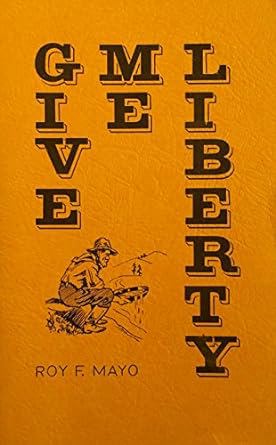
Give me Liberty by Roy F. Mayo
|
1989 |
|
Gifted earth the ethnobotany of the Quinault and neighboring tribes by Douglas Deur 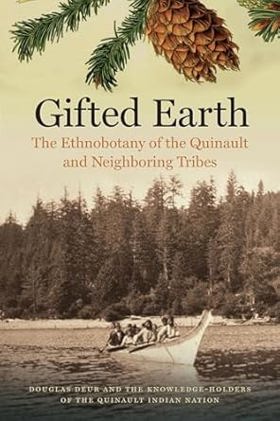
Gifted Earth features traditional Native American plant knowledge, detailing the use of plants for food, medicines, and materials. It presents a rich and living tradition of plant use within the Quinault Indian Nation in a volume collaboratively developed and endorsed by that tribe. The Quinault Reservation on the Olympic Peninsula of Washington state is a diverse tribal community, embodying the traditional knowledge of tribes along the entire Pacific Northwest coast. Its membership consists of descendants of many tribes—from the northwestern Olympic Peninsula to the northern Oregon coast—including the Quinault, but also many others who were relocated to the reservation in the nineteenth and early twentieth centuries. Individuals descended from these tribal communities, including Chinook, Chehalis, Hoh, Quileute, Queets, Cowlitz, Tillamook, Clatsop, and others, have contributed to Gifted Earth, giving it remarkable breadth and representation. A celebration of enduring Native American knowledge, this book will help non-specialists as they discover the potential of the region’s wild plants, learning how to identify, gather, and use many of the plants that they encounter in the Northwestern landscape. Part ethnobotanical guide and part “how-to” manual, Gifted Earth also prepares plant users for the minor hazards and pitfalls that accompany their quest—from how to avoid accidentally eating a bug hidden within a salal berry to how to prevent blisters when peeling the tender stalks of cow parsnip. As beautiful as it is informative, Gifted Earth sets the standard for a new generation of ethnobotanical guides informed by the values, vision, and voice of Native American communities eager to promote a sustainable, balanced relationship between plant users and the rich plant communities of traditional tribal lands. About the author: Douglas Deur is an associate research professor of anthropology at Portland State University and an adjunct professor of environmental studies at the University of Victoria. He is the author of Pacific Northwest Foraging and many other writings that explore the traditions, values, and ecological logic of Native American plant use. Gifted Earth is a product of his long-term collaboration with the Quinault Indian Nation to record plant knowledge of tribal members in order to guide modern land-use planning, ensure that this knowledge is passed on to future generations of tribal members, and share as appropriate with the outside world. xx, 250 pages : color illustrations, color map ; 23 cm CIRC [ 0 ]
|
2022 |
|
Ghosts of Seattle past an anthology of lost Seattle places by Jaimee Garbacik (Curator, Editor) 
"Seattle is built on booms--logging, fishing, aerospace, and now tech. This anthology gathers essays, interviews, photography, and comix to reconstruct community hubs lost to growth. From the settlements of Native American tribes to the incubators of grunge, from a foxxxy cabaret to an Old Spaghetti Factory, Ghosts of Seattle Past provides an eyes-on-the-street view of a city in flux. The Ghosts of Seattle Past anthology comes at a critical point: Seattle had the country's steepest rent hikes in 2015. The city is becoming a national focal point for issues of development. Both recent transplants and the old guard are trying to figure out how to live in the new landscape. Through their warm, conversational, whip-smart voices, the city speaks not only to the current boom, but also to longer-brewing problems of segregation, queer erasure, and colonization. Tracing the issues across six hand-drawn maps, Seattle's best-known artists (including Elissa Washuta, Kate Lebo, and Paul Constant) join community lynchpins (including Chief Seattle's great-great-great-great grandson) in a dialogue as incisively political as it is richly human. Anthology curator Jaimee Garbacik is a book editor, writer, artist, youth equity advocate, and the owner and founder of Footnote Editorial. She previously authored Gender and Sexuality for Beginners, currently on curricula at more than a dozen universities. Josh Powell, artist behind the anthology's hand-drawn maps, is the former director of all-ages youth-led music and arts organization The Vera Project and co-founder of Seattle nonprofit The Bikery. He currently works at Seattle's largest environmental remediation firm"--Provided by publisher xxxvi, 318 pages : illustrations (some color), 4 folded maps ; 26 cm CIRC [ 1 ]
|
2017 |
|
Ghost voices Yakima Indian myths, legends, humor, and hunting stories by Donald M. Hines 
The largest, most detailed collection of Yakima lore ever. Introductory notes and numerous photographs provide historical and cultural context. Tribal Myths and Legends explain the origin of the tribes, of fire, or the origins of landmarks, also mysterious, haunted lakes. Humorous Tales relate the ridiculous, often earthy antics of Coyote. Hunting Stories reveal the techniques, the terrors of the hunt for the ferocious grizzly, treacherous black bear, or deer, and more. 435 pages, 26 unnumbered pages of plates : illustrations ; 22 cm CIRC [ 0 ]
|
1992 |
|
Ghost towns of the Northwest by Norm Weis 
Sixty-two ghost towns from Oregon, Washington, Idaho, Wyoming, and Montana are individually described with the history of each town and specific directions on how to find them. Nearly twenty are unknown to the general public. The author has given you a head start in your quest, having explored new angles for information on some of the more familiar ghost towns, or visiting with old timers for an offbeat story or two. xviii, 319 p. : ill., maps ; 23 cm. CIRC [ 1 ]
|
1999 |
|
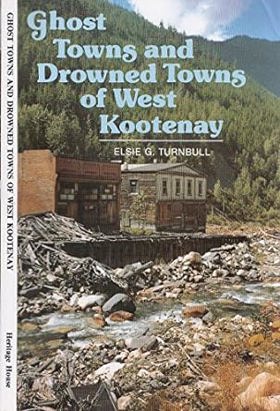
Ghost towns and drowned towns of West Kootenay by Elsie G. Turnbull
|
1988 |