Catalog of British Columbiana and Pacific Northwest Americana
Encyclopedia Cascadia Catalog contains book titles of mostly non-fiction Pacific Northwest Coast of North America Titles (primarially British Columbia, Idaho, Oregon and Washington State) in an easy-to-understand title catalog. If you see a link with this badge ONLINE CIRC it means that there is an online institution that provides free access to that title. In some cases there may be more than one institution hosting the title digitally.
| Catalog Title | Published |
|---|---|
|
Portland, Oregon, its history and builders by Joseph Gaston 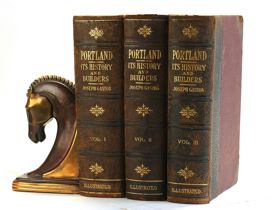
in connection with the antecedent explorations, discoveries, and movements of the pioneers that selected the site for the great city of the Pacific 3 volumes : illustrations, maps, portraits ; 27 cm ONLINE CIRC [ 3 ]
|
1911 |
|
Mountain camp fires by Edmond S. Meany 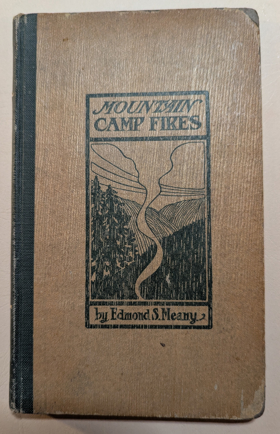
Authored by prominent Pacific Northwest historian and avid outdoorsman Edmond S. Meany, Mountain Camp Fires is a 1911 collection of evocative poetry celebrating the rugged, untamed wilderness of Washington State. The volume captures the spirit of the nascent "Mountaineers" club, translating the physical exhaustion and spiritual triumphs of alpine climbing, forest treks, and starlit encampments into romantic verse. Rather than detailing regional economic conquests, Meany uses rhythmic tributes to local geography, flora, and the camaraderie of the campfire to document the emerging conservationist ethos of the early 20th century. A keen insight drawn from the work is how the popularization of wilderness poetry signaled a profound regional shift in the cultural conception of nature; by framing the harsh, mountainous frontier as a sanctuary for spiritual renewal and recreation, Meany's verse captures the exact historical moment when the Pacific Northwest landscape transitioned from a hostile adversary to be conquered into a curated playground for the urban middle class. viii, 90 pages, 1 unnumbered leaf of plates frontispiece (illustration) 19 cm CIRC [ 1 ]
|
1911 |
|
Oregon Counties: Their Creations and the Origins of their Names by Frederick V. Holman 
Authored by early 20th-century historian and lawyer Frederick V. Holman, Oregon Counties: Their Creations and the Origins of their Names provides a detailed administrative and etymological history of the state's geopolitical boundaries. The text traces the legislative evolution of Oregon's map from the expansive provisional districts of the 1840s to the finalized county borders of the early 1900s, documenting the specific political acts that carved up the territory. Through a rigorous county-by-county catalog, Holman explores the diverse origins of the region's place names, detailing how local geography, Native American language fragments, and prominent American figures were immortalized on the newly drawn map. A keen insight drawn from the work is how the seemingly bureaucratic act of county naming functioned as a powerful mechanism for colonial possession; by overwriting existing indigenous geographies with the names of American presidents, military generals, and local pioneer politicians, the early Oregon legislature actively manufactured an anglicized political landscape that legally and linguistically normalized settler dominance. CIRC [ 1 ]
|
1910 |
|
Authored by S. P. Morgan, Idaho, Facts and Statistics Pertaining to Its Early Settlement and Colonization provides a focused historical account of the state's first permanent white settlement, the Mormon-founded Franklin colony. The text blends demographic data, pioneer chronologies, and agricultural records to document how early religious settlers transformed the arid southeastern frontier into a viable, structured agrarian community. Furthermore, the book details the escalating territorial frictions between the encroaching colonizers and the indigenous Shoshone population, framing these violent clashes solely as "Indian troubles" that threatened pioneer progress. A keen insight drawn from the work is how early statistical histories weaponized civic data to justify indigenous displacement; by pairing seemingly objective agricultural metrics with subjective, one-sided narratives of Native American hostility, the text effectively disguised the brutal realities of colonization behind a veneer of rational economic development and inevitable civilization. 36 pages ; cm. ONLINE CIRC [ 1 ]
|
1910 |
|
Fisheries of British Columbia by British Columbia
Published by the provincial government in 1910, Fisheries of British Columbia serves as an official, promotional survey of the region's rapidly expanding commercial fishing, canning, and whaling industries. The brief, illustrated report catalogs the marine biology of the Pacific coast—most notably the lucrative Pacific salmon runs—while detailing the economic infrastructure, processing yields, and emerging regulations of the early 20th-century maritime economy. Through statistical data and glowing assessments of the province's aquatic resources, the text functioned to attract foreign capital and project an image of boundless natural wealth. A keen insight drawn from the work is how early state-sponsored industrial reports actively commodified ecological abundance; by systematically reducing complex marine ecosystems into mere statistical yields and investment opportunities, the government officially codified a paradigm of relentless commercial extraction that simultaneously ignored indigenous fishing rights and laid the groundwork for severe future ecological depletion. 64 pages illustrations 25 cm ONLINE CIRC [ 1 ]
|
1910 |
|
The Columbia River: Its History, Its Myths, Its Scenery, Its Commerce by William Denison Lyman
Authored by historian William Denison Lyman, The Columbia River: Its History, Its Myths, Its Scenery, Its Commerce provides an expansive early 20th-century portrait of the Pacific Northwest's most vital waterway. The book chronicles the transformation of the mighty river from a wild, mythic landscape navigated by indigenous tribes and early fur traders into a heavily domesticated artery of steamboat commerce and regional agriculture. Through a blend of recorded Native American legends, pioneer chronologies, and glowing descriptions of geographic grandeur, the text captures the prevailing frontier optimism regarding the industrial subjugation of nature. A keen insight drawn from the work is how the juxtaposition of indigenous mythology and modern commerce exposes the inherent paradox of frontier boosterism; by romanticizing Native American legends as vanishing antiquities while simultaneously celebrating the aggressive industrial development of the river, the narrative illustrates how early historians actively mythologized the region's past to justify its colonial and ecological conquest. xx, 409 p : front., plates, ports., 2 fold. maps ; 25 cm. ONLINE CIRC [ 2 ]
|
1909 |
|
British Columbia coast names by John T. Walbran 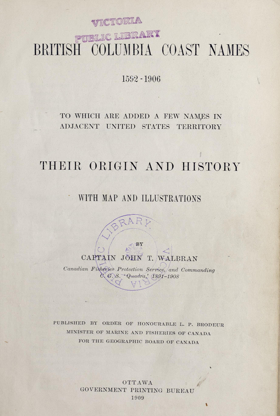
During his years as captain of the Canadian government steapship Quadra, John T. Walbran became fascinated with the BC coast and set to work on his classic British Columbia Coast Names, which was published in 1909 546 pages, plates : 1 folded map ONLINE CIRC [ 1 ] CIRC [ 1 ]
|
1909 |
|
The Chinook jargon and how to use it a complete and exhaustive lexicon of the oldest trade language of the American continent by George C. Shaw
Authored by George C. Shaw, The Chinook Jargon and How to Use It: A Complete and Exhaustive Lexicon of the Oldest Trade Language of the American Continent serves as a foundational linguistic guide to the ubiquitous pidgin language that facilitated cross-cultural communication in the 19th-century Pacific Northwest. The book meticulously compiles the vocabulary, grammar, and pronunciation of a hybrid tongue—blending Chinookan, Nuu-chah-nulth, French, and English—that enabled commerce and diplomacy between diverse Indigenous nations and arriving European colonizers. Through its dictionary format and practical conversational examples, the text captures a fleeting historical moment when Native and settler communities were forced to operate on a relatively equal linguistic playing field for mutual economic survival. A keen insight drawn from the work is how the commercial codification of an indigenous trade language by colonial authors often signaled its impending obsolescence; by publishing standardized lexicons for English-speaking settlers, compilers like Shaw unwittingly transitioned Chinook Jargon from a living, fluid tool of mutual negotiation into a static frontier novelty precisely as regional assimilation policies were aggressively enforcing English linguistic dominance. 3 preliminary leaves, [ix]-xvi, 65 pages + [3] pages advertisements 22 cm ONLINE CIRC [ 1 ]
|
1909 |
|
History of Washington the rise and progress of an American state by Clinton A. Snowden, C. H. Hanford , Miles C. Moore , William D. Tyler , Stephen James Chadwick
Authored by Clinton A. Snowden and overseen by a prominent advisory board of early political leaders, History of Washington: The Rise and Progress of an American State is a sweeping, multi-volume chronicle of the region's transition from indigenous territory to an industrialized modern commonwealth. The expansive work traces the narrative arc of maritime exploration, the fur trade, and grueling pioneer settlement, framing the political and economic development of the Pacific Northwest as an inevitable triumph of American enterprise. Drawing upon early archival records and the firsthand accounts of territorial founders, the text serves as a definitive, progressive-era monument to the state’s founding generation. A keen insight drawn from the work is how the overt involvement of powerful civic figures on the book's advisory board functioned to canonize a highly curated, top-down historical narrative; by having former governors and judges directly steer the project, the publication operated less as objective history and more as a state-sponsored ideological tool to legitimize the political authority and territorial conquests of Washington's pioneer elite. 6 volumes : illustrations, maps, portraits ; 25 cm ONLINE CIRC [ 5 ] CIRC [ 4 ]
|
1909 |
|
Dr. John McLoughlin: the Father of Oregon by Frederick V. Holman 
McLoughlin came from Riviere du Loup in Quebec and worked his way up through the Hudson's Bay Company until he alone was responsible for that great chunk of continent known as the Pacific Northwest, and the help and support he offered the American emigrants to the Oregon Country in the critical years 1843-1846 301 pages, 2 unnumbered leaves of plates + [2] page publisher's advertisements : frontispiece (portrait), portrait ; 25 cm ONLINE CIRC [ 1 ]
|
1907 |
|
Captain James Cook, R.N., F.R.S., "the circumnavigator" by Arthur Kitson
Authored by Arthur Kitson, Captain James Cook, R.N., F.R.S., "the circumnavigator" offers a comprehensive biographical account of the legendary British explorer and his monumental maritime expeditions. The book traces Cook’s ascent from his early days in the merchant coal trade to his command of three historic global voyages, detailing his meticulous mapping of the Pacific Ocean and his crucial surveys along the Pacific Northwest coastline. Drawing heavily upon Admiralty records and Cook’s own logs, the text captures the immense navigational achievements and devastating final act of a man who fundamentally redrew the map of the world. A keen insight drawn from the work is how Cook's disciplined expeditions marked a pivotal transition in European expansion from speculative treasure-hunting to empirical scientific imperialism; by weaponizing precise cartography and geographic observation, Cook's voyages demonstrated that the true mastery of new frontiers relied on systematic data collection rather than sheer military force. xvi, 525 pages : facsimiles, folded color map, facsimiles, plates, portraits ; 23 cm ONLINE CIRC [ 1 ] CIRC [ 1 ]
|
1907 |
|
Vancouver's discovery of Puget Sound portraits and biographies of the men honored in the naming of geographic features of northwestern America by Edmond S. Meany, Washington State Library Classics in Washington History
Chapters 5-12 (p. 61-334) include a portion of Vancouver's journal, reprinted from v. 2 of his Voyage of discovery to the north Pacific Ocean, and round the world, 2nd edition, London, 1801. The reprint "is designed to follow the explorer from the time he strikes the shore of the present state of Washington ... on into Puget Sound, and around Vancouver Island, and, finally, through the negotiations at Nootka." xvii, 344 pages : illustrations ; 22 cm ONLINE CIRC [ 1 ] CIRC [ 1 ]
|
1907 |
|
The Ox Team or, The Old Oregon Trail, 1852-1906 by Ezra Meeker 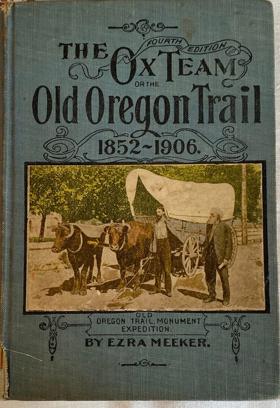
An account of the author's trip across the plains, from the Missouri River to Puget Sound, at the age of twenty-two, with an ox and cow team in 1852, and of his return with an ox team in the year 1906, at the age of seventy-six : with copious excerpts from his journal and other reliable sources of information, a narrative of events and descriptive of present and past conditions [4], 248, [5] pages : illustrations, maps, portrait ; 19 cm CIRC [ 0 ]
|
1907 |
|
Cathlamet on the Columbia Recollections of the indian people and short stories of early pioneer days in the valley of the lower Columbia river. by Thomas Nelson Strong 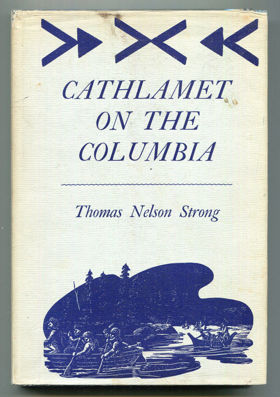
Published in 1906, Thomas Nelson Strong’s Cathlamet on the Columbia provides a vivid historical account of early pioneer life along the lower Columbia River during the mid-to-late 19th century. The book chronicles the foundational days of the Cathlamet settlement in Washington State, highlighting the complex interactions between incoming settlers and the indigenous Chinookan tribes. Through personal recollections and short stories, Strong documents the region's cultural shifts, the tragic decline of local Native American populations due to disease, and the rugged realities of frontier survival. It remains a valuable primary source for understanding the social and environmental transformation of the Pacific Northwest prior to heavy industrialization. xv, 170 pages, 1 unnumbered leaf of plates : colour, mounted illustration ; 21 cm ONLINE CIRC [ 1 ] CIRC [ 1 ]
|
1906 |
|
An Illustrated history of southeastern Washington, including Walla Walla, Columbia, Garfield and Asotin counties, Washington by Frederic Ambrose Shaver, Richard F. Steele, Arthur P. Rose, Western Historical Publishing Company, Spokane, Wash
Published by the Western Historical Publishing Company and compiled by regional historians, An Illustrated History of Southeastern Washington provides an exhaustive, county-by-county chronicle of early pioneer settlement across Walla Walla, Columbia, Garfield, and Asotin counties. The massive volume details the region's transformation from indigenous territories and early missionary outposts into a dominant agricultural empire driven by dryland wheat farming and regional railroad expansion. Through detailed biographical sketches of prominent citizens and extensive civic records, the text serves as a foundational archive for understanding the economic ambitions and social structures of the inland Pacific Northwest. A keen insight drawn from the work is how subscription-based county histories operated as early forms of civic boosterism; by heavily emphasizing the successes of local patriarchs and agricultural wealth while marginalizing the indigenous displacement that made it possible, the volume illustrates how frontier communities intentionally curated their own historical memory to attract further investment and institutional legitimacy. xxii, 874 p. illus., plates, ports. 31 x 25 cm. ONLINE CIRC [ 1 ]
|
1906 |
|
An Illustrated history of Skagit and Snohomish Counties, their people, their commerce and their resources with an outline of the early history of the State of Washington, endorsed as authentic by local committees of pioneers by The Interstate Publishing Company
Published by the Interstate Publishing Company, An Illustrated History of Skagit and Snohomish Counties offers a sweeping, encyclopedia-style chronicle of early pioneer settlement and economic development in northwestern Washington. The extensive volume traces the rapid transformation of the region's dense primeval forests and fertile river valleys into thriving hubs of the timber, agricultural, and maritime industries. Through exhaustive biographical sketches of prominent families—explicitly endorsed as "authentic" by local pioneer committees—the text serves as a monumental archive documenting the civic ambition and commercial resource extraction that defined the Puget Sound hinterlands. A keen insight drawn from the work is how the overt endorsement by pioneer committees reveals the manufactured nature of early frontier historiography; by tightly controlling the published narrative to validate their own commercial successes, the region's founding elite actively engineered a sanitized, triumphant origin story designed to cement their social authority and attract future investment. 1117 pages : portraits ; 29 cm ONLINE CIRC [ 1 ]
|
1906 |
|
Pioneer reminiscences of Puget Sound : the tragedy of Leschi by Ezra Meeker
"Pioneer Reminiscences of Puget Sound: The Tragedy of Leschi" is a historical account written by Ezra Meeker, an American pioneer who settled in the Puget Sound region of Washington state in the mid-1800s. The book focuses on the tragic story of Chief Leschi, a prominent leader of the Nisqually tribe who was accused of murder and subsequently executed by the territorial government in 1858. Meeker provides a firsthand account of the events leading up to Leschi's trial and execution, as well as his own personal experiences living among the Native American tribes of the region. The book offers a unique perspective on the early history of the Pacific Northwest, shedding light on the complex relationships between settlers and Native Americans during a tumultuous period of American expansion. xx, 554 pages, 26 unnumbered leaves of plates (2 folded) illustrations 24 cm ONLINE CIRC [ 1 ]
|
1905 |
|
Early Oregon : jottings of personal recollections of a pioneer of 1850 by George E. Cole
Authored by early pioneer and future territorial governor George E. Cole, Early Oregon: Jottings of Personal Recollections of a Pioneer of 1850 provides a firsthand memoir of the grueling overland migration and the nascent civic formation of the Pacific Northwest. The book chronicles Cole's arduous journey across the plains and his subsequent immersion into the turbulent economic, social, and political landscape of the early Oregon Territory. Through unvarnished personal anecdotes and biographical sketches of prominent fellow settlers, the text offers a valuable primary source lens detailing the region's rapid transition from a rugged frontier to an organized society. A keen insight drawn from the work is how the shared trauma and logistical hurdles of overland migration forged enduring, tight-knit political networks; by relying on personal alliances cemented during the grueling 1850 crossing, early pioneers successfully translated their trail-forged bonds directly into the foundational legislative and economic power structures of the new territory. 95 pages : frontispiece (portrait) ; 20 cm ONLINE CIRC [ 1 ]
|
1905 |
|
An illustrated history of central Oregon, embracing Wasco, Sherman, Gilliam, Wheeler, Crook, Lake and Klamath counties, state of Oregon by F. A. Shaver, Arthur P. Rose,Richard F. Steele,A. E. Adams, Western historical publishing company
Published in 1905 by the Western Historical Publishing Company, this extensive volume chronicles the early pioneer settlement and economic development of central and south-central Oregon. A keen insight drawn from the text is how the region's severe geographic isolation—cut off from the coast by the Cascade Mountains and defined by an expansive, arid high desert—forced early settlers to build an exceptionally self-reliant culture that depended heavily on massive livestock operations and fierce competition for scarce water rights. The authors provide comprehensive local histories for Wasco, Sherman, Gilliam, Wheeler, Crook, Lake, and Klamath counties, documenting their gradual transition from rugged frontier outposts into established civic and agricultural centers. Like other regional histories of its era, the narrative ultimately serves as a vital genealogical archive by preserving hundreds of detailed biographical sketches of the resilient ranchers, merchants, and civic leaders who built these foundational communities. xxx, 1097 pages : plates, portraits ; 31 cm ONLINE CIRC [ 1 ]
|
1905 |
|
The Selkirk Range by A. O. Wheeler, Canada Department of the Interior
An "account of a topographical survey of a portion of the Selkirk Mountains adjacent to the line of the Canadian Pacific Railway ... accompanied by a brief review of travel and exploration, of previous surveys and of mountaineering in these regions." xvii, 459 pages, 92 unnumbered leaves of plates : illustrations ; 25 cm + 1 case ([14] folded leaves of plates : illustrations, maps ; 25 cm) ONLINE CIRC [ 1 ]
|
1905 |
|
History vs. the Whitman saved Oregon story : three essays towards a true history of the acquisition of the old Oregon Territory by William Isaac Marshall
Published in the early 20th century, William Isaac Marshall’s collection of essays meticulously dismantles the highly romanticized myth that missionary Marcus Whitman single-handedly saved the Oregon Territory from British control through a heroic cross-country winter ride in 1842. Relying heavily on primary source documents, Marshall proves that the United States government was already fully committed to retaining Oregon, and that Whitman’s arduous journey was actually undertaken to prevent the closure of his own struggling mission by its governing board. A keen insight drawn from the text is how the enduring popularity of the "Whitman saved Oregon" legend exposes the vulnerability of historical narratives to religious and nationalist propaganda, demonstrating how early writers eagerly embraced a fabricated, providential savior figure to retroactively justify America's westward expansion. By prioritizing rigorous archival evidence over emotional storytelling, Marshall's work fundamentally corrected the historical record and set a new standard for historiography regarding the acquisition of the Pacific Northwest. 236 pages ; 24 cm ONLINE CIRC [ 1 ]
|
1904 |
|
An illustrated history of Stevens, Ferry, Okanogan and Chelan counties, state of Washington by Western Historical Publishing Company
Published in 1904 by the Western Historical Publishing Company, this comprehensive volume chronicles the pioneer settlement, civic foundation, and industrial emergence of four rugged counties in northern Washington state. A keen insight drawn from the text is how the sudden, controversial opening of former Native American reservation lands (such as the Colville Reservation) to white prospectors triggered explosive mining booms, acting as the primary catalyst that rapidly transformed this isolated northern frontier into permanent communities. The narrative details the distinct economic drivers across the region, from the rich mineral districts of Ferry and Stevens to the vast cattle ranges and early orchard irrigation projects of Okanogan and Chelan counties. Furthermore, the book preserves the area's pioneer legacy by featuring hundreds of detailed biographical sketches of the resilient prospectors, ranchers, and civic leaders who built these foundational settlements. xxii, 867 pages, 43 unnumbered leaves of plates : illustrations, portraits ; 31 cm ONLINE CIRC [ 1 ]
|
1904 |
|
An illustrated history of the Big Bend country, embracing Lincoln, Douglas, Adams, and Franklin counties, state of Washington by Richard F. Steele , Arthur P. Rose 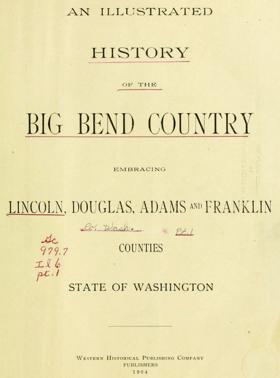
Published in 1904, this comprehensive volume documents the pioneer settlement, agricultural development, and civic formation of the Columbia River's Big Bend region in eastern Washington. A keen insight drawn from the text is how the seemingly barren, arid landscape was rapidly transformed into a highly lucrative wheat-producing powerhouse through the advent of dry farming techniques and the critical expansion of railroad infrastructure. The authors chronicle this dramatic economic and cultural shift across Lincoln, Douglas, Adams, and Franklin counties, detailing their transition from harsh frontier to thriving agricultural communities. Furthermore, the book serves as an invaluable genealogical archive by providing extensive biographical sketches of the resilient early settlers who drove this remarkable regional transformation. xxiv, 1024 pages : plates, portraits ; 31 cm ONLINE CIRC [ 2 ]
|
1904 |
|
An illustrated history of north Idaho : embracing Nez Perces, Idaho, Latah, Kootenai and Shoshone counties, state of Idaho by Western Historical Publishing Company
Published in 1903, this extensive volume chronicles the pioneer settlement, Native American history, and rapid industrial development across the rugged panhandle region of northern Idaho. A keen insight drawn from the text is how the area's extreme geographic isolation from southern Idaho forced these northern counties to develop a distinct, fiercely independent culture driven by the volatile boom-and-bust cycles of the Coeur d'Alene mining districts and vast timber operations. The book details the civic and economic growth within Nez Perces, Idaho, Latah, Kootenai, and Shoshone counties, documenting their transition from frontier wilderness to established industrial hubs. Like similar regional histories of its era, the narrative ultimately serves as a vital genealogical resource by preserving hundreds of biographical sketches of the prospectors, farmers, and civic leaders who built the region. xxviii, 1238 pages, [113] leaves of plates : illustrations, portraits ; 31 cm ONLINE CIRC [ 1 ]
|
1903 |
|
An Illustrated history of Baker, Grant, Malheur and Harney counties, with a brief outline of the early history of the state of Oregon by Western Historical Publishing Company
Published in 1902 by the Western Historical Publishing Company, this comprehensive volume documents the early settlement and economic foundation of eastern Oregon's vast frontier. Following a brief overview of the state's early years, the text provides detailed local histories and extensive biographical sketches of the pioneers who built communities across Baker, Grant, Malheur, and Harney counties. A keen insight drawn from the narrative is how the region's harsh, arid geography necessitated an economy based heavily on cattle ranching and mining, forging a rugged cultural identity that sharply contrasted with the agrarian settlements of the Willamette Valley. Ultimately, the book serves as both a valuable genealogical resource for these four counties and a historical testament to the sheer endurance required to establish industry in the high desert. 788 pages, 70 unnumbered leaves of plates : illustrations, portraits ONLINE CIRC [ 1 ]
|
1902 |