Catalog of British Columbiana and Pacific Northwest Americana
Encyclopedia Cascadia Catalog contains book titles of mostly non-fiction Pacific Northwest Coast of North America Titles (primarially British Columbia, Idaho, Oregon and Washington State) in an easy-to-understand title catalog. If you see a link with this badge ONLINE CIRC it means that there is an online institution that provides free access to that title. In some cases there may be more than one institution hosting the title digitally.
| Catalog Title | Published |
|---|---|
|
Leaded the poisoning of Idaho's Silver Valley by Michael C. Mix 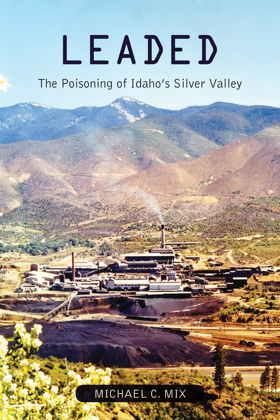
Leaded is a timely and deeply researched account of one of the largest environmental disasters in western US history. It examines the origin, evolution, and causes of the harmful environmental and human health effects caused by mining operations in Idaho’s Coeur d’Alene Mining District—the “Silver Valley”—from 1885 to 1981. During that period, district mines produced over $5 billion worth of lead, silver, and zinc. The Bunker Hill Company dominated business and community activities in the district as owners and operators of the largest mine, lead smelter, and zinc plant.During the first half of the twentieth century, industrial mining operations caused severe environmental damage to area waterways and lands from releases of sulfur gases, lead, and other toxic metals. Damaging human health effects were evident soon after the smelter opened in 1917, when Bunker Hill workers suffered from lead poisoning. Despite the obvious devastation, due to the influence of the mine and lead industry in state and federal politics, as well as scientific uncertainties about pollution effects, no effective federal laws regulating mining and smelting operations were passed until the 1970s.In 1974, uncontrolled Bunker Hill lead smelter emissions led to the worst community lead exposure problem in the United States and resulted in a widespread lead poisoning epidemic of Silver Valley children. In response, the Environmental Protection Agency ultimately mandated federal air lead standards. At the same time, the National Institute for Occupational Safety and Health passed national standards reducing allowable occupational lead exposures. Bunker Hill could not meet the new standards, which was a major factor in forcing the company to close, leaving behind a contaminated geographic area that was classified at the time as the largest Superfund site in the United States.Leaded will resonate with anyone who is concerned about the long-term effects of industrial pollution, as well as students of environmental history, western US history, mining history, environmental ethics, and environmental law xvi, 260 pages : illustrations, map ; 23 cm CIRC [ 0 ]
|
2016 |
|
Latah County centennial, 1888-1988 by Idahonian
|
1988 |
|
Latah County by Julie R. Monroe 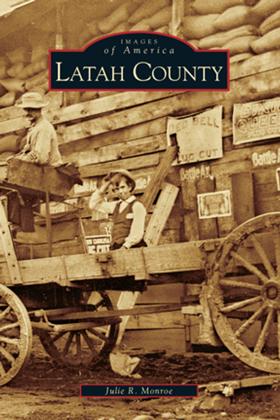
Its name derived from the Nez Perce language, Latah County is the only county in the United States to have been created by an Act of Congress. The abundance of its natural resources—from blue fields of camas to deep veins of gold, from great stands of white pine trees to vast green grasslands—attracted a diversity of dreamers seeking only the opportunity to build their own futures. Nestled in the heart of the Palouse, an agricultural area of extraordinary production, Latah County is a land of timber and, at Potlatch, was once the site of one of the largest sawmills in the world. At Moscow, it is also the home of the state’s land-grant institution, the University of Idaho. From the forests of Troy and the ridges of Juliaetta and Kendrick, from the homesteads of Genesee to Bovill’s hunting lodge and Deary’s town site, Latah County has had a rich and varied history. 127 pages : illustrations, maps ; 24 cm. CIRC [ 0 ]
|
2006 |
|
Last trail to Bear Paw flight of the Nez Perces, 1877 by Rowena L. Alcorn 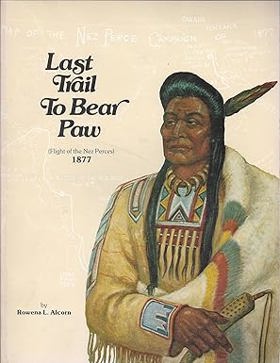
From introduction: "This project to paint a series of Nez Perce Indian portraits was undertaken in the fall of 1935, and covered a span of more than twenty years." 80 pages : illustrations ; 28 cm CIRC [ 0 ]
|
1977 |
|
Last stands a journey through North America's vanishing ancient rainforests by Larry Pynn 
The remarkable Pacific temperate rainforest has become an endangered landscape, rarer than even the embattled tropical rainforest. In Last Stands, award-winning environmental writer Larry Pynn plunges into coastal forests from California to Alaska to explore this unique ecosystem and the complex factors that threaten it. Whether standing with new-age loggers as they toil beneath the churning blades of a heli-logging operation, witnessing the wolverine's legendary ferocity, bounding along in the back of a pickup with a couple of bear hunters, or embarking on a week-long solo hike through an uncharted wilderness, Pynn's approach to understanding North America's temperate rainforest--and the creatures and people connected to it--is as diverse and unconventional as the forest itself. The result is a fascinating book, one part impassioned travelogue and one part natural history. Cathedral, cash crop, the Earth's respiratory system: the rainforest is all this and more. The incalculable wealth and magnificence of these last stands spring forth in this savvy, down-to-earth chronicle. xi, 212 pages : map ; 23 cm CIRC [ 0 ]
|
2000 |
|
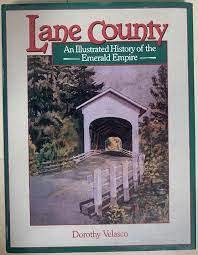
Lane County an illustrated history of the Emerald Empire by Dorothy Velasco, Dianne Donovan, Lane County Historical Society (Or)
|
1985 |
|
Landscapes of promise the Oregon story, 1800-1940 by William G. Robbins 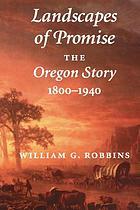
Landscapes of Promise is the first comprehensive environmental history of the early years of a state that has long been associated with environmental protection. Covering the period from early human habitation to the end of World War II, William Robbins shows that the reality of Oregon's environmental history involves far more than a discussion of timber cutting and land-use planning. Robbins demonstrates that ecological change is not only a creation of modern industrial society. Native Americans altered their environment in a number of ways, including the planned annual burning of grasslands and light-burning of understory forest debris. Early Euro-American settlers who thought they were taming a virgin wilderness were merely imposing a new set of alterations on an already modified landscape. Beginning with the first eighteenth-century traders on the Pacific Coast, alterations to Oregon's landscape were closely linked to the interests of global market forces. Robbins uses period speeches and publications to document the increasing commodification of the landscape and its products xvii, 392 pages, 16 unnumbered pages of plates : illustrations, maps ; 25 cm. CIRC [ 0 ]
|
1997 |
|
Landscapes of injustice a new perspective on the internment and dispossession of Japanese Canadians by Jordan Stanger-Ross 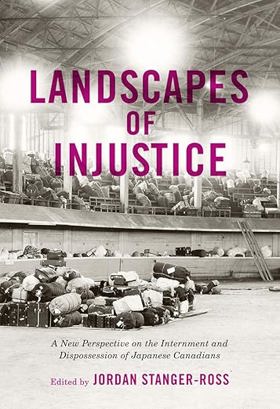
"In 1942, the Canadian government forced more than 21,000 Japanese Canadians from their homes in British Columbia. They were told to bring only one suitcase each and officials vowed to protect the rest. Instead, Japanese Canadians were dispossessed, all their belongings either stolen or sold. The definitive statement of a major national research partnership, Landscapes of Injustice reinterprets the internment of Japanese Canadians by focusing on the deliberate and permanent destruction of home through the act of dispossession. All forms of property were taken. Families lost heirlooms and everyday possessions. They lost decades of investment and labour. They lost opportunities, neighbourhoods, and communities; they lost retirements, livelihoods, and educations. When Japanese Canadians were finally released from internment in 1949, they had no homes to return to. Asking why and how these events came to pass and charting Japanese Canadians' diverse responses, this book details the implications and legacies of injustice perpetrated under the cover of national security. In Landscapes of Injustice the diverse descendants of dispossession work together to understand what happened. They find that dispossession is not a chapter that closes or a period that neatly ends. It leaves enduring legacies of benefit and harm, shame and silence, and resilience and activism."-- Provided by publisher ix, 501 pages : illustrations ; 25 cm. CIRC [ 0 ]
|
2020 |
|
Landscapes of conflict the Oregon story, 1940-2000 by William G. Robbins 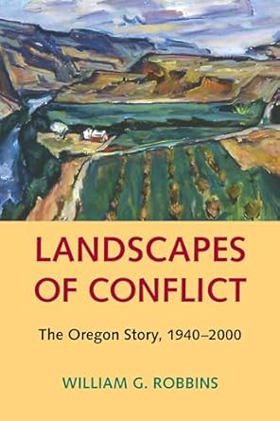
Post-World War II Oregon was a place of optimism and growth, a spectacular natural region from ocean to high desert that seemingly provided opportunity in abundance. With the passing of time, however, Oregon’s citizens — rural and urban — would find themselves entangled in issues that they had little experience in resolving. The same trees that provided income to timber corporations, small mill owners, loggers, and many small towns in Oregon, also provided a dramatic landscape and a home to creatures at risk. The rivers whose harnessing created power for industries that helped sustain Oregon’s growth — and were dumping grounds for municipal and industrial wastes — also provided passageways to spawning grounds for fish, domestic water sources, and recreational space for everyday Oregonians. The story of Oregon’s accommodation to these divergent interests is a divisive story between those interested in economic growth and perceived stability and citizens concerned with exercising good stewardship towards the state’s natural resources and preserving the state’s livability. In his second volume of Oregon’s environmental history, William Robbins addresses efforts by individuals and groups within and outside the state to resolve these conflicts. Among the people who have had roles in this process, journalists and politicians Richard Neuberger and Tom McCall left substantial legacies and demonstrated the ambiguities inherent in the issues they confronted. xxiii, 414 pages, 16 unnumbered pages of plates : illustrations, maps ; 24 cm. CIRC [ 0 ]
|
2004 |
|
Landscape traveled by coyote and crane the world of the Schi̲tsuʼumsh : Coeur d'Alene Indians by Rodney Frey, Coeur D'Alene Tribe of the Coeur D'Alene Reservation, Idaho 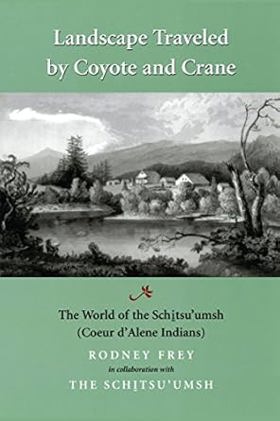
Anthropologist Rodney Frey culminates a decade of work with the Schitsu’umsh (the Coeur d’Alene Indians of Idaho) in this portrait of the unique bonds between a people and the landscape of their traditional homeland. The result of an intensive collaboration between investigator and Native people, the book includes many traditional stories that invite the reader’s participation in the world of the Schitsu’umsh. The Schitsu’umsh landscape of lake and mountains is described with a richness that emphasizes its essential material and spiritual qualities. The historical trauma of the Schitsu’umsh, stemming from their nineteenth-century contacts with Euro-American culture, is given dramatic weight. Nonetheless, examples of adaptation and continuity in traditional cultural expression, rather than destruction and discontinuity, are the most conspicuous features of this vivid ethnographic portrait. Drawing on pivotal oral traditions, Frey mirrors the Schitsu’umsh world view in his organization and presentation of ethnographic material. He uses first-person accounts by his Native consultants to convey crucial cultural perspectives and practices. Because of its unusual methodology, Landscape Traveled by Coyote and Crane is likely to become a model for future work with Native American peoples, within the Plateau region and beyond. xi, 329 pages : illustrations ; 24 cm CIRC [ 0 ]
|
2001 |
|
|
1982 |
|
Land-use planning in Oregon a no-nonsense handbook in plain English by Mitch Rohse 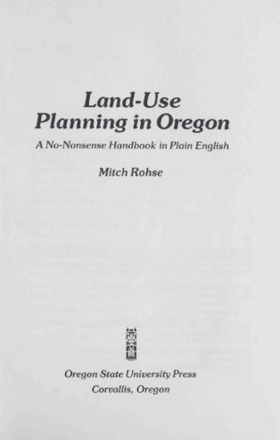
Oregon has the most extensive land-use planning program of any state in this country. Every acre of privately owned land in this state is zoned. Every acre is subject to a comprehensive plan. Planning affects the cost of your home, the distance you drive to work or shop, your property taxes, your schools, your police. But in spite of the significant effects of land-use planning, many Oregonians don't know much about ii. There are several reasons for this. First, Oregon has a relatively new program. Even those who developed it or who administer it are still learning just how it works. Second, the program is complicated. It combines law, ecology, economics, engineering, and politics. Any one of these fields is difficult to know and understand well. Small wonder, then, that the combination of all five is hard to grasp. Finally, even though "citizen involvement" is the first among Oregon's planning goals, not much has been written to explain Oregon's planning program to its citizens. Most planners and lawyers have been writing for other planners and lawyers. Their jargon-laden prose isn't comprehensible to those who are not in the field of planning. Come to think of it, some of that prose isn't comprehensible to those of us who are! The reasons described above have prompted me to write this book. This is a no-nonsense, plain-English guide to land-use planning in Oregon. It is intended mainly for lay persons-for elected officials, real estate salespersons, developers, planning commissioners, students, permit applicants, and the active, involved citizens that are so important to the program. Because so many lay persons have their first encounter with planning when they apply for some kind of permit, the book pays particular attention to the process of applying for permits. It offers many suggestions on how to make that process as painless as possible. The first chapter provides a brief overview of Oregon's program, that unique combination of state and local planning. The second discusses the permit process that results from that combination. Chapter 3 tells you the "dos" and "don'ts" of getting a permit. The fourth chapter is a glossary of planning terms-a concise encyclopedia with more than 600 entries, from "abate" to "zoning ordinance." The Appendix contains Oregon's statewide planning goals. As you read the book and encounter unfamiliar terms, turn to the glossary for an explanation. The glossary entries define the terms; many of those entries also discuss key concepts and issues and direct you to related subjects. I hope you will find this book to be helpful in understanding a program that so strongly affects us all. 286 pages : illustrations ; 22 cm ONLINE CIRC [ 1 ]
|
1987 |
|
Land snails and slugs of the Pacific Northwest by Thomas E. Burke 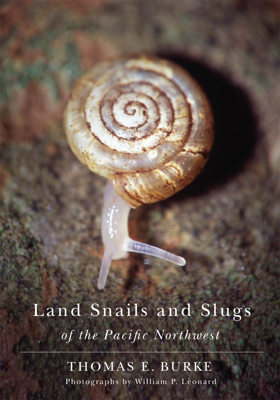
"Terrestrial mollusks, the second largest phylum in the animal kingdom, are vitally important to the earth's ecology. With the publication of Land Snails and Slugs of the Pacific Northwest, a definitive and comprehensive guide to snails and slugs of Oregon, Washington, Idaho, and western Montana is finally available. Primarily an identification guide, this richly illustrated volume offers complete information on the range of terrestrial mollusk shapes, sizes, and characteristics. It presents an overview of their habitat requirements as well as details of land snail and slug ecology, collection and preservation methods, and biogeography. Land Snails and Slugs of the Pacific Northwest is an essential reference for biologists, horticulturalists, gardeners, and naturalists, and anyone wishing to identify species in the field."--Publisher's website 344 pages : color illustrations, maps ; 25 cm CIRC [ 0 ]
|
2013 |
|
Land of the Umpqua a history of Douglas County, Oregon by Stephen Dow Beckham
|
1986 |
|
Land of the Royal Kwantlen. A history of North Surrey, B.C by John Pearson, John M. Reitz 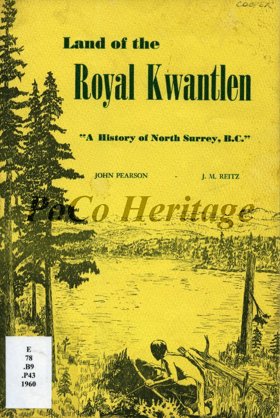
"It gives me great pleasure to present this booklet to the people who now inhabit the 'Land Of The Royal Kwantlen,' North Surrey, British Columbia, and to those who love to read about the transition of a primeval wilderness to a modern civilization." - Quote taken from Presentation by W. Roy Eckert. 27 pages 24 cm CIRC [ 0 ]
|
1960 |
|
Land of the Multnomahs by Margaret Watt Edwards , American Association of University Women Creative Writers
|
1973 |
|
Land of giants the drive to the Pacific Northwest, 1750-1950 by David Lavender 
The Pacific Northwest drew European explorers in search of a northwest passage to Asia. Overland traffic was spurred on by Lewis and Clark and later by huge fur companies. Missionaries and mountain men clashed with Native Americans in the area, and the discovery of gold, silver, and copper spurred even more conflict x pages, 2 unnumbered pages, 468 pages, 12 unnumbered leaves of plates : illustrations, maps ; 25 cm. CIRC [ 1 ]
|
1958 |
|
Land of destiny the golden age of British Columbia by Charles Lillard, Michael Gregson 
Co-authored by Charles Lillard and Michael Gregson, Land of Destiny: The Golden Age of British Columbia captures the vibrant, optimistic, and often turbulent era of early 20th-century development in Canada's westernmost province. The book chronicles an age of rapid railway expansion, booming resource extraction, and ambitious town-building that promised to transform the Pacific wilderness into an economic empire. Through rich historical anecdotes, vintage photographs, and archival documents, the authors reconstruct a time when pioneers and speculators viewed the landscape as an unexhausted horizon of boundless wealth. A keen insight drawn from the work is how the cultural obsession with a "golden age" relied on willful blindness toward ecological and human costs; by framing aggressive resource exploitation as a heroic destiny, society masked the rapid depletion of local forests and fisheries behind a glittering facade of unstoppable progress. 162 pages : illustrations ; 23 x 28 cm CIRC [ 0 ]
|
1991 |
|
Land in common an illustrated history of Jackson County, Oregon by Joy B. Dunn, Southern Oregon Historical Society 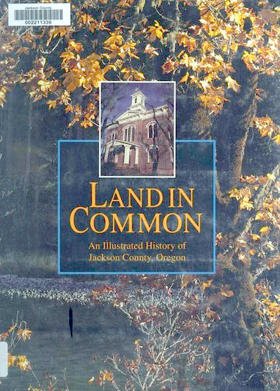
Published by the Southern Oregon Historical Society and authored by Joy B. Dunn, Land in Common: An Illustrated History of Jackson County, Oregon chronicles the complex and vibrant heritage of the Rogue River Valley. The book traces the region's transformation from ancestral indigenous homelands and a turbulent 1850s gold rush frontier into a thriving agricultural and timber-producing community. Through an extensive collection of historical photographs and archival records, the text highlights the diverse waves of settlers, miners, and entrepreneurs who shaped the physical and social landscape of southern Oregon. A keen insight drawn from the work is how the book's title operates as a poignant irony; by documenting how a land once held in common by native nations was rapidly parceled out into private claims, the history reveals that the foundational wealth of the frontier was built entirely upon the systematic legal enclosure of indigenous geography. xiv, 178 pages : illustrations (some color) ; 29 cm CIRC [ 1 ]
|
1993 |
|
Lakelure a tale of Medina, Washington by Junius Rochester 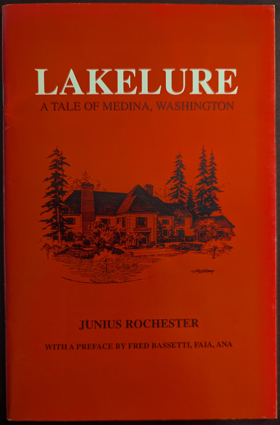
Published by local historian Junius Rochester, Lakelure: A Tale of Medina, Washington chronicles the colorful transformation of an exclusive eastern shore community along Lake Washington. The book traces Medina's evolution from a dense, stump-strewn wilderness and early 20th-century strawberry-farming enclave into one of the most affluent residential suburbs in the Pacific Northwest. Through historical photographs and engaging local archives, the text captures the summer-resort origins of families who fled the urban clamor of Seattle via the historic mosquito fleet ferries long before the floating bridges spanned the lake. A keen insight drawn from the work is how suburban wealth in the Seattle region repurposed geographical sanctuary into exclusivity; the transition of Medina from a quiet agrarian refuge into a fortress of tech barons and elites illustrates how pristine lakeside isolation is ultimately commodified and walled off from the very metropolitan core it once sought to escape. ii, 42 pages : illustrations ; 23 cm CIRC [ 1 ]
|
1993 |
|
Lake County history the first 100 years, 1876-1976 by Lake County Historical Society (Or) 
History of Lake County, Oregon from 1876-1976, compiled by the local historical society. Includes black and white historical photographs. viii, 250 pages : illustrations, maps ; 28 cm CIRC [ 1 ]
|
2008 |
|
Lake City a novel by Thomas B. Kohnstamm 
"Hunkered down in his childhood bedroom in Seattle's worn-out Lake City neighborhood, idealistic but self-serving striver Lane Bueche licks his wounds and hatches a plot to win back his estranged Manhattanite wife. He discovers a precarious path forward when he is contracted by a wealthy adoptive couple to seduce and sabotage a troubled birth mother from his neighborhood. Lane soon finds himself in a zero-sum game between the families as he straddles two cultures, classes, and worlds. Until finally, with the well-being of the toddler at stake, Lane must choose between wanting to do the right thing (if he could only figure out what that is) and reclaiming his idea of privilege"-- Provided by publisher 304 pages ; 22 cm CIRC [ 1 ]
|
2019 |
|
Lake Chelan in the 1890's 1891 steamboat trip to Stehekin on Lake Chelan's first steamer by Nelson Wayne Durham
|
1972 |
|
Lake Chelan the greatest lake in the world by John Fahey 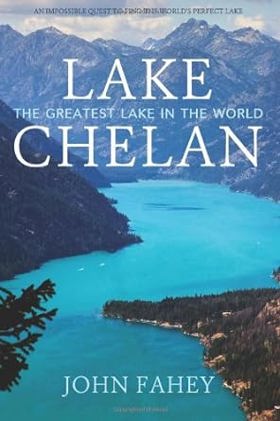
John Fahey fell in love with Lake Chelan at an early age and became convinced it is the world's greatest lake. As an adult, he set out to prove it. What unfolds is a story of remarkable endurance through extensive travel, exhaustive research, and countless baffled looks from friends and family. By foot, barstool, and paraglider, John explored Lake Chelan’s complex drainage system, from the cozy towns and vineyards to the glaciered peaks, and all the diverse microclimates in between. He determined to discover how this incredible body of water compared to others around the globe. 243 pages ; 23 cm CIRC [ 1 ]
|
2012 |
|
Lacey, Olympia, and Tumwater a pictorial history by Shanna Stevenson 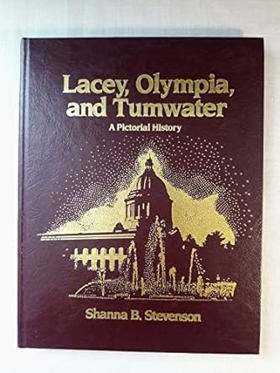
This book gives a reader the opportunity to view the Olympia, Lacy, Tumwater in its early development stages and fills a lot of gaps. 223 pages : illustrations ; 28 cm CIRC [ 1 ]
|
1985 |